What Is a CR80 Card? The Standard Card Size Guide
Table of Contents []
- What Is a CR80 Card? Your Complete Guide from Plastic Card ID
- The Full Spectrum of CR80 Card Types Available Through Plastic Card ID
- CR80 Card Programs in Practice: Real Applications Across Industries
- Choosing the Right CR80 Card for Your Program
- CR80 Card Frequently Asked Questions
- Why Plastic Card ID Is the Right Partner for Your CR80 Card Program
- Start Your Card Program Today with Plastic Card ID
What Is a CR80 Card? Your Complete Guide from Plastic Card ID
Pull a card out of your wallet right now. Chances are excellent that what you are holding is a CR80 card - and until this moment, you may never have known it had a name. That slim, rigid rectangle of white or colored plastic has a precise identity, a published standard, and a surprisingly rich history of practical applications that businesses across the United States rely on every single day.
Understanding the CR80 standard is not just trivia for printing nerds. It is genuinely useful knowledge for any organization planning a card program - whether that means employee badges, loyalty cards, membership credentials, access control tokens, or event passes. When you know what a CR80 card is and why it exists, you make smarter purchasing decisions, avoid costly mismatches with card printers, and build programs that run smoothly from day one.
The CR80 Definition: Dimensions, Thickness, and the ISO Standard Behind It
A CR80 card measures exactly 3.375 inches wide by 2.125 inches tall (85.6mm x 54mm), with a standard thickness of 30 mil - that is 0.030 inches, or roughly 0.76mm. This specification is not arbitrary. It is codified in ISO 7810, the international standard governing identification card dimensions, and it is the reason a card printed in Denver slots perfectly into a badge holder manufactured in Detroit.
The "CR" in CR80 stands for "Credit Card" - a nod to the format's origins in the financial industry. The "80" refers to the card's thickness in the CR sizing system. CR80 at 30 mil is the most common thickness. CR79 cards are slightly thinner at 30 mil with a slightly smaller footprint, designed to slide into proximity card clamshell holders. CR100 cards are thicker at 40 mil, used for durable keytags and specialty applications. But for the vast majority of business card programs, CR80 at 30 mil is the definitive standard.
Why Standardization Actually Matters for Your Card Program
Here is something that surprises many first-time buyers: card printers are precision machines. The feed rollers, print heads, and card rails inside an Evolis Primacy, a Zebra ZC300, or a Fargo HDP5000 are calibrated to accept cards within tight dimensional tolerances. Feed a card that is slightly too thick, too long, or too flexible, and you risk jammed cards, misaligned prints, and - in worst cases - mechanical damage to a printer that costs hundreds or thousands of dollars.
CR80 standardization eliminates that guesswork entirely. When CPE supplies CR80 blank cards, every card in that box has been manufactured to meet ISO 7810 tolerances. They load reliably, print cleanly, and encode correctly. Consistency at the card level means consistency at the program level - and that matters whether you are printing 50 cards a month or 50,000.
CR80 Cards vs. Other Card Sizes: A Quick Comparison
Not every plastic card is a CR80. Understanding the landscape helps you specify the right product the first time. CR79 cards, as mentioned, are slightly smaller and thinner - primarily used in proximity card programs where the card gets embedded in a clamshell holder. CR100 keytags are shorter but thicker, designed for key rings. Business card-sized plastic cards exist too, though they follow different dimensions entirely.
For most identity, loyalty, membership, and access applications, CR80 is the correct choice. It fits standard badge holders, card sleeves, card carriers, and wallet slots. It is compatible with every major desktop card printer on the market. And it is the format that badge printers, ribbon manufacturers, and card program administrators have optimized around for decades. When in doubt, CR80 is almost certainly the answer.
| Card Format | Dimensions | Thickness | Common Use |
|---|---|---|---|
| CR80 | 3.375" x 2.125" | 30 mil | ID, loyalty, membership, access |
| CR79 | 3.303" x 2.051" | 30 mil | Proximity clamshell holders |
| CR100 | 3.375" x 2.125" | 40 mil | Keytags, heavy-duty applications |
| CR80 (ISO 7810) | 85.6mm x 54mm | 0.76mm | International standard, all industries |
The Full Spectrum of CR80 Card Types Available Through Plastic Card ID
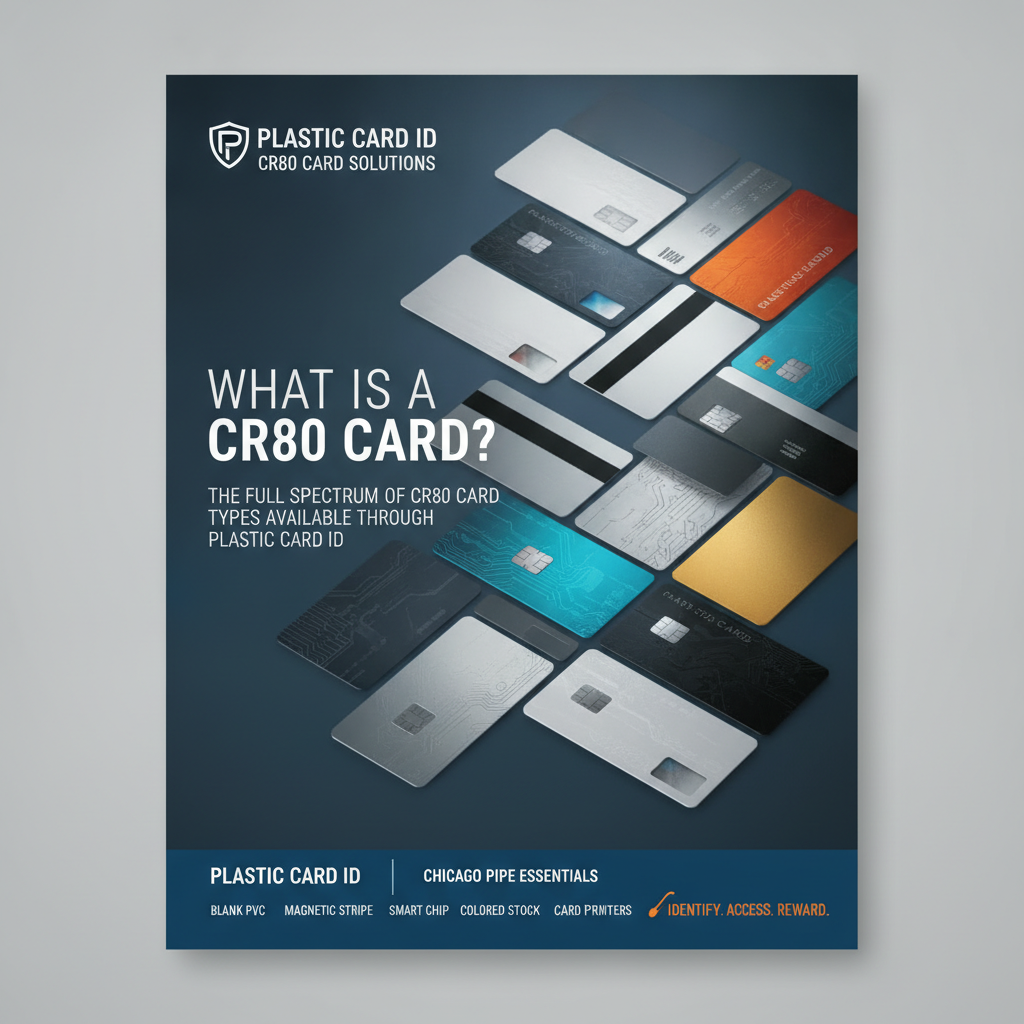 The CR80 form factor is a vessel. What gets built into or printed onto that card determines its function entirely. A blank white PVC CR80 card is a canvas. Encode a magnetic stripe onto it, and it becomes a hotel key or loyalty card. Embed an RFID chip, and it becomes a contactless access credential. Load it into a card printer and run a full-color print job, and it becomes an employee badge with a photo, a name, a logo, and a barcode. The form factor is constant; the capability is limited only by what the card contains.
CPE maintains one of the most comprehensive CR80 card catalogs available to USA businesses, spanning every major card technology. Whether your program requires simple blank white stock or sophisticated contactless smart cards with MIFARE DESFire encryption, the inventory exists and ships quickly. Building a complete card program from a single supplier is genuinely possible here - and that operational simplicity has real value.
Blank PVC CR80 Cards: The In-House Printing Workhorse
Blank CR80 cards at 30 mil are the starting point for any organization that wants to print cards in-house. They are manufactured from polyvinyl chloride (PVC) - the same material that gives plastic cards their rigidity, durability, and smooth printable surface. Blank white cards accept dye-sublimation printing from any major card printer, producing crisp, full-color images that bond permanently to the card surface.
The economics of blank cards are compelling. Rather than ordering pre-printed cards in large minimum quantities and waiting for delivery, organizations with a card printer can maintain a stock of blanks and print cards on demand. New employee starting Monday? Print their badge Friday afternoon. Membership renewed unexpectedly? Issue a new card in minutes. In-house printing transforms card issuance from a logistics challenge into a routine operational task.
Magnetic Stripe CR80 Cards: HiCo and LoCo Explained
Magnetic stripe CR80 cards carry a thin strip of magnetically encoded material along their back surface - the same technology that has powered hotel keys, loyalty cards, and access credentials for decades. Two main grades exist: HiCo (High Coercivity) and LoCo (Low Coercivity). HiCo stripes, identifiable by their dark brown or black color, require a stronger magnetic field to encode but resist accidental erasure far better. LoCo stripes, typically brown, are easier to encode and erase, making them appropriate for short-term use like event access or temporary credentials.
For most business applications - employee badges, loyalty programs, membership cards, hotel keys - HiCo magnetic stripe cards are the correct choice. They survive wallet storage near smartphones and other magnetic fields without data loss. CPE stocks both HiCo and LoCo options in standard CR80 sizing with one, two, and three track configurations to match whatever card reader infrastructure your operation uses. Matching your card's stripe grade to your application is one of the most important decisions in card program design.
RFID, Proximity, and Smart Chip CR80 Cards
Contactless card technology has expanded rapidly, and CR80 remains the standard form factor even as the technology inside grows more sophisticated. Proximity cards operate at 125 kHz and are widely used in commercial access control systems - Wiegand-based door readers, parking gates, and building entry points. They require no battery, no contact, and no card orientation: a wave near a reader is all it takes. Smart RFID cards operating at 13.56 MHz offer higher data capacity and security, with MIFARE DESFire EV1 and EV2 being the gold standard for applications requiring encryption, multi-application support, and audit trail capability.
Casino player cards, hotel room keys, transit credentials, and corporate access systems increasingly rely on 13.56 MHz smart card technology precisely because of that security depth. RFID CR80 cards look identical to a plain white card from the outside - the technology is embedded invisibly within the card body. This matters for aesthetics: your card can carry full-color branding on both sides while functioning as a sophisticated contactless credential beneath the surface.
Specialty CR80 Cards: Clear, Colored, and Custom Options
Not every card program runs on white stock. Clear CR80 cards - available in fully transparent or frosted finishes - enable design approaches that opaque white cards simply cannot. When you print on a clear card and place it over a colored background or badge holder insert, the visual effect is distinctly premium. Frosted clear cards diffuse light softly and give printed colors a muted, sophisticated quality that certain brands specifically seek out.
Pre-colored CR80 stock, available in a range of standard colors, allows organizations to color-code card programs visually - blue for staff, red for contractors, yellow for visitors - without printing a background color on every card. This saves printer ribbon, speeds production, and creates an instantly recognizable credential hierarchy. Custom die-cut shapes and luxury metal cards in stainless steel, brass, and gold round out the specialty options for programs where first impression is everything.
CR80 Card Programs in Practice: Real Applications Across Industries
The abstract specifications of a CR80 card become concrete when you look at how organizations actually deploy them. Across industries, these cards do different jobs - but they all share one quality: they signal that the organization issuing them takes its operations seriously. A plastic card handed to a new employee, a new member, or a new customer communicates something a paper slip simply cannot.
Retailers who have made the switch from paper gift certificates to plastic CR80 gift cards report consistent sales increases in the 35-50% range. The plastic card sits in a wallet, visible and accessible, rather than crumpling in a pocket or getting forgotten in a drawer. Physical durability translates directly into purchase behavior - and that is a measurable return on a straightforward investment.
Employee ID and Access Control Badges
CR80 cards printed with employee photos, names, titles, and department information - and optionally encoded with magnetic stripe or RFID data for door access - are the backbone of organizational identity programs. They clip to lanyards, slot into badge holders, and survive daily handling across years of use. For organizations with high staff turnover or seasonal workforces, in-house card printing on blank CR80 stock means new badges can be issued within minutes of onboarding, not days.
Access control applications pair CR80 proximity or smart cards with door readers, creating credential systems that log entry and exit, restrict zones by clearance level, and revoke access instantly when a card is deactivated in the system. The card becomes an extension of your security infrastructure, and its CR80 form factor ensures it works with every badge holder, every lanyard, and every reader on the market.
Loyalty and Membership Card Programs
Loyalty cards in plastic outlast and outperform their paper counterparts by every measure that matters. They live in wallets. They survive spills. They look professional when handed to a cashier. And they encode purchase data on magnetic stripes or store value on smart chips, enabling the kind of program tracking that paper punch cards cannot support. CPE has supplied loyalty card programs for businesses ranging from single-location boutique retailers to multi-state chains with tens of thousands of active members.
Membership cards for clubs, gyms, associations, professional organizations, and community groups carry a different function: legitimacy. Handing someone a plastic membership card with their name, a member number, and your organization's logo is a moment of formalization. It says: you belong here, and here is the proof. That moment of belonging is worth more than the cost of the card many times over.
Event Credentials, Hotel Keys, and Casino Cards
Short-term card applications require the same CR80 precision as permanent programs. Event credential cards - for conferences, concerts, trade shows, and corporate gatherings - need to print quickly, scan reliably, and survive a full day of handling. Magnetic stripe event credentials can encode access levels, session permissions, and attendee data in a format that badge scanner infrastructure reads instantly at checkpoints.
Hotel key cards encoding room access on HiCo magnetic stripes are among the highest-volume CR80 applications in the United States. Casino player cards, often incorporating RFID and magnetic stripe in the same card body, track player activity and drive loyalty rewards in some of the most data-intensive card programs that exist. These advanced applications still live on the same CR80 form factor that a small gym uses for its membership cards - the standard scales from the simplest to the most sophisticated programs imaginable.
Choosing the Right CR80 Card for Your Program
 With so many CR80 card options available, matching the right card to the right application requires asking a few focused questions before placing an order. The good news: most programs fall into predictable categories, and the correct card type becomes obvious once you understand the variables. What does the card need to do? How long does it need to last? What systems will it interact with? What will it look like?
Answering those questions honestly shapes every subsequent decision - card technology, print method, encoding requirements, and accessory needs. CPE has worked through this process with over 100,000 customers across 25 years of business, and the patterns are well-established. The right card program starts with the right card specification, and that starts with understanding your use case clearly.
Key Questions Before You Buy CR80 Cards
- Will the card need to be encoded? Magnetic stripe, RFID, and smart chip cards all require compatible readers. Buy the card technology that matches your existing infrastructure - or plan your reader selection alongside your card selection.
- How long will each card be in service? Long-term credentials benefit from HiCo magnetic stripes and thicker laminate. Short-term event passes can use LoCo stock or thinner options.
- Who will print the cards? In-house printing on blank CR80 stock requires a compatible card printer and ribbon. Pre-printed cards require a print vendor and longer lead times but no equipment investment.
- What accessories will you need? Badge holders, lanyards, card sleeves, card carriers for mailing, and cleaning kits for your printer all extend the life and professionalism of your program.
- What volume are you printing? Monthly volumes under a few hundred cards suit direct-to-card desktop printers. Programs printing thousands monthly may benefit from retransfer printers or pre-printed card orders.
Pairing CR80 Cards with the Right Card Printer
A CR80 card is only as useful as the printer that personalizes it. CPE carries a full lineup of card printers from three of the industry's most trusted manufacturers: Evolis, Zebra, and Fargo. Each brand spans a range of print volumes, feature sets, and price points. Entry-level desktop printers like the Evolis Badgy handle light-duty programs printing a few hundred cards monthly. Mid-range workhorses like the Zebra ZC300 suit medium-volume programs needing consistent quality and durability. High-end retransfer printers like the Fargo HDP5000 deliver edge-to-edge printing with exceptional image quality for premium credential programs.
Matching your printer to your CR80 card type matters. Single-sided printers work beautifully for employee badges and loyalty cards that only need one printed side. Dual-sided printers automate the process of printing both faces, critical for cards carrying information on the back like terms and conditions, barcodes, or magnetic stripe instructions. Buying a printer and cards from the same supplier eliminates compatibility guesswork entirely.
Ribbons, Cleaning Kits, and Program Supplies
Card printers consume ribbon with every card printed. YMCKO ribbons - yellow, magenta, cyan, black, overlay - are the standard for full-color single-sided printing. YMCKOK ribbons add a second black panel for crisp text on the back. Monochrome ribbons in black or other single colors are significantly more economical for programs printing simple text or barcodes without full-color graphics. Matching the correct ribbon to your printer model and your print requirements is essential for quality output.
Printer cleaning kits - typically including cleaning cards and swabs pre-saturated with isopropyl alcohol - remove dust and debris from print heads and transport rollers, preventing the streaks and misprints that accumulate when maintenance is deferred. Running a cleaning cycle every 500-1000 cards extends print head life dramatically and keeps output quality consistent. A five-dollar cleaning card can protect a five-hundred-dollar print head - the math on maintenance is straightforward. Contact CPE at 800.835.7919 to match the right supplies to your printer model.
CR80 Card Frequently Asked Questions
After supplying cards to businesses across the country for over two decades, certain questions surface consistently. These are the ones that matter most to buyers new to CR80 card programs - and the answers that help them move forward confidently.
What Is the Difference Between CR80 and a Standard Credit Card?
Dimensionally, there is no difference. Credit cards are CR80 cards - 3.375 by 2.125 inches, 30 mil thick. What distinguishes financial credit and debit cards is not their physical format but their payment network encoding, security features, and regulatory compliance requirements. CPE supplies CR80 cards for identity, access, loyalty, membership, marketing, and event applications only. Financial payment cards - credit cards, debit cards, prepaid cards with payment network affiliation - are outside the scope of what CPE provides.
This distinction matters because it clarifies what is possible and what is not. You can use a CR80 card as a store-specific gift card that tracks value in your own POS system, as a loyalty card, as an access credential, or as a membership credential. What you cannot do is issue a Visa or Mastercard on blank CR80 stock - that requires financial industry licensing and network compliance that falls entirely outside this product category.
How Many CR80 Cards Fit on a Sheet? Can I Print Them on a Regular Printer?
CR80 cards are not printed on sheet printers and cut down. They are manufactured as finished card-sized pieces and loaded directly into card printers designed to accept individual cards or small card hoppers. Standard desktop card printers feed CR80 cards one at a time or from hoppers holding 100 cards or more, printing directly onto the card surface using dye-sublimation technology and YMCK ribbon.
Attempting to print CR80 cards on a standard inkjet or laser printer is not feasible - those printers are not designed for the card thickness or the direct-to-card print process. If you are setting up an in-house card printing operation, the investment is in a dedicated card printer, the appropriate ribbons, and a supply of blank CR80 cards. The setup cost pays back quickly for any organization printing more than a few dozen cards monthly. Purpose-built card printers produce results that general office printers simply cannot replicate.
What Minimum Order Quantities Apply to CR80 Cards?
Blank CR80 cards typically ship in boxes of 500 cards - a standard quantity that suits most in-house printing programs running for several weeks or months at a time. Larger orders in quantities of 1,000, 5,000, or more are available with volume pricing that reduces per-card cost significantly. For pre-encoded cards - magnetic stripe, RFID, or smart chip - minimum quantities may vary by card technology and encoding specification.
CPE serves programs of all scales, from organizations ordering 50 cards a month to operations running mass production in the tens of thousands. There is no card program too small to merit professional-grade card stock and proper printing equipment. Starting right with proper CR80 cards sets the foundation for a card program that scales cleanly as your organization grows, without having to switch formats or suppliers later.
Why Plastic Card ID Is the Right Partner for Your CR80 Card Program
Supplying CR80 cards for 25 years, shipping to businesses in every state, and supporting over 100,000 customers across more than 50 million cards - those numbers describe an organization that has navigated every card program scenario imaginable. Start-ups building their first employee badge program. National retailers launching plastic loyalty card rollouts. Hotels replacing aging key card inventory. Corporate campuses upgrading from proximity to smart card access. CPE has been through each of these program types many times, and that experience lives in every conversation and every recommendation.
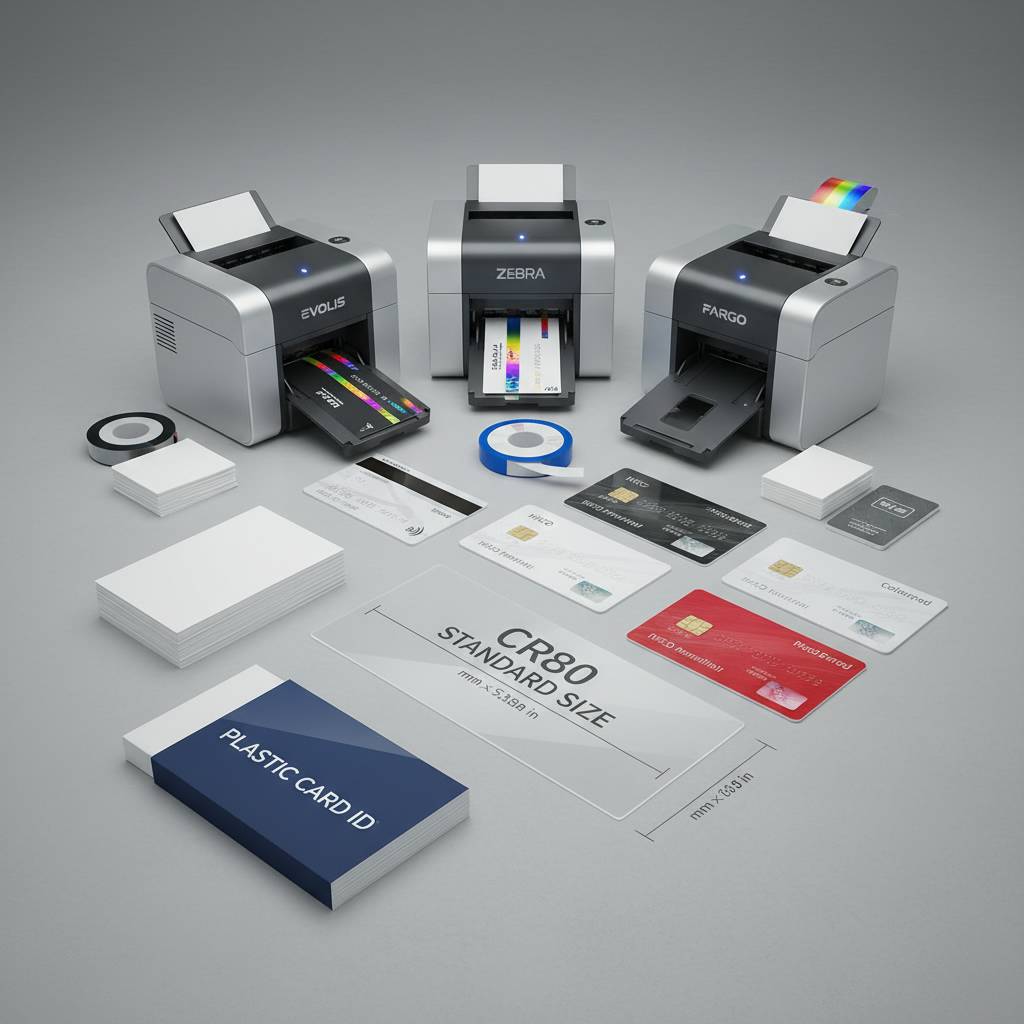
The breadth of inventory matters too. Buying blank CR80 cards, magnetic stripe cards, RFID cards, card printers, ribbons, cleaning kits, badge holders, and card mailing services from a single supplier is not just convenient - it is operationally intelligent. One vendor relationship. One purchase order process. One point of contact when something needs to be resolved quickly. True one-stop sourcing for card programs is rarer than it should be, and CPE has built it deliberately.
Long-Term Partnership Over Transactional Sales
The difference between a supplier and a strategic partner shows up over time. A supplier takes your order and ships your cards. A strategic partner helps you think through card format, technology selection, printer compatibility, and program design before the first order is placed - and stays engaged as the program evolves. CPE operates explicitly as the latter, building relationships that span years and sometimes decades with clients who value continuity and expertise alongside competitive pricing.
Card programs change. Organizations grow, add locations, upgrade access systems, expand loyalty programs, and refresh their brand identity. Having a card supplier who understands your program history and can advise on upgrades without starting from scratch every time has real operational value. The best card programs are not one-time purchases - they are ongoing operations that benefit from ongoing expertise.
Shipping, Turnaround, and Service Across the USA
Every order placed with CPE ships to a USA address. Turnaround on standard blank CR80 card orders is fast - typically same-day or next-day ship from well-maintained inventory. Card printer orders ship with full manufacturer warranty coverage and access to the technical support resources that keep printers running at peak performance. For organizations with urgent credential needs - new hires starting immediately, events happening this week - the combination of ready inventory and fast shipping makes the difference between a program that works and one that scrambles.
Specialty services like card affixing and mailing handle the logistics of getting personalized cards directly into members' or customers' hands without requiring internal fulfillment capability. For loyalty card launches, membership renewals, or new customer welcome packages, outsourcing the card mailing function to a supplier who already handles the card production is a straightforward operational win. Less complexity in your operations means more capacity for the work that actually grows your business.
Getting Started: Your First CR80 Card Order
Starting a new card program or expanding an existing one begins with a single conversation. What are you trying to accomplish with your cards? Who will carry them, and for how long? What systems - if any - will the cards need to interact with? What equipment do you currently have, and what might you need to add? These questions take minutes to answer and shape a recommendation that fits your program precisely rather than generically.
CPE has helped organizations of every size and type navigate these decisions, and the guidance is grounded in genuine experience rather than a sales script. Whether you need 500 blank white CR80 cards and a desktop printer to launch an employee badge program, or a sophisticated RFID smart card program for a multi-building campus, the path to a working solution starts with the right initial conversation. The sooner that conversation happens, the sooner your program is up and running.
Ready to launch or upgrade your CR80 card program? Reach out today and let a card program expert walk you through your options.
Start Your Card Program Today with Plastic Card ID
Every organization that issues cards - whether that means five employees or fifty thousand members - deserves a card program built on the right foundation. CR80 cards at ISO 7810 standard are that foundation: proven, universal, compatible with every printer and badge holder and card reader in the market, and capable of carrying any technology your program requires. The format has endured because it works, and it will continue working for your program as long as you run it.
CPE has been the CR80 card supplier of choice for businesses across the United States for over 25 years. The catalog covers every card type, every printer brand, and every accessory your program needs. The service is built around long-term relationships, not one-time transactions. And the expertise - accumulated across more than 50 million cards shipped to more than 100,000 customers - is available to every client who picks up the phone or sends an inquiry.
Contact Plastic Card ID at 800.835.7919 today. Your CR80 card program - whether it is 50 cards or 50,000 - deserves a partner who knows this business as well as you know yours.
Previous Page