Blank Plastic Card Supplier Checklist: Find the Right Partner
Table of Contents []
- Your Complete Blank Plastic Card Supplier Checklist - Powered by Plastic Card ID
- Why the Right Supplier Checklist Changes Everything
- The Technical Checklist: Card Specifications That Actually Matter
- The Operational Checklist: Reliability, Turnaround, and Support
- Printer and Supply Ecosystem: The Checklist Items Most Buyers Skip
- Specialty and Advanced Card Options: Expanding Your Checklist
- Frequently Asked Questions: Blank Plastic Card Supplier Checklist
- Ready to Build a Better Card Program? Start with Plastic Card ID
Your Complete Blank Plastic Card Supplier Checklist - Powered by Plastic Card ID
Choosing a supplier for blank plastic cards sounds straightforward - until it isn't. Suddenly you're comparing card thicknesses, asking whether HiCo or LoCo magnetic stripe matters for your application, wondering if that quoted price includes the right encoding, and questioning whether a vendor can actually scale with you when order volume doubles. The stakes are higher than most buyers initially realize.
This checklist-driven guide exists to cut through that confusion. Whether you're launching a loyalty program, upgrading employee badges, or building out a full access control system, CPE has spent over 25 years helping organizations like yours make smart, confident decisions from day one.
| Card Type | Key Feature | Best For |
|---|---|---|
| Standard CR80 PVC | ISO 7810 compliant, 30 mil | ID badges, membership, loyalty |
| HiCo Magnetic Stripe | 2750 Oe high coercivity | Hotel keys, access control, gift cards |
| LoCo Magnetic Stripe | 300 Oe low coercivity | Short-term use, event credentials |
| RFID / Proximity | Contactless, embedded chip | Door access, campus ID, time clock |
| Smart Chip (MIFARE) | DESFire EV1/EV2 encryption | Casino, secure facilities, campus |
| Clear / Frosted PVC | Translucent finish | Premium branding, VIP, specialty |
| Colored Stock PVC | Pre-colored base material | Departmental coding, events |
Why the Right Supplier Checklist Changes Everything
 Most purchasing decisions for blank plastic cards start with a Google search and end with a price comparison. That process leaves out roughly 80% of what actually matters. A supplier who delivers on price but fails on card quality, encoding accuracy, or turnaround time can derail an entire card program - and in high-stakes environments like access control or casino operations, that's not a recoverable situation.
A well-built supplier checklist protects you before you spend a dollar. It forces the conversation past surface-level pricing into specifications, reliability, and service depth. The checklist framework below is built from over 25 years of real-world experience and more than 50 million cards delivered to over 100,000 customers across the United States.
What Makes a Supplier a Strategic Partner
There's a meaningful difference between a vendor who processes your order and a partner who helps you build a successful card program. Partners ask what your card reader uses before recommending HiCo or LoCo. They flag potential compatibility issues before a purchase order is signed. They scale with you.
The best supplier relationships are built on communication, not just catalogs. When a school district needs 200 student ID cards one month and 2,000 the next due to unexpected enrollment changes, a strategic partner absorbs that shift gracefully. That's the level of service CPE is built around.
Understanding Volume Flexibility
One of the most overlooked items on any supplier checklist is volume flexibility. Can your supplier fill a reorder of 50 cards without charging you a setup fee that negates the entire purchase? Can they handle 50,000 without requiring a six-week lead time? The answer should be yes to both.
Programs evolve. Membership drives exceed projections. Events get bigger. Employee headcounts shift. A supplier who can only serve you at one scale is a liability at every other scale. Ask directly about minimum and maximum order thresholds - and get a clear answer before committing.
Evaluating Product Range Honestly
Many suppliers carry a narrow slice of the card market and present it as a full catalog. That becomes a problem the moment your needs expand. A school that starts with blank PVC ID cards may later add proximity access cards for staff doors and magnetic stripe cards for cafeteria accounts. Sourcing from three vendors creates management headaches and inconsistency.
A complete supplier carries blank CR80 cards, magnetic stripe options, RFID and smart chip cards, clear and frosted specialty cards, colored stock, printers, ribbons, cleaning kits, and card carriers under one roof. CPE covers all of it - one relationship, one account, complete coverage.
The Technical Checklist: Card Specifications That Actually Matter
Specifications are where most buyer errors happen. Not because buyers are careless - but because the terminology isn't always explained clearly by sellers who benefit from the confusion. Let's break down the specs that genuinely affect performance.
Card thickness, material composition, magnetic stripe coercivity, chip protocol, and surface finish all influence how a card performs in the real world. Getting these specs wrong means reprinting, re-encoding, or - worst case - replacing hardware. This section of your checklist should be non-negotiable.
CR80 Dimensions and Why Compliance Matters
CR80 is the ISO 7810 standard card format: 3.375 inches by 2.125 inches, 30 mil thick. Every standard card reader, badge holder, card printer, and wallet slot in the United States is designed around this specification. Deviation - even slight - causes feed errors, printing misalignment, and reader failures.
Always confirm ISO 7810 compliance in writing. Suppliers who can't produce a spec sheet on demand are waving a red flag. Compliance documentation is basic professional practice, and any serious supplier provides it without being asked twice.
HiCo vs. LoCo Magnetic Stripe: The Decision That Trips Up Buyers
High Coercivity (HiCo) magnetic stripes operate at 2750 Oersteds. Low Coercivity (LoCo) operates at 300 Oe. The practical difference: HiCo stripes resist magnetic field interference far better than LoCo, making them the correct choice for cards that live in wallets near phones, keys, and other magnets.
LoCo cards cost slightly less per unit but are best limited to short-duration use - event passes, temporary access badges, single-day credentials. Using LoCo for a loyalty card or hotel key program that expects months of use is a common and costly mistake. Ask your supplier which format they recommend for your specific application, and if they don't ask about your use case first, that's telling.
RFID and Smart Chip Protocols
Contactless cards come in multiple frequency ranges and protocol standards. 125kHz proximity cards (HID, EM4100) are the most common for basic door access. 13.56MHz smart cards - including MIFARE Classic, MIFARE DESFire EV1, and EV2 - offer higher data capacity and encryption suitable for casino player tracking, secure campus systems, and multi-application environments.
Compatibility between card protocol and reader hardware is not optional to verify - it's essential. A MIFARE DESFire card will not communicate with a reader configured for HID proximity. Confirm your existing infrastructure before ordering contactless cards, and lean on your supplier to validate compatibility. CPE fields these questions regularly and has the technical depth to help you match cards to systems correctly.
The Operational Checklist: Reliability, Turnaround, and Support
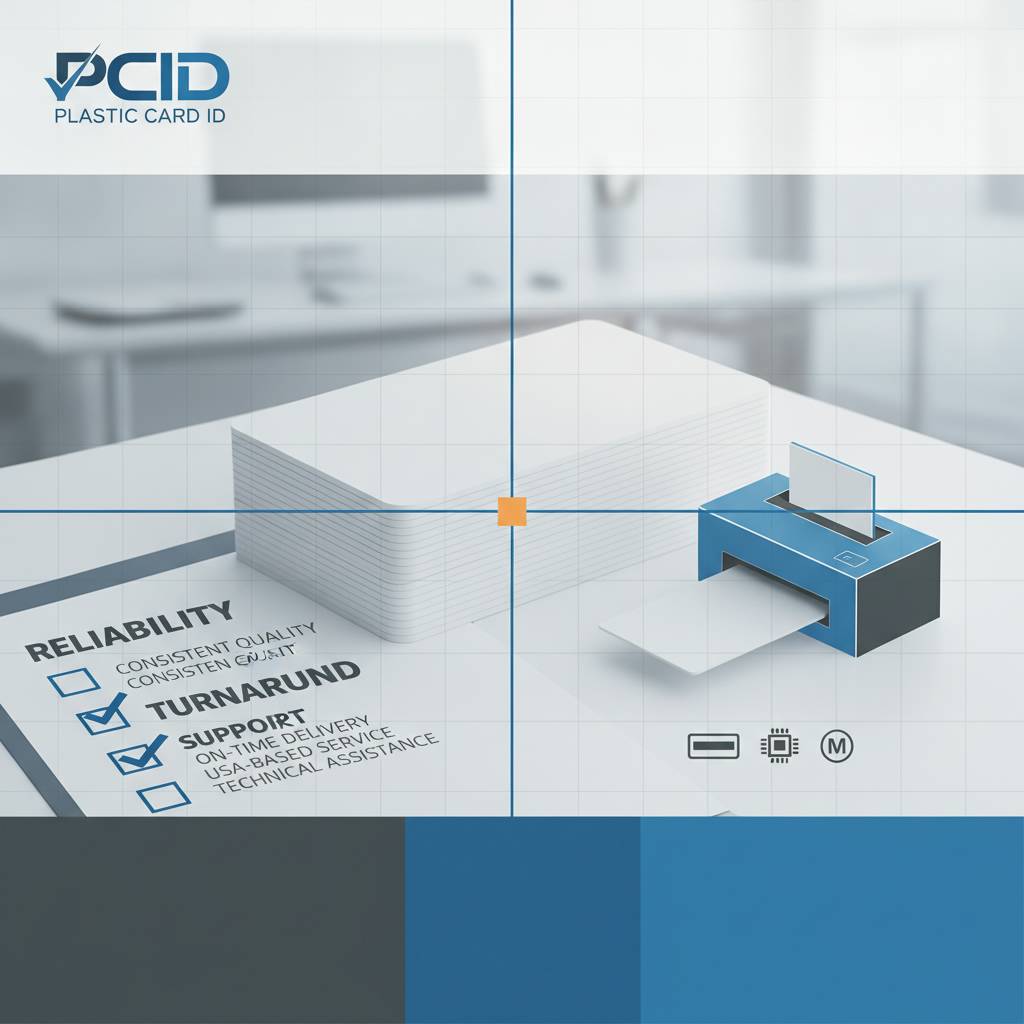 Technical specifications only matter if the operational side of your supplier relationship works. On-time delivery, consistent card quality across batches, responsive customer service, and transparent pricing combine to form the operational foundation of a card program. This section of the checklist is often underweighted by first-time buyers and overweighted by experienced ones who've been burned.
When a card program is embedded in daily operations - issuing employee badges, activating membership cards at point of sale, managing hotel check-in - any supply disruption creates downstream consequences. Operational reliability is not a nice-to-have; it's the backbone of the relationship.
Turnaround Time and Reorder Simplicity
Ask any supplier for their standard turnaround on a reorder of 500 blank PVC cards. Then ask what happens if you need to double that quantity in the same timeframe. Their answer tells you more than any catalog page. Suppliers with robust inventory and efficient fulfillment will give you a confident, specific answer. Those without will hedge.
Reordering should be frictionless. Programs that require a new quote, a new setup process, or a new contact person every time you reorder are operationally inefficient. The best suppliers build account history, track your common card types, and make reordering as simple as a phone call or email.
Customer Support Depth
Not all customer service is equal. There's a meaningful difference between a support team that can track your order and one that can help you troubleshoot a card printer ribbon issue, recommend the right cleaning kit schedule, or advise on which card stock is compatible with a newly acquired Evolis printer.
Deep product knowledge at the customer support level is a differentiator - one that CPE has developed over decades of serving businesses ranging from small retail boutiques to major healthcare networks and casino operations. Call 800.835.7919 to experience that depth firsthand before committing to any card purchase.
Batch Consistency Across Orders
One of the quieter reliability issues in blank card supply is batch-to-batch consistency. Card color, surface texture, and material uniformity must remain consistent across reorders - especially in branded programs where visual uniformity signals professionalism. A loyalty card from a January order should look and feel identical to one from an August reorder.
Ask suppliers directly how they ensure batch consistency. Do they source from a single manufacturer? Do they quality-check incoming inventory? Do they maintain product specifications across stock refreshes? These aren't nitpicky questions - they're the kind of things that determine whether your card program looks polished or inconsistent over time.
Printer and Supply Ecosystem: The Checklist Items Most Buyers Skip
Blank cards don't do much without a card printer. And card printers don't perform without the right ribbons, cleaning kits, and maintenance supplies. Buyers who treat these as separate purchasing decisions often end up with incompatible components, voided warranties, or degraded print quality that reflects poorly on their cards - and by extension, on their brand.
The smartest purchasing decision is sourcing cards and printer supplies from the same vendor. It eliminates the compatibility guesswork and gives you a single point of accountability when something doesn't work as expected.
Matching Cards to Printer Brands
Not every blank card performs equally in every printer. Evolis, Zebra, and Fargo printers each have recommended card specifications - thickness tolerances, surface treatments, and material compositions that optimize print quality and reduce printhead wear. Using off-spec cards in a precision printer is a quiet way to shorten equipment life and degrade output quality.
CPE carries printers from all three major brands alongside card stock that's fully compatible with each. That alignment isn't accidental - it's the result of building a product ecosystem where every component works together. The card, the ribbon, the printer, and the cleaning kit are all part of the same system.
Ribbons and Cleaning Kits
Ribbon selection depends on card design complexity. YMCKO ribbons (full color plus overlay) are standard for photo ID and full-color loyalty cards. Monochrome ribbons serve high-volume text-and-barcode applications at significantly lower cost per card. Using the wrong ribbon type wastes money and delivers suboptimal results.
Cleaning kits are frequently overlooked until print quality degrades or cards start misfeeding. Regular cleaning cycles - per manufacturer recommendation - extend printhead life, maintain color consistency, and reduce error rates. Ask your supplier whether cleaning kits are available for your printer model and how frequently they recommend cleaning based on your print volume.
Card Carriers, Sleeves, and Mailing Services
A complete card program often extends past the card itself. Loyalty cards need to be distributed. Membership cards need to arrive looking professional. Employee badges need holders and lanyards. Each of these add-ons, when sourced from a different vendor, introduces friction and potential inconsistency.
Card carriers, protective sleeves, badge holders, and card affixing and mailing services round out the CPE catalog in ways that save program managers significant time and logistics complexity. When your supplier can print, package, and mail cards on your behalf, you're operating with genuine efficiency.
Specialty and Advanced Card Options: Expanding Your Checklist
Standard blank CR80 PVC cards cover the majority of use cases. But certain industries and applications demand something more - whether that's the encryption depth of MIFARE DESFire for a casino floor, the visual impact of clear frosted PVC for a VIP membership, or the tactile prestige of a metal card for a premium loyalty tier.

Knowing whether your supplier can serve these advanced needs - even if you don't need them today - is good checklist practice. Programs evolve, and discovering mid-evolution that your supplier can't support the next tier of your program is a disruptive and avoidable situation.
Casino and Hospitality Cards
Casino player tracking cards operate in demanding environments. They're swiped hundreds of times per month, exposed to spilled beverages, passed between cage staff and players, and expected to maintain reliable encoding across their entire lifespan. These requirements push beyond standard loyalty card specifications into purpose-built card construction.
Hotel key cards carry their own engineering considerations - HiCo magnetic stripes that survive proximity to phones and key fobs, consistent card thickness for lock hardware feed reliability, and surface treatments that maintain print quality through repeated handling. CPE supplies both categories with products designed specifically for those environments.
Clear, Frosted, and Die-Cut Specialty Cards
Clear and frosted PVC cards create a premium visual impression that standard white stock cannot replicate. Translucent cards catch light differently, feel substantial in hand, and communicate a brand investment that resonates with VIP members and high-value customers. They're particularly effective in spa, resort, fine dining, and luxury retail membership programs.
Custom die-cut cards - non-standard shapes like rounded rectangles, keyfobs, or branded silhouettes - offer another dimension of differentiation. When your card looks nothing like everyone else's card, it commands attention and memorability. Ask your supplier what die-cut options are available and what minimum order quantities apply.
Metal Cards: Stainless Steel, Brass, and Gold
At the apex of the card product category sit luxury metal cards. Available in stainless steel, brass, and gold finishes, these cards are the unmistakable signal of a premium program tier. They're heavy. They're distinctive. And they generate a reaction every time they're handed across a table or pulled from a wallet.
Metal cards are not gimmicks - they are serious brand tools with measurable impact on perceived value and program prestige. Banks, private clubs, high-end retailers, and luxury hospitality brands deploy them precisely because they communicate something paper and standard PVC fundamentally cannot. If your program has a premium tier, metal cards belong in your supplier checklist conversation.
Frequently Asked Questions: Blank Plastic Card Supplier Checklist
The questions below surface repeatedly in conversations with buyers who are building or expanding card programs. They're worth addressing directly because the answers inform real purchasing decisions.
What's the difference between blank and pre-printed custom cards?
Blank cards arrive from the supplier as unmarked white (or colored/clear) PVC stock, ready to be printed in-house using a card printer. Custom pre-printed cards are printed by the supplier before shipment, typically in larger quantities, and arrive ready to use or encode. Blank cards give you maximum flexibility - design can change without reordering stock - while custom-printed cards trade that flexibility for potentially lower per-card cost at volume.
For organizations with frequently changing card designs, variable data (like employee photos), or moderate monthly volumes, blank cards plus an in-house printer is almost always the more practical and cost-effective solution. For organizations with stable designs and high volumes, custom pre-printed cards can reduce per-unit cost meaningfully.
How many cards do I need before volume pricing applies?
Volume pricing thresholds vary by supplier and card type. In general, meaningful per-card price breaks begin around 500 cards and accelerate significantly at 1,000, 2,500, and 5,000 unit quantities. The per-card economics of blank PVC cards favor buyers who can plan ahead and order in larger batches even if they'll use the cards over several months.
Ask your supplier for a tiered pricing sheet rather than a single quantity quote. Understanding the break points lets you make smarter order decisions and potentially time purchases to maximize savings without overstocking.
Do I need to buy a printer from the same supplier as my cards?
Not strictly required - but strongly advisable. Card stock compatibility with specific printer models affects print quality, printhead longevity, and card feeding reliability. Buying cards and printers from the same supplier gives you a single point of accountability and access to staff who can troubleshoot the complete system rather than just one component.
- Confirm card stock compatibility with your specific printer model before ordering.
- Ask whether the supplier stocks ribbons and cleaning kits for your printer brand.
- Request documentation of recommended card specifications from the printer manufacturer.
- Check whether the supplier offers technical support for printer setup and calibration.
- Verify that warranty terms on printers are honored when using third-party card stock.
What should I check when evaluating a new card supplier for the first time?
Start with a sample order. No supplier checklist substitutes for holding actual cards from a prospective vendor and running them through your printer. Verify card thickness with a micrometer if encoding precision matters for your application. Test magnetic stripe encoding if applicable. Check surface uniformity under direct light.
Beyond product quality, assess responsiveness: how quickly did the supplier respond to your inquiry? Did they ask clarifying questions about your use case, or did they simply send a catalog? Did they volunteer information about compatibility and specs, or did you have to pull it out of them? Those behavioral signals are as revealing as any spec sheet.
Ready to Build a Better Card Program? Start with Plastic Card ID
 Every checklist item in this guide reflects a real decision point in a real card program - decisions that Plastic Card ID has helped over 100,000 customers navigate across more than 25 years of business. From the first blank CR80 card to a full-scale RFID access control rollout, the depth of experience and product range here is genuinely difficult to match.
Retailers who switched from paper punch cards to plastic loyalty cards saw revenue increases of 35-50%. Membership organizations that moved to plastic credentials reported stronger member retention and higher perceived program value. Employee badge programs that standardized on a single supplier for cards, printers, and supplies reduced administrative overhead and improved consistency. These outcomes are replicable - and they start with choosing the right supplier from the beginning.
Call Plastic Card ID today at 800.835.7919 and speak with a card program specialist who will help you move from checklist to launch with confidence. Whether you need 50 cards or 50,000, blank PVC stock or MIFARE DESFire smart cards, the right answer is one conversation away.
Previous Page