ISO 7810 Card Standard: What It Means for Buyers
Table of Contents []
- What the ISO 7810 Card Standard Actually Means for Buyers - Plastic Card ID
- The Anatomy of an ISO 7810 Compliant Card
- How ISO 7810 Compliance Affects Your Card Program Operations
- Buyer's Guide: Choosing the Right ISO 7810 Card for Your Use Case
- ISO 7810 and the Business Case for Physical Cards
- Frequently Asked Questions About ISO 7810 and Card Buying
- Partner With Plastic Card ID for Your ISO 7810 Card Program
What the ISO 7810 Card Standard Actually Means for Buyers - Plastic Card ID
You have probably seen the term "CR80" or "ISO 7810" thrown around when shopping for plastic cards, and if you have ever wondered whether it actually matters for your business - it does, significantly. The standard is not just a technicality buried in a spec sheet. It is the invisible infrastructure behind every card program that works reliably, every printer that feeds correctly, and every reader that accepts a credential without hesitation.
At Plastic Card ID, we have supplied over 50 million plastic cards to more than 100,000 businesses across the United States. That kind of volume teaches you one thing quickly: specifications are not suggestions. When a card deviates from ISO 7810, things break down - printers jam, card holders crack, readers fail to scan. Understanding what the standard means is the first step toward building a card program that actually works at scale.
| Specification | ISO 7810 ID-1 (CR80) Value | Why It Matters |
|---|---|---|
| Width | 85.60 mm (3.375 inches) | Fits standard wallets and card holders |
| Height | 53.98 mm (2.125 inches) | Universal slot compatibility in readers and printers |
| Thickness | 0.76 mm (30 mil) | Consistent feed through card printers without jamming |
| Corner Radius | 3.18 mm | Prevents cracking and chipping at edges over time |
| Material | PVC (standard) | Durable, printable, encodable surface |
The Anatomy of an ISO 7810 Compliant Card
 ISO 7810 is an international standard published by the International Organization for Standardization that defines the physical dimensions and characteristics of identification cards. The most commonly used format is ID-1, better known in the card industry as CR80. When someone says "standard credit card size," they mean ISO 7810 ID-1 - and that is exactly the format Plastic Card ID supplies across virtually its entire catalog of blank and custom cards.
The dimensions are precise for a reason. At 85.60 mm wide by 53.98 mm tall by 0.76 mm thick, every CR80 card is engineered to work universally across readers, printers, wallets, badge holders, lanyards, and card dispensers. That universality is the hidden value of the standard - you buy equipment once, and cards from any ISO-compliant supplier will work with it reliably for years.
The 30 Mil Thickness Rule
Thirty mil - that is 0.030 inches, or 0.76 mm - is the gold standard for card thickness. It is not arbitrary. Card printers from Evolis, Zebra, and Fargo are calibrated for this exact thickness. Feed a 20 mil card through a printer designed for 30 mil stock, and you will experience misfeeds, off-center printing, or ribbon drag. Feed an oversized card, and you risk damaging the print head entirely.
At CPE, every blank PVC card sold meets this 30 mil specification without exception. It is what allows buyers to purchase blank stock confidently, knowing their existing printer setup will handle the cards without recalibration, adjustment, or guesswork. The thickness is where reliability lives.
Corner Radius and Why It Is Not Just Aesthetic
The 3.18 mm corner radius specified by ISO 7810 serves a functional purpose beyond looking polished. Sharp corners on thinner or non-compliant cards crack under pressure, especially when cards are repeatedly inserted and removed from wallets, badge holders, or card readers. Over hundreds of cycles, a card with proper corner radius maintains its structural integrity far better than a trimmed or non-standard alternative.
For organizations running employee badge programs or loyalty card programs where cards are used daily, this detail adds up to a meaningful difference in card longevity. Replacing cards prematurely costs money and disrupts operations. Compliance with the standard is, at its core, a cost-saving decision dressed in engineering language.
Material Composition Under the Standard
ISO 7810 does not mandate a single material - it specifies the performance characteristics the material must meet, including dimensional stability, resistance to warping, and surface properties suitable for encoding and printing. In practice, PVC (polyvinyl chloride) has become the dominant material in the industry because it satisfies all of these requirements reliably and affordably.
PVC cards from Plastic Card ID accept dye-sublimation and direct-to-card printing cleanly, support magnetic stripe encoding, and bond well with laminate overlays for extended surface durability. Whether the card ends up as an employee ID, a hotel key, or a retail gift card, the PVC substrate is what makes all of those use cases possible from a single, standard card format.
How ISO 7810 Compliance Affects Your Card Program Operations
Most buyers who call CPE for the first time ask about price per card or minimum order quantities. Those are important questions - but the more experienced buyers, the ones running programs of several thousand cards per month, ask first about compliance. They have learned through hard experience that a cheap card that jams your printer is not actually cheap.
Printer downtime, reprinting costs, service calls, and frustrated cardholders all have real dollar values. Sourcing cards that meet ISO 7810 specifications is what separates a smooth operation from a constant troubleshooting exercise. Plastic Card ID has spent over 25 years ensuring that every card in the catalog meets or exceeds the standard, so buyers can focus on their programs rather than their card stock.
Compatibility With Card Printers
Evolis, Zebra, and Fargo - the three major card printer brands stocked by Plastic Card ID - are all factory-calibrated to ISO 7810 ID-1 dimensions. The feed rollers, print head positioning, and ribbon tension systems in these printers are designed around a 30 mil, 85.60 x 53.98 mm card. When you load compliant cards, the printer performs exactly as its engineering intended.
This is particularly important for high-volume operations. A printer running 500 cards per day has zero tolerance for inconsistency in card stock. Even a few tenths of a millimeter variance in card width can cause cascading feed errors that shut down production. Consistent ISO compliance is what makes unattended batch printing possible.
Call 800.835.7919 to confirm which blank card stock is optimal for your specific printer model before placing a large order. The team at Plastic Card ID can cross-reference your printer with the correct card specifications instantly.
Encoding and Technology Layers on ISO Cards
One of the most important things to understand about ISO 7810 is that it governs the physical card - not the data encoded on it. Magnetic stripes, RFID chips, smart card chips, and proximity technology are all layered on top of the base CR80 form factor. Additional ISO standards (like ISO 7811 for magnetic stripes and ISO 14443 for contactless cards) govern those features, but the card they live on still follows ISO 7810.
Plastic Card ID supplies magnetic stripe cards in both HiCo (high coercivity) and LoCo (low coercivity) formats, RFID cards including MIFARE DESFire variants, proximity access cards, and smart chip cards - all in CR80 format. The technology stack changes; the physical compliance does not. That is the elegance of building a standard around the form factor rather than the function.
Specialty Cards That Still Meet the Standard
Buyers sometimes assume that specialty cards - clear PVC, frosted finishes, custom die-cut shapes, or even metal cards - depart from ISO 7810. In most cases, they do not. Clear and frosted cards from Plastic Card ID maintain full CR80 dimensions at 30 mil thickness. Custom die-cut shapes obviously deviate from the rectangular ID-1 format by design, but standard-format specialty cards like clear stock remain fully compliant.
Metal cards in stainless steel, brass, and gold present a different profile - they are typically thicker and heavier than standard PVC - and buyers should confirm compatibility with their specific card holders or readers before ordering. For the vast majority of programs, however, specialty finishes and ISO compliance coexist without compromise, giving organizations access to premium visual impact without sacrificing functional reliability.
Buyer's Guide: Choosing the Right ISO 7810 Card for Your Use Case
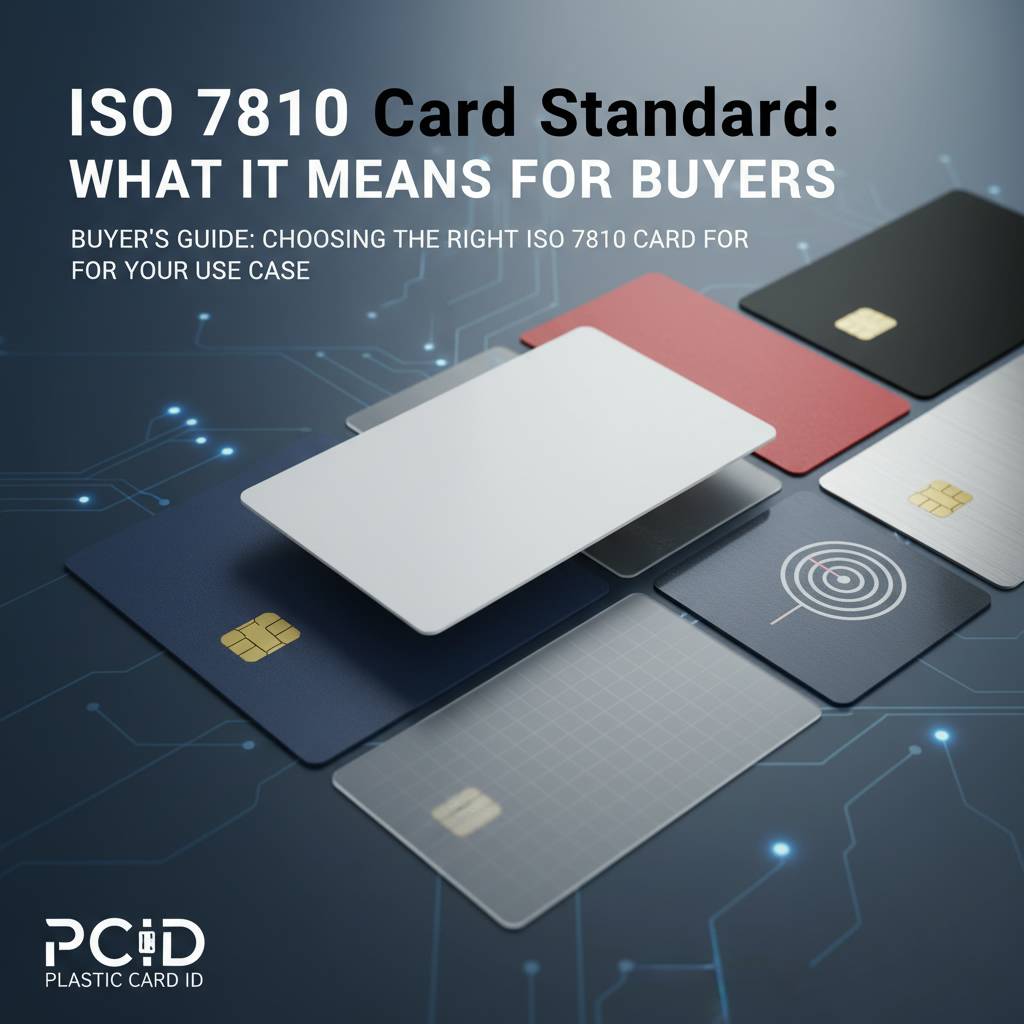 The catalog at Plastic Card ID contains dozens of card types, all built on the CR80 standard. Navigating that catalog intelligently requires matching card features to program requirements - not just grabbing the cheapest option. Here is a practical framework buyers can use to narrow down their selection.
Matching Card Type to Program Function
Employee ID programs typically need a plain white PVC card with a printable surface - no encoding required unless access control is involved. Event credentials often benefit from thinner stock (20 mil) for one-time use, though 30 mil is preferred for multi-day events. Loyalty and gift card programs require durable 30 mil PVC that can withstand years of wallet storage and repeated use at point of sale.
Access control programs add a technology layer: proximity cards for basic door access, RFID smart cards for multi-application or encrypted credential environments, or HiCo magnetic stripe for systems that rely on traditional mag-stripe readers. Each function has an optimal card specification, and pairing them correctly from the start saves significant money over the life of the program.
Key Questions to Ask Before Ordering
- Will the cards be printed in-house or pre-printed? In-house printing requires blank stock; pre-printed cards require artwork and setup.
- Does your access system use magnetic stripe, proximity, RFID, or smart chip technology?
- What printer model are you running, and what card thickness does it support?
- How many cards will you need per month, and what is your storage capacity for bulk stock?
- Do you need encoding, lamination overlays, or any value-added processing?
- Are cardholders expected to carry the card in a wallet, or will it be used in a badge holder?
Working through these questions before contacting a supplier saves time and prevents the frustration of receiving the wrong card for your infrastructure. The team at CPE fields these questions daily and can match any use case to the right card type, quantity, and technology configuration.
Volume and Pricing Considerations
ISO 7810 compliant blank PVC cards scale well in price as volume increases. Small organizations ordering 500-1,000 cards pay a meaningfully higher per-card cost than operations buying in quantities of 10,000-50,000. However, even at lower volumes, standardized card stock is almost always more cost-effective than custom-printed alternatives for programs that require frequent design updates or variable data printing.
The blank card model gives buyers total design flexibility while maintaining the economies of bulk blank stock pricing. An organization that prints 200 cards per month in-house using a desktop Evolis or Zebra printer can achieve per-card costs well below what commercial print runs would cost for equivalent quantities, especially once the printer investment is amortized over 12-24 months of operation.
ISO 7810 and the Business Case for Physical Cards
It is worth stepping back from the technical specifications to revisit why plastic cards conforming to ISO 7810 generate better business outcomes than paper, digital, or non-standard alternatives. The standard exists because the card ecosystem - readers, printers, wallets, dispensers - was built around it. When your cards conform to that ecosystem, they perform inside it seamlessly.
Retailers who have made the switch from paper gift certificates to ISO 7810 compliant plastic gift cards report sales increases in the range of 35-50%. That is not a coincidence. A physical card that lives in a wallet is a persistent marketing tool. It is seen every time the holder opens their wallet - a paper certificate lives in a drawer until it is forgotten. The standard is what makes that wallet presence possible, because a non-standard card does not fit the slot.
Loyalty Cards That Outperform Paper Punch Cards
Paper punch cards are inexpensive to produce and easy to understand, which is why small businesses gravitate toward them. But they are also easy to lose, easy to counterfeit, and forgettable. A plastic loyalty card at CR80 dimensions fits in the same slot as a credit card - which means it travels everywhere the customer goes, ready to be presented at the moment of a repeat purchase.
Plastic Card ID supplies blank loyalty card stock in standard white PVC as well as colored stock options for programs that want visual differentiation between tiers. Combining in-house card printing with a blank ISO-compliant base stock gives businesses a loyalty card infrastructure that punches well above its cost in terms of customer retention and program credibility.
Membership and ID Cards That Signal Permanence
There is a psychological dimension to card quality that is difficult to quantify but easy to observe. A laminated paper membership card signals temporary. A rigid, glossy, CR80 plastic card signals permanent. Organizations from gyms to professional associations to libraries have discovered that issuing an ISO 7810 compliant plastic membership card increases perceived value of membership itself - not just the card.
For ID programs - employee badges, visitor passes, student IDs - the physical robustness of a 30 mil PVC card also carries practical significance. These cards are scanned, tapped, swiped, and handled dozens of times per day. A card that degrades under that usage undermines the entire identity program it was designed to support. Compliance with the standard is what prevents that degradation.
Casino, Hotel, and Specialty Program Applications
High-frequency card programs in hospitality and gaming environments demand the most from card stock. Casino player cards are handled thousands of times before replacement, and they must encode and decode reliably on every transaction. Hotel key cards need dimensional consistency to function in door readers that are sensitive to even minor deviations in card thickness or flatness.
Plastic Card ID supplies hotel key cards and casino player cards built to ISO 7810 standards, with encoding options that match the specific reader infrastructure each client operates. These are not generic cards - they are cards matched to system requirements, which is exactly the kind of strategic supplier relationship that separates CPE from commodity card vendors.
| Card Type | Typical Use Case | ISO 7810 Compliant? |
|---|---|---|
| Blank White PVC | Employee ID, loyalty, event | Yes - CR80, 30 mil |
| HiCo Magnetic Stripe | Access control, gift cards | Yes - CR80, 30 mil |
| RFID / Proximity | Door access, contactless ID | Yes - CR80, standard |
| Clear / Frosted PVC | Premium membership, VIP | Yes - CR80, 30 mil |
| Metal Cards | Luxury membership, VIP | Verify thickness with supplier |
Frequently Asked Questions About ISO 7810 and Card Buying
After 25 years and over 100,000 customers, certain questions come up repeatedly. Here are the ones buyers ask most often when evaluating card stock for the first time - along with direct, practical answers.
Does Every Card Printer Accept ISO 7810 Cards?
Virtually every dedicated card printer on the market - including all models from Evolis, Zebra, and Fargo sold by Plastic Card ID - is designed for ISO 7810 ID-1 cards. Desktop printers, retransfer printers, and high-volume card issuance systems all share this baseline compatibility. The standard exists in part to ensure that hardware investments are protected regardless of which card supplier a buyer uses.
Where buyers occasionally run into trouble is with non-standard or imported card stock that claims CR80 dimensions but delivers variance outside tolerance. Sourcing from a verified supplier with 25 years of proven quality is the simplest way to avoid this problem entirely.
Reach the team at 800.835.7919 to verify card compatibility with your current printer before committing to a bulk order. One call can prevent a costly mismatch.
Can I Mix Card Types in a Single Program?
Yes, and many organizations do. A hospital might run plain white PVC for general visitor badges while using proximity RFID cards for staff with access to restricted areas, and HiCo magnetic stripe cards for cafeteria payment programs - all on the same CR80 form factor. The physical standardization of ISO 7810 makes this mix-and-match approach operationally clean.
What changes between card types is the technology layer and potentially the surface finish, not the card dimensions. The CR80 standard is the common language all of these cards speak, which is why multi-technology card programs are far more manageable than they might initially appear.
What Is the Minimum Order Quantity for ISO Compliant Cards?
Plastic Card ID serves programs of all scales, from small organizations ordering 50-100 cards per month to large enterprises ordering in the tens of thousands. Minimum order quantities vary by card type, but the accessible entry point for blank PVC stock is deliberately low to accommodate growing programs that are not yet ready for bulk purchasing commitments.
As volume increases, per-card pricing decreases substantially - which is an incentive for programs to consolidate their card purchasing with a single strategic supplier rather than splitting orders across multiple vendors. Consistency in card stock quality across large volumes is one of the operational advantages that has kept CPE clients coming back for years.
Partner With Plastic Card ID for Your ISO 7810 Card Program
The ISO 7810 standard is not complicated once you understand what it is protecting - your investment in printers, readers, and card infrastructure, and ultimately your cardholders' experience with your brand every time they pull a card from their wallet. Every card in the Plastic Card ID catalog is built on this foundation. Not as an afterthought, but as the starting point for every program we help build.
Over 25 years, more than 100,000 clients, and 50 million cards shipped have given the team at CPE a perspective on card programs that no spec sheet can replicate. Whether you are launching your first employee badge program, scaling a loyalty card operation, or upgrading to contactless RFID credentials, the right card starts with compliance to the standard - and the right supplier starts with a conversation.
Call Plastic Card ID today at 800.835.7919 - your ISO 7810 compliant card program is one conversation away from being exactly right.
Previous Page