Smart Chip vs Magnetic Stripe Security Comparison
Table of Contents []
- Smart Chip vs Magnetic Stripe Security: What Every Business Needs to Know - Plastic Card ID
- Understanding Magnetic Stripe Technology
- Smart Chip Cards: How the Technology Actually Works
- Head-to-Head: The Security Comparison That Matters Most
- Choosing the Right Card Technology for Your Program
- How Plastic Card ID Supports Your Card Program
Smart Chip vs Magnetic Stripe Security: What Every Business Needs to Know - Plastic Card ID
Choosing the right card technology is not just a procurement decision - it shapes how your organization manages identity, controls access, rewards customers, and protects sensitive data every single day. Whether you are running a 50-card employee badge program or scaling up to tens of thousands of loyalty cards, the technology encoded on those cards matters enormously. Two technologies dominate the landscape: smart chip cards and magnetic stripe cards. They look similar. They serve overlapping purposes. But they are profoundly different when it comes to security, versatility, and long-term value.
This guide breaks down the real differences, cuts through the technical noise, and helps you make a confident, informed decision for your specific program. And if you have questions along the way, CPE is standing by to help you find exactly the right card solution for your operation.
| Feature | Magnetic Stripe | Smart Chip |
|---|---|---|
| Data Storage | Low (up to 140 bytes) | High (up to 64KB) |
| Cloning Risk | High | Very Low |
| Read Method | Swipe (contact) | Contact or Contactless |
| Encryption | None (static data) | Advanced (AES, DES) |
| Durability | Moderate | High |
| Cost Per Card | Lower | Moderate to Higher |
| Best Use Cases | Loyalty, gift, time-clock | Access control, ID, hotel keys |
Understanding Magnetic Stripe Technology
 Magnetic stripe cards - often called magstripe cards - have been a workhorse of card programs for decades. The technology is simple, time-tested, and widely supported by existing reader infrastructure across the country. A thin band of iron-oxide particles, magnetized in specific patterns, encodes data that a reader can pull in an instant when the card is swiped. It is not flashy. But for many applications, it does not need to be.
The stripe typically contains three tracks. Most commercial card programs use Track 1 and Track 2, which together hold information like cardholder name, ID number, and program-specific data. The capacity is modest - roughly 140 bytes total - but for a loyalty punch replacement, a time-and-attendance system, or a basic membership card, magnetic stripe does exactly what it needs to do without overcomplicating your program or your budget.
HiCo vs LoCo: Choosing the Right Stripe
Not all magnetic stripes are created equal. High-coercivity (HiCo) stripes require a stronger magnetic field to encode and are far more resistant to accidental erasure - think proximity to magnets, security scanners, or everyday wallet friction. HiCo cards are rated at 2750 Oe (oersteds), making them the preferred choice for any card expected to see regular, long-term use.
Low-coercivity (LoCo) stripes, rated at 300 Oe, are easier and cheaper to encode but significantly more vulnerable to magnetic interference. They are most appropriate for single-use or short-term applications - think event passes or temporary access cards where lifespan is days, not years. Selecting the wrong coercivity is one of the most common and costly mistakes businesses make when launching a new card program.
Where Magnetic Stripe Cards Truly Shine
For loyalty programs, gift card programs, employee time-clock systems, and library cards, magnetic stripe technology remains an excellent match. The reader infrastructure is inexpensive and widely available. Per-card costs are low. Encoding can be handled in-house with a desktop card printer equipped with a mag encoder - a feature available on many Evolis, Zebra, and Fargo models that CPE supplies.
Businesses that are scaling from paper punch cards to plastic loyalty cards see dramatic results. The data consistently shows retail loyalty programs that switch to plastic cards drive 35-50% increases in gift card sales, and that plastic cards which live in wallets keep your brand visible in ways that paper simply cannot replicate. For these use cases, there is no need to over-engineer the solution - magstripe delivers the outcome at the right price point.
The Inherent Security Limitations You Should Know
Here is where the honest conversation has to happen. Magnetic stripe data is static - meaning the information encoded on the stripe never changes and does not use encryption. A determined bad actor with a $50 reader can capture and clone a magnetic stripe card. The data does not fight back. For programs where the card grants access to physical spaces, stores sensitive personal information, or ties to high-value accounts, this is not a theoretical risk - it is a real vulnerability.
This is not a reason to dismiss magnetic stripe technology entirely. Millions of loyalty and membership programs run perfectly well on magstripe every day. But when you are evaluating smart chip vs magnetic stripe security, this static-data vulnerability is the single most important factor that separates the two technologies - and understanding it clearly helps you choose with confidence rather than guessing.
Smart Chip Cards: How the Technology Actually Works
A smart chip card contains an embedded integrated circuit - a tiny computer, essentially - that can store data, run small programs, and perform cryptographic operations. This is the technology powering hotel key cards, hospital ID badges, university campus cards, and sophisticated access control systems. The chip does not simply hold information; it processes it dynamically, which is the root of its superior security profile.
When a smart chip card interacts with a reader, the two engage in an authentication dialogue. The card can verify the reader's legitimacy. The reader verifies the card. Encryption keys are involved. Data transmitted during this handshake is never the same twice, which means even if a bad actor intercepts the communication, they capture nothing usable. This dynamic authentication model is why smart chip cards are the standard for high-security applications worldwide.
Contact vs Contactless Smart Chips
Smart chip cards come in two main variants: contact and contactless. Contact chips require the card to be physically inserted into a reader - the gold pads on the card's surface make direct electrical contact with the reader's terminals. Contactless chips, by contrast, use radio frequency identification (RFID) to communicate with a reader without any physical touch. Simply tap or wave the card near the reader and the transaction is complete.
Contactless technology has exploded in popularity for good reason. Speed, convenience, and hygiene all favor a tap-and-go interaction over inserting and removing a card repeatedly. Hotel key cards, transit passes, corporate access badges, and campus ID systems have moved heavily toward contactless. MIFARE DESFire - a high-security contactless chip standard - is among the most deployed technologies in access control and smart card programs globally, and CPE supplies these cards to organizations across the United States.
Encryption Standards That Set Smart Cards Apart
The encryption capabilities embedded in smart chips are not a marketing claim - they are documented, standardized, and independently audited. AES (Advanced Encryption Standard) at 128-bit or 256-bit levels, Triple-DES (3DES), and the newer DESFire EV3 implementations provide layers of cryptographic protection that magnetic stripe technology simply cannot approach. Each card can hold unique cryptographic keys, and the chip itself can be programmed to self-lock after repeated failed authentication attempts.
For organizations managing employee access to sensitive areas, controlling admission to restricted facilities, or running any program where card fraud would carry serious consequences, this encryption architecture is not optional - it is essential. The slightly higher per-card cost of smart chip technology pays for itself rapidly when compared to the cost of a single security breach, a compromised access system, or a loyalty program fraudulently exploited at scale.
MIFARE DESFire and Advanced Smart Card Options
MIFARE DESFire has become the gold standard in access control and smart card deployments. The EV2 and EV3 generations support 128-bit AES encryption, secure messaging, and transaction MAC verification - meaning every read and write operation is authenticated. For organizations running multi-application card programs - where a single card serves as both an ID badge and an access token, for example - DESFire's flexible file structure supports multiple applications on one card without security compromise between them.
Beyond MIFARE, the smart card landscape includes ISO 7816 contact chips for specialized enrollment and ID programs, Java Card platforms for highly custom applications, and hybrid cards that combine a smart chip with a magnetic stripe for backward compatibility. Hybrid solutions are especially practical during technology transitions, letting organizations upgrade to smart chip security while maintaining compatibility with legacy readers still in the field.
Head-to-Head: The Security Comparison That Matters Most
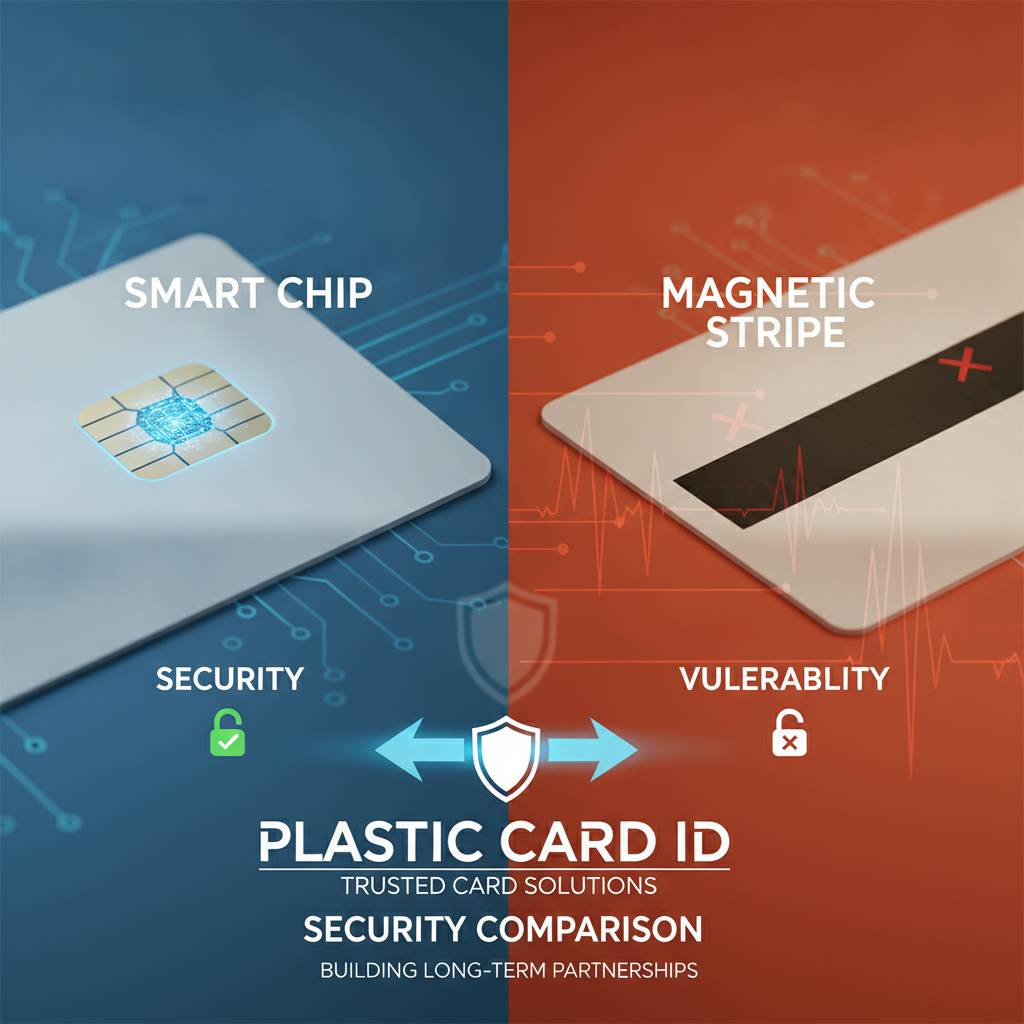 Strip away the technical jargon and the smart chip vs magnetic stripe security comparison comes down to a few fundamental questions. Can the card be cloned? Can the data be intercepted? Can access be fraudulently replicated? For magnetic stripe, the honest answers are yes, yes, and yes - under the right circumstances. For smart chip, the honest answers are extremely unlikely, no, and no - even under sophisticated attack conditions.
That said, security is always proportional to need. A gym membership card stored on magstripe is not a high-value target. A corporate access badge granting entry to a data center absolutely is. Matching your security technology to your actual risk profile is the discipline that separates smart card programs that deliver lasting value from those that either over-invest unnecessarily or underprepare dangerously.
Cloning and Skimming Risks Compared
Magnetic stripe skimming is well-documented and inexpensive to execute. Overlay readers, handheld skimmers, and compromised terminals have all been used to harvest magstripe data at scale. Once captured, that data can be re-encoded onto a blank card in seconds - creating a functional clone that most readers cannot distinguish from the original. For programs where the card is the only layer of authentication, this represents a genuine vulnerability.
Smart chip cards neutralize skimming at the architectural level. Even if a contactless chip's radio signal is intercepted, the captured data includes dynamic cryptographic values that expire immediately and cannot be replayed. There is no practical method to clone a properly implemented MIFARE DESFire card with today's publicly known technology. The chip does not give up its secrets, because the design principle is that the secrets never leave the chip in a usable form.
Physical Durability and Longevity
Both technologies are built on CR80 PVC card stock - the ISO 7810 standard format at 30 mil thickness. That means both benefit from the durability inherent in plastic construction. However, magnetic stripes are the more vulnerable component between the two. Bending, heat, proximity to magnets, and everyday contact can degrade stripe performance over time. Smart chips, embedded within the card body and protected by the laminate, are significantly more resilient to the physical abuse a frequently used card endures.
For programs expecting cards to remain in active use for two, three, or five or more years - corporate employee badges, university ID cards, and hotel key card programs come to mind - smart chip technology offers a better total lifespan. Fewer card replacements mean lower program costs over time, and fewer reprinting cycles mean less administrative overhead for your team.
Cost Considerations Across Program Scales
- Magnetic stripe cards cost less per card upfront - ideal for high-volume loyalty programs, gift card programs, and any application where volume matters more than advanced security.
- Smart chip cards carry a moderate to higher per-card cost, but the investment is justified for access control, high-security ID, and programs where fraud prevention delivers measurable ROI.
- HiCo magstripe cards are the sweet spot for most mainstream programs - lower cost than smart chip, far more reliable than LoCo in day-to-day use.
- Hybrid cards (chip plus stripe) add cost but allow graceful migration from legacy to modern reader infrastructure without stranding your existing investment.
- Reader infrastructure cost matters too: magstripe readers are inexpensive and ubiquitous; smart card readers carry higher upfront cost but deliver long-term operational advantages.
The total cost of a card program is never just the per-card price. Factor in reader hardware, encoding infrastructure, card replacement rates, fraud exposure, and administrative overhead. When you look at the complete picture, smart chip technology frequently delivers lower total program cost over a three-to-five year horizon for security-critical applications - even though the per-card price is higher.
Choosing the Right Card Technology for Your Program
The right answer for your organization depends entirely on what you need the card to do. There is no universally superior technology - only the right match between capability and application. A regional grocery chain deploying 20,000 loyalty cards has fundamentally different requirements than a hospital network issuing employee access badges for 500 clinical staff. Both are legitimate card programs. Both deserve the right technology for their context.
Start by mapping your program's actual requirements. What data does the card need to carry? What level of security is genuinely necessary? How long will each card be in service? What reader infrastructure do you already have or are willing to invest in? Answering these questions honestly takes ten minutes and can save thousands of dollars in program costs over the life of your card system.
Applications Best Suited for Magnetic Stripe
Loyalty programs, retail gift cards, library cards, employee time-and-attendance systems, event credentials, club membership cards, and basic access applications with low security stakes are all natural fits for magnetic stripe technology - particularly HiCo cards for anything expected to last more than a few weeks. The cost efficiency is real, the infrastructure is accessible, and the encoding process is simple enough to handle entirely in-house with a desktop card printer.
Organizations that are transitioning from paper loyalty punch cards to plastic - and there are still many making this move - will find that a straightforward HiCo magstripe card program, paired with a capable desktop card printer, delivers rapid ROI. The productivity gains, the brand visibility lift, and the documented 35-50% increase in program engagement that plastic cards drive over paper make this one of the clearest high-return investments available to small and mid-size businesses.
Applications Best Suited for Smart Chip
Corporate access control, hospital and healthcare ID, university and campus card programs, casino player cards, hotel key cards, government facility access, and any program where card compromise carries serious consequences are all strong fits for smart chip technology. The encryption, the dynamic authentication, and the resistance to cloning justify the higher per-card investment many times over in these contexts.
Hotel key card programs deserve special mention. Guests expect a tap-and-go experience. Hotels need cards that can be programmed and reprogrammed quickly at the front desk. RFID-based hotel key cards built on smart chip technology deliver both - and they are one of the most frequently requested specialty card products that CPE supplies to hospitality clients across the country. The guest experience improvement alone often justifies the upgrade from older magnetic stripe key systems.
Hybrid and Specialty Options Worth Considering
Hybrid cards combine a smart chip with a magnetic stripe on a single CR80 card. This approach is particularly valuable during technology transitions - when some of your readers have been upgraded to smart card capability but others have not yet been replaced. Rather than forcing an all-or-nothing decision, a hybrid card lets your program evolve at its own pace without stranding cardholders who interact with legacy infrastructure.
Specialty options extend the conversation further. Clear plastic cards offer visual impact for premium membership and VIP programs. Custom die-cut shapes make event credentials and promotional cards genuinely memorable. Luxury metal cards in stainless steel, brass, and gold carry a weight and permanence that signals exclusivity and drives cardholder retention. These premium formats are available in both magnetic stripe and smart chip configurations, so you do not have to sacrifice technology for aesthetics - or aesthetics for technology.
How Plastic Card ID Supports Your Card Program
With more than 25 years supplying plastic cards to businesses across the United States, Plastic Card ID has worked through virtually every card program scenario imaginable - from 50-card monthly orders for boutique fitness studios to mass production runs in the tens of thousands for national retail chains. That accumulated experience is the resource you are actually purchasing when you partner with CPE, not just the cards themselves.
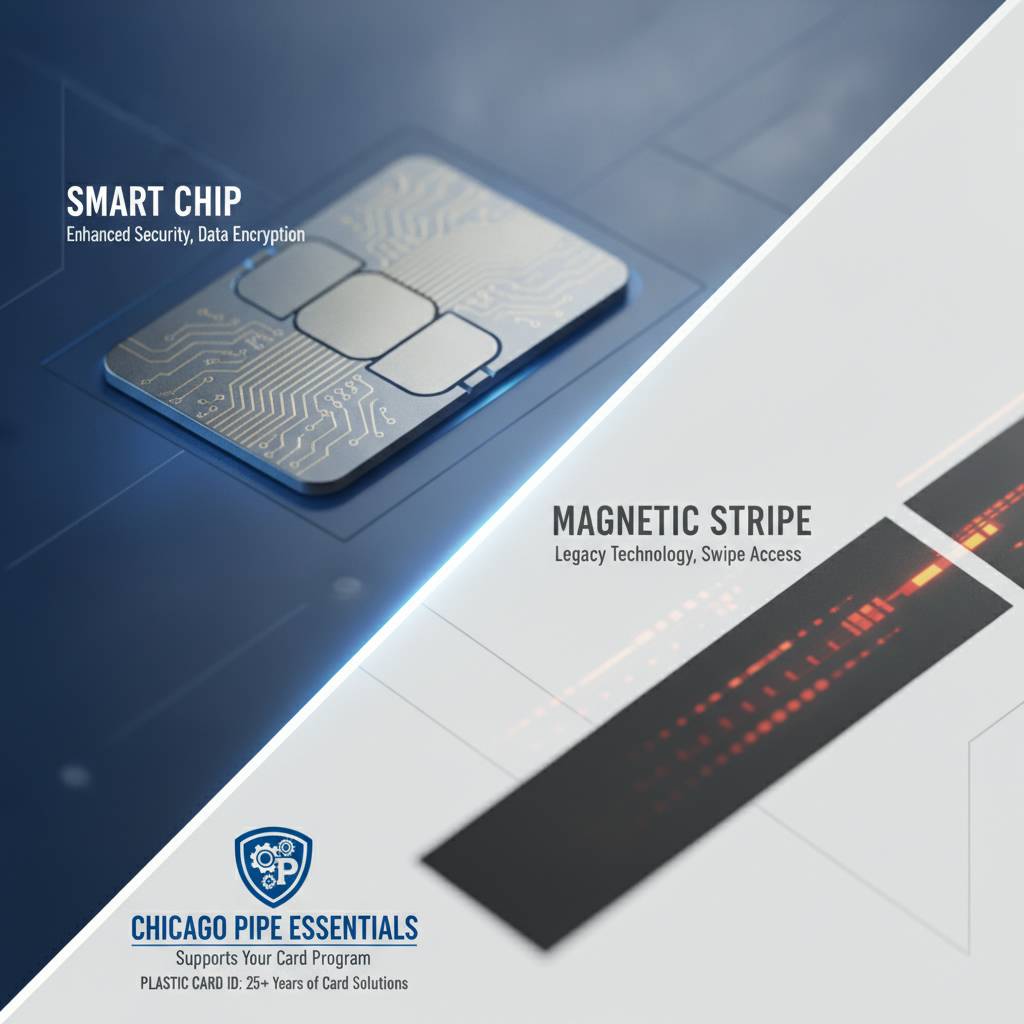
The catalog covers the full range of card technology: blank PVC CR80 cards, HiCo and LoCo magnetic stripe cards, RFID proximity cards, MIFARE DESFire smart cards, contact chip cards, hybrid cards, clear and frosted specialty stock, and luxury metal cards. Add to that a complete lineup of card printers from Evolis, Zebra, and Fargo - plus ribbons, cleaning kits, card carriers, sleeves, and card mailing services - and you genuinely have a single-source partner for every element of your program.
The Strategic Partner Difference
Plenty of suppliers will sell you cards. CPE takes a different approach - working as a strategic partner to help you build and scale a card program that actually delivers results for your organization. That means asking the right questions upfront: What are you trying to achieve? What infrastructure do you have? What is your volume now, and where do you expect to be in two years? The answers shape a recommendation that fits your reality, not a one-size pitch that ships the same SKU to everyone.
Over 100,000 customers and more than 50 million cards sold is a track record built on getting these conversations right, repeatedly, over decades. When you call or contact CPE, you are not navigating an automated system - you are reaching people who understand card programs and want yours to succeed. That is the foundation on which long-term partnerships are built.
Getting Started: What to Expect
Starting a new card program with Plastic Card ID is straightforward. Whether you know exactly what you need or are starting from scratch with questions, the process begins with a conversation. Share your application, your volume expectations, your existing infrastructure, and your budget parameters. From there, the recommendation is specific, practical, and grounded in what actually works for programs like yours.
Call 800.835.7919 to speak directly with a card program specialist. There is no obligation, no pressure, and no templated pitch - just a genuine conversation about what card technology makes sense for your organization and how to get your program running efficiently from day one. The right card technology decision starts with the right conversation, and that conversation is easier than you might expect.
Ongoing Support and Program Scaling
Card programs evolve. What starts as a 200-card employee badge system may grow into a multi-site access control deployment covering 5,000 personnel. A regional loyalty program that begins on HiCo magstripe may mature into a smart chip program with contactless tap capability as your infrastructure catches up. CPE supports programs at every stage of that evolution - supplying cards, printers, supplies, and guidance as your needs change over time.
Printer ribbons, cleaning kits, and maintenance supplies are stocked and ready to ship. Card carriers and sleeves protect your investment in transit and presentation. Card affixing and mailing services take fulfillment off your plate when volume demands it. Every element of your card program lifecycle is covered under one roof, so you spend less time sourcing and more time running the program that drives results for your business.
Ready to make the right call on smart chip vs magnetic stripe security for your program? Contact Plastic Card ID today at 800.835.7919 - your card program deserves the expertise, inventory, and partnership that only Plastic Card ID delivers.
Previous Page