Plastic Card Dimensions and Sizing Guide: Find Your Fit
Table of Contents []
- Your Complete Plastic Card Dimensions and Sizing Guide from Plastic Card ID
- The CR80 Standard: Why One Size Dominates Every Industry
- Beyond CR80: Understanding Other Card Size Formats
- Card Thickness Guide: Understanding Mil Measurements
- Encoding Options by Card Dimension and Format
- Specialty Card Formats: Clear, Frosted, and Colored Stock
- Practical Buying Tips: Getting Card Dimensions Right Every Time
- Partner with Plastic Card ID for Every Card Program Need
Your Complete Plastic Card Dimensions and Sizing Guide from Plastic Card ID
Walk into any wallet in America and you will find the same thing: a stack of cards that all share one precise size. That is not coincidence. It is engineering. Understanding plastic card dimensions is the foundation of building any successful card program, and yet it is one of the most overlooked details when businesses first start printing or ordering cards. Get it wrong, and your cards will not fit standard wallets, badge holders, or card printers. Get it right, and everything downstream works beautifully.
CPE has supplied more than 50 million plastic cards to over 100,000 businesses across the United States. In that time, we have answered more questions about card sizing, thickness, and format than almost any other topic. This guide exists to give you clear, complete answers - whether you are ordering your first batch of 50 cards or scaling a program that ships tens of thousands every month.
| Card Format | Dimensions (inches) | Dimensions (mm) | Thickness | Common Use |
|---|---|---|---|---|
| CR80 (Standard) | 3.375 x 2.125 | 85.6 x 54 | 30 mil | ID, loyalty, gift, membership |
| CR79 | 3.303 x 2.051 | 83.9 x 52.1 | 30 mil | Hotel key cards, access cards |
| CR100 | 3.88 x 2.63 | 98.5 x 66.8 | 30 mil | Oversized cards, promotional |
| CR60 | 2.63 x 1.69 | 66.8 x 42.9 | 30 mil | Mini cards, specialty use |
| Custom Die-Cut | Variable | Variable | 30 mil | Brand campaigns, specialty programs |
The CR80 Standard: Why One Size Dominates Every Industry
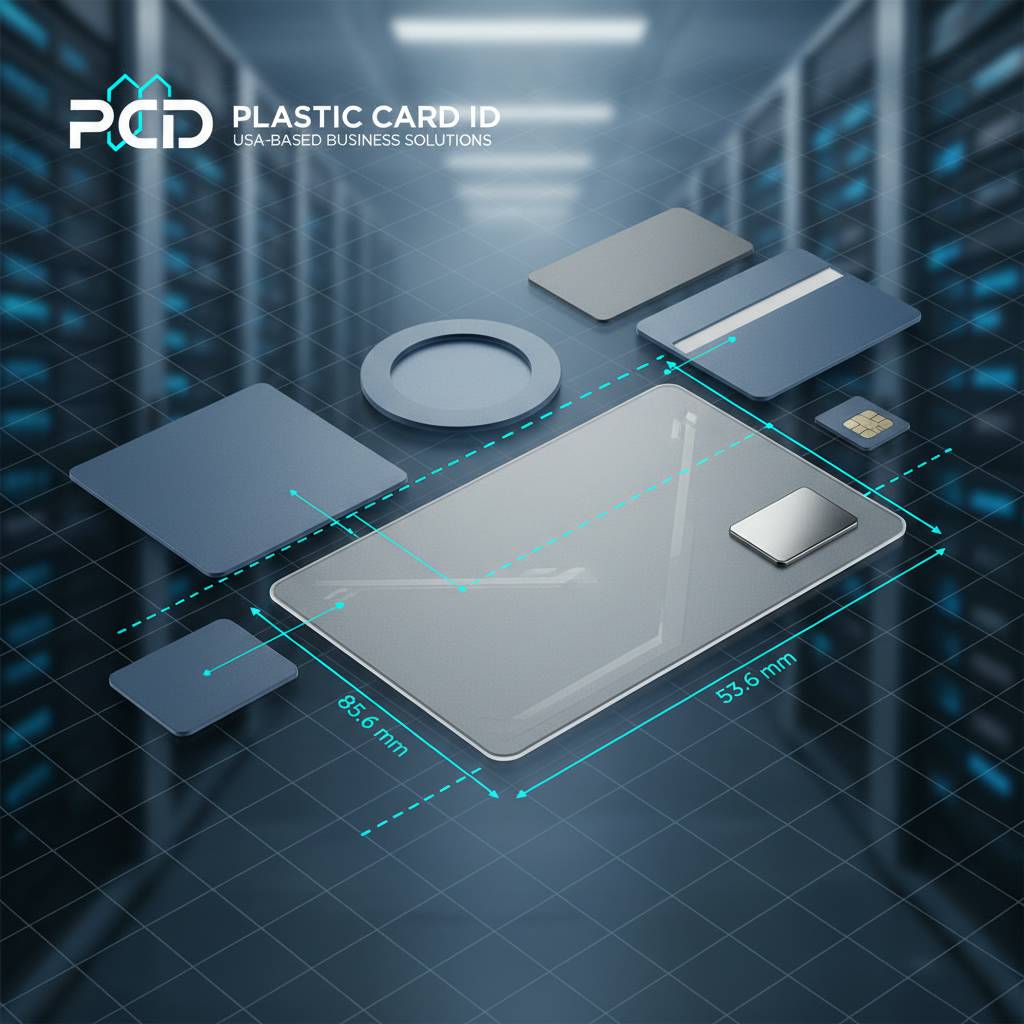 The CR80 card is the undisputed workhorse of the plastic card world. Measuring exactly 3.375 inches by 2.125 inches at 30 mil thickness, it is defined by the ISO 7810 standard - the same international specification that governs virtually every wallet card you have ever carried. When people say "credit card size," they mean CR80. When your card printer arrives, it is built around CR80. Everything in the card industry orbits this one format.
What makes the CR80 so dominant is not tradition alone - it is practicality refined over decades. These cards slide into wallets, badge holders, cardholders, and card readers with zero friction. For businesses building employee ID programs, loyalty programs, gift card programs, or membership systems, starting with CR80 means your cards will work everywhere they need to work, right out of the box.
Breaking Down the CR80 Dimensions
The official CR80 specification calls for 85.6mm x 54mm, which converts cleanly to 3.375 x 2.125 inches. That 30 mil thickness is the industry standard for good reason: it provides enough rigidity to survive daily wallet wear while remaining thin enough to stack efficiently, load into printers, and process through magnetic stripe or chip readers without jamming.
Tolerances matter too. High-quality CR80 cards from CPE are manufactured to tight dimensional tolerances - typically plus or minus 0.010 inches - ensuring consistent feeding through card printers. Bargain-bin cards that fall outside these tolerances cause costly printer jams and wasted ribbon, which is a hidden cost many buyers discover only after purchasing.
What Can You Do with a Blank CR80 Card?
The blank CR80 is one of the most versatile objects in the business world. Loaded into an in-house card printer, it becomes whatever you need it to be: an employee badge printed with a photo and access level, a loyalty card encoded with a magnetic stripe, a membership card carrying a smart chip, or an event credential printed on demand. Total design control at the lowest per-card cost is the defining advantage of blank card programs.
Organizations from hospital systems to boutique gyms, from casino floors to corporate campuses, rely on blank CR80 cards for their in-house programs. The card itself is neutral. Your printer, your design software, and your encoding hardware are what make it specific. That flexibility is exactly why the blank CR80 has sustained its popularity through decades of industry change.
CR80 vs. Business Card: Not the Same Thing
This is one of the most common points of confusion. Standard paper business cards are typically 3.5 x 2 inches - slightly wider and shorter than CR80. Do not substitute business card dimensions for card dimensions when designing artwork or ordering card stock. The difference is small enough to look identical on screen, but large enough to cause misaligned printing and card reader failures.
Plastic business cards are typically made to CR80 dimensions specifically so they can double as loyalty cards, contact cards, or gift cards while fitting standard cardholders. Always design to 3.375 x 2.125 inches when working with plastic card stock, and add a 0.125-inch bleed on all sides to ensure clean edges after any trimming.
Beyond CR80: Understanding Other Card Size Formats
While CR80 handles the vast majority of card programs, there are scenarios where alternative sizes deliver real advantages. The card industry has developed several standardized formats beyond CR80 to address specific applications in access control, hospitality, promotions, and specialty markets. Knowing when to use them - and why they exist - separates informed buyers from those who simply default to what they know.
Each non-standard format was developed to solve a specific problem. CR79 cards are fractionally smaller than CR80, which makes them ideal for laminated badge applications and hotel key card systems where the card slots into a technology carrier. CR100 cards give promoters and marketers an oversized canvas. CR60 cards serve compact keyfob-sized applications. Understanding the portfolio is understanding the tool set.
CR79: The Hotel Key Card Format
Measuring 3.303 x 2.051 inches (83.9 x 52.1mm), the CR79 card is slightly smaller than CR80 in both dimensions. That small reduction is deliberate. CR79 cards are designed to be over-laminated - an additional protective laminate layer is applied after printing or encoding, which brings the final card dimensions up to near-CR80 size. Hotel key cards and high-security access cards commonly use this format for exactly this reason.
If your application involves laminating cards after printing or encoding, CR79 is the format that accounts for that process. Using CR80 as a base for over-laminated applications will result in a final card that is slightly oversized, potentially causing reader or holder fit issues. CPE stocks CR79 cards for clients running laminated badge programs and hotel key card systems.
CR100: When Bigger Makes an Impact
The CR100 format - 3.88 x 2.63 inches, or 98.5 x 66.8mm - gives designers significantly more real estate to work with. Retailers, event organizers, and marketing teams use CR100 cards when they want a card that physically stands out. The larger format commands attention in point-of-sale displays and is harder to overlook in a stack of mail, making it a legitimate upgrade for direct-mail campaigns.
It is worth noting that CR100 cards do not fit standard wallets or most badge holders. They are specialty-use items designed to be displayed, mailed, or carried separately rather than tucked into a cardholder. For promotional campaigns where impact outweighs portability, the CR100 delivers exactly that.
Custom Die-Cut Shapes: Breaking the Rectangle
Not every card needs to be rectangular. Custom die-cut plastic cards can be produced in virtually any shape - a key shape for a locksmith, a tooth outline for a dental practice, a star for a hotel rewards program. Custom-shaped cards are among the highest-impact brand marketing tools available at the plastic card price point, generating conversation and retention in ways that standard rectangles cannot.
Die-cut cards are manufactured from standard card stock and then cut to a custom shape using precision tooling. The base material is still ISO-standard PVC at 30 mil thickness, maintaining durability and print quality. Setup costs for die-cutting are higher than standard formats, but for programs with high brand awareness goals, the return on that investment can be significant and measurable.
Card Thickness Guide: Understanding Mil Measurements
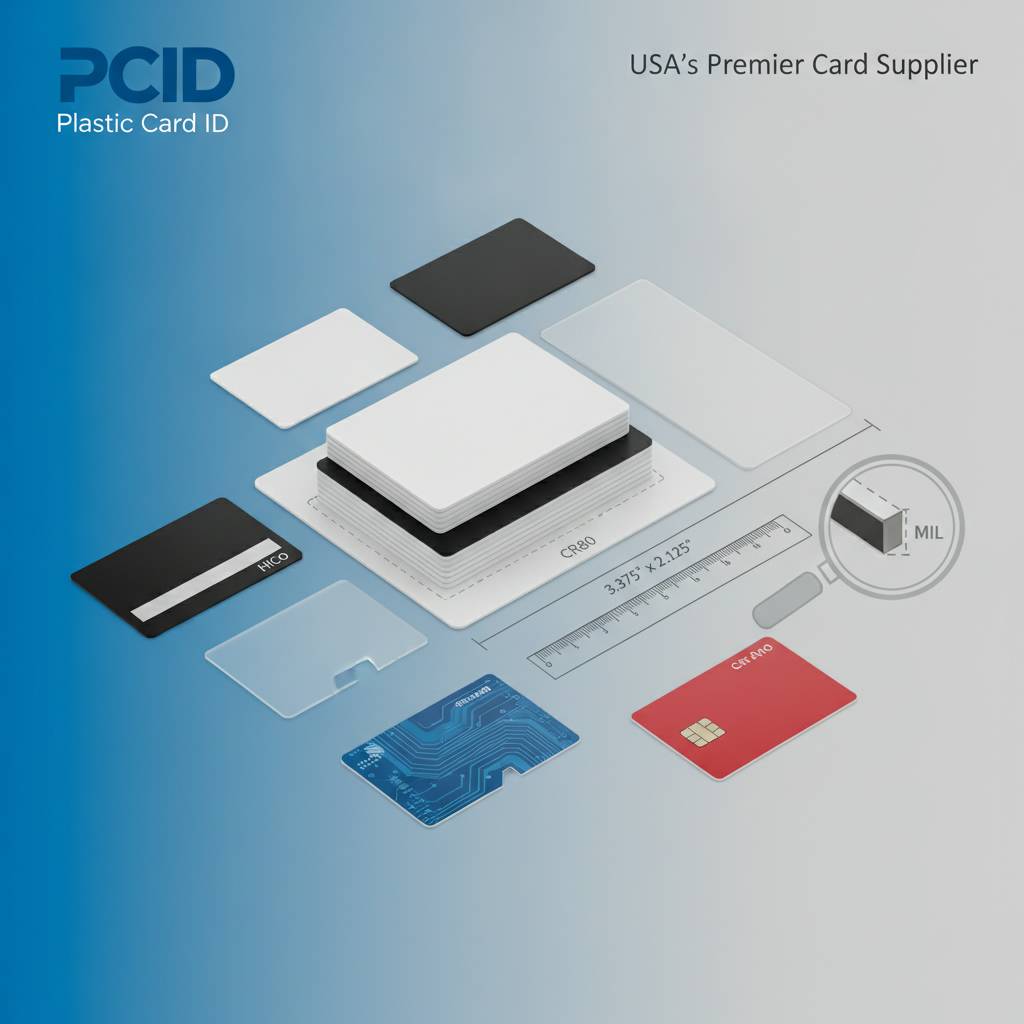 Thickness is the dimension most people forget to specify, and it is the one that causes the most compatibility problems when overlooked. Plastic card thickness is measured in "mil" - not millimeters, but thousandths of an inch. This is a frequent source of confusion for buyers new to card programs. One mil equals 0.001 inches. A standard 30 mil card is 0.030 inches thick, or approximately 0.76mm.
| Thickness | Inches | Best For |
|---|---|---|
| 10 mil | 0.010" | Paper-laminate overlays, inserts |
| 20 mil | 0.020" | Lighter-duty passes, thin overlays |
| 30 mil | 0.030" | Standard ID, loyalty, access, gift cards |
| 40 mil | 0.040" | Heavy-duty badges, outdoor applications |
Why 30 Mil Is the Sweet Spot
The 30 mil thickness is specified in ISO 7810 as the standard for ID-1 format cards - the same global standard that governs passports and financial cards. It balances rigidity against flexibility perfectly: stiff enough that cards do not curl or bend during normal use, flexible enough that they will not crack or shatter under the bending stress of wallet life. Almost every card printer on the market is engineered for 30 mil cards, which means sourcing is simple and reliable.
When clients ask whether they should upgrade to 40 mil for durability, the honest answer is: only in specific circumstances. Outdoor badge applications, cards handled in industrial environments, and heavy-use laminated cards can benefit from the extra rigidity. For most programs - gift cards, loyalty cards, membership cards, employee IDs - 30 mil is the correct choice and the one that will work without complications.
Thin Card Formats and When They Apply
Cards thinner than 30 mil - including 10 mil and 20 mil formats - serve specific applications. Thin cards are commonly used as inserts within packaging, as paper-laminate overlays applied to thicker substrates, or as short-life event passes where durability beyond a single use is not required. Do not attempt to run thin-format cards through standard card printers unless those printers are specifically rated for the thickness you are using.
Printer damage from wrong-thickness cards is a real and preventable problem. Fargo, Zebra, and Evolis card printers - the three brands CPE carries - each specify acceptable card thickness ranges in their documentation. Always verify compatibility before feeding non-standard thickness stock through any card printer, especially those under warranty.
Metal Cards: A Different Thickness Universe
Luxury metal cards from Plastic Card ID - available in stainless steel, brass, and gold - operate in an entirely different thickness category. Metal cards are typically 0.8mm to 0.9mm thick, which is comparable to 30-35 mil, but the weight and feel are dramatically different. These are premium statement pieces used in VIP membership programs, high-end hospitality, and executive loyalty initiatives.
Metal cards cannot be processed through standard desktop card printers. They are produced as finished, fully customized products rather than blank stock for in-house printing. Clients ordering metal cards work directly with CPE on design and specification, and cards are delivered ready to distribute. The impact they make with recipients is difficult to replicate with any other format.
Encoding Options by Card Dimension and Format
Card dimensions and card functionality are deeply intertwined. Not all encoding technologies are available in all card formats, and understanding which technologies map to which formats helps you specify the right card from the start. The major encoding categories are magnetic stripe, RFID and proximity, and smart chip - each with distinct physical requirements that interact with card dimensions and thickness in specific ways.
A card's physical dimensions determine where encoders, antennas, and chips can be physically embedded without compromising card integrity. The ISO 7810 ID-1 format (CR80 at 30 mil) was deliberately designed to accommodate all three major encoding technologies, which is another reason why CR80 dominates every application category.
Magnetic Stripe Cards: HiCo vs. LoCo
High-coercivity (HiCo) magnetic stripes are rated at 2750 Oe and are highly resistant to accidental erasure from common magnetic fields - the kind found in purses, near phones, or alongside other cards. LoCo stripes (300 Oe) are easier to encode but more vulnerable to erasure. For most business card programs, HiCo is the appropriate choice. Hotel key cards are a notable exception where LoCo is often used since the encoding is overwritten frequently anyway.
Magnetic stripe positioning on CR80 cards follows ISO 7811 specifications, placing the stripe along the top 0.547 inches of the card back. This standardization ensures that any ISO-compliant card reader - from retail point-of-sale systems to gym check-in kiosks - will read the stripe without adjustment. Non-standard card sizes may require custom reader configurations, which adds cost and complexity.
RFID, Proximity, and Smart Chip Cards
RFID and proximity cards embed an antenna loop within the card body. The CR80 format at 30 mil provides exactly the internal volume needed to embed these antenna loops without distorting card dimensions or compromising the surface for printing. Cards using MIFARE DESFire and other advanced RFID protocols are available from CPE in standard CR80 dimensions, making them drop-in compatible with existing badge holders and access control infrastructure.
Smart chip cards (contact chips) embed a gold contact pad on the card face, following ISO 7816 positioning standards. Again, the CR80 format was designed with this in mind. Proximity cards for access control typically operate at 125 kHz, while modern smart cards for secure access and casino player card programs can operate at 13.56 MHz. Both formats are available in CR80 and, in some cases, CR79 for laminated applications.
Choosing the Right Encoding for Your Program
- Loyalty and gift card programs: Magnetic stripe (HiCo) is cost-effective, widely compatible, and sufficient for most retail and hospitality environments.
- Employee ID and access control: Proximity (125 kHz) or RFID smart cards (13.56 MHz MIFARE) depending on required security level.
- Hotel key cards: LoCo magnetic stripe or RFID, typically on CR79 format for laminated systems.
- Casino player cards: Smart chip with RFID for tracking and rewards integration across large gaming floors.
- Event credentials: Barcode or QR printing on blank CR80 cards provides low-cost, high-speed check-in functionality.
- High-security environments: MIFARE DESFire EV2 or EV3 for encrypted, sector-level access control.
Contact CPE at 800.835.7919 if you are uncertain which encoding format fits your application. The right choice at the ordering stage saves significant time and cost downstream.
Specialty Card Formats: Clear, Frosted, and Colored Stock
Standard white PVC is where most programs begin, but it is far from the only option. Specialty card stock opens creative and functional possibilities that white cards simply cannot deliver. Clear plastic cards, frosted cards, and pre-colored stock are all manufactured to CR80 dimensions and 30 mil thickness, maintaining full compatibility with standard card printers and badge hardware while dramatically expanding design options.
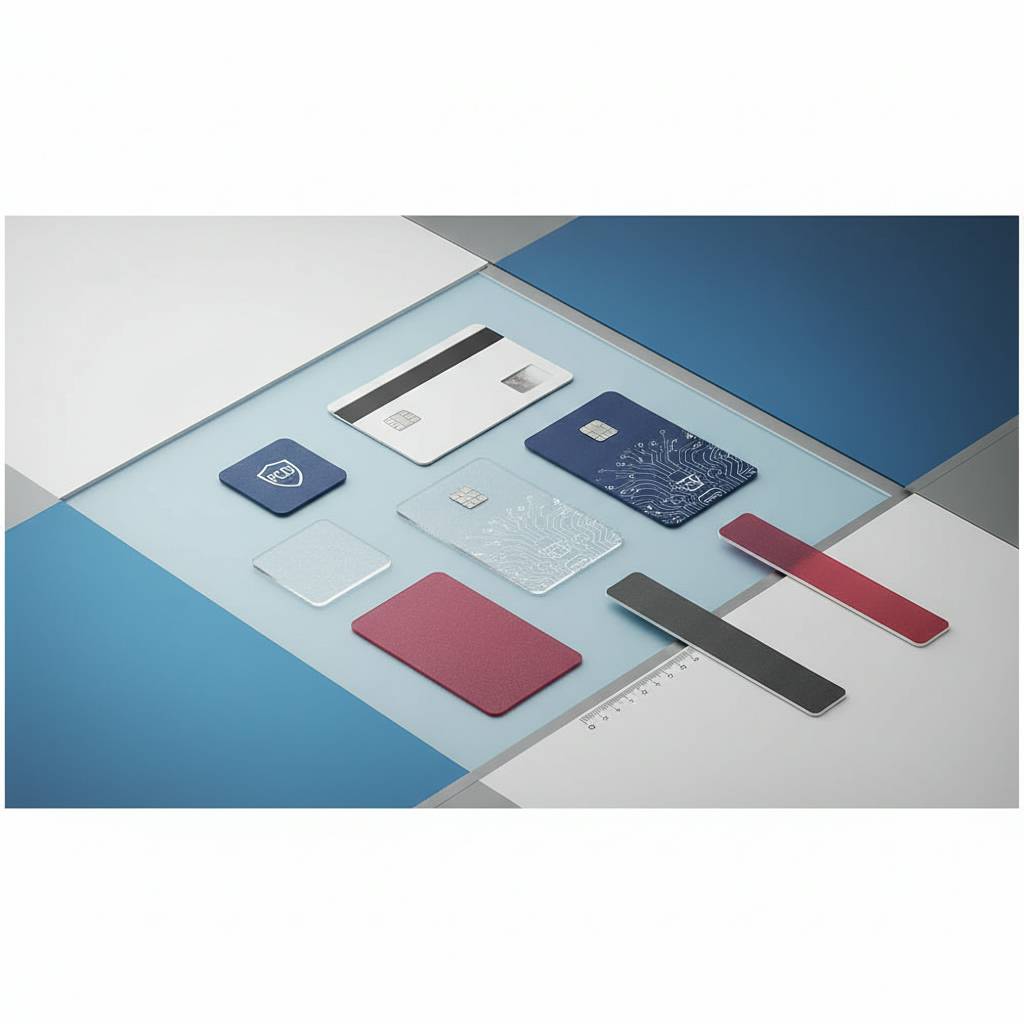
The visual impact of specialty stock is real and measurable. A clear plastic loyalty card displaying printed artwork that seems to float in transparent material stands out from every other card in a wallet. A frosted card with spot printing creates a premium, modern aesthetic that communicates quality before a customer even reads the text. These are not novelties - they are deliberate communication tools.
Clear Plastic Cards
Clear PVC cards are manufactured from transparent plastic stock at the same 30 mil thickness and 3.375 x 2.125 inch dimensions as standard white CR80 cards. They are fully compatible with dye-sublimation card printers - the ink is deposited directly onto the clear surface, creating vivid graphics that show through the transparent card body. Clear cards work exceptionally well for VIP programs, nightclub memberships, and premium retail loyalty programs where visual distinction matters.
Note that because clear cards lack the white backing of standard PVC, colors printed on them will appear with more saturation and contrast. Artwork needs to be designed with this in mind - dark backgrounds and bold colors typically perform better on clear stock than light pastels or white-heavy designs. CPE can advise on artwork optimization for clear card printing.
Frosted and Colored Pre-Stock Cards
Frosted cards offer a semi-opaque milky finish that gives printed designs a soft, diffused quality. Combined with selective printing, frosted cards create an elegant, understated look that resonates strongly in healthcare, spa, and professional services environments. Colored PVC stock - available in a range of base colors - allows designers to use the card body itself as a design element, reducing ink coverage requirements and creating a consistent color field that printing alone cannot achieve.
Both frosted and colored stock are available in blank format for in-house printing programs, and both process through standard card printers without modification. Pre-colored stock is a smart cost reducer for programs that require a consistent base color across thousands of cards, as it eliminates the need to flood-coat the entire card surface with ink, reducing ribbon consumption and extending printer life.
Matching Card Stock to Your Printer
Not all card printers handle all card stock equally well. Direct-to-card dye-sublimation printers are optimized for white or near-white PVC stock. Retransfer printers, like Fargo's HDP series, deposit ink to a transfer film first before applying it to the card, which means they perform well on clear, colored, and even textured card surfaces. Zebra's ZXP series and Evolis printers each have published specifications for acceptable card stock types.
Always verify printer compatibility when ordering specialty stock. CPE carries the full lineup from Evolis, Zebra, and Fargo and can match card stock specifications to your printer model, ensuring optimal output quality and preventing avoidable equipment issues. Ribbons and cleaning kits for all three brands are also stocked, making us your complete in-house card printing supply chain.
Practical Buying Tips: Getting Card Dimensions Right Every Time
Knowing the dimensions is one thing. Ordering correctly - and designing correctly - is where theory becomes practice. The following guidance reflects the most common mistakes CPE sees from first-time and experienced card buyers alike, distilled into actionable steps that save time, money, and frustration.
Whether you are setting up an in-house badge printing program or ordering pre-printed cards in bulk, the details of dimension, thickness, and format interact with your printer, your design software, and your downstream hardware in ways that reward attention. A small investment in getting specifications right at the start pays dividends across the entire life of your card program.
Design File Setup for CR80 Cards
Set your design canvas to exactly 3.375 x 2.125 inches. Add a bleed area of at least 0.125 inches on all four sides, extending background colors and full-bleed images beyond the trim line to prevent white edges after any final cutting. Keep critical content - text, logos, barcodes, chip contacts - at least 0.125 inches inside the trim line as a safety margin. Resolution should be a minimum of 300 DPI for sharp, professional output.
Magnetic stripe placement follows ISO standards: the stripe runs along the top 0.547 inches of the card back. If your design includes a magnetic stripe, ensure no critical printed content in that zone, as the stripe either covers or restricts printing in that area depending on your card type. Smart chip contacts are positioned on the card front in the upper-left quadrant per ISO 7816 - design around this placement rather than trying to print over it.
Ordering the Right Quantities
Blank CR80 cards from Plastic Card ID are available from small starter quantities up through mass-production volumes. For in-house programs just getting started, smaller initial orders allow you to refine your printing process before committing to large inventory. For established programs with predictable monthly volume, larger orders deliver a lower per-card cost and reduce reorder frequency. Programs printing 50 cards a month have different needs than those printing 50,000, and CPE structures supply accordingly.
Consider total program lifecycle when determining order quantities. Cards have a practical lifespan tied to their use case: hotel key cards may be reused dozens of times over months; employee badges last until staff turnover; loyalty cards in active wallets may need replacement after one to two years of wear. Estimating replacement rates alongside initial issuance needs gives a more accurate picture of annual card volume than new enrollments alone.
Frequently Asked Questions About Card Dimensions
- Are all CR80 cards exactly the same size? They should be, per ISO 7810, but quality varies. High-quality cards from CPE are manufactured to tight tolerances that prevent printer jams and reader errors.
- Can I print on both sides of a blank CR80 card? Yes, with a dual-sided printer. Single-sided printers output one face only. Specify your printer capability when designing your card program.
- What file format should I use for card artwork? PDF, AI, or high-resolution TIFF at 300 DPI minimum. RGB color mode for dye-sublimation printers.
- Do RFID cards print the same as standard blank cards? Yes, the embedded antenna does not affect the printable surface. RFID cards print and feel identical to blank PVC cards.
- What is the difference between CR79 and CR80 in practice? CR79 is 0.072 inches shorter and 0.074 inches narrower than CR80 - small enough that the cards look nearly identical, but significant for laminated badge and hotel key systems.
- Do metal cards fit standard wallets? Most metal cards are produced at near-CR80 dimensions and do fit standard cardholders, though weight and thickness vary by material and finish.
Still have questions about which card format is right for your program? The team at CPE is ready to help you get every specification right the first time.
Partner with Plastic Card ID for Every Card Program Need
 Twenty-five years of serving over 100,000 customers across the United States does not happen by accident. It happens because Plastic Card ID treats every client as a long-term partner, not a single transaction. From the first conversation about card dimensions to ongoing supply of blank stock, ribbons, cleaning kits, card carriers, and printers, the goal is always the same: help you build a card program that works reliably, looks professional, and delivers results.
Retailers who switch from paper gift certificates to plastic gift cards consistently see sales increases of 35-50%. Loyalty programs built on plastic cards outperform paper punch cards by every measurable metric. Membership and ID cards in plastic signal permanence and legitimacy that no paper alternative can replicate. The format matters - and so does the partner you choose to supply it.
Ready to build your card program on a foundation that performs? Reach out to Plastic Card ID today at 800.835.7919 and speak directly with a card program specialist who will help you select the right dimensions, format, encoding, and supply structure for exactly what your organization needs. From 50 cards to 50,000, we are ready to deliver.
Previous Page