Blank Plastic Cards vs Paper Cards: Durability Comparison
Table of Contents []
- Blank Plastic Cards vs Paper Cards: Why the Material You Choose Changes Everything - Plastic Card ID
- The Physical Reality: What Happens to Cards Under Real-World Conditions
- Business Impact: What the Durability Gap Costs (and Earns) You
- The CR80 Standard: Understanding What Blank Plastic Cards Actually Are
- Encoding Options: What Plastic Cards Can Do That Paper Cannot
- Building Your Card Program: From Blank Stock to Full In-House Production
- Frequently Asked Questions: Blank Plastic Cards vs Paper Cards
- Start Your Blank Plastic Card Program with Plastic Card ID Today
Blank Plastic Cards vs Paper Cards: Why the Material You Choose Changes Everything - Plastic Card ID
Walk into any thriving retail shop, fitness center, or corporate office and look at the cards being handed to customers and employees. The ones that get used, kept, and respected? They're plastic. The ones that end up crumpled in a jacket pocket or fading in a drawer after two weeks? Paper. This isn't coincidence - it's physics, psychology, and business performance converging on one very simple conclusion.
The durability comparison between blank plastic cards and paper cards isn't just a materials science discussion. It's a business decision with measurable consequences for your brand image, operational costs, and program success rates. CPE has watched thousands of organizations make this switch - and the results speak loudly and consistently.
| Feature | Blank Plastic Cards (CR80 PVC) | Paper Cards |
|---|---|---|
| Lifespan | 3-7 years with normal use | Weeks to months |
| Water Resistance | Fully resistant | Destroyed by moisture |
| Brand Perception | Professional, permanent | Temporary, low-commitment |
| Encoding Capability | Magnetic stripe, RFID, chip | Barcode only (limited) |
| Wallet Retention Rate | High - fits standard slots | Low - folds, tears, discarded |
| Reusability | High - rechargeable, reissuable | Single or limited use |
| Long-Term Cost | Lower per-use cost over time | Repeated replacement costs |
The Physical Reality: What Happens to Cards Under Real-World Conditions
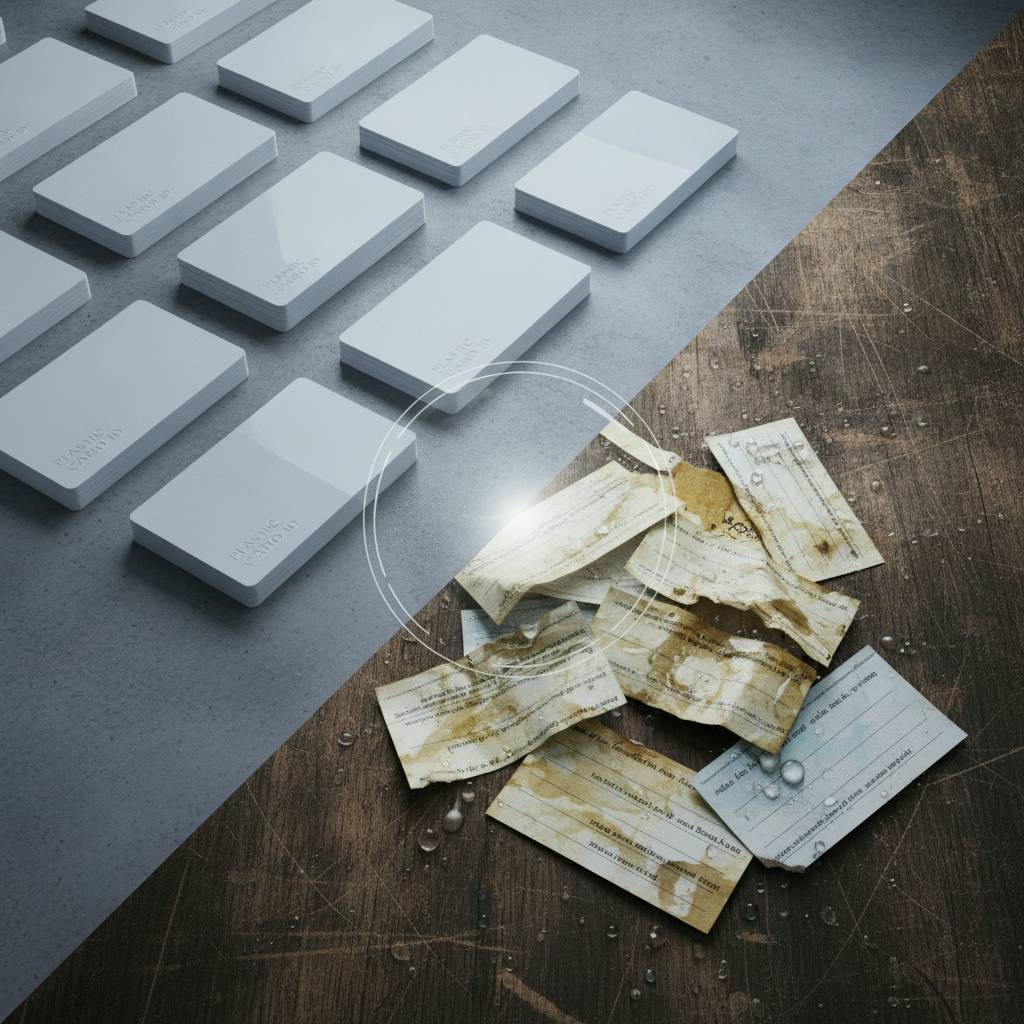 Paper cards aren't engineered for wallets. They're engineered for printing. That distinction becomes painfully obvious the moment someone stuffs a paper loyalty card into a back pocket, drops it in a bag with car keys, or leaves it on a counter where a coffee cup leaves a ring. The card loses its legibility, its structure, and - critically - its usefulness within days or weeks of issue.
Blank PVC plastic cards, manufactured to the CR80 ISO 7810 standard at 30 mil thickness, are built to survive exactly those conditions. PVC plastic resists moisture, bending, tearing, and surface abrasion in ways that paper never can. This isn't marketing language - it's the reason credit card networks, government agencies, and every serious membership organization in the world issues plastic, not paper.
Moisture, Heat, and the Enemies of Paper
Humidity alone will destroy a paper card over time. In regions with hot summers or rainy seasons, paper cards kept in wallets begin to warp, soften, and fuse to adjacent materials. The ink bleeds. The barcode becomes unreadable. The whole program fails at the moment of use - which is precisely when it matters most to your customer.
Plastic cards don't absorb moisture. They don't warp in heat below extremes. A card printed on a Zebra or Evolis card printer and issued to a customer in January will still scan correctly in August, look presentable in December, and remain functional years beyond that. Durability is not a luxury feature - it is a baseline expectation that paper fundamentally cannot meet.
Mechanical Stress: Wallets, Keyrings, and Daily Handling
The average loyalty or membership card changes hands dozens of times per year. It gets pulled from a wallet, swiped or tapped, returned, and stuffed back in. Paper cards - even laminated ones - develop cracks along fold lines, corner tears, and surface delamination that render them unusable far sooner than any organization would prefer.
CR80 PVC cards flex under pressure and return to shape. Their edges stay clean. Their surfaces resist the micro-abrasions that accumulate from repeated contact with wallet fabric and neighboring cards. A plastic card behaves like the professional credential it is, maintaining its integrity across thousands of individual handling events over its operational lifetime.
Printed Surface Longevity: Ink on Plastic vs Ink on Paper
When a card printer applies dye-sublimation or resin thermal transfer printing to a PVC card surface, the result is a fused image - not ink sitting on top of fibers. The color becomes part of the card. It doesn't flake, smear, or fade under normal conditions the way ink on paper stock does after repeated handling.
This matters enormously for ID cards, employee badges, and access credentials where the printed photo and text must remain legible over months or years of daily use. CPE supplies blank CR80 cards in both standard white and a full range of colored stock options, all optimized for the dye-sublimation printing process that makes this longevity possible.
Business Impact: What the Durability Gap Costs (and Earns) You
Organizations sometimes default to paper cards because the upfront cost appears lower. This math rarely survives contact with reality. When you account for replacement frequency, staff time processing rerequests, customer frustration from failed scans, and the measurable drop in program engagement that follows every card failure event, paper's apparent savings evaporate quickly.
Retailers who make the switch from paper to plastic gift cards consistently report sales increases of 35-50%. That's not because the card design changed - it's because customers treat a plastic gift card as a stored-value instrument worth protecting, while a paper gift certificate gets lost, forgotten, or damaged before redemption. The card's material communicates its value to the recipient.
Loyalty Programs: Retention Lives in the Wallet
Loyalty card program performance is directly tied to physical card retention. When a customer keeps a card in their wallet, they see your brand every time they open it. That visibility drives repeat visits, even when a customer wasn't consciously planning to use the card. Paper punch cards, by contrast, live in a kitchen junk drawer - or the trash - within weeks of issue.
Plastic loyalty cards sized to the CR80 standard fit perfectly in standard wallet card slots. They sit alongside credit cards, ID cards, and other permanent credentials. Physical placement in the wallet is a marketing channel that paper cards simply cannot access. Every time a customer sees your card between their bank card and their driver's license, your brand is reinforced.
Membership and ID Programs: Permanence Signals Credibility
A membership card that looks and feels like it was printed on a home printer signals something about the organization that issued it - whether that impression is intended or not. Plastic membership cards communicate investment, seriousness, and institutional permanence. They signal that the organization issuing them intends to be around, and considers its members worth a durable credential.
For gyms, associations, clubs, and professional organizations, a well-printed plastic card is part of the membership experience. It's tangible proof of belonging. Paper cannot replicate that psychological function, regardless of what's printed on it. Contact 800.835.7919 to discuss how a blank card program can transform your membership experience.
Access Control: Why Paper Has No Place at the Door
Proximity cards, RFID smart cards, and magnetic stripe access cards require a physical substrate rigid and durable enough to house functional electronic components or reliable magnetic encoding. Paper cards with barcodes exist at the very low end of access control - one damaged scan surface and the credential becomes useless. Worse, paper credentials are trivially easy to duplicate.
PVC access cards carrying HiCo magnetic stripes, MIFARE DESFire RFID chips, or proximity technology provide security layers that paper barcodes cannot approach. They survive the badge-reader contact cycle thousands of times. They don't curl away from readers. When security depends on the credential working every single time, plastic is the only viable material.
The CR80 Standard: Understanding What Blank Plastic Cards Actually Are
 Blank CR80 cards are the universal format for professional card programs - the same dimensions as a standard credit card (3.375 x 2.125 inches) at 30 mil thickness, conforming to ISO 7810 ID-1 specifications. This standardization matters because it means your cards work in every standard card printer, every wallet slot, every card holder, and every reader designed for the format.
Starting with a blank card gives organizations complete control over design, encoding, and application. The same blank substrate becomes an employee ID badge, an event access credential, a hotel key card, a loyalty card, or a casino player card depending entirely on what is printed or encoded onto it. The blank card is the most flexible platform in the professional card ecosystem.
PVC vs Paper Stock: A Materials Breakdown
Standard PVC card stock used in CR80 cards is composed of multiple laminated layers bonded under heat and pressure, creating a rigid, sealed structure with no exposed fiber. The material is inherently resistant to moisture penetration, UV degradation (at normal indoor exposure levels), and the mechanical stresses of daily use in wallets and readers.
Paper card stock, including heavy cardstock and laminated paper products marketed as card alternatives, retains fiber-based vulnerabilities. Even laminated paper eventually delaminates at edges and corners. The lamination layer scratches and clouds over time. Barcodes fade. Magnetic stripes - to the extent they can be applied to paper stock at all - fail sooner than those on PVC substrates. The comparison isn't close.
Card Thickness and Why 30 Mil Matters
At 30 mil (0.030 inches), CR80 PVC cards are thick enough to survive reader contact, wallet compression, and frequent handling without flexing to failure - but thin enough to stack efficiently, ship economically, and fit every standard card slot. This is the sweet spot engineered into the ISO standard after decades of real-world use.
Thinner card stock - including paper products - flexes excessively under wallet compression, eventually developing stress fractures along frequently-bent axes. Thirty mil PVC is not an arbitrary specification; it is the product of extensive practical engineering aimed at maximizing card lifespan under the specific conditions of real-world professional card use.
Specialty Substrates: When Standard PVC Isn't Enough
Beyond standard white PVC, CPE carries clear plastic cards, frosted cards, and colored card stock for organizations whose brand identity benefits from a distinctive substrate. Clear and frosted cards create striking visual effects when printed with dye-sublimation technology - effects that paper stock cannot even approximate.
For premium applications, luxury metal cards in stainless steel, brass, and gold deliver a tactile and visual impact that exists in a category entirely separate from both paper and standard PVC. These are not novelty items - they are high-retention credential tools for organizations whose members or clients expect an exceptional unboxing and first-use experience.
Encoding Options: What Plastic Cards Can Do That Paper Cannot
The functional capabilities of a plastic card extend far beyond its printed surface. Blank PVC cards serve as the substrate for magnetic stripe encoding, RFID and proximity technology, and smart chip integration - technologies that enable automated access control, loyalty point tracking, contactless payment-adjacent applications, and secure identity verification at scale.
Paper cards can carry a printed barcode. That's essentially the ceiling of their functional capability. Plastic cards carry HiCo or LoCo magnetic stripes, 125kHz proximity chips, 13.56MHz RFID including MIFARE DESFire, and contact smart chips - a spectrum of data encoding capabilities that supports every serious card program use case in the modern business environment.
Magnetic Stripe Cards: HiCo vs LoCo
High-coercivity (HiCo) magnetic stripes resist accidental erasure from common magnetic fields encountered in everyday environments - near phones, other cards, and electronic equipment. They are the standard for access control, employee ID, and any application where data integrity over the card's lifespan is non-negotiable. LoCo stripes are appropriate for short-term use applications where lower cost justifies reduced magnetic resistance.
Neither option is available on paper cards in any format that delivers comparable reliability in automated readers. Magnetic stripe technology on PVC substrates is a mature, proven platform that has supported billions of card transactions globally and continues to underpin a wide range of business card programs.
RFID and Proximity Cards: Contactless Access at Scale
Proximity cards and RFID smart cards enable contactless credential verification - the card doesn't need to make physical contact with a reader to authenticate. For high-traffic access points, time-and-attendance systems, hotel key applications, and event credentialing, this translates directly to throughput and convenience advantages that paper-based systems cannot approach.
MIFARE DESFire cards in particular offer multi-application capability, encrypted data storage, and the kind of security architecture that organizations with serious access control requirements demand. These are plastic cards by necessity - the embedded antenna and chip structure require a rigid, sealed PVC substrate to function reliably across thousands of read cycles.
Casino, Hotel, and Specialty Card Applications
Casino player cards, hotel key cards, and event credentials represent specialized use cases where plastic is not merely preferable but functionally mandatory. Casino player cards carry magnetic stripe or RFID encoding that ties to player management systems. Hotel key cards encode room access data that changes with each guest stay. Event credentials serve as access tokens, VIP markers, and brand experiences simultaneously.
In every one of these applications, the durability and encoding capability of plastic is what makes the program work. Paper alternatives exist only at the very low end of each category, where functionality and brand impact are both sacrificed in exchange for minimal upfront cost savings that rarely materialize over the full program lifecycle.
Building Your Card Program: From Blank Stock to Full In-House Production
One of the most significant advantages of blank plastic card programs is the operational control they return to the issuing organization. Rather than waiting for an outside vendor to produce finished cards on a multi-week turnaround, organizations with in-house card printers from Evolis, Zebra, or Fargo can produce personalized cards on demand - one card or one thousand, exactly when they're needed.

The economics of in-house production improve significantly over time. The per-card cost of blank CR80 PVC stock is low, and a quality card printer amortized over its multi-year operational life adds a modest incremental cost per card. Compare that to the ongoing expense of outsourced card production, and the business case for in-house capability becomes compelling quickly for organizations issuing more than a few hundred cards per year.
Choosing the Right Card Printer for Your Program
Card printer selection depends on volume, encoding requirements, and single- vs. dual-sided printing needs. Evolis printers are well-suited for low-to-medium volume programs with a premium on compact footprint and ease of use. Zebra printers offer robust performance and deep encoding capability for higher-volume and more complex programs. Fargo printers are widely used in enterprise ID and access control environments where security features and throughput matter most.
Matching the printer to the program avoids both under-investment (resulting in bottlenecks and quality problems) and over-investment (paying for capabilities the program will never use). CPE helps organizations navigate this decision based on actual program parameters, not catalog upselling.
Consumables and Maintenance: The Full Program Picture
A card printer is only as good as the ribbons, cleaning kits, and maintenance practices supporting it. Printer ribbons determine print quality and longevity. Using generic or incompatible ribbons with a premium card printer degrades output quality and can void manufacturer warranties. Cleaning kits remove the accumulated debris from card-feed rollers and print heads that gradually degrade image quality and card throughput.
Running a complete, well-maintained card printing operation requires access to the right consumables from a supplier who understands the full ecosystem. Card carriers, sleeves, and card affixing and mailing services round out the capability for organizations that need to distribute cards to a dispersed membership or workforce rather than issuing them face-to-face.
Scaling Your Program: From 50 Cards to 50,000
Card programs grow. A fitness studio that starts issuing 50 plastic membership cards per month will find, two years later, that their member base has expanded and their operational model has evolved. A blank card program built on quality PVC stock and a reliable in-house printer scales with the organization without requiring a complete infrastructure rebuild.
For organizations with requirements in the tens of thousands of cards, bulk ordering of blank stock dramatically reduces per-card cost while maintaining the flexibility to personalize each card in-house as needed. The blank card model is inherently scalable - the substrate is standardized, the workflow is consistent, and the economics improve with volume in ways that outsourced or paper-based programs cannot replicate.
Frequently Asked Questions: Blank Plastic Cards vs Paper Cards
Organizations evaluating the switch from paper to plastic card programs tend to ask similar questions. The answers are usually straightforward - but they matter for making a confident, well-informed decision about program infrastructure.
Common Questions About Durability and Card Lifespan
- How long do blank PVC plastic cards actually last? With normal use in a wallet or card holder, CR80 PVC cards typically remain functional and presentable for 3-7 years or more, depending on the application and handling frequency.
- Do plastic cards fade? Cards printed using dye-sublimation technology resist fading far better than paper cards. The dye is fused into the card surface rather than sitting on top of it.
- Are plastic cards waterproof? Yes. PVC plastic cards are impervious to moisture under normal conditions - rain, spilled drinks, and high-humidity environments that destroy paper cards have no meaningful effect on PVC stock.
- Can blank cards be printed in-house? Absolutely. Blank CR80 PVC cards are designed specifically for in-house printing on Evolis, Zebra, Fargo, and other major card printers.
- What is the minimum order quantity for blank plastic cards? CPE accommodates programs of all sizes, including small organizations and startups that need modest quantities to get their program operational.
Questions About Encoding and Technology
Many organizations transitioning from paper wonder whether they need encoded cards or whether printed cards will suffice for their use case. The answer depends on the specific program. ID and access control programs generally benefit from magnetic stripe or RFID encoding. Loyalty and membership programs can function effectively with printed barcodes or QR codes, though magnetic stripe encoding provides a more seamless scan experience.
For organizations unsure about their encoding needs, starting with standard blank white PVC stock and a basic card printer is a low-risk entry point. The program can be upgraded to include encoded cards as requirements evolve without scrapping the existing infrastructure investment. Call 800.835.7919 to discuss the right starting configuration for your specific program.
Questions About Cost and Program Economics
The cost per card for blank PVC stock may be higher than paper at the individual card level - but that comparison ignores replacement frequency, program performance, and brand impact. A plastic card that lasts three years and drives measurable customer retention has a vastly lower effective cost than a paper card replaced every few months that fails to meaningfully engage the customer holding it.
When organizations calculate the full program cost - including reprinting, staff time, customer friction from card failures, and lost revenue from disengaged loyalty program members - the economics of plastic cards almost universally prevail. The question isn't whether plastic cards cost more upfront. The question is what your program is worth to your organization long-term.
Start Your Blank Plastic Card Program with Plastic Card ID Today
 The durability gap between blank plastic cards and paper cards is not a subtle distinction - it is a fundamental difference in material performance, brand impact, program reliability, and long-term economics. Every organization that has made the switch to plastic has done so for reasons grounded in real operational experience, not marketing.
CPE has spent more than 25 years helping businesses across the United States build card programs that work - programs that serve 50 cardholders or 50,000, that run on in-house printers or bulk stock orders, and that deliver the professional credential experience that customers and members expect from organizations that take their programs seriously.
Ready to leave paper behind and build a card program that actually performs? Contact Plastic Card ID at 800.835.7919 today - and find out why over 100,000 customers across the country trust us with their card programs.
Previous Page