Blank Magnetic Stripe Cards Explained: HiCo vs LoCo
Table of Contents []
- What Plastic Card ID Wants You to Know About Blank Magnetic Stripe Cards
- HiCo vs. LoCo: The Decision That Shapes Your Entire Card Program
- Core Applications: What Businesses Actually Use These Cards For
- Choosing the Right Blank Card Stock for Your Program
- Frequently Asked Questions About Magnetic Stripe Cards
- Advanced Magnetic Stripe Options and Specialty Card Formats
- Partner With Plastic Card ID for Your Magnetic Stripe Card Program
What Plastic Card ID Wants You to Know About Blank Magnetic Stripe Cards
Most businesses encounter magnetic stripe cards long before they ever think to ask how they work. A hotel key slides across a reader. A loyalty card gets swiped at checkout. A staff badge unlocks a restricted door. The mechanism behind all of it? A thin, oxide-coated strip running along the back of a standard plastic card - quietly storing data, quietly doing its job. Understanding that strip is the first step toward building a smarter card program.
At Plastic Card ID, we have spent more than 25 years helping businesses across the United States source exactly the right card for exactly the right application. Blank magnetic stripe cards are among our most requested products - and for good reason. They give organizations the freedom to print, encode, and deploy cards in-house, on their own timeline, at a per-card cost that beats almost every outsourced alternative. But not all magnetic stripe cards are the same, and the difference between the wrong and right choice can mean unreliable reads, frustrated customers, or failed access attempts.
This page cuts through the confusion. We will explain how magnetic stripes work, break down the critical HiCo vs. LoCo distinction, walk through common use cases, and help you identify which card format belongs in your program. Whether you are ordering 200 cards or 200,000, the fundamentals apply.
The Physics Behind the Strip
A magnetic stripe is composed of iron-based magnetic particles suspended in a binder and applied to the card surface. Data is encoded by magnetizing clusters of those particles in different polarities - a process carried out by the encoder in your card printer. When a reader sweeps the card, it detects those polarity transitions and converts them back into usable data. Simple in concept, remarkably precise in execution.
The stripe itself is divided into tracks - up to three of them, labeled Track 1, Track 2, and Track 3. Each track stores different types of information at different densities. Track 1 carries alphanumeric data (names, account numbers, additional fields). Track 2 is numeric only but reads faster and is preferred for financial and loyalty applications. Track 3 is less commonly used but supports read/write operations for specific systems.
Most card programs in the United States use Track 1 and Track 2 together. If you are deploying gift cards, loyalty programs, employee ID cards with access logging, or membership credentials, chances are high that your system reads one or both of those tracks. Knowing which tracks your software and readers require is step one before you place a single card order.
CR80 Standard: The Format That Fits Everything
Blank magnetic stripe cards are manufactured to the CR80 standard - the same ISO 7810 specification that governs every credit card, ID card, and gift card in circulation. That means 3.375 inches wide, 2.125 inches tall, and 30 mil thick. They slide into wallets, badge holders, card sleeves, and readers without modification. The standardization is deliberate, and it is why your existing card printers, lanyards, and POS terminals will accept these cards without any adaptation.
The 30 mil thickness is worth noting because it is the sweet spot between rigidity and flexibility. Thinner cards (20 mil) are available for special applications, but for daily-use programs - employee badges, loyalty cards, hotel keys - 30 mil delivers the durability your cardholders expect. Plastic Card ID stocks CR80 cards in both HiCo and LoCo configurations precisely because that standard thickness is what virtually every card printer and reader on the market expects.
Tracks, Encoding, and In-House Control
One of the most compelling arguments for blank magnetic stripe cards is the control they hand back to your organization. Rather than ordering pre-encoded cards from a third party and waiting days or weeks, you purchase blank stock in bulk and encode each card at the moment of issuance. An employee's card gets encoded when they are hired. A loyalty card gets encoded when a customer signs up at the register. A hotel key gets encoded when a guest checks in.
This on-demand encoding model requires a card printer with an encoding module - something Plastic Card ID supplies through our lineup of Evolis, Zebra, and Fargo printers. Once that infrastructure is in place, the per-card cost drops dramatically and the turnaround goes from days to minutes. For organizations issuing cards at any meaningful volume, in-house encoding is a genuine operational advantage that compounds over time.
HiCo vs. LoCo: The Decision That Shapes Your Entire Card Program
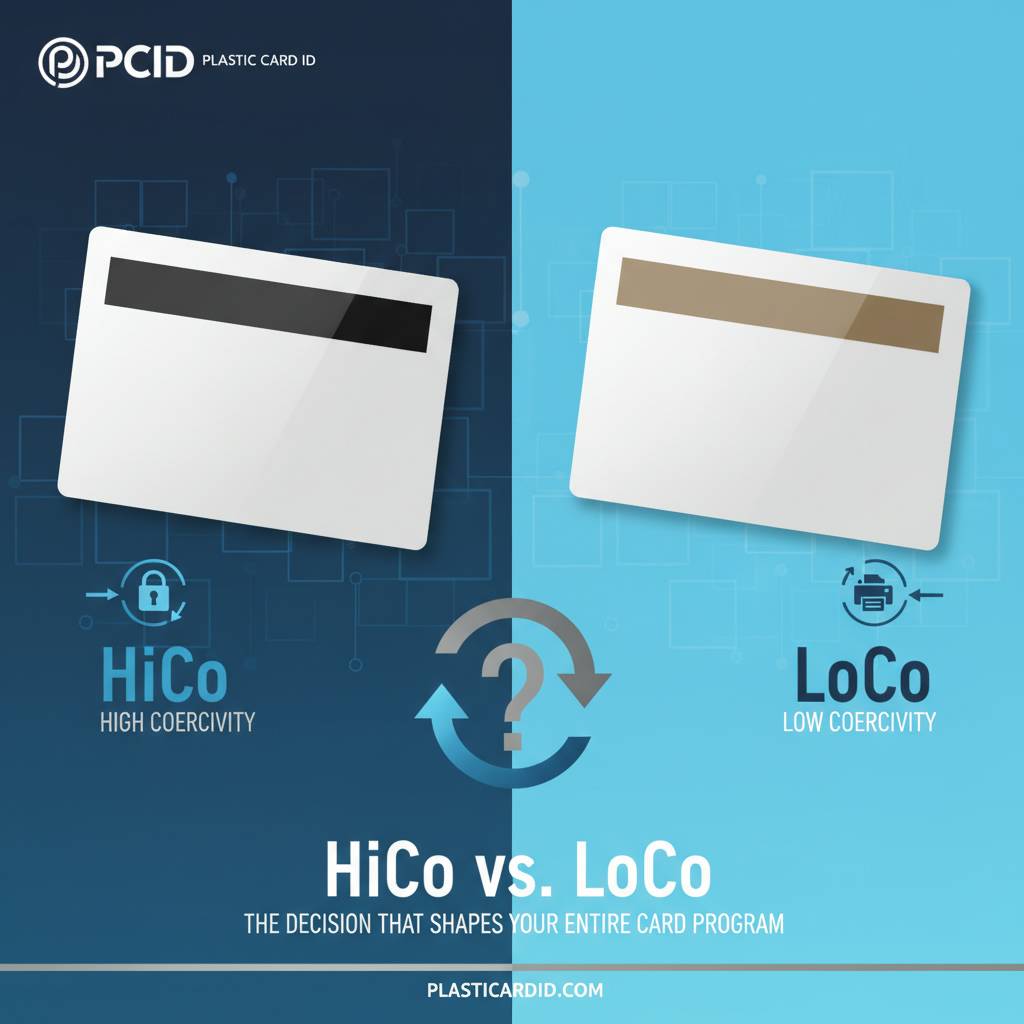 Here is where many buyers make their first critical mistake - and where we see the most questions come through at CPE. HiCo and LoCo refer to the coercivity of the magnetic stripe: essentially, how much magnetic force is required to write data to the strip and, by extension, how resistant that data is to accidental erasure. The difference is not cosmetic. It is functional, and choosing the wrong type can undermine your entire card program.
Coercivity is measured in Oersteds (Oe). HiCo (High Coercivity) stripes measure at approximately 2750 Oe. LoCo (Low Coercivity) stripes measure at approximately 300 Oe. That difference - nearly a tenfold gap - determines how easily the encoded data can be disrupted by external magnetic fields. And in day-to-day environments filled with smartphones, magnetic clasps, and payment terminals, that gap matters enormously.
| Feature | HiCo (High Coercivity) | LoCo (Low Coercivity) |
|---|---|---|
| Coercivity Level | 2750 Oe | 300 Oe |
| Data Durability | High - resistant to accidental erasure | Lower - more easily overwritten |
| Stripe Color | Dark brown / black | Light brown |
| Typical Applications | ID cards, loyalty, gift cards, access control | Hotel keys, short-term event credentials |
| Card Lifespan Expectation | Multi-year, heavy use | Short-term, limited use |
| Printer Encoder Required | HiCo-capable encoder | Standard magnetic encoder |
Why HiCo Dominates Long-Term Card Programs
If your cards are going to live in wallets alongside credit cards, near smartphones, or anywhere close to magnetic fields in the environment, HiCo is almost always the right choice. The higher coercivity means data stays encoded reliably through thousands of swipes and years of everyday carry. HiCo cards are the standard for employee ID programs, loyalty cards, membership credentials, and gift cards - any application where the card has a lifespan measured in months or years.
Retailers who have made the switch from paper loyalty punch cards to plastic HiCo magnetic stripe cards frequently report significant lifts in customer engagement. The card does not get lost at the bottom of a bag. It does not tear. It does not fade. It sits in the wallet next to cards the customer already values, and that proximity alone drives usage. At CPE, we regularly field calls from businesses surprised at how dramatically a physical plastic card program outperforms their previous paper-based approach.
From a printing perspective, HiCo cards require a printer encoder specifically rated for high coercivity. Most professional card printers from Evolis, Zebra, and Fargo support HiCo encoding - but it is worth confirming before purchasing card stock. Plastic Card ID can help you match the right blank card to the right printer to avoid any compatibility issues before they become operational headaches.
When LoCo Makes Sense
LoCo cards have a genuine role to play - just a specific one. Hotel key cards are the classic application. A guest checks in for three nights, receives a LoCo-encoded key card, uses it a handful of times, and returns it (or doesn't) at checkout. The hotel re-encodes that card for the next guest in seconds. Because the intended lifespan is short and the use frequency is low, LoCo's lower data durability is not a liability - it is actually an operational convenience. Easy encoding means faster reuse.
Short-term event credentials, conference badges with access permissions, and temporary visitor passes are similarly good candidates for LoCo cards. The lower coercivity threshold also means slightly lower encoding costs at scale, which can matter when you are issuing thousands of cards for a single weekend event. The key question is always lifespan and use environment. If the answer involves extended daily carry or exposure to magnetic interference, step up to HiCo without hesitation.
Stripe Color as a Quick Visual Guide
One practical tip for buyers and card program administrators: HiCo stripes typically appear dark brown to black, while LoCo stripes appear light brown or tan. This is not a universal rule - some manufacturers produce darker LoCo stripes - but it is a useful field check when you are sorting through existing card stock or receiving a new shipment. When in doubt, your card printer's encoder settings will confirm the coercivity before you begin a production run.
At Plastic Card ID, all of our magnetic stripe cards are clearly labeled HiCo or LoCo in our product listings, so there is never any ambiguity at the point of order. We find that clearly labeled specifications prevent the most common and frustrating card program mistakes before they happen, which is exactly why we take those details seriously across our entire catalog.
Core Applications: What Businesses Actually Use These Cards For
Blank magnetic stripe cards are extraordinarily versatile precisely because they start as nothing. The stripe holds whatever data your system requires. The card surface accepts full-color printing, embossing, or remains blank for simplest utility. That combination - encodable data storage on a durable, wallet-sized format - applies to an almost surprising range of business scenarios.
Loyalty and Gift Card Programs
The numbers are hard to ignore. Businesses that transition from paper gift certificates or punch cards to plastic magnetic stripe gift and loyalty cards consistently report sales increases in the range of 35-50%. Plastic gift cards are displayable, giftable, and professional in a way paper simply cannot replicate. They get loaded into POS systems, tracked against real-time balances, and reloaded - extending customer lifetime value well beyond the first transaction.
Loyalty cards stored in wallets see dramatically higher redemption rates than paper alternatives. When a card occupies the same physical space as a customer's driver's license and credit cards, it enters their daily decision-making rotation. Out of pocket, out of mind does not apply to a card that rides in the wallet all day. That behavioral reality is one of the most compelling arguments for investing in a proper plastic loyalty card program.
Employee ID and Access Control
Magnetic stripe employee ID cards are foundational to access control systems in offices, warehouses, healthcare facilities, schools, and government buildings. The encoded data on Track 1 or Track 2 corresponds to employee records in your management software, triggering door unlocks, time-and-attendance logging, or tiered access permissions depending on the system's configuration. Because the data lives on the card, lost or terminated employees' cards can be deactivated at the software level without any physical card retrieval required.
For organizations that want to consolidate functions, a single magnetic stripe ID card can serve as a visual credential (with a printed photo and name), an access token, and a time-tracking tool simultaneously. Multi-function cards reduce badge complexity and cardholder friction - two outcomes that HR departments and facilities managers appreciate equally. Plastic Card ID supplies blank HiCo CR80 cards specifically suited for these multi-purpose identity applications.
Membership, Club, and Event Cards
Gyms, country clubs, professional associations, libraries, and community organizations all benefit from magnetic stripe membership cards. The stripe handles check-in verification and usage tracking. The printed face communicates membership tier, validity dates, or organizational branding. Together, they create a credential that members keep, show, and associate with belonging - a psychological dimension that digital-only credentials still struggle to replicate.
Event credentials are where LoCo cards earn their place. Multi-day conferences, trade shows, and access-controlled events often issue thousands of badges over a short period. LoCo blank cards encoded on-site provide cost-effective, quickly deployed credentials that serve their purpose and can be recollected and recycled at the event's close. The temporary nature of the application aligns perfectly with LoCo's profile.
Choosing the Right Blank Card Stock for Your Program
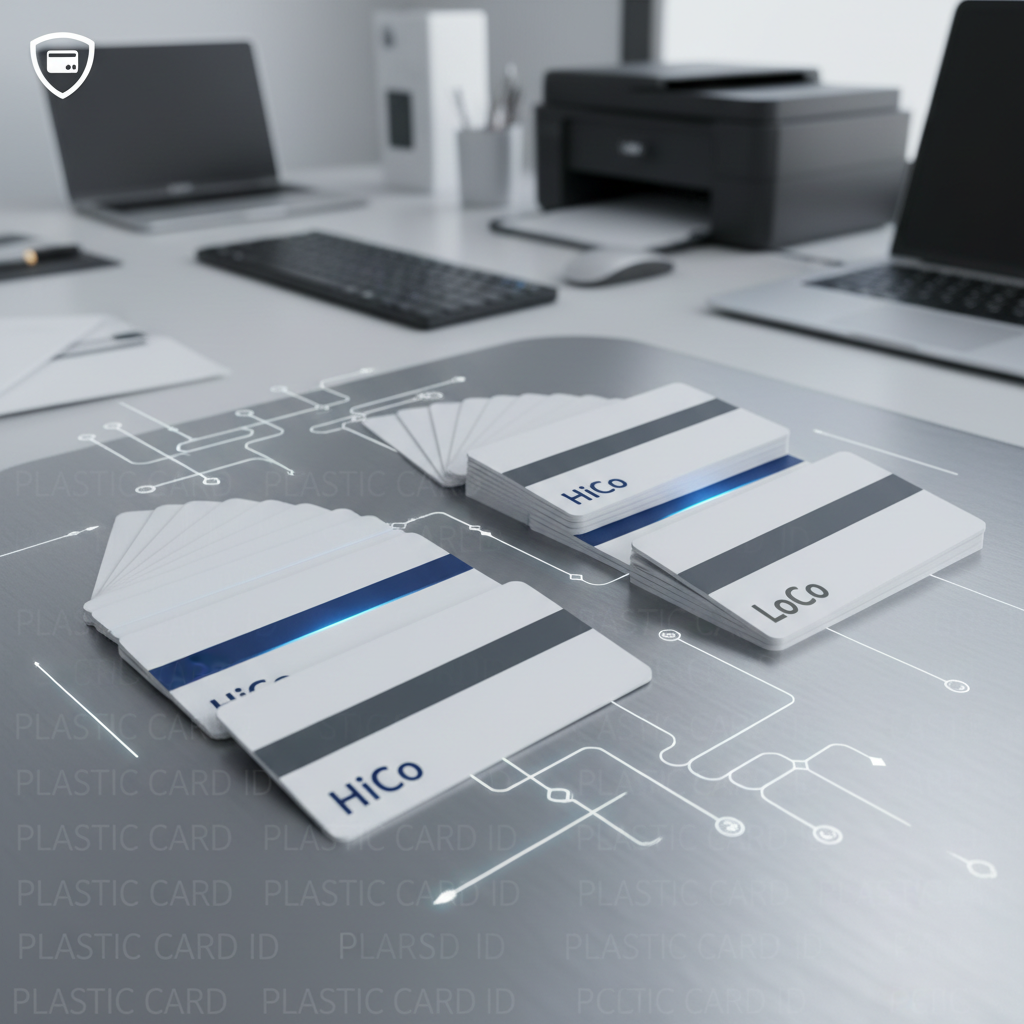 The card you choose is upstream of everything else in your program. Get it right, and the rest of your workflow - encoding, printing, distribution, reading - runs smoothly. Get it wrong, and every subsequent step is fighting against you. CPE fields these specification questions constantly, and there are a handful of decision points that resolve the vast majority of card selection questions.
Key Specifications to Confirm Before You Order
- Coercivity: HiCo (2750 Oe) for long-term programs, LoCo (300 Oe) for temporary or short-use applications.
- Track Configuration: Confirm whether your system reads Track 1, Track 2, Track 3, or a combination - and order cards whose stripe supports those tracks.
- Card Thickness: Standard CR80 at 30 mil covers most applications. Specialty applications may require 20 mil or 40 mil.
- Printer Compatibility: Verify that your card printer's encoder module supports the coercivity of your chosen card stock.
- Surface Finish: Glossy white PVC is the standard. Clear, frosted, and colored stock options are available for programs requiring visual differentiation.
- Volume: Plastic Card ID handles programs ranging from 50 cards per month to tens of thousands - volume affects per-card pricing and order structure.
Running through this checklist before placing an order saves significant time and cost. A mismatch between card coercivity and printer encoder, for instance, results in either unreadable cards or encoder damage - neither of which is a minor inconvenience. A five-minute specification check prevents a five-day replacement delay.
Pairing Cards with the Right Printer
Blank magnetic stripe cards are only as useful as the system encoding them. Plastic Card ID carries a full lineup of card printers from Evolis, Zebra, and Fargo - the three brands that dominate professional in-house card printing. Each manufacturer offers models with optional or integrated magnetic stripe encoding modules, and the selection spans entry-level single-sided printers to high-volume dual-sided systems with inline encoding and lamination.
For organizations new to in-house card printing, we recommend starting with a clear picture of your monthly card volume and the complexity of your card design before selecting a printer. A small-business loyalty program issuing 100 cards per month has very different needs than a hospital system issuing 2,000 employee badges annually. Reach us at 800.835.7919 to talk through your printer options alongside your card stock selection - the combination matters as much as either component alone.
Accessories That Complete the Program
Blank magnetic stripe cards are the foundation, but a complete card program involves more than card stock. Plastic Card ID supplies printer ribbons calibrated for each printer model, cleaning kits that maintain encoder read/write accuracy over time, card carriers for mailing issued cards securely, and card sleeves and badge holders for display and daily use. These accessories are not afterthoughts - they directly affect how long your cards perform and how professionally they are received.
Card affixing and mailing services are available for organizations that prefer to outsource the distribution step entirely. Whether you are mailing renewal cards to a membership list or distributing employee credentials across multiple locations, having a single partner manage the full workflow - from blank card stock through to delivered credential - is a meaningful operational simplification.
Frequently Asked Questions About Magnetic Stripe Cards
After 25 years and more than 100,000 customers, certain questions come up reliably. The answers below address the most common points of confusion and help buyers make faster, more confident decisions about their magnetic stripe card programs.
Can I Re-Encode a Magnetic Stripe Card?
Yes - magnetic stripe cards can be re-encoded as many times as the stripe's material allows. LoCo cards, with their lower coercivity threshold, are re-encoded more easily and are frequently cycled through multiple guests or users (hotel keys being the prime example). HiCo cards can also be re-encoded, though the higher coercivity means the encoder must apply more force. Most professional-grade card printers handle HiCo re-encoding without issue.
The practical limit on re-encoding is not usually the stripe itself but the card's physical condition. A card that has been heavily swiped over years may show wear on the stripe surface that affects read reliability. For high-rotation applications, building a card replacement schedule into your program is a straightforward way to maintain read accuracy across your entire deployment.
Will Other Magnetic Fields Erase My Cards?
This concern comes up often, and the honest answer is: it depends on the coercivity. LoCo cards are more vulnerable to magnetic interference - a strong magnet, certain phone cases with magnetic clasps, or proximity to magnetic POS components can corrupt the encoded data. HiCo cards, with their much higher coercivity, resist casual magnetic interference significantly better. They will not be erased by a nearby smartphone or standard consumer magnets.
That said, no magnetic stripe card is immune to a sufficiently strong magnetic field. The practical guidance is simple: HiCo for anything carried daily in a wallet or purse, LoCo for controlled short-term environments. If your cardholders are going to be in environments with industrial magnets or strong electromagnetic equipment, consider whether RFID or smart chip technology might be a more appropriate access solution - both of which Plastic Card ID also supplies.
How Many Cards Should I Order at Once?
For most organizations, ordering a three-to-six month supply of blank card stock at one time balances per-card cost efficiency against storage and cash flow considerations. Larger orders bring per-card pricing down, and because blank magnetic stripe cards have a long shelf life when stored away from extreme heat and strong magnetic fields, buying in moderate bulk is generally a sound approach.
Programs with predictable, steady issuance - like an ongoing employee onboarding process or a continuously operating loyalty program - benefit from setting up a recurring order schedule. Plastic Card ID works with clients to establish supply rhythms that keep card stock available without requiring constant reordering. Running out of card stock at a critical moment is an operational disruption that a small amount of forward planning eliminates entirely.
Advanced Magnetic Stripe Options and Specialty Card Formats
Standard white CR80 HiCo or LoCo covers the majority of use cases - but not all of them. Plastic Card ID's catalog includes specialty card formats that extend what a magnetic stripe card program can look and feel like, without sacrificing the encoding functionality at the core of the program.

Clear and Frosted Magnetic Stripe Cards
Clear PVC cards with magnetic stripes offer a striking visual alternative to standard white stock. The transparency of the card body makes printed graphics float against whatever background the card is displayed against - a popular choice for premium loyalty programs, exclusive membership cards, and brand-forward gift card programs. Frosted variants offer a softer, diffused appearance with similar visual impact. Both are available in CR80 30 mil with HiCo or LoCo stripes.
The encoding functionality on clear and frosted cards is identical to standard white stock - the visual distinction is purely in the card body material, not the stripe. Organizations that want their cards to stand out in a wallet full of generic white plastic will find that clear and frosted formats create immediate perceived value that customers notice and respond to. CPE stocks both formats and can help you determine which finish suits your brand.
Colored Stock and Custom Magnetic Stripe Cards
Colored PVC card stock - available in a range of base colors - provides visual differentiation at the card level without requiring full custom printing. A gym that uses blue cards for standard members and gold cards for premium members creates an instant visual hierarchy that staff and members both understand at a glance. Combined with magnetic stripe encoding, colored stock delivers both function and form in a single product.
For organizations requiring custom-printed magnetic stripe cards, Plastic Card ID offers full-color custom printing alongside card encoding services. Custom cards arrive ready to issue, bypassing the in-house printing step for programs that prefer a fully finished product. Whether you need 500 custom-printed loyalty cards or 50,000 branded gift cards, the production capabilities at Plastic Card ID scale to fit the requirement.
Combining Magnetic Stripe with RFID or Smart Chip
Some applications benefit from hybrid cards that combine a magnetic stripe with RFID or smart chip technology. An employee badge, for instance, might use the magnetic stripe for legacy access control readers while the embedded RFID chip handles newer contactless readers in the same facility. This dual-technology approach protects existing infrastructure investments while allowing gradual migration to more advanced systems.
Plastic Card ID supplies RFID and proximity cards, smart chip cards including MIFARE DESFire variants, and combination formats where the application demands it. The right technology combination depends entirely on your readers, your software, and your security requirements - and our team is equipped to help you navigate that decision with clarity and without unnecessary upsells.
Partner With Plastic Card ID for Your Magnetic Stripe Card Program
The difference between a card supplier and a card program partner is the depth of support you receive after the order is placed. At Plastic Card ID, we have built 25 years and over 100,000 customer relationships on the premise that your card program's success is our success. That means honest specification guidance, a catalog deep enough to handle any requirement, and the operational reliability that comes from having shipped more than 50 million cards to businesses across the United States.
Blank magnetic stripe cards - whether HiCo or LoCo, standard white or specialty format - are one of the most cost-effective tools available to businesses that want to formalize their loyalty, identity, access, or membership programs. The technology is proven, the infrastructure is widely available, and the results are measurable. What changes from one program to the next is the specificity of the choices: the right coercivity, the right track configuration, the right card format, paired with the right printer and the right supply of accessories to keep the whole system running.
Ready to get your magnetic stripe card program built on the right foundation? Call 800.835.7919 today and speak with a card program specialist at Plastic Card ID.
Whether you are starting your first card program or scaling an existing one, Plastic Card ID has the card stock, the equipment, the accessories, and the experience to make it work. Do not leave one of your most visible customer touchpoints to guesswork. Plastic Card ID is ready to help - call 800.835.7919 and let's build something that lasts.
Previous Page