Difference Between Blank Cards and Pre-Printed Cards Explained
Table of Contents []
- Blank Cards vs. Pre-Printed Cards: What Every Smart Buyer Should Know - Plastic Card ID
- Why Blank PVC Cards Are the Backbone of In-House Card Programs
- The Case for Pre-Printed Cards: When Professional Finish Wins
- Functional Card Types and How Format Choice Applies to Each
- Card Printers and Supplies: The Infrastructure Behind Blank Card Programs
- Real-World Applications: What Different Organizations Actually Choose
- Your Next Step With Plastic Card ID - Call 800.835.7919 Today
Blank Cards vs. Pre-Printed Cards: What Every Smart Buyer Should Know - Plastic Card ID
You are standing at a fork in the road. On one side: a box of blank white PVC cards, crisp and unadorned, waiting to become whatever your operation needs. On the other: finished, pre-printed cards with your logo already on them, ready to hand out the moment they arrive. Both are legitimate paths. But choosing the wrong one - even once - can cost you time, money, and flexibility you did not know you needed. Understanding the difference between blank cards and pre-printed cards is one of the most practical decisions any card program manager can make.
After 25 years and more than 50 million cards shipped to businesses across the United States, CPE has seen every permutation of this decision play out. Small nonprofits printing 50 membership cards a month in-house. Retailers ordering 10,000 pre-printed gift cards per quarter. Hotel chains managing key card programs with complex encoding requirements. The right answer is almost never obvious upfront - and that is exactly why this guide exists.
Defining the Two Categories
A blank card is a standard CR80 PVC card - 3.375 inches by 2.125 inches, 30 mil thick, ISO 7810 compliant - that arrives with no artwork, no text, and no encoding. It is a raw canvas. Your organization provides the design, the printer, and the process. The card itself is simply the substrate on which your program is built.
A pre-printed card, by contrast, is produced with your design already applied - typically via commercial offset or digital printing - before it leaves the manufacturer. Everything from background color to logo placement to variable data like names, numbers, or barcodes can be part of the finished product. When the cards arrive, the visual work is done.
What seems like a simple distinction actually carries profound implications for cost structure, turnaround time, design control, volume thresholds, and operational flexibility. Neither format is universally superior. Both have genuine strengths depending on context, and CPE stocks and supplies both categories with equal depth of expertise.
The Physical Makeup: More Similar Than You Think
Here is something many buyers overlook: at their core, blank and pre-printed cards are often built from the same PVC material. CR80 cards - blank or printed - share identical dimensions and thickness standards. A magnetic stripe card begins life as a blank card with a magnetic stripe laminated to its surface; printing comes later, either by you or by the factory.
RFID and smart chip cards follow the same logic. The contactless chip embedded in a card for hotel access or campus ID is a component added to the card body - independent of whether that card is blank or pre-printed. This is worth understanding because it means functionality and aesthetics are separable design decisions. You can have a fully encoded proximity card that is visually blank, or a beautifully printed card with no electronic components at all.
Where the Differences Actually Matter
The distinctions that carry real weight fall into five areas: per-card cost, minimum order quantities, design flexibility, lead time, and operational overhead. Blank cards win decisively on flexibility and speed for low-to-medium volume programs. Pre-printed cards win on professional finish quality and cost efficiency at high volume where commercial printing advantages kick in.
Think of it this way: a blank card costs more per unit to print in-house (factoring in ribbon and printer wear) but gives you instant turnaround and zero minimum order constraints. A pre-printed card from a commercial run might drop to pennies per card - but requires a setup process, a proof approval cycle, and a minimum run quantity that may not suit every buyer.
| Factor | Blank Cards | Pre-Printed Cards |
|---|---|---|
| Minimum Order | As few as 1 box (typically 100 cards) | Usually 250-500 card minimums |
| Per-Card Cost at Scale | Moderate (printing cost added in-house) | Lower at high volume |
| Turnaround Time | Same day (print in-house) | Days to weeks depending on run size |
| Design Changes | Instant, no cost | Requires new order or setup |
| Variable Data (names, IDs) | Easy - printed individually | Possible but adds complexity |
| Print Quality Ceiling | Dependent on your printer/ribbon | Commercial-grade offset finish |
Why Blank PVC Cards Are the Backbone of In-House Card Programs
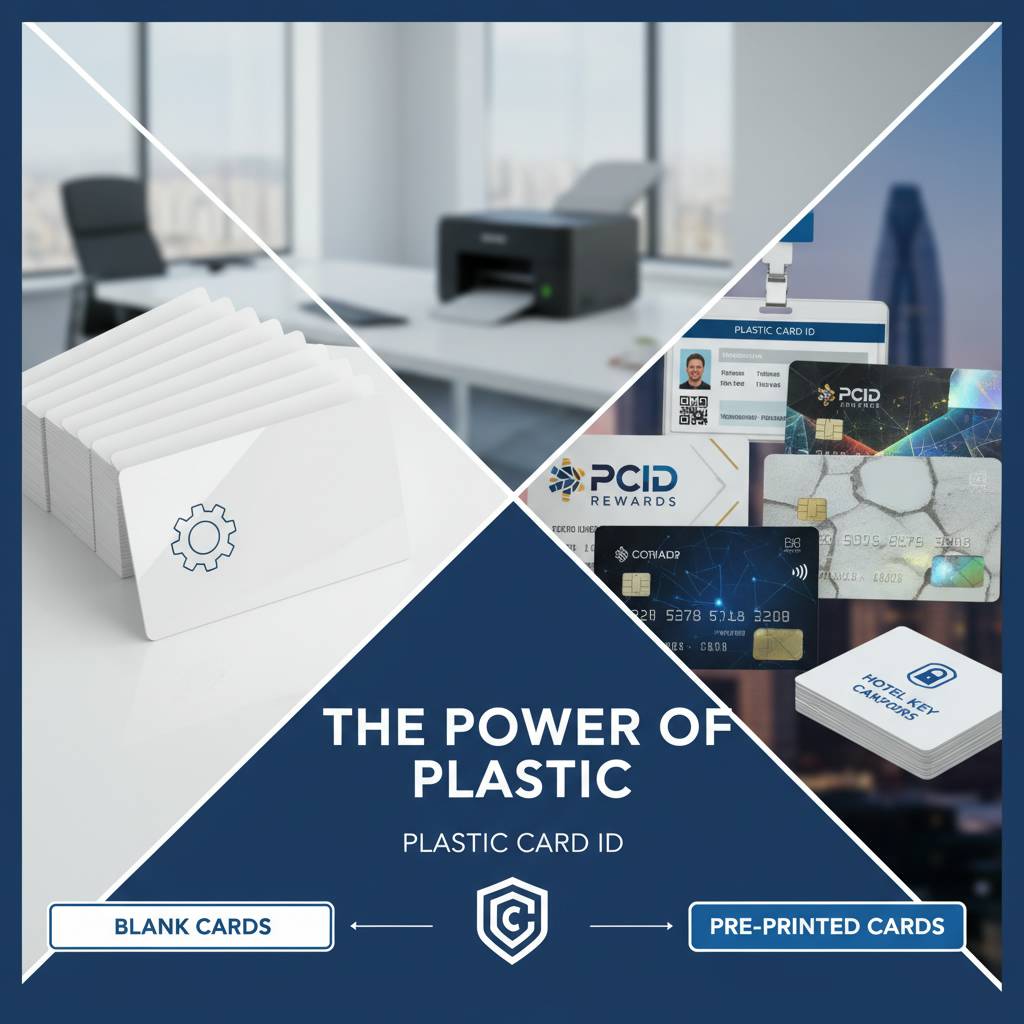 Pull back the curtain on almost any mid-sized organization running a successful ID, loyalty, or access card program and you will likely find a card printer sitting on a desk somewhere, loaded with blank white PVC cards and a fresh ribbon. Blank CR80 cards are the unsung workhorses of the American card industry. They are unremarkable objects individually and remarkable systems in aggregate.
The case for blank cards is fundamentally a case for control. When your design team updates the company logo, you update the template on your computer and print new cards the same afternoon. When an employee is hired or terminated, the badge prints in two minutes. When a loyalty card program adds a new tier, the new design rolls out immediately - no waiting on a print vendor, no minimum run quantity, no reorder delay.
The CR80 Standard and Why It Matters
Every blank card CPE supplies meets the CR80 standard: 3.375 x 2.125 inches, 30 mil thickness. This is the same size as a standard credit card, and it is the size that every major card printer in the market - Evolis, Zebra, Fargo - is designed to handle. Standardization means interoperability. Cards from our stock feed your printer without adjustment, every time.
That 30 mil thickness is not arbitrary. It is the ISO 7810 ID-1 specification, established to ensure cards fit every card reader, every wallet slot, and every ID badge holder manufactured to the same standard. Thinner cards warp under heat; thicker cards jam in printers. The 30 mil standard eliminates both problems and explains why CR80 has dominated the industry for decades.
Blank Card Varieties That Expand Your Options
Blank does not mean limited. The blank card catalog at CPE spans a wide range of substrates and functional variants, each suited to different program requirements. White gloss is the default, but it is far from the only option.
- Blank white PVC cards - the universal standard, compatible with all dye-sublimation and direct-to-card printers
- Blank magnetic stripe cards - HiCo (high coercivity, 2750 Oe) for durable long-term encoding, LoCo for applications like hotel key cards
- Blank RFID and proximity cards - embedded with 125 kHz or 13.56 MHz chips for access control without printing
- Blank smart chip cards - contact or contactless, including MIFARE DESFire for advanced security applications
- Blank clear and frosted cards - for visual effects that a standard white card cannot achieve
- Blank colored stock cards - pre-pigmented PVC in various colors, useful for visual tier differentiation
Each of these variants accepts in-house printing, encoding, or both. The functional layer (chip, stripe, RFID) is built in; the visual layer is yours to control. That combination is remarkably powerful for organizations that want professional-grade functionality without outsourcing every design decision.
Cost Dynamics: What Blank Cards Actually Cost Over Time
The honest math on blank cards includes two components: the card stock itself and the cost of in-house printing. Card stock from CPE runs competitively - bulk orders reduce per-card cost significantly. In-house printing adds ribbon cost (typically $0.10-$0.40 per card depending on coverage and ribbon type) and amortized printer wear.
At low-to-medium volume - say, 50 to 2,000 cards per month - in-house blank card programs almost always outperform pre-printed card orders on total cost. The break-even shifts as volume climbs, and at 10,000 cards per run, commercial pre-printing starts to compete seriously. Knowing your volume is the single most important input to this decision.
Call 800.835.7919 and the team at CPE can walk you through a straightforward cost comparison for your specific program - no pressure, just math.
The Case for Pre-Printed Cards: When Professional Finish Wins
There are programs where pre-printed cards make obvious sense - where the scale is large enough, the design stable enough, and the professional finish important enough that outsourcing production to a commercial print run is the smart play. Pre-printed cards offer a visual quality ceiling that most in-house card printers simply cannot match.
Commercial offset printing delivers richer color saturation, sharper fine-line detail, and more consistent results across large runs than desktop card printers. If your brand depends on color accuracy - a specific Pantone value, a photographic background, or a complex gradient - commercial pre-printing will deliver superior output. For gift card programs, retail loyalty cards, and high-visibility membership cards, that finish quality carries real brand value.
When Volume Justifies Pre-Printing
The economics of pre-printed cards improve dramatically with scale. Set up costs - design, plates or digital files, proof approvals - are fixed regardless of run size. Spread those costs across 500 cards and they sting. Spread them across 25,000 cards and they become negligible. Volume transforms the cost structure of pre-printed cards from a liability into an advantage.
Retailers running seasonal gift card campaigns, hotel chains restocking key cards by the thousand, and membership organizations with large annual renewal cycles are natural fits for pre-printed card programs. The design does not change frequently, the quantity justifies the run, and the per-card cost can be impressively low at scale.
Design Stability: The Key Pre-Condition
Here is the caveat that separates successful pre-printed card buyers from frustrated ones: your design must be stable. Pre-printed cards cannot be updated on the fly. If your logo changes, your event date passes, or your offer expires, those cards become obsolete inventory. Organizations that update their branding, change their pricing, or run time-limited programs are poor fits for large pre-printed card orders.
Conversely, organizations with stable branding, predictable volume, and multi-year program horizons can commit to pre-printed card runs with confidence. The key question to ask before ordering: "Will this design still be accurate in 12 months?" If the answer is yes, pre-printing starts to make real sense.
Hybrid Approaches That Combine Both Worlds
Smart card program managers sometimes split the difference. They order pre-printed cards with the static design elements - logo, background, brand colors - already applied commercially, then run those cards through an in-house printer to add variable data: names, employee numbers, barcodes, or membership IDs. This approach captures the visual quality of commercial printing while retaining the personalization flexibility of in-house production.
CPE supports this approach by supplying pre-printed card stock compatible with major card printer brands. If you are considering a hybrid program, the team can advise on compatible substrate specifications and overprint compatibility to ensure your in-house printer bonds correctly to the pre-printed surface.
| Use Case | Recommended Format | Key Reason |
|---|---|---|
| Employee ID badges | Blank cards | Variable data, instant issuance |
| Retail gift cards (large run) | Pre-printed | Volume economics, brand finish |
| Hotel key cards | Blank LoCo magnetic | Encoded on-site, frequent reuse |
| Event credentials | Blank or short-run pre-printed | Date-specific, low volume |
| Membership cards | Hybrid | Stable brand variable member data |
Functional Card Types and How Format Choice Applies to Each
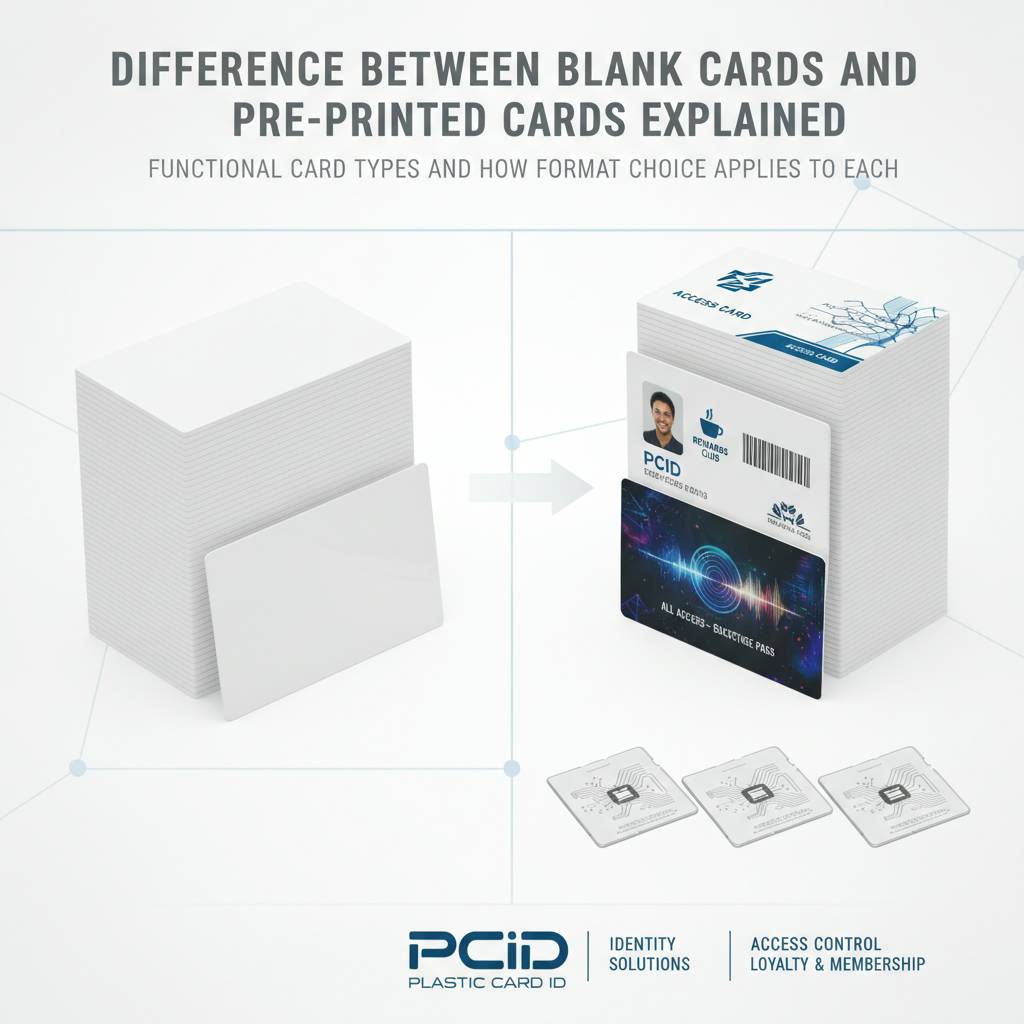 The blank-vs-pre-printed question does not exist in a vacuum - it plays out differently across the major card application categories. Understanding how format choice intersects with card function helps you make decisions that serve your program for years, not just the next order cycle. Let us walk through the major categories where CPE serves clients every day.
ID and Access Control Cards
Employee ID cards, visitor passes, student IDs, and physical access control cards are nearly always better served by blank card programs. The reason is variable data: every card is unique, carrying a specific name, photo, employee number, and potentially an encoded access level. In-house card printing is the only practical way to issue individualized credentials on demand.
Access control specifically benefits from blank RFID and proximity card stock. The chip handles authentication; your card printer adds the visual ID layer. Proximity cards operating at 125 kHz and smart cards using MIFARE DESFire are both available as blank stock through CPE, ready for in-house printing and encoding through compatible systems.
Casino player cards and hotel key cards follow similar logic - both are high-throughput, frequently reissued, and operationally dependent on rapid in-house personalization. Blank LoCo magnetic cards for hotel applications and blank smart cards for casino loyalty programs are among CPE's most consistently reordered product categories.
Loyalty and Membership Cards
Loyalty cards that live in a customer's wallet outperform paper punch cards by a wide margin - and plastic membership cards signal legitimacy and permanence that paper simply cannot convey. Retailers switching from paper to plastic gift and loyalty card programs report sales increases of 35-50%. The format question here is nuanced.
For small independent retailers or gyms printing 50-200 loyalty cards per month, blank card programs are the obvious choice - fast, affordable, and flexible. For larger retail chains launching a branded loyalty program with consistent design across hundreds of locations, pre-printed card runs with variable magnetic stripe encoding make more sense. The brand consistency benefits of commercial printing are real at that scale.
Gift Cards, Marketing Cards, and Specialty Formats
Gift cards occupy a special category. Functionally, the card value is managed by software - the card itself is just a carrier for a barcode or magnetic stripe number. That means the card's job is largely visual and tactile: it needs to look good, feel premium, and represent your brand at the point of gift-giving. This is one of the clearest use cases for pre-printed cards with commercial print quality.
Specialty formats - clear plastic cards, frosted cards, custom die-cut shapes, and luxury metal cards in stainless steel, brass, or gold - exist primarily in the pre-printed or custom-produced category. These are not blank canvas products; they are finished statements. CPE supplies these specialty options for clients whose brand positioning demands something beyond the standard white PVC card.
Card Printers and Supplies: The Infrastructure Behind Blank Card Programs
A blank card program is only as good as the printer running it. CPE carries a full lineup of card printers from the three dominant brands in the professional card printing market - Evolis, Zebra, and Fargo - alongside a complete selection of printer ribbons, cleaning kits, card carriers, and sleeves. This is what makes CPE a true one-stop shop rather than just a card vendor.
Matching the Right Printer to Your Program
Entry-level card printers in the $300-$800 range are well suited to programs printing fewer than 500 cards per month. Mid-range models in the $800-$2,500 range add features like dual-sided printing, lamination overlays, and higher throughput - appropriate for programs between 500 and 5,000 cards monthly. High-volume production printers push into the $2,500-$8,000 range and are designed for operations printing tens of thousands of cards per month.
Ribbon selection is equally important. YMCKO ribbons (full color plus overlay) deliver the richest photo-quality prints. KO ribbons (black resin plus overlay) are used for monochrome badges where durability matters more than color. Specialty ribbons for security overlays, holographic laminates, and UV-fluorescent printing add additional protection layers. The right ribbon choice affects both print quality and card longevity.
Contact 800.835.7919 if you need help selecting a printer and ribbon combination for your specific blank card program - the team has matched hundreds of buyers to the right equipment over the years.
Supporting Supplies That Complete the Program
Blank card programs require more than cards and printers. Card carriers and sleeves protect finished cards during distribution. Lanyards and badge holders keep ID cards accessible and professional-looking in workplace environments. Cleaning kits - rollers, swabs, cleaning cards - maintain print head health and extend printer life significantly. Skipping cleaning cycles is one of the most common causes of premature printer failure.
CPE also offers card affixing and mailing services for organizations that need finished cards delivered directly to cardholders. This is particularly relevant for membership renewal programs, loyalty card launches, and large-scale ID card distributions where individual mailing is operationally necessary.
Frequently Asked Questions About Card Formats
Buyers new to card programs tend to ask the same practical questions. Here are the most common, answered directly.
- Can I print on RFID or magnetic stripe blank cards with a standard card printer? Yes - as long as the printer is compatible with the card's surface. The functional component (chip or stripe) does not interfere with printing on the card face.
- What is the minimum quantity for blank cards? CPE supplies blank cards in quantities starting at 100 cards per box, with no formal minimum order for standard stock items.
- Can pre-printed cards be encoded after printing? Yes - magnetic stripe encoding and RFID programming can be performed on pre-printed cards, either by the manufacturer before shipment or by you in-house with compatible equipment.
- How do I store blank PVC cards? Store flat, away from heat and direct sunlight, in original packaging until use. Avoid stacking heavy objects on card boxes to prevent warping.
- What is the lead time for pre-printed card orders? Standard pre-printed runs typically require 7-15 business days depending on quantity and complexity. Rush options may be available - call CPE to confirm current timelines.
Real-World Applications: What Different Organizations Actually Choose
Theory is useful. Real-world examples are more useful. Here is how the blank-vs-pre-printed decision tends to play out across the types of organizations CPE serves every day across the United States.

Healthcare and Education Organizations
Hospitals, clinics, universities, and K-12 school districts almost universally operate blank card programs. The driver is straightforward: every card issued is unique. A hospital with 3,000 employees and a 20% annual turnover rate is issuing and retiring hundreds of badges per year. No pre-printed program can keep pace with the personalization and issuance speed demands of a large healthcare ID program.
Universities face similar dynamics with student IDs, faculty badges, and campus access cards - often with multiple card types running on the same printer. Blank smart card stock with MIFARE DESFire chips handles campus access, library privileges, and dining accounts from a single card. The in-house printing model is not optional in these environments; it is operationally essential.
Retail, Hospitality, and Entertainment
Retailers launching gift card programs at meaningful scale - hundreds of locations, tens of thousands of cards per quarter - are the clearest pre-printed card buyers. The design is fixed, the volume is high, and the commercial print quality elevates the brand at point of purchase. Gift cards printed commercially with glossy finishes and rich color simply look and feel more premium than desktop-printed equivalents.
Hotels sit in an interesting middle position. Key cards are almost always blank LoCo magnetic cards encoded at the front desk - the functional requirement drives the blank card choice. But hotel loyalty cards and branded amenity cards for upscale properties are often pre-printed commercially, reflecting the brand investment those properties are willing to make in cardholder experience. Casino operations follow a similar split: player cards printed in-house for rapid issuance, marketing cards printed commercially for brand impact.
Small Businesses and Independent Organizations
The independent gym, the local wine club, the regional trade association - these organizations almost always land in the blank card camp, and for good reason. Their volumes are modest, their designs evolve over time, and they cannot afford the minimum run commitments that commercial pre-printing typically requires. A desktop card printer and a case of blank PVC cards gives a small organization capabilities that were once reserved for enterprises with serious print budgets.
The investment is manageable: an entry-level card printer in the $400-$600 range, a supply of blank white PVC cards, and a YMCKO ribbon will get a small membership organization fully operational within a day of setup. CPE has helped thousands of organizations at exactly this scale build card programs that punch well above their weight in professionalism and impact.
Your Next Step With Plastic Card ID - Call 800.835.7919 Today
The difference between blank cards and pre-printed cards is not a trivial technical distinction - it is a foundational program decision that shapes your costs, your flexibility, your timeline, and your results for as long as the program runs. Getting it right from the start saves money, reduces operational headaches, and positions your card program to scale smoothly as your organization grows.
CPE has navigated this decision with over 100,000 customers across 25 years of business. The catalog covers every card type, every functional variant, the full range of card printers and supplies, and value-added services like card mailing and affixing that take fulfillment off your plate entirely. Whatever your card program looks like - 50 employee badges a month or 50,000 loyalty cards a quarter - the infrastructure, experience, and inventory are here to support it.
Call Plastic Card ID at 800.835.7919 today. Whether you are starting a program from scratch, optimizing one that has been running for years, or simply trying to figure out which card format makes sense for a specific application, the team is ready to help you make the right call - quickly, clearly, and without the runaround.
Previous Page