Shipping Blank Plastic Cards: What to Expect From Your Order
Table of Contents []
- Shipping Blank Plastic Cards: What Plastic Card ID Wants You to Know Before Your Order Arrives
- How Blank Plastic Cards Are Packaged for Shipment
- Transit Times and Shipping Options Across the USA
- Inspecting Your Shipment the Right Way
- Storing Blank Plastic Cards After Delivery
- Buyer Tips: Getting the Most From Every Blank Card Order
- Ready to Order? Plastic Card ID Makes Every Step Simple
Shipping Blank Plastic Cards: What Plastic Card ID Wants You to Know Before Your Order Arrives
Most people ordering blank plastic cards for the first time focus entirely on the card itself - the stock, the quantity, the finish. What catches them off guard is everything that happens between placing that order and actually holding the cards in their hands. Shipping isn't an afterthought. It's an active part of the experience, and understanding it upfront saves confusion, prevents costly delays, and helps your card program launch on time.
Whether you're ordering 500 blank CR80 PVC cards for an in-house badge program or 20,000 magnetic stripe cards for a seasonal loyalty push, the shipping process follows predictable patterns - once you know what to look for. This guide breaks it all down, from how cards are packaged to what you should inspect the moment your shipment arrives.
| Card Type | Typical Order Quantity | Standard Packaging | Avg. Transit Time (USA) |
|---|---|---|---|
| Blank PVC CR80 Cards | 500 - 5,000 | Boxed in card stacks | 2-5 business days |
| Magnetic Stripe Cards (HiCo/LoCo) | 250 - 10,000 | Wrapped stacks, boxed | 2-5 business days |
| RFID / Proximity Cards | 100 - 5,000 | Specialty protected packaging | 2-7 business days |
| Smart Chip Cards | 100 - 2,500 | Anti-static protected packaging | 3-7 business days |
| Clear / Frosted PVC Cards | 250 - 5,000 | Interleaved protective layers | 2-5 business days |
How Blank Plastic Cards Are Packaged for Shipment
 There's a reason your blank plastic cards don't arrive tossed loosely into a mailer envelope. Proper packaging is the first line of defense against warping, scratching, and structural damage. PVC cards at 30 mil thickness are durable - but they're not invincible, especially in bulk quantities where stacking pressure and moisture exposure during transit become real concerns.
At Plastic Card ID, cards are shipped in stacked configurations with protective layers between groupings. Specialty card types like clear, frosted, and chip-embedded cards receive additional interleaving or anti-static wrapping to ensure the product arrives in print-ready, encode-ready condition. The box itself is selected to minimize internal movement during carrier handling.
Standard PVC Card Packaging
Blank CR80 PVC cards - the workhorse of any in-house card program - are typically packaged in stacks of 100, wrapped securely, and boxed in quantities matching your order. The 30 mil ISO 7810 standard thickness means these cards stack cleanly without bowing when properly contained, which is exactly how they're shipped.
When you open the box, the cards should be flat, clean, and ready for your card printer. Any deviation from that standard is worth noting immediately. More on what to do in that scenario appears later in this guide - but know that it's rare when packaging protocols are followed correctly.
Magnetic Stripe Card Handling
HiCo and LoCo magnetic stripe cards require a bit more attention during packaging because the stripe itself - while protected within the card laminate - can theoretically be affected by proximity to strong magnetic fields during transit. CPE packs these cards in non-magnetized materials and avoids any contact with ferrous materials in the packaging chain.
The stripe encoding on HiCo cards (2750 Oersteds) is far more resistant to incidental field exposure than LoCo (300 Oersteds), but both types ship with the same level of protective care. Never store or ship magnetic stripe cards near magnets, motors, or speakers - this applies to your storage facility as much as to the shipping process itself.
To reach our team about your order, call 800.835.7919 and we'll walk you through the specifics of magnetic card care during transit and storage.
RFID, Smart Chip, and Specialty Card Packaging
RFID cards, proximity cards, and smart chip cards with embedded technology such as MIFARE DESFire require protective packaging that accounts for the embedded components. These aren't just plastic substrates - they contain antennas, chips, and microelectronics that can be sensitive to static discharge and physical pressure.
Anti-static packaging is standard for chip-embedded cards, and RFID cards are grouped and wrapped in a way that prevents antenna compression over long transit periods. This level of care directly translates to cards arriving functionally intact and ready for encoding or direct deployment in your access control or loyalty system.
Transit Times and Shipping Options Across the USA
One of the most common questions CPE receives from new customers is deceptively simple: "How long will it take?" The answer depends on your location within the United States, the card type, your chosen shipping method, and current carrier conditions. Planning your card program around realistic transit windows is smarter than assuming the fastest possible scenario.
For most in-stock blank card orders, ground shipping within the continental United States runs 2-5 business days from the point of shipment. Expedited options - 2-day and overnight - are available for customers with tight launch timelines. Keep in mind that "business days" exclude weekends and federal holidays, which can compress your actual calendar window significantly around peak seasons.
Ground Shipping: The Standard Choice for Most Orders
Ground shipping is the most cost-effective option for bulk blank card orders and works well when your program timeline allows for a 3-5 day arrival window. For a loyalty card launch that's three weeks out, there's no reason to pay for overnight delivery on 5,000 blank PVC cards. Smart procurement planning saves real money over the lifetime of your card program.
Orders shipped ground from Plastic Card ID's distribution point reach most major metro areas within 2-3 business days and more remote locations within 4-5. If you're running an ongoing monthly card program - say, 500 cards per month for employee badges - setting a predictable reorder schedule aligned with ground transit times keeps your operation running without interruption.
Expedited Shipping for Time-Sensitive Programs
Event credentials, last-minute membership card campaigns, or urgent access card replacements sometimes require faster delivery. Expedited 2-day and overnight options are available and work well when the alternative is a program delay with real operational consequences. The cost premium is usually worth it when measured against the cost of that delay.
Build a small buffer stock whenever possible. Customers who maintain a reserve of blank cards - even just 200-300 units above current need - rarely need to pay for expedited shipping. That small investment in buffer inventory consistently outperforms emergency freight costs over time, and it keeps your card printer running during any reorder cycle.
Call 800.835.7919 to discuss shipping options that fit your specific timeline and order volume.
Alaska, Hawaii, and USA Territories
Plastic Card ID ships exclusively within the United States, including Alaska, Hawaii, and U.S. territories. Transit times for non-continental destinations are longer - typically 5-10 business days depending on destination and service level. Freight costs for these destinations also differ from standard continental rates, so it's worth confirming your shipping quote at the time of order.
Customers in Hawaii and Alaska running ongoing card programs often find it more efficient to place larger, less frequent orders rather than smaller monthly shipments. A single quarterly order of blank PVC cards can significantly reduce cumulative shipping costs while ensuring your program never runs short between reorder cycles.
| Shipping Method | Estimated Delivery | Best For |
|---|---|---|
| Ground | 2-5 business days | Planned reorders, bulk quantities |
| 2-Day Express | 2 business days | Moderate urgency, event prep |
| Overnight | 1 business day | Emergency replacements, launches |
Inspecting Your Shipment the Right Way
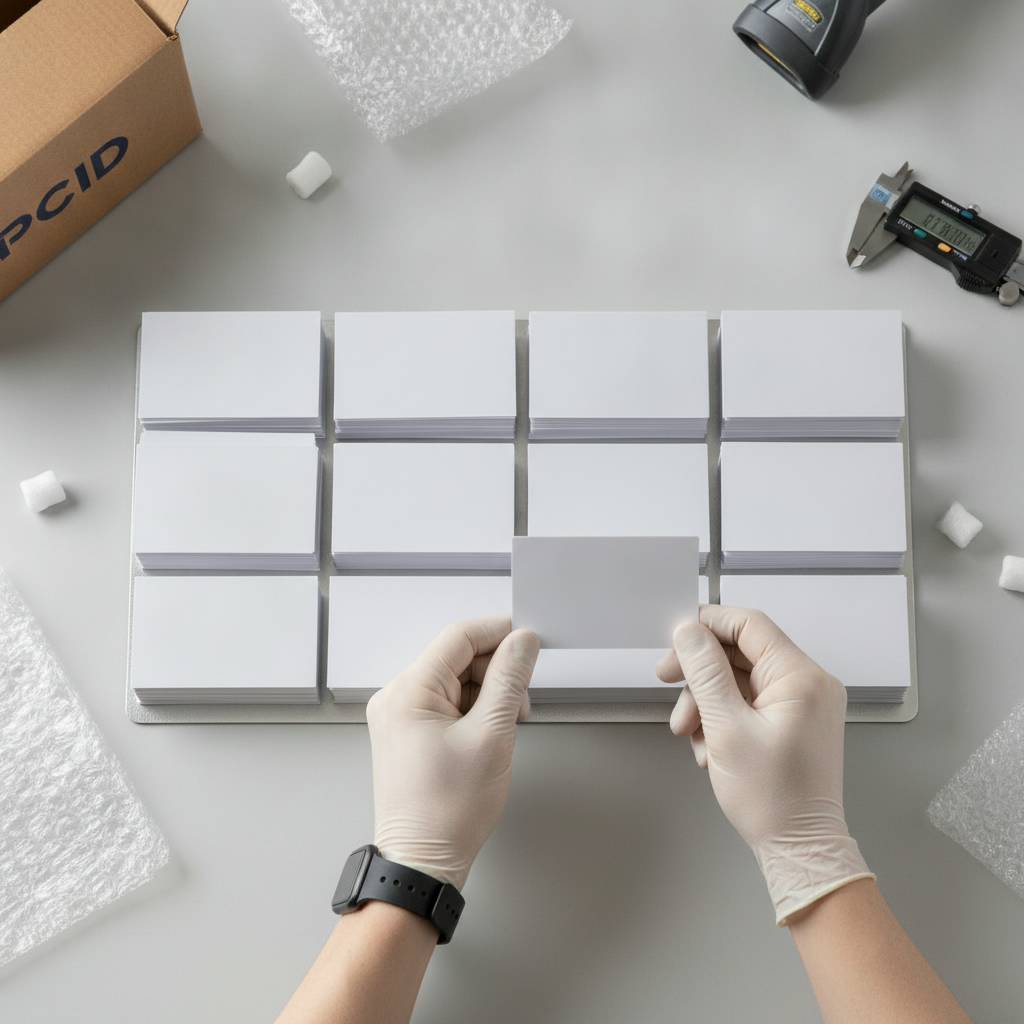 The moment your blank plastic card shipment arrives, a quick but thorough inspection is worth doing - not because problems are common, but because catching any issue immediately is vastly easier than discovering it after your team has already loaded cards into a printer. Train whoever receives shipments to follow a consistent inspection routine.
Start with the outer box. Look for crushing, moisture damage, or evidence of rough handling. A damaged box doesn't automatically mean damaged cards - the internal packaging often absorbs a lot of punishment - but it's a signal to inspect more carefully. Open the box and check card stacks for flatness, cleanliness, and count accuracy.
What to Check on Arrival
For standard blank PVC cards, run through this mental checklist before signing off on the delivery. Flat cards with no warping, clean surfaces free of scuffs or contamination, sealed packaging intact, and quantity matching your order confirmation. Most of these checks take under two minutes and can prevent downstream issues with your card printer or encoding equipment.
- Check outer box for crushing, moisture staining, or obvious impact damage
- Verify that internal packaging is intact and hasn't shifted significantly during transit
- Inspect card surfaces for scratching, scuffing, or contamination
- Confirm cards lie flat - warped cards can jam printers and cause ribbon waste
- Spot-count or full-count cards against your packing slip
- For magnetic stripe cards, verify stripe integrity with a test swipe on arrival
- For RFID and smart chip cards, test a sample card with your reader or encoder
Documenting any issues with photos at the time of delivery makes resolution dramatically faster and clearer for all parties. A quick photo of a damaged outer box and the affected cards inside eliminates ambiguity and speeds up any replacement or claims process.
Understanding Card Count and Tolerance
Blank plastic card orders are typically fulfilled to exact quantities, but it's worth understanding that manufacturing counts at high volume can sometimes yield minor variations. Plastic Card ID works to ensure accurate counts, and any shortfall outside acceptable tolerance should be reported promptly with your order number and delivery documentation ready.
Keep your packing slip until your order is fully confirmed and in use. It sounds obvious, but it's remarkable how often a packing slip gets discarded the day of delivery - and then becomes critically needed when a count question arises a week later. Store it digitally with a quick phone photo if physical filing isn't your team's strong suit.
What to Do If Something Isn't Right
Contact CPE immediately if your inspection turns up anything concerning - damaged cards, incorrect items, or quantity discrepancies. Prompt communication is the fastest path to resolution. Have your order number, delivery date, and documentation (photos if applicable) ready when you reach out. Most issues can be identified and addressed quickly when reported within the delivery window.
Call 800.835.7919 to speak directly with the team. Email works for non-urgent matters, but for time-sensitive card program issues, a phone call gets you to the right person faster. Our team has been handling these situations for over 25 years and can typically diagnose and resolve most delivery concerns on the first call.
Storing Blank Plastic Cards After Delivery
Receiving your cards properly is step one. Storing them correctly keeps them in print-ready condition for as long as your program requires. PVC cards are durable, but they're not immune to the effects of poor storage conditions - heat, humidity, direct sunlight, and contamination can all degrade card quality before they ever see the inside of a printer.
The ideal storage environment for blank PVC cards is climate-controlled, dry, and away from direct light. A temperature range of 65-75 degrees Fahrenheit with humidity below 50% is the sweet spot. This isn't exotic - most standard office or warehouse environments meet this criteria. What causes problems is storing cards in a hot garage, a damp basement, or near HVAC vents that cycle extreme temperatures.
Flat Storage and Stack Management
Cards should always be stored flat, never on their edge in a way that creates uneven pressure across the stack. Heavy objects placed on top of card boxes can cause warping, particularly in larger quantities. Keep card boxes in their original sealed packaging until ready for use - the original packaging is designed for exactly this purpose and does its job well.
For large card inventories, shelving that keeps boxes flat and off the floor is ideal. Floor-level storage in any environment creates exposure to moisture wicking and temperature fluctuation at ground level. Simple shelving at waist height significantly reduces the most common environmental risks for stored card stock.
Special Storage Considerations for Technology Cards
Magnetic stripe cards stored near magnets, magnetic closures on cabinets, or industrial equipment with motors can suffer stripe degradation over time - even without physical contact. Keep magnetic stripe card stock away from these sources, and label your storage area clearly so team members know not to store magnets or electronics alongside the card inventory.
RFID cards and smart chip cards should be stored away from strong electromagnetic fields and high static environments. Anti-static storage bags or the original anti-static packaging used during shipment are worth retaining for this purpose. A few minutes of correct storage setup protects hundreds or thousands of dollars in card inventory from avoidable degradation.
Reach the team at 800.835.7919 if you have questions about long-term storage for specialty card types - especially if your program involves infrequent but large-volume ordering cycles.
Rotation and Inventory Management for Ongoing Programs
For businesses running continuous card programs - employee badge systems, membership programs, retail loyalty card operations - first-in, first-out inventory rotation keeps your card stock fresh and avoids situations where older inventory sits untouched while newer shipments get used first. It's a small discipline with measurable impact on card quality consistency over time.
Customers who process 500 or more cards per month benefit from establishing a formal reorder trigger - a minimum on-hand quantity that automatically prompts a new order. Running a card program without a reorder buffer is one of the most common and avoidable operational mistakes in badge and loyalty programs. CPE can help you calculate the right buffer based on your monthly volume and typical shipping lead time.
Buyer Tips: Getting the Most From Every Blank Card Order
Twenty-five years of supplying blank plastic cards to over 100,000 U.S. customers generates a lot of practical knowledge about what separates smooth card programs from frustrating ones. Most of the friction buyers encounter is entirely preventable with a few well-placed habits and decisions made before the order is even placed.

The biggest single variable? Knowing your card specifications before you order rather than after. CR80 is the standard size (3.375 x 2.125 inches, 30 mil), but specialty programs sometimes require different dimensions, different thicknesses, or specific technology types. Confirming your printer's compatibility with the card type you're ordering takes five minutes and prevents a potentially costly mismatch.
Matching Cards to Your Card Printer
Not all blank PVC cards are compatible with all card printers. Evolis, Zebra, and Fargo printers each have defined card thickness tolerances and surface finish requirements. Using cards outside those tolerances causes feed errors, ribbon waste, and in worst cases, printer mechanism damage. Always confirm card thickness and finish compatibility with your specific printer model before ordering in bulk.
Plastic Card ID supplies card printers alongside blank card stock, which means our team can confirm compatibility across the entire card program supply chain - not just the cards in isolation. If you're unsure whether a specific blank card will run correctly in your printer, a quick call resolves that question before it becomes an expensive problem.
Ordering the Right Quantity the First Time
- Calculate your monthly card usage accurately - overestimating wastes budget, underestimating causes operational gaps
- Add 10-15% to your calculated need as a buffer for print errors, reprints, and unexpected demand spikes
- Consider whether seasonal programs (holiday gift cards, event passes) require separate surge inventory
- Take advantage of per-card price breaks at higher quantities - larger orders typically yield significantly lower per-card costs
- For new programs, start with a modest test quantity before committing to a large production run
The per-card economics of plastic are compelling when ordered correctly. Retailers who switch from paper gift certificates to blank PVC gift cards - printed and encoded in-house - routinely report 35-50% increases in gift card sales, and the per-card cost of that upgrade is often recovered within the first month of the program. Getting the quantity right from the start means those economics work in your favor faster.
Planning for Program Continuity
Card programs that work best are ones that run without interruption. An employee badge program that runs out of blank stock mid-month, or a loyalty program that can't issue cards during a busy weekend, loses both the immediate opportunity and some customer confidence. Continuity planning is part of running a professional card program - and it starts with reliable, consistent ordering habits.
CPE works with clients at every scale, from organizations printing 50 cards per month all the way through mass production programs in the tens of thousands. Whatever your volume, the same principle applies: know your reorder lead time, maintain a buffer, and build your ordering cadence around your actual usage pattern rather than an optimistic projection.
Ready to Order? Plastic Card ID Makes Every Step Simple
Shipping blank plastic cards isn't complicated when you understand the process - packaging protocols that protect your investment, transit windows that align with your program timeline, arrival inspection habits that catch issues before they become problems, and storage practices that keep your card stock in perfect condition between orders. Every piece of this process is designed to deliver cards that perform exactly as expected.
With over 25 years of experience, more than 50 million cards shipped, and a catalog that covers every blank card type a U.S. business could need - from standard PVC stock to clear frosted cards, magnetic stripe, RFID, smart chip, proximity cards, and specialty luxury metal cards - Plastic Card ID is the kind of partner that makes your card program run the way it should: reliably, professionally, and without surprises.
Contact Plastic Card ID today and speak with a card program specialist who can help you select the right blank cards, confirm shipping options, and get your order moving. Call 800.835.7919 now - your next card program starts here.