Blank White PVC Cards vs Printed Cards: Key Differences Explained
Table of Contents []
- Blank White PVC Cards vs Printed Cards: Which Is Right for Your Business? Plastic Card ID
- Understanding the Blank White PVC Card
- The Case for Pre-Printed Custom Cards
- Matching the Card Type to the Application
- Card Printers and the In-House Ecosystem
- Frequently Asked Questions: Blank vs Printed Cards
- Ready to Build Your Card Program? Contact Plastic Card ID Today
Blank White PVC Cards vs Printed Cards: Which Is Right for Your Business? Plastic Card ID
Every card program starts with a decision that shapes everything downstream: do you print in-house using blank white PVC cards, or do you order cards already printed and ready to hand out? It sounds simple. It rarely is. The answer depends on your volume, your timeline, your budget, and just how much control you want over the final product - and CPE has helped businesses work through exactly this question for more than 25 years.
What follows is a detailed, honest comparison - not a pitch, but a practical breakdown - of two legitimately powerful approaches to running a card program. Whether you are issuing 50 employee badges a month or scaling toward tens of thousands of loyalty cards, understanding the mechanics of each path will save you money, time, and frustration.
| Factor | Blank White PVC Cards | Pre-Printed Custom Cards |
|---|---|---|
| Upfront Cost | Lower per-card cost | Higher minimum order costs |
| Turnaround Speed | Print on demand | Lead time for production |
| Personalization | Total control, variable data | Consistent, fixed design |
| Volume Flexibility | Print as few or as many as needed | Best at high volume |
| Equipment Required | Card printer ribbons | None |
| Best For | ID cards, badges, access cards | Gift cards, loyalty, membership |
Understanding the Blank White PVC Card
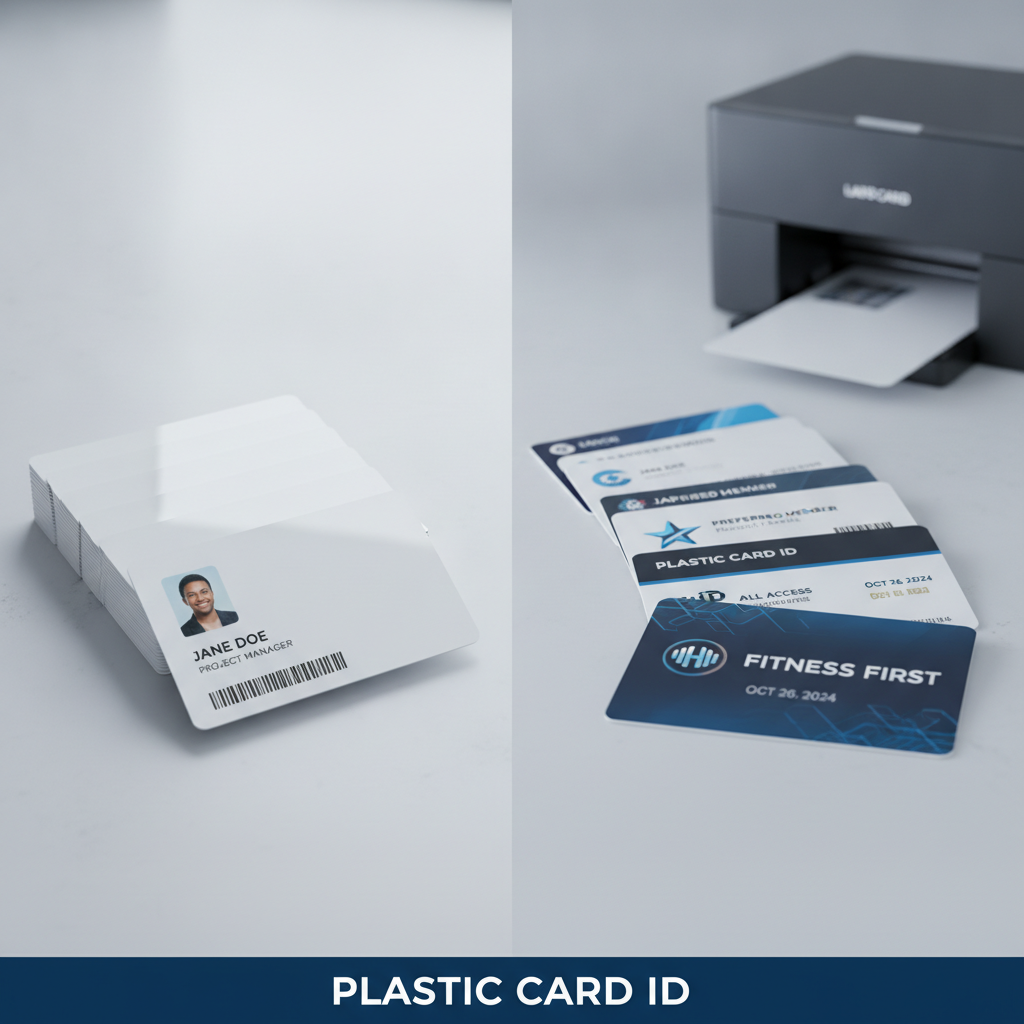 A blank white PVC card is, at first glance, almost deceptively plain. A smooth, clean, credit-card-sized piece of plastic conforming to the CR80 standard - 3.375 inches by 2.125 inches, 30 mil thick - sitting there waiting to become something. What it becomes is entirely up to you. That is precisely the point, and precisely why organizations ranging from hospitals to hotels have been relying on them for decades.
These cards conform to ISO 7810 standards, which means they fit every standard card printer, wallet slot, lanyard holder, and card reader you will encounter. They are not a compromise format. They are the universal format. Blank CR80 PVC cards are the workhorse of serious in-house card programs because they give you the raw material to produce virtually any card type your operation demands.
What Makes PVC the Right Material
PVC - polyvinyl chloride - offers a combination of durability, flexibility, and printability that other materials simply do not match at scale. Cards printed on PVC resist cracking, bending, and surface wear in ways that paper-laminate alternatives cannot. For cards that will be scanned, swiped, or handled daily, this matters enormously over the life of the card.
The surface of a blank white PVC card is engineered specifically to accept dye-sublimation and thermal transfer printing. That smooth, consistent finish is not accidental - it is what allows a card printer to lay down photo-quality images, crisp text, and edge-to-edge graphics without bleeding or distortion. The material itself is doing real work before a single pixel is printed.
Card Variants Within the Blank Category
Not every blank card is a plain white rectangle. CPE offers blank cards across a wide spectrum of configurations that extend far beyond the standard white core. HiCo and LoCo magnetic stripe cards, for instance, arrive blank and ready for in-house encoding - they simply carry a magnetic stripe on the back, waiting for data. Clear and frosted PVC cards offer translucency that creates sophisticated visual effects when printed. Colored PVC stock in black, gold, silver, and other finishes adds instant visual differentiation.
Smart chip cards, proximity cards, and RFID cards - including MIFARE DESFire configurations - are also available in blank form. The chip or antenna is embedded during manufacturing; the card arrives ready for encoding and printing. This is the same blank-card flexibility applied to access control and contactless applications. Blank does not mean basic.
The Total Cost Equation for Blank Cards
The economics of blank white PVC cards are compelling when you do the full math. Per-card costs are low, often dramatically lower than ordering pre-printed cards in modest quantities. Over time - and across tens of thousands of cards - that gap compounds. Yes, there is the upfront investment of a card printer and ongoing ribbon costs, but organizations running continuous card programs almost always find the in-house model cheaper per issued card once volume crosses a relatively modest threshold.
Beyond direct cost, there is the hidden value of on-demand issuance. Printing a card the moment someone needs it eliminates waste from pre-printed card stockpiles that become outdated when designs, logos, or employee rosters change. In-house printing gives you financial control and operational agility simultaneously - a rare combination in any supply chain decision.
The Case for Pre-Printed Custom Cards
Pre-printed cards arrive at your door complete. The design - your logo, colors, imagery, promotional text - is already on the card, produced by commercial-grade printing equipment capable of color fidelity and detail that desktop card printers cannot always match. For certain use cases, this is not a minor distinction; it is the whole game.
Gift cards are the canonical example. A retailer launching a gift card program wants cards that look as polished and intentional as the brand itself. The card is a marketing artifact as much as a payment instrument - it sits in a display rack, gets handed to customers, gets carried in wallets. Visual quality at this level is non-negotiable, and professionally printed cards consistently deliver it.
When Pre-Printed Cards Win on Volume
At high volumes - tens of thousands of identical or near-identical cards - pre-printed production becomes extremely cost-efficient. The setup cost is absorbed across a large run, driving down per-card pricing to levels that in-house printing cannot always match. For a national retail chain ordering 50,000 loyalty cards with a consistent brand design, pre-printed custom production is almost always the right answer.
Retailers who have switched from paper punch cards to plastic loyalty cards have seen measurable results that make the investment straightforward. Sales increases of 35-50% are documented among retailers who move to plastic gift cards from paper alternatives. The card itself - durable, professional, wallet-friendly - changes customer behavior in ways that a paper alternative simply cannot replicate.
Fixed Design Situations
Some card programs genuinely do not need variable data. A hotel key card branded with the property's logo. An event credential printed with the conference name and dates. A membership card for an organization where all members receive identical cards. In these situations, the personalization capability of in-house printing adds no value - the design is fixed, the quantity is known, and professional pre-printed production makes complete sense.
Club membership cards, casino player cards, and branded hotel key cards fall naturally into this category when volume supports it. The card needs to look exceptional and communicate brand identity at a glance. A beautifully printed custom card signals legitimacy and permanence in ways that even the best desktop printer has to work hard to match.
Specialty Card Formats and Pre-Printing
Specialty formats - custom die-cut shapes, luxury metal cards in stainless steel, brass, or gold, clear plastic cards with dramatic visual effects - are almost exclusively pre-printed by definition. These are not formats that in-house card printers handle. They require specialized production processes, and they arrive ready to use or encode.
For organizations that want cards as premium artifacts - the kind of card that a recipient notices and keeps - these specialty formats represent a meaningful investment in brand perception. A metal card carries tactile weight, literally and figuratively. It communicates a level of quality that even a perfectly printed PVC card cannot replicate.
Matching the Card Type to the Application
 The cleanest way to resolve the blank-versus-printed debate is to map card type against application requirements. Different programs have different priorities, and the right approach usually becomes obvious once those priorities are explicit. Here is how the most common applications tend to break down.
Employee ID and access control programs almost universally benefit from blank white PVC cards and in-house printing. Enrollment is continuous, individual data varies per card, photos need to be printed, and access credentials need to be encoded at issuance. The on-demand flexibility of blank cards is not just convenient - it is operationally essential for programs like these.
Employee Badges and ID Programs
A corporate ID program issuing cards to new hires, contractors, and visitors cannot practically wait on a pre-printed card order every time someone needs a badge. The blank card plus card printer model was essentially designed for this situation. You load blank cards, open your ID software, pull the employee record, and print. The card is in hand in minutes, not days.
Access control integration adds another layer of capability. Blank cards with embedded proximity chips or magnetic stripes can be simultaneously printed and encoded during issuance, producing a fully functional access card and visual ID in a single pass through the printer. For security-sensitive environments, this matters. There is no gap between credential issuance and access activation when everything happens in-house at the moment of enrollment.
Loyalty and Membership Programs
Loyalty and membership programs often benefit from a hybrid approach. The base card design - the brand, the logo, the color scheme - can be printed commercially in large quantities at excellent per-card cost. Member-specific data (name, member number, barcode) can then be added in-house using a card printer, or the base card can be issued as-is if the program links member data to an account rather than encoding it on the card itself.
Loyalty cards that live in wallets consistently outperform paper punch cards in both engagement and redemption rates. The physical durability of a PVC card means it stays in the wallet rather than getting crumpled and discarded. Plastic loyalty cards are a retention tool, not just a convenience, and their presence in a customer's wallet is a daily brand impression that paper cannot sustain.
Event Credentials and Temporary Access Cards
Events present a unique challenge: you often do not know final attendee details until shortly before the event, but you need professional-looking credentials ready at check-in. Blank PVC cards printed on-site solve this elegantly. A card printer at the registration desk, loaded with blank cards, can produce attendee badges instantly as people check in - complete with name, photo, and any access tier designations.
For large, recurring events with consistent branding across hundreds or thousands of attendees, pre-printing the card shell (background design, event branding, security features) and personalizing in-house at registration combines the visual quality of commercial printing with the flexibility of on-demand issuance. This hybrid model is increasingly common among professional event organizers who want both quality and speed.
Card Printers and the In-House Ecosystem
Committing to blank white PVC cards means committing to a card printing ecosystem. That is not a burden - it is an investment in operational capability. But it is worth understanding what that ecosystem looks like and what it requires to function well.
CPE carries card printers from three of the industry's most respected manufacturers: Evolis, Zebra, and Fargo. Each brings a distinct positioning to the market, and the right choice depends on your volume, your required card features, and your budget. What they share is compatibility with standard CR80 blank PVC cards and reliable, repeatable output quality.
Choosing the Right Card Printer
Entry-level printers from brands like Evolis handle single-sided printing beautifully for lower-volume programs - a small business issuing employee badges, a gym printing membership cards, a school producing student IDs. Mid-range and high-volume models from Zebra and Fargo add duplex printing, lamination, encoding options for magnetic stripe and smart card programming, and throughput rates measured in hundreds of cards per hour.
The printer selection decision should be made in parallel with the card program design, not after. If you know you will be encoding magnetic stripes and printing duplex cards at 200 cards per hour, that dictates a different hardware investment than a 10-cards-per-day badge program. Matching printer capability to program requirements prevents both under-investment and over-spending.
Ribbons, Supplies, and Ongoing Costs
Card printer ribbons are consumables that need to be factored into total program cost. A full-color YMCK ribbon capable of printing approximately 250-500 cards typically costs in the range of $50-$150 depending on printer model and ribbon type. Monochrome ribbons for simple text and barcode printing are less expensive and cover more cards per ribbon. Planning ribbon consumption based on monthly card volume gives you a reliable ongoing cost baseline.
Cleaning kits are not optional accessories - they are maintenance requirements that extend printer life and protect print quality. A printer running dirty will produce inconsistent output and wear out faster. Card carriers, sleeves, and lanyards round out the accessory ecosystem, particularly for ID badge programs where the card needs to be displayed rather than just carried. A complete supply chain from blank card to finished, worn badge is something CPE covers end to end.
Getting Support When You Need It
Over 100,000 customers and more than 50 million cards sold means CPE has seen virtually every card program configuration imaginable. That depth of experience translates into genuinely useful guidance when clients are making setup decisions, troubleshooting print quality issues, or scaling a program that has grown beyond its original design. The relationship does not end at the sale.
For businesses setting up their first card program, this kind of support is worth more than it might initially appear. Getting the card type, printer, ribbon, and encoding configuration right from the start avoids costly do-overs. Experience in a supplier is not a soft benefit - it is a hard one that shows up in fewer mistakes and faster ramp-up to a functioning program. To speak with a specialist, call 800.835.7919 and get personalized guidance for your specific program needs.
Frequently Asked Questions: Blank vs Printed Cards
After decades of helping businesses design and run card programs, certain questions come up consistently. Here are honest answers to the ones that matter most when you are deciding between blank white PVC cards and pre-printed custom cards.
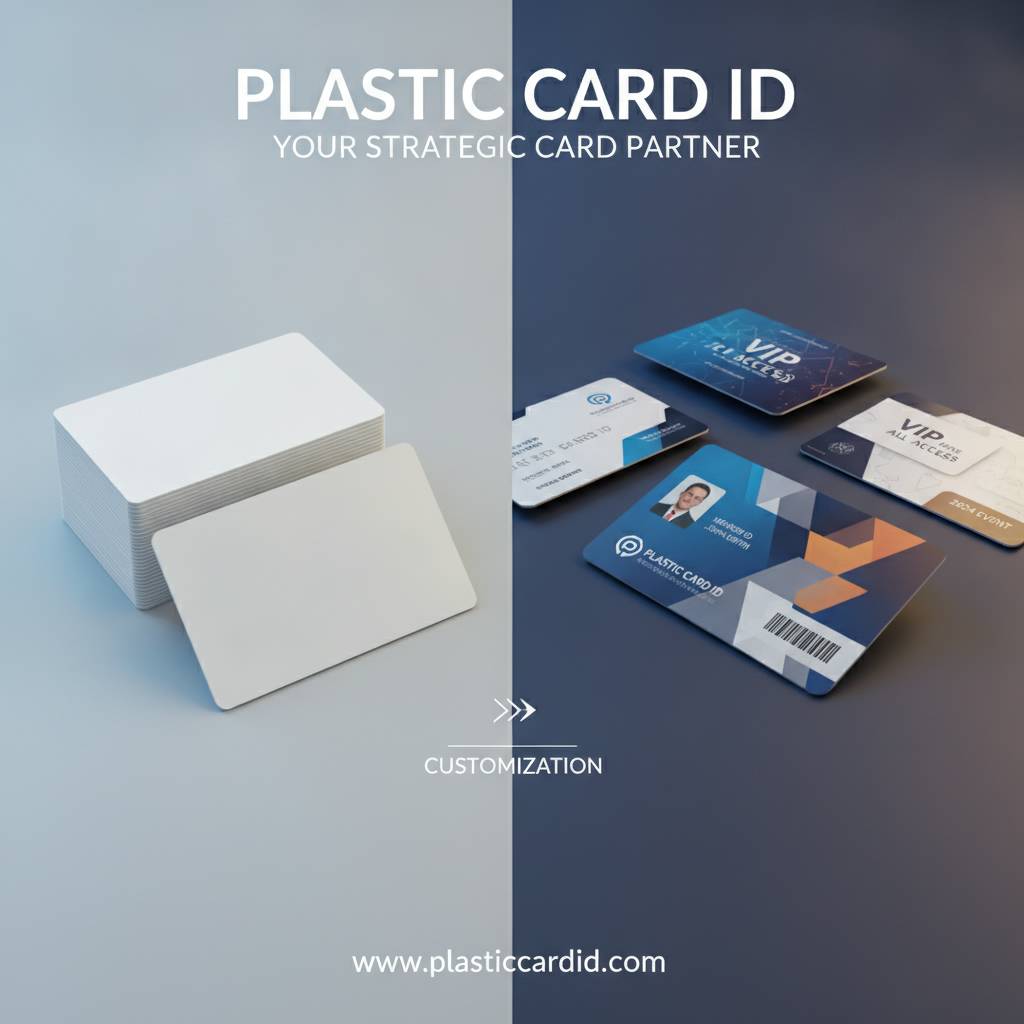
Common Questions About Blank White PVC Cards
- What is the minimum quantity for blank PVC cards? Quantities as low as 50-100 cards are typically available, making blank cards accessible even for small organizations just getting started.
- Can I print photos on blank PVC cards? Yes - full-color dye-sublimation card printers produce photo-quality output on blank PVC. This is standard for employee ID and access badge programs.
- Do blank cards come with magnetic stripes or chips? Blank cards are available in standard white, with HiCo or LoCo magnetic stripes, with proximity chips, with RFID/smart chip configurations, and in clear or colored variants. Blank simply means unprinted, not featureless.
- How long does a PVC card last? Standard 30 mil PVC cards are designed for years of regular use. Cards subject to heavy daily handling - like access cards - typically last 2-5 years depending on conditions.
- Is the print from a card printer as good as commercial printing? For most ID and badge applications, absolutely. For very high-fidelity brand graphics at large scale, commercial printing may have a quality edge, which is why some programs use a hybrid approach.
Common Questions About Pre-Printed Custom Cards
Pre-printed cards generate questions primarily around minimums, turnaround, and design control. Minimum order quantities vary by card type and configuration, but most programs become cost-effective at a few hundred cards or more. Turnaround time accounts for design approval, production, and shipping - typically measured in days to a couple of weeks depending on complexity and volume.
Design control is strong with pre-printed cards in the sense that what you approve in the proof is what you receive. Variation between cards in the same run is essentially zero, which is exactly what you want for consistent brand presentation. Pre-printed cards deliver uniformity and brand fidelity at scale better than any in-house option.
Hybrid Program Strategies
The most sophisticated card programs often use both approaches deliberately. A national gym chain might order a large run of branded membership cards pre-printed with their visual identity, then use in-house printing to add member photos and names at each location. A hotel might use pre-printed key card shells with their branding, then encode them at the front desk for each guest's stay without printing anything additional.
Recognizing that blank and pre-printed are not mutually exclusive - that they can serve complementary roles within a single program - is one of the more valuable insights that experience in this industry provides. The best card program design is the one that matches every component to its job. CPE can help you map that out regardless of where you are starting from.
Ready to Build Your Card Program? Contact Plastic Card ID Today
Whether you are standing up your first employee badge program, scaling a loyalty initiative, or rethinking a card setup that has outgrown its original design, the path forward starts with getting the fundamentals right. Blank white PVC cards or pre-printed custom cards - or a deliberate combination of both - there is a configuration that fits your volume, your timeline, your budget, and your brand.
The decision does not have to be complicated when you have the right partner guiding it. CPE has helped more than 100,000 businesses across the United States build card programs that work - programs that run smoothly, look professional, and deliver the measurable results that plastic cards consistently produce over their paper and digital alternatives.
Call Plastic Card ID at 800.835.7919 today. Whether you need 50 cards or 50,000, Plastic Card ID has the cards, the printers, the supplies, and the expertise to make your program a success from day one.
Previous Page