How Proximity Cards Work for Building Security
Table of Contents []
- How Proximity Cards Work for Building Security - Plastic Card ID
- The Science Behind Contactless Access
- Types of Proximity Cards and Smart Card Technologies
- Building a Complete Access Control Card Program
- Practical Security Considerations for Proximity Card Deployments
- Frequently Asked Questions About Proximity Cards and Building Security
- Why Plastic Card ID Is the Right Source for Your Proximity Card Program
How Proximity Cards Work for Building Security - Plastic Card ID
Walk up to a secured door, hold a card near a reader, and the lock clicks open in under a second. No PIN, no fumbling for keys, no contact required. That seamless experience is powered by proximity card technology - and once you understand what is happening beneath the surface, you realize just how sophisticated these little cards actually are.
Proximity cards have quietly become one of the most relied-upon tools in physical access control across the United States. Hotels, corporate campuses, hospitals, schools, government facilities, warehouses - virtually every category of commercial building that needs to manage who goes where has adopted proximity-based access in some form. CPE has spent decades helping organizations deploy these systems at every scale imaginable.
| Card Type | Frequency | Typical Read Range | Common Use Case |
|---|---|---|---|
| Standard Proximity (125 kHz) | 125 kHz | 2-5 inches | Office access, time and attendance |
| HID iCLASS | 13.56 MHz | Up to 4 inches | Healthcare, government, enterprise |
| MIFARE DESFire | 13.56 MHz | Up to 4 inches | High-security, multi-application |
| Long-Range RFID | Varies | Up to 30 feet | Parking gates, vehicle access |
The Science Behind Contactless Access
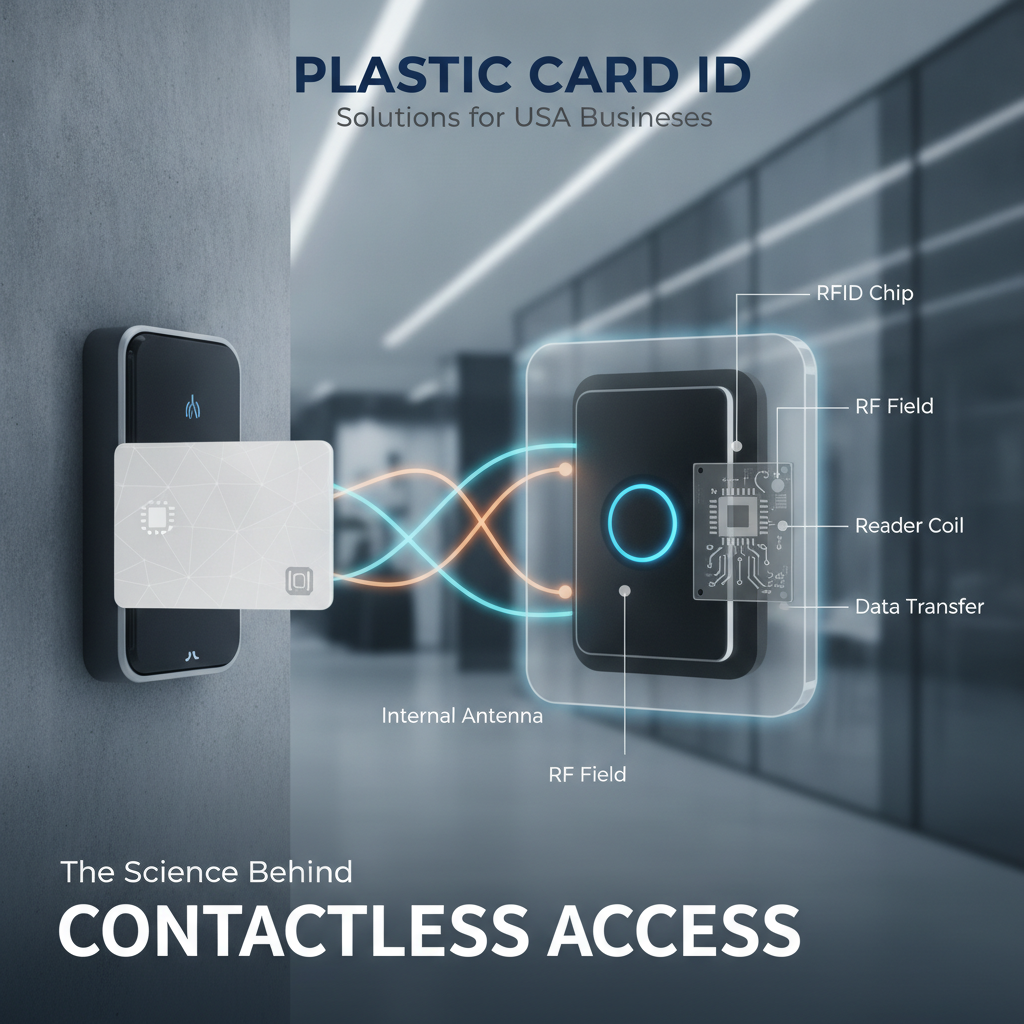 At its core, a proximity card is a passive radio frequency identification device. There is no battery inside. The card sits dormant until a compatible reader broadcasts an electromagnetic field - typically at 125 kHz for legacy systems or 13.56 MHz for modern smart card platforms. The moment the card enters that field, energy is harvested by the card's internal antenna coil, powering up the embedded microchip just long enough to transmit its unique identifier.
That transmitted ID travels back to the reader in milliseconds. The reader passes it along to an access control panel, which checks the credential against a database of authorized users. If it matches, the door unlocks. If it doesn't, it stays shut. The whole transaction - from card presentation to door response - happens faster than a human blink. The elegance of the technology is that it demands almost nothing from the user while delivering precise, auditable control to building managers.
The Antenna and Chip: What's Actually Inside a Proximity Card
Crack open a standard CR80 proximity card (though we wouldn't recommend it) and you'd find a paper-thin copper or aluminum antenna coil winding in loops around the card's perimeter, connected to a microchip smaller than a grain of rice. The antenna is laminated between PVC layers, giving the card its rigid, professional feel while protecting the electronics from moisture, flex stress, and everyday wear.
The chip stores a facility code and card number - together forming a unique identifier that distinguishes one cardholder from another across an entire access control system. In standard 26-bit Wiegand format, the most common legacy encoding, the system supports up to 255 facility codes with thousands of unique card numbers within each. More advanced formats extend well beyond this, accommodating enterprise deployments of virtually any size.
Wiegand Protocol and How Data Travels to the Panel
The Wiegand protocol is the language most proximity card readers use to communicate with access control panels. Named after John Wiegand, who discovered the unusual magnetic properties used in early card stripes, the protocol has evolved into a purely electronic data-transfer standard transmitted over a simple two-wire connection. It remains the dominant communication standard in North American access control despite being decades old.
When a card is read, the reader sends a stream of binary data - ones and zeros - down the Wiegand wire pair. The access panel receives this burst of data and compares it against its permission database. One valid match, and a relay activates, releasing the door strike or magnetic lock. Invalid credential? The panel logs the attempt and the door stays secured. Every transaction, successful or denied, can be recorded with timestamp and location.
Read Range: How Close Is Close Enough?
Standard proximity cards operate effectively at distances of two to five inches from the reader surface. This is intentional - it forces deliberate card presentation, reducing accidental reads and ensuring the right person is actively attempting access. Long-range readers exist for specific applications like parking garage entry, where a card mounted on a vehicle dashboard can be read from up to three feet away.
The read range of any given card-reader pair depends on the antenna size in both the card and the reader, the operating frequency, and environmental interference. Metal surfaces near readers can absorb RF energy and reduce range. Proper reader mounting away from metal framing and conduit is a standard installation consideration that affects system reliability significantly.
Types of Proximity Cards and Smart Card Technologies
The broad term "proximity card" covers a spectrum of technologies with meaningfully different security profiles, capabilities, and price points. Choosing the right card type for your facility isn't just a procurement decision - it directly determines how well protected your building will be and how flexibly the system can grow with your organization.
Legacy 125 kHz proximity cards are still widely deployed and work reliably for access control applications where high-level security encryption isn't the primary concern. Modern 13.56 MHz smart card platforms like HID iCLASS, MIFARE Classic, and MIFARE DESFire layer cryptographic security on top of the basic read/write functions, making credential cloning exponentially more difficult for would-be intruders.
125 kHz Proximity Cards: Proven Workhorses
The original proximity card format - operating at 125 kHz - has been securing commercial buildings since the 1990s. Cards like the HID Prox, EM4100, and similar formats broadcast a fixed, unencrypted identification number to any compatible reader within range. They are simple, durable, and remarkably cost-effective at scale, which explains their continued prevalence across mid-market commercial facilities throughout the United States.
The limitation worth acknowledging is that fixed-code transmission without encryption means a determined attacker with inexpensive equipment can intercept and clone the card signal. For facilities requiring only basic access separation - employee areas versus public areas in a low-risk environment - 125 kHz proximity remains a practical, economical choice. For higher-security environments, upgrading to encrypted smart card technology is strongly advisable.
13.56 MHz Smart Cards: Encrypted, Versatile, Powerful
MIFARE DESFire EV2 and EV3 cards represent the current gold standard in contactless smart card security. Operating at 13.56 MHz, these cards engage in a mutual authentication handshake with the reader before transmitting any data - each side of the transaction proves its legitimacy before information changes hands. The credential data itself is encrypted using AES-128 cryptography, the same standard used to protect sensitive government communications.
Beyond access control, these cards support multiple applications on a single chip - one card can serve simultaneously as a building access credential, a cashless vending token, a time-and-attendance badge, and an IT login authenticator. CPE supplies these advanced MIFARE DESFire cards for organizations that want to consolidate multiple credential functions into a single, professional plastic card that employees actually want to carry.
Comparing Card Technologies Side by Side
- 125 kHz Proximity: No encryption, fixed code, wide reader compatibility, lower cost per card, suitable for basic access control applications
- 13.56 MHz MIFARE Classic: Basic encryption, rewritable sectors, widely deployed in transit and campus environments, good middle-ground security
- MIFARE DESFire EV2/EV3: AES-128 encryption, mutual authentication, multi-application capable, highest security level for commercial access control
- HID iCLASS: Encrypted 13.56 MHz platform, dominant in healthcare and government, compatible with extensive HID reader ecosystem
- Long-Range RFID: Designed for hands-free vehicle access, parking control, and logistics environments where distance reading is essential
Building a Complete Access Control Card Program
 Knowing how the technology works is only half the battle. Implementing an effective proximity card program requires thinking through card management, personnel procedures, printer infrastructure, and ongoing supply logistics. Organizations that treat this as a one-time purchase often find themselves struggling with inconsistent card quality, mismatched encodings, or supply chain gaps that leave card programs in limbo.
A strategic partner - not just a box-shipper - makes the difference between a card program that runs smoothly for years and one that creates headaches every quarter. CPE approaches every client relationship with the intention of becoming that long-term partner, supplying not just cards but the printers, ribbons, cleaning kits, and expertise to keep programs running without friction.
Selecting the Right Card Printer for In-House Issuance
Organizations that issue cards frequently - new employee onboarding, visitor management, temporary credentials, replacement cards - benefit enormously from in-house card printing capability. Desktop card printers from Evolis, Zebra, and Fargo handle CR80 cards with precision, printing full-color photos, logos, text, and barcodes in minutes. Encoding modules can simultaneously write magnetic stripe data or program RFID/smart card chips during the same print pass.
Printer selection depends on print volume, required print quality, and whether dual-sided printing and lamination overlay are needed for durability. Entry-level printers suit organizations issuing a few dozen cards monthly. Higher-volume organizations running hundreds to thousands of cards per month benefit from faster throughput models with larger ribbon capacity and automated input hoppers that reduce manual intervention significantly.
Card Quantities, Costs, and Program Scaling
One of the most common questions facilities managers ask is how many cards to order at once. Ordering in larger quantities consistently lowers the per-card cost, which matters when you're managing hundreds of cardholders with regular turnover. Blank proximity cards ordered in bulk give in-house printing programs maximum flexibility - cards can be personalized on demand without the lead time required by pre-printed custom orders.
Small organizations starting with 50-100 cards monthly can scale to thousands per month using the same card stock and printer infrastructure, simply adding ribbon capacity and cleaning supplies as volume grows. CPE serves clients across this entire spectrum, with pricing structures and support resources calibrated to programs of every size, from small nonprofit membership offices to large multi-facility enterprise deployments.
Get Expert Guidance on Your Card Program
Choosing the right proximity card technology, printer, and accessories doesn't have to be complicated when you have experienced people in your corner. Call 800.835.7919 to speak directly with a specialist who understands access control card programs inside and out. No scripts, no generic answers - just real expertise applied to your specific situation.
Practical Security Considerations for Proximity Card Deployments
No access control system is stronger than its weakest procedural link. Proximity cards are powerful tools, but they require thoughtful policies around issuance, deactivation, and physical handling to realize their full security potential. A card in the wrong hands - whether lost, stolen, or cloned - can be every bit as damaging as a lock with no key management.
The most critical moment in any access control system is deactivation. When an employee leaves, a contractor's project ends, or a card is reported lost, that credential must be immediately removed from the authorized list at the access control panel. Organizations with clean offboarding procedures experience dramatically fewer unauthorized access incidents than those with lax card retirement processes.
Anti-Cloning Measures and Credential Security
For facilities genuinely concerned about credential cloning - a real and growing threat as 125 kHz card readers become more prevalent - the solution is migration to encrypted 13.56 MHz smart card technology. MIFARE DESFire's mutual authentication protocol makes cloning attacks orders of magnitude harder because capturing the RF transmission yields encrypted data that is computationally infeasible to reverse without the cryptographic keys.
Some organizations add a secondary factor requirement to high-security zones - combining proximity card presentation with a PIN entry or biometric scan. This layered approach, known as multi-factor authentication, ensures that even a successfully cloned card cannot unlock the door without the additional factor. CPE supplies cards compatible with the full range of combined credential readers available in the commercial market.
Card Carrier and Sleeve Accessories for Professional Programs
Physical card protection extends credential lifespan and maintains professional appearance across an organization's workforce. Card sleeves protect proximity cards from scratching and contamination while still allowing contactless reads - the RF signal passes through most plastic sleeve materials without meaningful interference. Retractable badge reels and clip-on badge holders make card presentation easier and reduce the likelihood of cards being left at desks instead of carried.
Card carriers serve a dual purpose in mailing programs - protecting cards in transit while doubling as a branded communication piece when new credentials are issued to remote employees or distributed members. CPE stocks a complete range of card accessories designed to complement every type of card program, ensuring organizations project consistency and professionalism from card issuance to daily use.
Frequently Asked Questions About Proximity Cards and Building Security
Organizations evaluating proximity card systems often arrive with a common set of questions - concerns about compatibility, security, longevity, and program logistics. Addressing these directly helps decision-makers move forward with confidence and avoid common mistakes that derail card programs before they gain traction.
What follows are the most frequently asked questions CPE encounters when working with new clients exploring contactless access control for the first time or upgrading from legacy systems.
Can Proximity Cards Work with My Existing Access Control System?
In most cases, yes - particularly if your existing system uses Wiegand interface readers and a standard access control panel. The Wiegand protocol's universality means cards from various manufacturers can communicate with a wide range of installed readers. The critical variable is matching the card's encoding format - bit length and data structure - to what the reader and panel expect to receive. An experienced supplier can identify the correct card specification for your installed infrastructure.
Upgrading from 125 kHz to 13.56 MHz smart cards requires replacing readers since the two frequency bands are not interoperable. Many organizations phase this transition by replacing readers in highest-security zones first while maintaining legacy proximity in lower-risk areas, creating a dual-technology environment managed through a common access control platform.
How Long Do Proximity Cards Last?
Well-manufactured PVC proximity cards have operational lifespans of five to ten years under normal use conditions. The PVC laminate protects the internal antenna and chip from moisture and physical damage, making them substantially more durable than paper-based credentials or older magnetic stripe-only cards. Chips and antennas inside quality proximity cards are rated for hundreds of thousands of read cycles - far exceeding what any normal cardholder will accumulate.
The practical end of a proximity card's life is usually administrative rather than technical - an employee departure, role change, or security policy update requiring credential rotation - long before the card physically fails. Organizations should plan card replacement cycles around their security audit schedules rather than expecting hardware failure to trigger the replacement.
What Is the Difference Between Proximity Cards and Smart Cards?
The terms are often used interchangeably but describe meaningfully different technologies. Traditional proximity cards (125 kHz) transmit a fixed, unencrypted identifier. Smart cards (13.56 MHz platforms like MIFARE DESFire) engage in an encrypted, authenticated dialogue with the reader, storing and processing data with far greater security and versatility. All smart cards used contactlessly are technically RFID devices, but not all proximity cards are smart cards.
- Proximity cards: Simple, fast, economical, fixed code, no encryption
- Smart cards: Encrypted, multi-application, higher security, slightly higher cost per card
- Both formats: CR80 standard size, contactless operation, compatible with access control panels via Wiegand interface
- Key decision factor: Match the technology to your actual threat model and operational requirements
Why Plastic Card ID Is the Right Source for Your Proximity Card Program
There is a real difference between a company that ships boxes and a company that helps you build something that works. Proximity card programs touch your facility's physical security, your employees' daily experience, and your organization's professional image simultaneously. Getting the cards, the printers, the accessories, and the expertise right from the start saves money, time, and significant operational frustration over the life of the program.
CPE has helped more than 100,000 customers across the United States deploy card programs of every description - from small office access programs with 50 cards to enterprise deployments spanning tens of thousands of credentials across multiple facilities. That breadth of experience means real-world insight into what works, what doesn't, and how to avoid the procurement mistakes that organizations without a strategic card partner so frequently make.
A Full Catalog Built for Serious Card Programs
Every component your proximity card program needs lives in one place. Blank PVC cards in standard CR80 30 mil thickness, proximity and RFID smart cards across all major frequency formats, card printers from Evolis, Zebra, and Fargo, printer ribbons, cleaning kits, card sleeves, badge holders, card carriers, and mailing services - the complete toolkit for building and sustaining a professional access control card program without juggling multiple suppliers.
Specialty options extend well beyond the basics. Clear and frosted PVC cards, custom die-cut shapes, luxury metal cards in stainless steel, brass, and gold, and full custom printing programs give organizations the flexibility to build cards that align with their brand and culture while maintaining the technical performance their security infrastructure demands.
Scalable Supply for Programs of Every Size
Whether your program issues 50 cards per month or tens of thousands, the supply relationship needs to be reliable, consistent, and properly priced for your actual volume. CPE structures supply arrangements to accommodate growth without forcing organizations to commit to quantities that don't match their current operational reality. Start where you are. Scale when you're ready. The supply infrastructure grows with you.
Consistent card quality matters more than most buyers realize until they experience an inconsistent supplier. Proximity cards with antenna defects or delamination issues create access control failures at the worst possible moments - during high-traffic entry rushes, shift changes, or security-sensitive events. CPE's sourcing standards and quality controls keep defect rates negligible across programs of every size.
Ready to Talk? Reach the Team That Knows Cards
No automated system, no offshore call center. When you call, you speak with people who understand proximity card technology, access control infrastructure, and the practical realities of running a card program for a real organization. That kind of direct expertise is genuinely rare in the card supply industry, and it makes a measurable difference in program outcomes.
Reach the team at 800.835.7919 to discuss your proximity card requirements, get recommendations on card type and quantity, or explore printer and accessory options that fit your program's specific needs. The conversation is free. The expertise is real.
Contact Plastic Card ID today at 800.835.7919 - your strategic partner for proximity cards, access control credentials, and complete card program solutions across the United States.
Previous Page