Microtext Security Printing on Plastic ID Cards
Table of Contents []
- Why Plastic Card ID Trusts Microtext Security Printing to Protect Plastic ID Cards
- What Microtext Security Printing Actually Is
- Plastic ID Card Types That Benefit Most From Microtext
- How to Implement Microtext in Your Card Design Program
- Security Card Program Buyer's Guide: What to Ask Before You Order
- Card Security Features That Work Alongside Microtext
- Plastic Card ID Is Your Partner for Secure Plastic ID Card Programs Across the USA
Why Plastic Card ID Trusts Microtext Security Printing to Protect Plastic ID Cards
Security threats to identity cards are not abstract - they are daily, deliberate, and increasingly sophisticated. Organizations issuing employee badges, membership cards, access credentials, and event passes face a real challenge: how do you make a card that looks professional, functions reliably, and resists counterfeiting without turning every card into an expensive production project? Microtext security printing answers that question with elegant, scalable precision.
Microtext involves printing text so small - typically between 0.2mm and 0.5mm in height - that it appears as a decorative line or background element to the naked eye, yet reveals legible words or codes under magnification. It is one of the most cost-effective and visually unobtrusive security layers available for plastic ID cards, and when combined with quality PVC card stock and professional card printing equipment, the results are remarkably difficult to reproduce fraudulently.
Plastic Card ID has spent over 25 years helping businesses across the United States build card programs that work. With more than 50 million cards sold and over 100,000 customers served, CPE understands that security is not a luxury feature - it is a foundational requirement for any card that represents identity, access, or value.
| Feature | Benefit | Best Application |
|---|---|---|
| Sub-0.5mm text lines | Invisible to casual counterfeiters | Employee ID cards |
| Embedded in design patterns | Blends with artwork seamlessly | Membership and loyalty cards |
| Readable under loupe or scanner | Easy in-house verification | Access control credentials |
| Difficult to replicate by inkjet | Raises the bar for forgery attempts | Event and VIP passes |
| Combinable with magnetic stripe | Layered security in one card | Casino player cards, hotel keys |
What Microtext Security Printing Actually Is
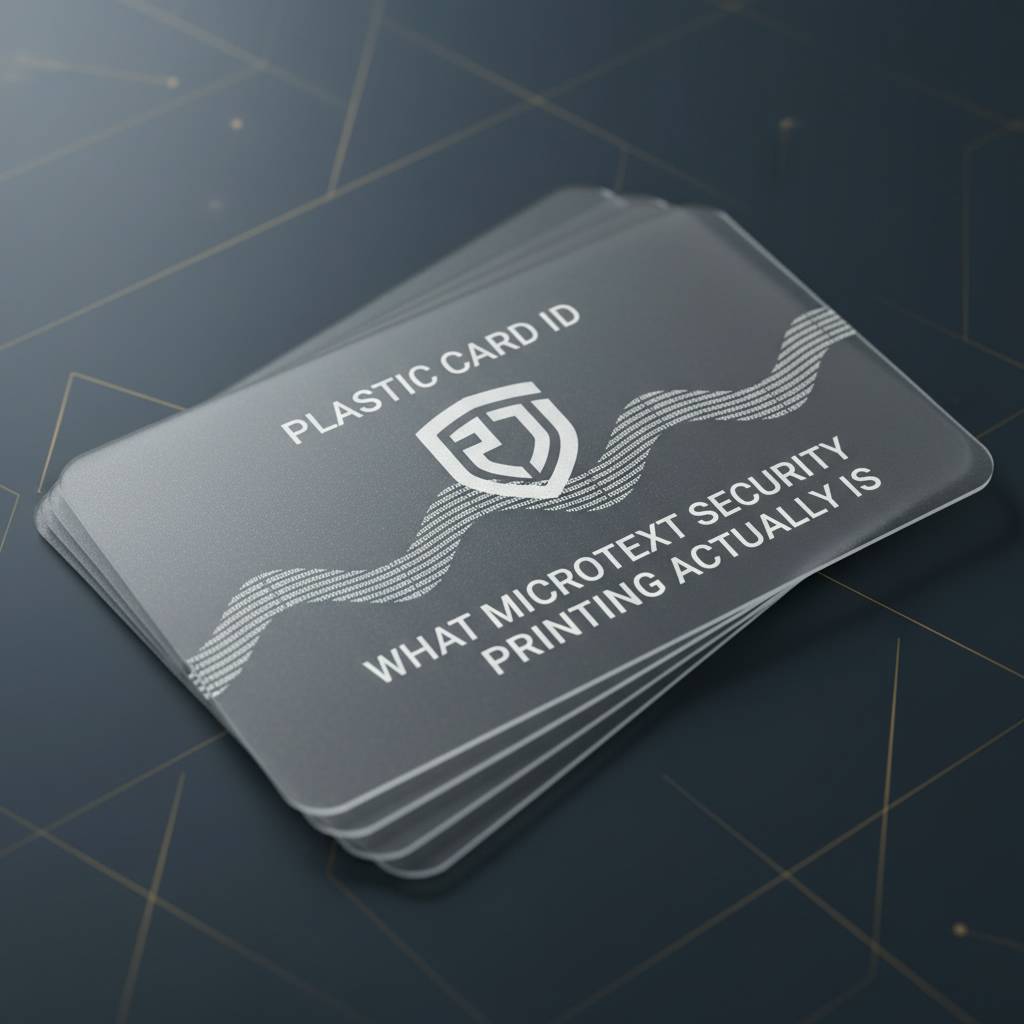 Strip away the technical language and microtext is a beautifully simple idea: hide words in plain sight. A border that looks purely decorative might actually read "AUTHORIZED PERSONNEL ONLY" in 0.3mm characters. A background gradient that seems like abstract design may contain a repeating encoded serial pattern. These elements do not interrupt the visual identity of the card - they strengthen it while doing invisible security work.
The technology has migrated from government-issued documents and currency into the commercial card market as printing resolution has improved dramatically. Modern direct-to-card and retransfer card printers available through CPE are capable of rendering microtext with sufficient sharpness that the technique becomes genuinely practical for mid-to-large card programs without requiring industrial offset printing.
The Science Behind the Tiny Text
Resolution is everything with microtext. A printer operating at 300 DPI can approximate microtext but may produce characters that blur or bleed into one another - defeating the purpose. At 600 DPI and above, the precision required to render individual strokes of a 0.3mm character becomes achievable, resulting in text that is crisp under magnification and meaningless to a cursory visual scan.
The PVC card substrate matters just as much as the printer. Cards printed on premium 30 mil CR80 PVC stock hold ink and dye-sub layers more cleanly than thinner, lower-quality alternatives. The card itself is a security component, not merely a canvas - and choosing the right blank card from the start determines how well any security feature ultimately performs.
Microtext vs. Other Card Security Features
Holographic overlaminates, UV-reactive ink, guilloche patterns, and microtext are not competing technologies - they are complementary layers. Each addresses a different attack vector. Holograms are difficult to replicate visually. UV ink is invisible under normal light. Guilloche creates complex line patterns. Microtext targets the replication step: a counterfeiter who manages to copy the visible design still has to reproduce text that most office printers simply cannot render at the required resolution.
What makes microtext especially practical for organizations working with Plastic Card ID is that it adds security without adding significant cost. Unlike embedded RFID chips or smart card microprocessors, microtext is purely a design and printing consideration. Once the card art is set up correctly, every card in the print run carries the feature automatically.
Common Misconceptions About Microtext
One widespread misconception is that microtext requires specialized reader hardware. It does not. A standard jeweler's loupe or even a strong smartphone camera in macro mode can reveal microtext for verification purposes. This makes it accessible for front-line staff who need to confirm card authenticity quickly and without expensive equipment.
Another myth is that microtext is only viable on government or financial credentials. In reality, any organization that issues ID cards, access passes, membership credentials, or loyalty cards can benefit from this feature. Businesses of any size can deploy microtext as part of a serious card security strategy.
Plastic ID Card Types That Benefit Most From Microtext
Not every card needs microtext, but several categories of plastic ID cards gain measurable security value from including it. Understanding which applications benefit most helps organizations make smarter decisions about where to invest in security features versus where standard printing is entirely sufficient.
The selection of card type also influences how microtext is implemented. A card with heavy graphic design provides more opportunities to embed microtext within decorative elements. A minimalist access card with a clean white background may use microtext as a subtle border or watermark-style background pattern - equally effective, just differently positioned within the layout.
Employee ID Badges and Access Credentials
Employee ID cards are among the highest-stakes credentials an organization produces. A fraudulent badge that passes a visual inspection can compromise physical security across an entire facility. Microtext on employee ID cards creates a verification layer that security personnel can check when a card looks even slightly off - different laminate sheen, slightly different color saturation, or an unusual thickness can all prompt a closer look that microtext either passes or fails conclusively.
When combined with HiCo magnetic stripe encoding available through CPE, an employee badge carries both electronic and visual security simultaneously. This dual-layer approach is highly effective at deterring low-to-mid sophistication forgery attempts, which account for the vast majority of credential fraud incidents in commercial settings.
Call 800.835.7919 to discuss how your employee badge program can incorporate microtext security features alongside magnetic stripe or proximity chip options.
Membership Cards and Club Credentials
Country clubs, fitness centers, professional associations, and fraternal organizations all issue membership cards that carry symbolic weight. A plastic membership card signals permanence and legitimacy in a way no paper card achieves - and when it incorporates microtext, it also signals that the issuing organization takes its credentialing seriously.
Fraudulent membership card use, while less dramatic than access control breaches, represents real losses for organizations. Members who share credentials or produce copied cards cost revenue and undermine the exclusivity that membership programs are designed to preserve. Microtext raises the friction cost of duplication high enough to deter most opportunistic fraud.
Casino Player Cards and VIP Passes
Casino environments are extraordinarily security-conscious, and player cards are a natural fit for microtext security printing. A player card that has been fraudulently produced to claim tier benefits or access restricted areas represents both financial and reputational risk. Microtext, combined with smart chip technology such as MIFARE DESFire, creates a credential that is exceptionally difficult to replicate.
VIP event passes face similar challenges at a different scale. High-demand events see significant counterfeiting attempts, and the presence of microtext in the card design - known to event security staff but not publicly advertised - creates a fast verification protocol that does not slow entry lines while still catching fraudulent passes effectively.
How to Implement Microtext in Your Card Design Program
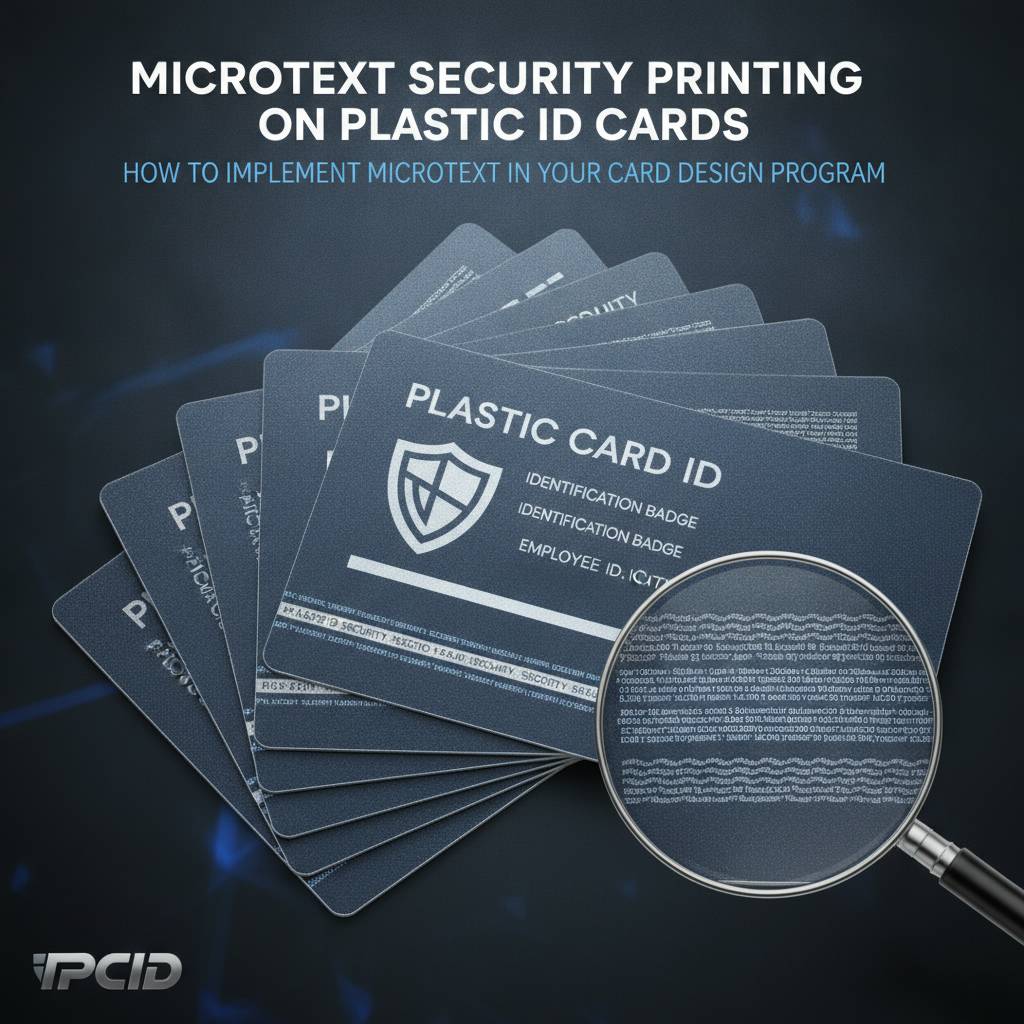 Implementation sounds technical, but the process is more approachable than most organizations expect. The design phase is where microtext is established, and working with the right card program partner makes this step straightforward rather than overwhelming. Plastic Card ID has guided hundreds of organizations through exactly this process.
The critical decision points are: what text to encode, where to place it within the card design, what font to use (sans-serif fonts perform best at micro scale), and which printer and ribbon combination will render it reliably. Each of these decisions interacts with the others, which is why working with an experienced card program supplier rather than attempting to DIY every element produces far better outcomes.
Choosing the Right Card Printer for Microtext Output
Among the card printer brands carried by CPE, retransfer printers from Zebra and Fargo consistently perform best for microtext applications. Retransfer printing applies the image to a film that is then bonded to the card surface - producing edge-to-edge coverage and sharper resolution than direct-to-card alternatives. This additional clarity is precisely what microtext demands to remain legible under magnification.
Evolis printers, while excellent for many standard ID card applications, are generally better suited to programs where microtext is used as a supplementary element rather than a primary security feature. Matching your printer to your security requirements is one of the most important technical decisions in building a card program. The team at Plastic Card ID can help you navigate this selection based on your card volume, design complexity, and security needs.
Design Best Practices for Effective Microtext
- Use sans-serif fonts such as Arial, Helvetica, or similar for microtext elements - serifs at sub-0.5mm scale tend to fill in and become illegible.
- Place microtext in border zones, background patterns, or along the edges of design elements rather than in open white space where it may be more obvious to casual observation.
- Choose text content that is meaningful to your security team - department codes, authorization strings, or internal identifiers that a counterfeiter would not know to include.
- Test your design output at actual card scale before committing to a full print run - what looks crisp on a monitor at 400% zoom must also read clearly through a loupe at actual size.
- Maintain consistent microtext placement across card versions so security staff develop reliable verification habits based on known card anatomy.
Never assume that microtext will be automatically correct on first print. Calibration between your design file, your printer settings, and your ribbon type is necessary to ensure optimal output. This is exactly the kind of technical support that Plastic Card ID provides as part of a long-term card program partnership.
Ribbon and Laminate Selection for Sharp Microtext Results
The ribbon type directly affects the sharpness of microtext output. YMCKO ribbons - which include a clear overlay panel - provide an additional protective layer that can slightly soften fine detail if the overlay application temperature is not precisely controlled. YMCK ribbons without the overlay panel, used in conjunction with a separate overlaminate film, offer greater control over the final output quality for security-critical applications.
Overlaminate films with embedded holographic patterns or UV-reactive elements can be layered over microtext without obscuring it, provided the film is optically clear in its base state. This combination of microtext plus holographic overlaminate represents one of the strongest accessible security stacks available for commercially produced plastic ID cards.
Security Card Program Buyer's Guide: What to Ask Before You Order
Investing in a security-enhanced card program is a considered purchase, not an impulse order. Organizations that approach this process thoughtfully end up with better cards, fewer reprints, and significantly stronger credential integrity over time. The questions below reflect the conversations CPE has had with clients building serious card programs across a wide range of industries.
Frequently Asked Questions About Microtext on Plastic Cards
Q: Can I add microtext to cards I already have designed? Yes, in most cases. Microtext can be incorporated into an existing design as a revision - added to border elements, background fields, or as a new design layer. Your card supplier should be able to review your existing artwork and identify natural placement opportunities that do not require a complete redesign.
Q: How small does microtext actually need to be to be effective? The practical security threshold is around 0.4mm character height. Below this, most consumer and office printers cannot reproduce the text recognizably. Above 0.8mm, the text may be readable without magnification by someone looking carefully, reducing its covert value. The 0.2mm-0.5mm range represents the sweet spot for most commercial ID card applications.
Evaluating Your Card Program's Security Needs
Not every organization needs maximum security on every card. A loyalty card for a coffee shop faces different threat profiles than an access credential for a healthcare facility or a government contractor site. Matching your security investment to your actual risk profile is smart program management - and it is something a good card program partner helps you assess honestly rather than overselling features you do not need.
For organizations where card fraud has never occurred, microtext still has value as a deterrent and as a verification backstop. The cost increment is low enough that the question is rarely whether to include it, but rather how to implement it most effectively within your existing design framework. Reach out to 800.835.7919 for a no-pressure program consultation.
Scaling Microtext Security Across Large Card Programs
Organizations producing cards at volume - tens of thousands annually - benefit from establishing microtext standards early and maintaining them consistently across every card refresh cycle. Version control matters: if your microtext content changes between card generations (for example, incorporating a production year code), your security team must be aware of which text to expect when verifying any given card cohort.
Bulk blank card orders from Plastic Card ID combined with in-house printing capability give large-volume organizations the flexibility to manage this process internally. Total design control is one of the most compelling arguments for in-house card printing - and blank CR80 PVC cards from CPE are the foundation that makes it possible.
Card Security Features That Work Alongside Microtext
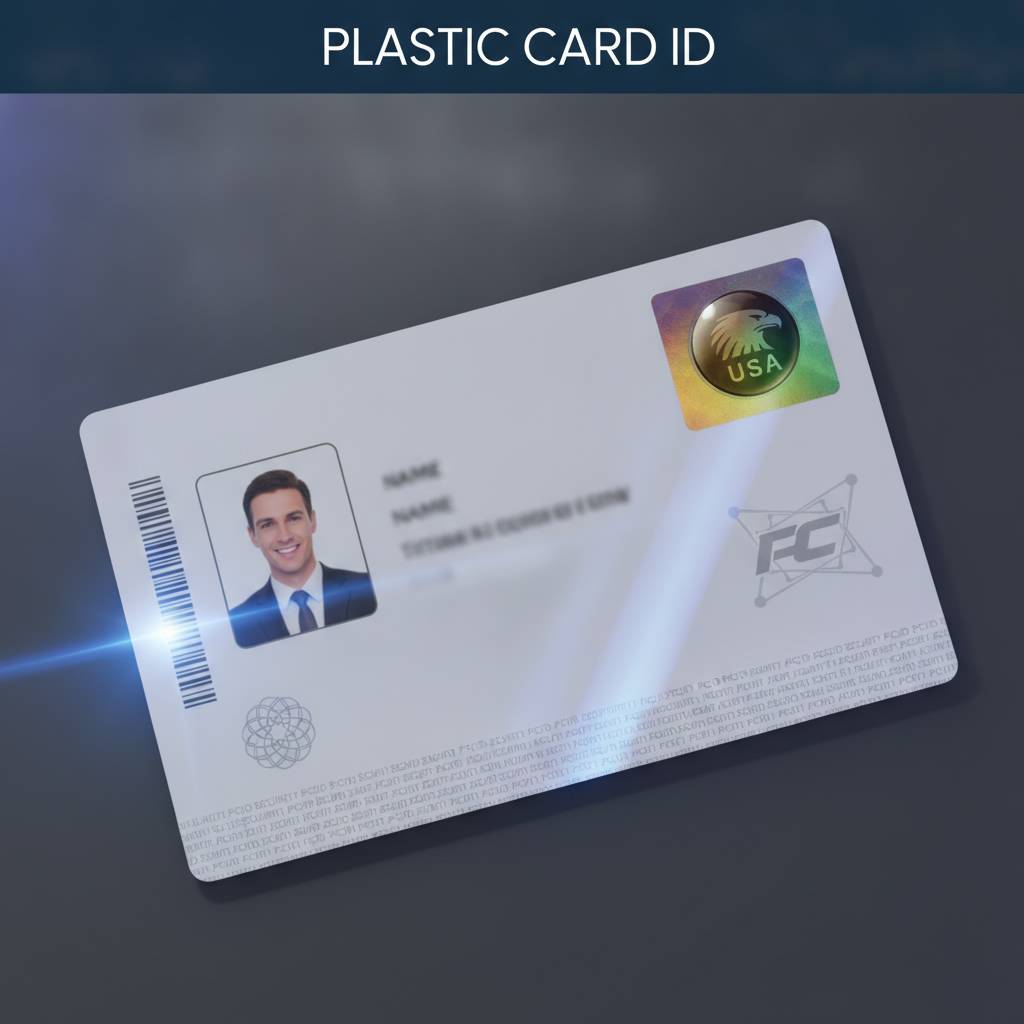
Microtext does not operate in isolation. The most secure plastic ID card programs layer multiple features, each addressing different fraud vectors, so that compromising any single layer does not automatically compromise the entire credential. Understanding what these complementary features are helps organizations build genuinely robust card programs rather than relying on any one technology as a sole safeguard.
Magnetic Stripe Encoding: HiCo vs. LoCo
Magnetic stripes remain one of the most widely deployed card security technologies in commercial settings. HiCo (High Coercivity) stripes require stronger magnetic fields to encode and are significantly more durable and resistant to accidental erasure than LoCo (Low Coercivity) alternatives. For any card that needs to reliably store and transmit encoded data over repeated use, HiCo is the professional standard. Plastic Card ID supplies both HiCo and LoCo magnetic stripe cards in blank form for in-house encoding.
Combining microtext visual security with HiCo magnetic stripe data creates a credential that must be both visually and electronically correct to pass verification - a combination that dramatically raises the difficulty of producing a convincing forgery.
RFID and Proximity Technology for Access Control
Proximity cards and RFID smart cards add an electronic dimension to access security that visual inspection alone cannot provide. Cards based on MIFARE DESFire technology offer encrypted communication between card and reader, making cloning attacks significantly more difficult than older 125kHz proximity card formats allow. When these cards also carry microtext security printing, they combine electronic and visual authentication in a single credential.
Hotel key cards, facility access badges, and campus ID cards all represent natural applications for this combination. The card that a fraudster manages to photograph or scan must also pass a visual microtext check - and the card they attempt to clone electronically must defeat modern encryption. Layered security is not paranoia; it is good program architecture.
Specialty Card Formats and Custom Die-Cut Options
Beyond standard CR80 format, CPE offers specialty card options including clear and frosted PVC, custom die-cut shapes, and luxury metal cards in stainless steel, brass, and gold finishes. While microtext in its traditional printed form is most applicable to standard PVC cards, clear and frosted cards open interesting design possibilities where microtext might appear in an unexpected substrate context - such as a reversed-print microtext pattern visible from the card's reverse face.
Metal cards carry their own inherent anti-counterfeiting value through material cost and feel, but can still incorporate laser-engraved microtext details that are genuinely difficult to replicate. For premium membership programs and executive credential applications, metal cards with engraved microtext details represent a security and prestige combination that is virtually impossible to counterfeit convincingly at scale.
Plastic Card ID Is Your Partner for Secure Plastic ID Card Programs Across the USA
Security in card programs is a journey, not a one-time purchase. As fraud techniques evolve, card security features must be revisited and strengthened. Organizations that treat their card program as a living system - maintained, updated, and periodically audited - are consistently better protected than those that issue cards once and never reconsider their approach.
Plastic Card ID has been supporting exactly that kind of ongoing card program partnership for over 25 years. From supplying blank CR80 PVC cards and magnetic stripe stock to providing full-lineup card printers, ribbons, overlaminates, cleaning kits, and advisory support, CPE is structured to be a single source for everything a serious card program needs. Whether your program issues 50 cards per month or tens of thousands, the same expertise and commitment to quality applies.
Getting Started With a Security-Enhanced Card Program
Starting a microtext-enabled card program does not require a complete infrastructure overhaul. Many organizations begin by incorporating microtext into their next scheduled card redesign cycle - a natural opportunity to refresh card art while simultaneously strengthening credential security. The incremental cost is modest, and the security value compounds over every card issued from that point forward.
The best time to strengthen your card security was at the beginning of your program. The second best time is right now. Connect with the team at Plastic Card ID to discuss where microtext security printing fits within your specific program requirements, card volumes, and existing printing infrastructure.
Card Affixing, Mailing, and Fulfillment Support
For organizations distributing cards to members, employees, or customers at volume, the production of the card itself is only part of the challenge. Plastic Card ID offers card affixing and mailing services that complete the fulfillment chain - cards affixed to carrier documents, stuffed, and mailed to recipients directly. This capability is especially valuable for membership organizations and loyalty programs distributing cards across broad geographic footprints.
Security-printed cards that are also professionally fulfilled signal organizational competence from the moment a recipient opens their envelope. The card's quality, its security features, and the professionalism of its delivery all contribute to the recipient's perception of the issuing organization. Every element of the card program reflects on your brand.
Pricing, Volumes, and Program Flexibility
Card programs vary enormously in scale and budget, and Plastic Card ID is built to serve across that entire range. Blank CR80 PVC cards are available at price points that make in-house printing economically viable even for smaller organizations, while high-volume custom card orders benefit from pricing structures that reward scale. Security-enhanced cards with magnetic stripes, RFID chips, or specialty substrates carry premium pricing reflecting their additional components - expect ranges from approximately $0.25 per card for standard blank PVC up to $5.00-$15.00 or more per card for smart chip or metal formats depending on specifications and quantities.
Card printer packages from Evolis, Zebra, and Fargo range from entry-level direct-to-card models suitable for small-batch production to high-throughput retransfer systems engineered for continuous large-volume output. Starter packages including printer, ribbon supply, and blank card stock can be configured in the $500-$3000 range for most standard applications, with advanced systems running higher depending on features required.
Ready to add microtext security printing to your plastic ID card program? Contact Plastic Card ID today at 800.835.7919 and speak with a card program specialist who can walk you through every option, from blank card selection to printer configuration to finished card fulfillment - all in one conversation, all from one trusted partner.
Previous Page