Difference Between PVC and ABS Plastic Cards Explained
Table of Contents []
- What Most Buyers Get Wrong About Plastic Cards: Plastic Card ID Breaks It Down
- The Chemistry Behind the Cards: PVC vs. ABS Explained
- PVC Card Types That Power Real Card Programs
- Specialty PVC Cards: Clear, Colored, Die-Cut, and Luxury Metal
- Card Printers and Supplies: Completing the In-House Card Ecosystem
- Why Physical PVC Cards Outperform Digital Alternatives in Key Metrics
- Working With Plastic Card ID: What the Partnership Looks Like
What Most Buyers Get Wrong About Plastic Cards: Plastic Card ID Breaks It Down
Ask a hundred purchasing managers what their loyalty cards are made of, and ninety will say "plastic" without missing a beat. That answer is technically correct and practically useless. Because the real question - the one that determines durability, printability, cost, and long-term program performance - is which plastic. Two materials dominate the card industry: PVC and ABS. They look nearly identical in your hand, yet they behave very differently in production, in printers, and in the field.
This is exactly the kind of detail that separates a card program that runs smoothly for years from one that generates complaints, reprints, and wasted budget. CPE has supplied cards to over 100,000 businesses across the United States, and this question comes up constantly. So let's answer it properly - with the specificity serious buyers deserve.
| Feature | PVC Cards | ABS Cards |
|---|---|---|
| Full Name | Polyvinyl Chloride | Acrylonitrile Butadiene Styrene |
| Flexibility | Flexible, bend-resistant | Rigid, more brittle |
| Print Compatibility | Excellent with dye-sublimation | Limited; may require special inks |
| Magnetic Stripe Support | Yes - HiCo and LoCo | Limited compatibility |
| Standard for ID/Loyalty Cards | Yes - ISO 7810 CR80 | Occasionally used in retail tags |
| Durability in Wallets | High - resists cracking | Moderate - can crack under stress |
| Cost at Scale | Lower per-unit at volume | Comparable or higher |
| Typical Use Cases | ID, loyalty, access, gift cards | Keytags, retail hang tags, some name badges |
The Chemistry Behind the Cards: PVC vs. ABS Explained
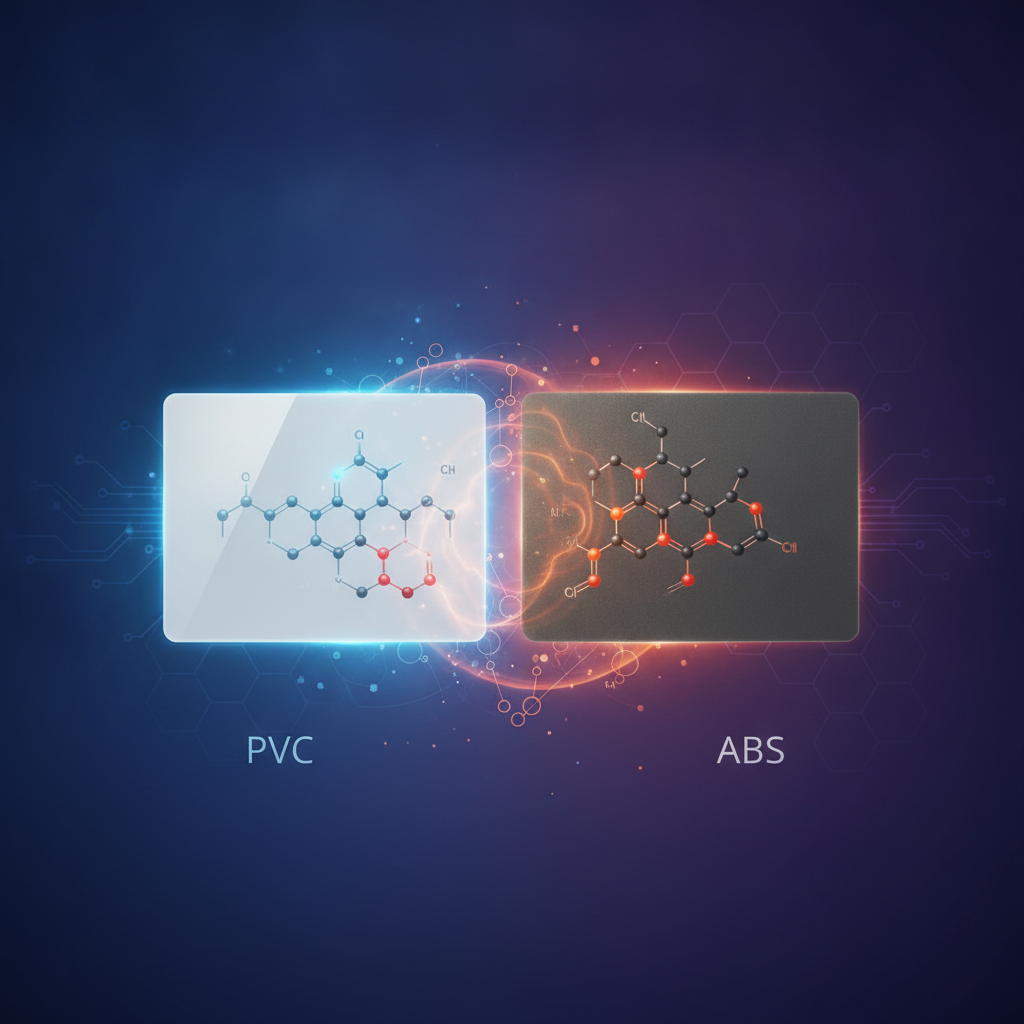 PVC - polyvinyl chloride - is the gold standard of card manufacturing, and has been for decades. It's a thermoplastic polymer that combines excellent flexibility with impressive surface hardness. PVC accepts dye-sublimation and thermal transfer printing beautifully, which is why every major card printer manufacturer - Evolis, Zebra, Fargo - optimizes their ribbons and calibration settings around it. When you buy a blank CR80 card at 30 mil thickness, that's a PVC card engineered to the ISO 7810 standard. It fits ATMs, card readers, and wallet slots because it was literally designed to do so.
ABS - acrylonitrile butadiene styrene - is a different beast. It's the same polymer used in LEGO bricks and automotive dashboard panels. Strong in compression, yes. But rigid in a way that works against cards that need to flex in pockets, survive thousands of swipes, or accept high-resolution print. ABS is harder to encode with magnetic stripes and doesn't bond as cleanly during lamination, which matters enormously if you're building a card program at scale.
Why PVC Became the Industry Default
The ISO 7810 standard didn't choose PVC arbitrarily. The material passed rigorous testing for dimensional stability, surface resistance to abrasion, and tolerance for temperature variation. A card sitting in a car dashboard in August in Texas and a card pulled from a coat pocket in January in Minnesota both need to perform. PVC does that. Its glass transition temperature and flexibility profile make it the reliable choice across climates and conditions.
Card programs that depend on consistency simply cannot afford material surprises. When a hotel deploys 10,000 key cards, or a fitness chain launches a membership program in 40 locations, the last thing anyone wants is to discover mid-program that their card material doesn't work with their encoder or doesn't print evenly. PVC eliminates those variables because it's the material the entire ecosystem was built around.
Where ABS Cards Actually Show Up
ABS cards aren't without legitimate use cases. You'll find them in key fobs, retail hang tags, and certain types of name badge holders. Some budget-tier card stock uses ABS blends to cut costs. But the critical point is that ABS was never engineered with card reader compatibility or dye-sublimation printing as design priorities. It was adapted, not purpose-built.
Buyers sometimes encounter ABS cards when sourcing offshore without specification controls in place. The physical resemblance to PVC means problems don't surface until a card jams in a printer, prints with inconsistent color saturation, or arrives with a slightly off-spec thickness that prevents it from working in access control readers. These are expensive lessons that CPE helps clients avoid before they happen.
The Role of Card Thickness and ISO Standards
CR80 is the standard card size - 3.375 inches by 2.125 inches - and 30 mil (0.030 inches) is the standard thickness. These measurements aren't arbitrary preferences; they're load-bearing specifications that determine whether a card feeds correctly through a printer, whether it trips the right sensor in an access control terminal, and whether it fits in standard cardholders and sleeves.
PVC cards manufactured to CR80/30 mil specification hit these tolerances reliably. ABS cards, depending on their formulation and manufacturing process, can drift just enough to cause feeding errors or reader failures. For small quantities, that might seem like a minor inconvenience. For an organization printing badges for 500 employees or mailing gift cards to customers nationwide, tolerance drift creates real operational cost.
PVC Card Types That Power Real Card Programs
Understanding that PVC is the right material is step one. Step two is knowing which PVC card configuration fits your program. The catalog runs deep - from blank white cards ready for in-house printing to fully encoded smart cards with embedded microchips. Each configuration exists for a reason, and the differences matter operationally. Choosing the wrong card type for your application is almost as costly as choosing the wrong material.
What makes CPE's approach effective is the breadth of inventory combined with the expertise to match clients with the right configuration from the start. Whether you're launching a campus access program, rolling out gift cards for a regional retailer, or building a loyalty card for a chain of salons, the card type you choose shapes every downstream decision - printers, ribbons, encoding equipment, and fulfillment workflow.
Blank PVC Cards: The Workhorse of In-House Programs
Blank CR80 PVC cards are the foundation of any self-managed card program. No pre-printed design, no encoding - just a clean, flat, ISO-compliant surface ready to accept whatever your printer and your program require. Organizations that print cards in-house control timing, personalization, and cost in ways that pre-printed card orders simply can't match. Need a new employee badge on a Tuesday morning? Print one. Need to update a loyalty card design mid-quarter? You own the process entirely.
The per-card economics are compelling too. Blank PVC cards ordered in volume drop to fractions of a cent per card, and the design cost is a one-time investment in art files and printer setup. For businesses running ongoing programs - employee ID systems, membership clubs, event credentials - blank PVC stock paired with the right card printer is the most cost-efficient model available.
Magnetic Stripe PVC Cards: HiCo vs. LoCo
Magnetic stripe cards add a functional layer to the standard PVC card. The stripe is encoded with data - account numbers, loyalty balances, access credentials - and read by a swipe terminal or encoder. The two formats, HiCo (High Coercivity) and LoCo (Low Coercivity), differ in how resistant the stripe is to accidental erasure from proximity to magnetic fields.
HiCo stripes require a stronger magnetic field to encode but hold data far more reliably in everyday use. Gift cards, hotel key cards, and access control applications almost universally use HiCo because cards get tossed in purses with phones, stuck to refrigerators, and carried in wallets alongside other cards. LoCo has its place in shorter-lifespan applications where data longevity is less critical. Matching stripe type to use case is a detail that pays dividends in program reliability.
RFID, Proximity, and Smart Chip Cards
For contactless applications - building access, cashless payment within closed systems, campus services, casino player tracking - PVC cards can carry embedded technology. Proximity cards use low-frequency (125 kHz) RFID, which is the backbone of most legacy access control systems. Smart cards with MIFARE DESFire chips operate at 13.56 MHz and support encrypted, read-write transactions suitable for more complex use cases.
These are still PVC cards at their core. The chip or antenna is laminated within the card body, protected by the same material that makes standard PVC cards durable. ABS doesn't lend itself to this kind of laminated construction, which is another reason why the advanced card categories - casino, hotel key, access control, campus ID - default to PVC without exception. Call 800.835.7919 to discuss which contactless technology fits your access or loyalty infrastructure.
Specialty PVC Cards: Clear, Colored, Die-Cut, and Luxury Metal
 Once you move beyond standard white CR80 cards, the design possibilities expand considerably. Specialty card formats give brands the ability to make a physical card into a statement piece - something a customer picks up and notices, something that communicates quality before it's ever swiped or scanned. This is where card programs cross from functional infrastructure into brand marketing.
The spectrum runs from clear and frosted PVC cards - which create striking visual effects when custom graphics are printed over translucent stock - all the way to luxury metal cards in stainless steel, brass, and gold. Each format serves a different purpose at a different price point, but they all share one characteristic: they make an impression that paper credentials simply cannot replicate.
Clear and Frosted PVC Cards
Clear PVC cards are exactly what they sound like - transparent card stock that remains ISO-compliant in size and thickness. When printed with reverse-side graphics or used with selective printing that lets the transparency show through, the visual effect is distinctive and memorable. Frosted cards offer a similar premium feel with a matte translucency that photographs beautifully and feels substantial in the hand.
These aren't novelty items. High-end fitness clubs, boutique hotels, upscale retail loyalty programs, and premium membership organizations use clear and frosted cards specifically because the tactile and visual premium signals brand quality at the moment of interaction. The card becomes part of the customer experience, not just an operational tool.
Colored Stock and Custom Die-Cut Shapes
Standard card stock comes in white, but colored PVC stock - available in black, gold, silver, and other options - gives designers a base that changes what's possible with printed graphics. Dark-stock cards with metallic printing create a look that's simply not achievable on white cards regardless of print quality. The material choice becomes a design choice.
Custom die-cut shapes take the concept further. Cards cut to the shape of a product, logo, or brand element create instant recognition and collectability. A loyalty card shaped like a coffee cup or a key card shaped like a hotel's signature icon turns a transactional object into a marketing touchpoint. These are PVC cards with custom geometry - still functional, still durable, dramatically more distinctive.
Luxury Metal Cards: Stainless Steel, Brass, and Gold
Metal cards occupy the top tier of the premium card category. Stainless steel, brass, and gold card options deliver weight, permanence, and a tactile quality that no polymer can replicate. These are the cards issued to VIP loyalty members, premium club clients, and high-value account holders - cards that recipients don't just carry but notice.
The functional case for metal cards is real: they're virtually impossible to damage in a wallet, they don't fade, and they never look worn. The brand case is equally compelling. When a business gives a customer a metal card, it communicates a level of investment in that relationship that elevates the program above every competitor using paper or standard PVC. For the right program and audience, metal cards deliver an outsized return on a modest incremental cost.
Card Printers and Supplies: Completing the In-House Card Ecosystem
A card program run on PVC stock is only as effective as the printer producing those cards. The right printer choice determines print quality, encoding capability, throughput speed, and total cost of ownership over the life of the program. CPE carries a complete lineup from the three dominant brands in the desktop and mid-volume card printer market - Evolis, Zebra, and Fargo - each with distinct strengths suited to different program profiles.
What makes the printer selection important beyond brand preference is understanding how each model interacts with specific card stocks and ribbons. Mismatched printer-ribbon-card combinations produce subpar results that no amount of software adjustment can fix. Sourcing cards, printers, and ribbons from the same supplier removes that variable entirely.
Evolis, Zebra, and Fargo: Matching Printer to Program
Evolis printers are known for compact form factor, ease of use, and excellent print quality at low-to-mid volumes. They're a natural fit for HR departments printing employee badges, small businesses managing their own loyalty card programs, or event coordinators producing credentials on-site. Zebra's card printer lineup brings enterprise-grade reliability and throughput for organizations with high daily card volumes and centralized production environments.
Fargo - now part of HID Global - occupies strong ground in security-focused ID programs. Their HDP (High Definition Printing) technology prints to a retransfer film that then bonds to the card, producing crisp, edge-to-edge results that standard direct-to-card printing can't match. For government IDs, institutional credentials, and high-security access cards, Fargo's HDP models are frequently the specification of choice.
Ribbons, Cleaning Kits, and Card Carriers
Ribbons are consumables that directly determine print quality - and using the wrong ribbon for a given printer or card stock creates color inconsistency, poor adhesion, and premature printhead wear. CPE stocks OEM and compatible ribbons for every printer model in the lineup, matched to the PVC card types that perform best with each. Contact 800.835.7919 to confirm ribbon compatibility before placing a large order.
Cleaning kits maintain printhead performance and card feed reliability over time. A printer that isn't cleaned regularly accumulates card dust and ribbon residue that degrades print quality and increases jam frequency. Card carriers and sleeves protect finished cards during handling and mailing, ensuring that a card that left the printer in perfect condition arrives at its destination the same way. These supporting supplies are the unglamorous infrastructure that keeps a card program running without interruption.
Card Affixing and Mailing Services
For programs that distribute cards by mail - gift card campaigns, loyalty program launches, membership card renewals - the fulfillment step is where programs often stumble. Card affixing, inserting into carriers, and coordinating bulk mail requires equipment, labor, and postal knowledge that most organizations don't keep in-house. CPE offers card affixing and mailing services that close this gap cleanly.
Outsourcing fulfillment to the same supplier providing the cards eliminates coordination friction and quality control gaps that come with using multiple vendors. A single-source model for cards, printers, supplies, and fulfillment is operationally elegant and consistently more cost-effective than a fragmented approach.
Why Physical PVC Cards Outperform Digital Alternatives in Key Metrics
Digital wallets and apps generate a lot of conversation, but the data on physical card performance tells a consistent story. Retailers that switch from paper gift certificates to plastic gift cards see sales increases of 35-50%. That's not a marginal improvement - it's a program transformation driven almost entirely by the physical format of the card. Plastic gift cards get purchased as presents. They get displayed at checkout. They get reloaded. Paper certificates get lost in drawers.
Loyalty cards that live in wallets consistently outperform app-based loyalty programs in frequency metrics for brick-and-mortar retailers. The physical card serves as a constant, passive brand reminder every time a wallet is opened. An app buried on page three of a phone's app screen serves no equivalent function. The card is present; the app is absent until deliberately sought out.
Gift Card Programs: The Revenue Case
Gift cards are one of the most effective revenue tools available to retail and hospitality businesses, and the physical format is central to their performance. A plastic gift card at a point-of-sale display sells itself - it requires no explanation, no sales pitch. Customers pick them up because they look like what they are: a convenient, transferable value token. Paper versions of the same concept simply don't generate the same impulse purchase behavior.
Breakage - the industry term for card balances that go unredeemed - is another financial factor that favors plastic card programs. Plastic cards are retained and redeemed at higher rates than paper alternatives, which seems counterintuitive until you consider how people treat the two formats. A plastic card goes in a wallet. A paper certificate gets folded, misplaced, or forgotten entirely.
Loyalty and Membership Card Performance
Plastic loyalty cards signal program legitimacy in a way that paper punch cards cannot. When a business hands a new customer a card that matches their wallet's existing card stack in size, weight, and format, it communicates permanence and investment. That impression directly affects whether the customer chooses to engage with the program long-term or treat it as a one-off transaction.
Membership organizations - gyms, clubs, professional associations - see similar dynamics. A plastic membership card is a credential that carries social and functional weight. It's shown at the door, carried to events, and displayed to peers. A paper card or a digital-only credential simply doesn't function in the same way in these social contexts. The physical object creates a sense of belonging that digital alternatives approximate poorly.
ID and Access Control: Where Card Material Is Non-Negotiable
- Employee badges printed on PVC CR80 stock work with badge reels, lanyards, and clip holders designed to standard card dimensions
- Access control cards encoded with HID or MIFARE technology require PVC lamination to protect embedded antenna structures
- Event credentials that need to survive a full conference day of repeated handling require PVC's flex resistance
- Campus ID programs combine photo printing, magnetic encoding, and sometimes contactless technology - a combination that only PVC handles reliably
- Casino player cards are exposed to high-frequency handling and must maintain magnetic stripe integrity over thousands of reads
In every one of these applications, ABS is not a viable alternative. The use case demands PVC's combination of print compatibility, encoding support, dimensional stability, and durability. This isn't a preference - it's an engineering requirement that the card manufacturing industry settled decades ago.
Working With Plastic Card ID: What the Partnership Looks Like
There's a meaningful difference between a supplier who ships boxes and a partner who helps you build and maintain a successful card program. CPE occupies the second category deliberately. With over 25 years of experience, more than 100,000 customers served, and over 50 million cards delivered, the institutional knowledge embedded in that track record is a resource available to every client regardless of program size.
Programs ranging from 50 cards a month to tens of thousands in a single production run receive the same attention to configuration fit and order accuracy. A small business launching its first loyalty card program and a national chain reordering employee badges in bulk both benefit from working with a team that has seen nearly every card program scenario imaginable and knows what works.
Flexible Program Scales: From Small Business to Enterprise
The economics of card programs change significantly with volume, and CPE structures sourcing to take advantage of that curve on behalf of clients. Small programs benefit from quality card stock at accessible minimums. Larger programs access volume pricing that makes in-house card production cost-effective against outsourced alternatives. The model is designed to grow with clients rather than requiring them to change suppliers as their programs scale.
For organizations new to card programs, the guidance on card type selection, printer configuration, and ribbon compatibility prevents the costly mismatches that frequently affect first-time buyers. Getting the setup right from the beginning is dramatically less expensive than correcting a poorly configured program after cards have already been ordered and printers purchased.
Frequently Asked Questions About PVC vs. ABS Cards
Can I use ABS cards in my card printer? Most desktop card printers are calibrated for PVC cards at 30 mil thickness. ABS cards may feed incorrectly, cause jams, or produce uneven print results. Unless your printer manufacturer explicitly lists ABS compatibility, assume PVC is required.
Do all magnetic stripe cards use PVC? Virtually all magnetic stripe cards used in loyalty, gift, access, and ID applications use PVC. The magnetic stripe bonding and lamination process is optimized for PVC card construction. ABS cards are rarely offered with magnetic stripes for this reason.
What's the minimum order for blank PVC cards? Minimums vary by card type and configuration, but CPE services programs starting at modest quantities and scaling to full production volumes. Reach out to discuss your specific program requirements and find the configuration that fits your needs and budget.
Getting Started: Matching Cards to Your Program
The fastest path to the right card configuration is a direct conversation about what the program actually needs. What technology does the card need to carry - magnetic stripe, RFID, smart chip, or none? What printing will happen in-house versus what arrives pre-printed? What volume is the program running now, and where does it realistically go in 12 months? These questions determine everything downstream.
Starting a card program on the right foundation costs the same as starting it on the wrong one - the difference is entirely in the outcome. A well-configured program runs smoothly, produces consistent cards, and scales without disruption. A poorly configured program generates operational friction, reprints, and equipment problems that drain time and budget with no return.
Ready to get your card program configured correctly from day one? Reach out to Plastic Card ID and put 25 years of card program expertise to work for your business.
Call Plastic Card ID today at 800.835.7919 - because the right card, made from the right material, configured for the right program, is the foundation every successful card program is built on.
Previous Page