Encoding Blank Plastic Cards for Secure Access
Table of Contents []
- Encoding Blank Plastic Cards for Secure Access - Plastic Card ID
- Why Encoding Technology Matters More Than Most Organizations Realize
- Blank CR80 Cards - The Foundation of Every In-House Card Program
- Card Printers That Handle Encoding - Evolis, Zebra, and Fargo
- Access Control Applications - Where Encoding Makes or Breaks the Program
- Frequently Asked Questions About Encoding Blank Plastic Cards
- Partner With Plastic Card ID for Every Encoding Challenge Your Program Faces
Encoding Blank Plastic Cards for Secure Access - Plastic Card ID
What separates a card program that actually works from one that creates headaches? Encoding. The moment a blank plastic card receives magnetic stripe data, an RFID signature, or smart chip credentials, it transforms from a flat piece of PVC into a functional key - one that can open doors, verify identities, track loyalty points, and protect your organization from unauthorized access. Plastic Card ID has spent over 25 years helping businesses across the United States get that transformation exactly right.
Encoding blank plastic cards for secure access is not a one-size-fits-all process. Different applications demand different technologies, different card specifications, and different encoding standards. Whether you are running a 50-card employee badge program or deploying thousands of hotel key cards across multiple properties, understanding how encoding works - and which card format matches your security requirements - determines whether your program succeeds or struggles.
| Card Type | Encoding Method | Best Use Case | Security Level |
|---|---|---|---|
| HiCo Magnetic Stripe | Magnetic Write Head | Access control, loyalty, ID | Moderate |
| LoCo Magnetic Stripe | Magnetic Write Head | Hotel keys, short-term access | Basic |
| Proximity Card (125kHz) | RFID Reader/Writer | Building access, time and attendance | Moderate-High |
| MIFARE DESFire Smart Card | Contactless Chip Encoding | High-security facilities, transit, campuses | Very High |
| Contact Smart Card (ISO 7816) | Chip Contact Interface | Secure ID, healthcare, government | High |
Why Encoding Technology Matters More Than Most Organizations Realize
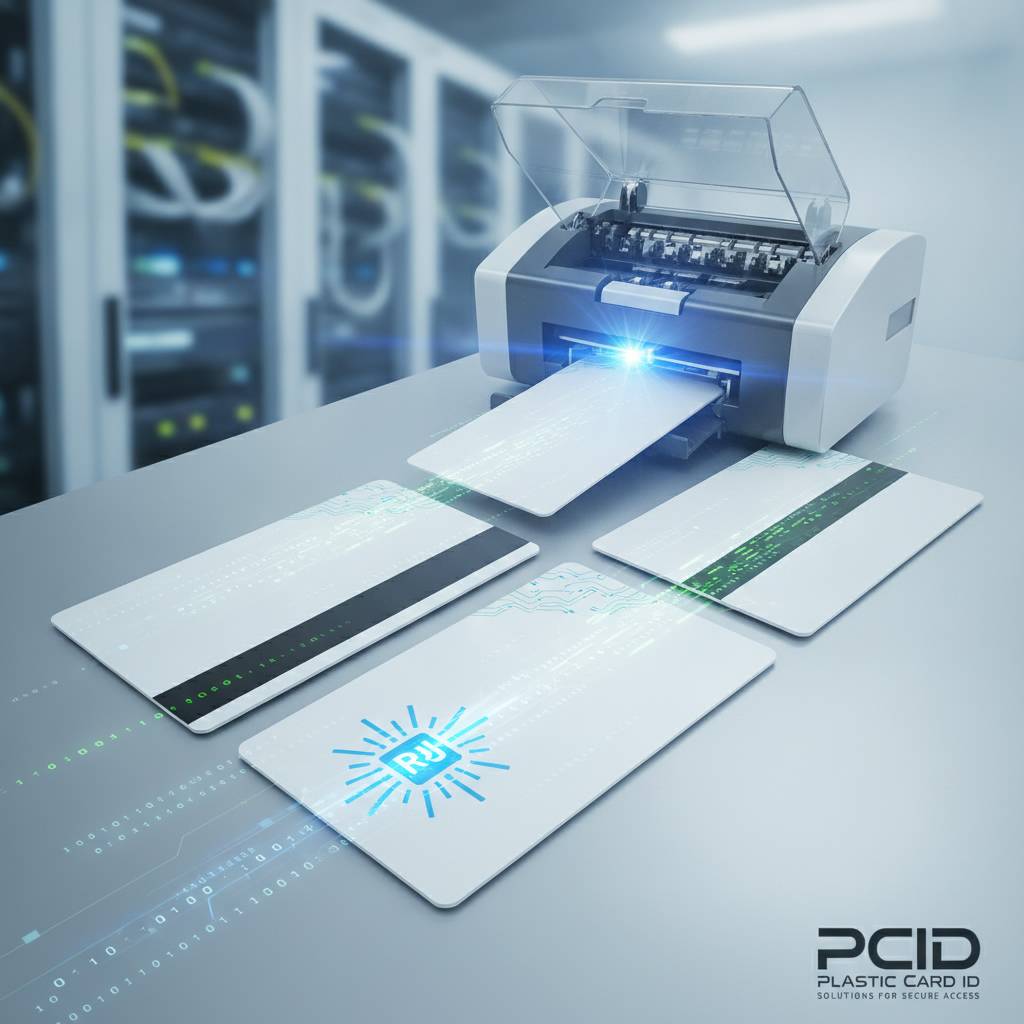 Organizations frequently underestimate encoding choices until something goes wrong - a card that demagnetizes too easily, a proximity credential that can be cloned, or a smart chip that is incompatible with the access system already installed. Choosing the right encoding standard at the beginning of your card program saves significant time, money, and frustration. CPE works with clients to match encoding technology to real-world requirements, not just what sounds impressive on paper.
Security access programs live and die by consistency. A single card that fails at the reader creates friction for the user and doubt in the program administrator. When you source blank plastic cards with the right encoding specifications from the start - the right coercivity for magnetic stripe, the right frequency for proximity, the right chip protocol for smart cards - every card in your batch performs identically and reliably every time.
Magnetic Stripe Encoding - HiCo Versus LoCo
Magnetic stripe technology remains one of the most widely deployed encoding methods in access control, loyalty programs, and employee identification. The choice between High Coercivity (HiCo) and Low Coercivity (LoCo) affects how reliably your card holds its data over time and in challenging environments.
HiCo cards require more magnetic force to encode but resist accidental erasure far better than LoCo alternatives. If your staff routinely carries cards near other magnetic sources - computers, phones, security wands, or industrial equipment - HiCo is almost always the correct choice. LoCo cards serve well in short-term or controlled environments, such as hotel room keys that see limited use before reprogramming.
Magnetic stripe encoding happens through the write head on a compatible card printer. Models from Evolis, Zebra, and Fargo support magnetic stripe encoding modules, meaning your in-house card printer can handle the entire issuance process. No third-party encoding step required. That in-house capability dramatically reduces per-card cost and issuance time.
RFID and Proximity Card Encoding Explained
Proximity cards operate at 125kHz and represent the backbone of building access control for countless businesses, schools, hospitals, and government facilities across the United States. The card contains a coil and chip embedded in the PVC - invisible to the user but fully functional when presented to a compatible reader. Encoding assigns a unique credential to each card that the access control system recognizes and acts upon.
Unlike magnetic stripe cards, proximity cards are read without physical contact. The reader energizes the card through radio frequency, and the card transmits its encoded identifier back to the reader. This contactless interaction adds convenience and reduces wear on both the card and the reader. Well-encoded proximity credentials can perform reliably for years without degradation.
It is worth noting that standard 125kHz proximity technology, while widely used, has known vulnerabilities to cloning. Organizations with stricter security requirements - data centers, healthcare facilities, research campuses - often step up to 13.56MHz smart card technology, which offers encrypted, two-way communication and is dramatically harder to duplicate.
Smart Chip Cards and High-Security Credential Encoding
Smart cards represent the highest tier of plastic card security. MIFARE DESFire, in particular, delivers advanced encryption, mutual authentication between card and reader, and the ability to store multiple applications on a single card. A single DESFire card can function as an access credential, a cashless payment token within a closed campus, and a loyalty program card simultaneously.
The security architecture of MIFARE DESFire makes it the preferred choice for casinos, universities, healthcare systems, and any organization where credential cloning is an unacceptable risk. Encoding these cards requires specialized equipment and a clear understanding of the access control platform they will integrate with - something CPE helps clients navigate from the product selection stage forward.
Blank CR80 Cards - The Foundation of Every In-House Card Program
Before any encoding occurs, you need the right card substrate. The CR80 standard - 3.375 inches by 2.125 inches, 30 mil thick, ISO 7810 compliant - is the universal format for plastic identity and access cards. It fits every standard card printer, every cardholder, and every wallet slot designed for a standard credit-card-sized credential. Starting with quality blank CR80 PVC cards ensures your encoding, printing, and lamination results are consistent and professional.
Blank cards come in multiple configurations: plain white PVC for full print coverage, pre-printed color stock in standard hues, clear and frosted options for design effects, and cards pre-loaded with magnetic stripes, RFID inlays, or chip modules ready for encoding. Ordering the correct blank card specification for your intended encoding method is step one of any functional card program - and it is where CPE adds immediate value.
Selecting the Right Blank Card for Your Encoding Method
Not all blank cards are created for all encoding technologies. A standard white PVC card with no embedded components cannot be encoded with RFID - the antenna and chip must be part of the card at the manufacturing stage. Magnetic stripe cards require the stripe to be laminated to the card before printing and encoding. Smart chip cards require the chip module to be embedded before any surface printing occurs.
This is why card program planning starts with a conversation about the intended technology, not just the desired design. Ordering the wrong blank card spec wastes your entire investment in that batch. Getting it right the first time - with guidance from a team that has supplied over 50 million cards across every category - makes the difference between a smooth rollout and an expensive redo.
Blank Card Volumes and Program Scaling
One of the practical advantages of sourcing blank cards and encoding in-house is the flexibility to issue cards on demand. Rather than ordering a fully printed, pre-encoded batch from an outside vendor every time you hire a new employee or enroll a new member, you maintain an inventory of blank cards and print-encode each one as needed. This reduces waste and eliminates the lag time associated with external fulfillment.
Programs that start small often grow faster than expected. A 50-card monthly program at a regional fitness club can scale to 500 cards per month within a year if the club grows or merges with another location. Blank card inventory scales effortlessly - you simply order more cards and run more print-encode cycles through your in-house printer. No vendor renegotiation, no minimum order headaches, no design revision fees.
Specialty Blank Card Formats Worth Knowing
Beyond the standard white PVC CR80, CPE stocks specialty blanks that serve specific encoding and design requirements. Clear cards allow full card-face visibility for creative designs where the card material itself is part of the visual presentation. Frosted cards diffuse light attractively and work well for membership and loyalty programs where premium aesthetics reinforce brand perception.
Custom die-cut shapes break the standard rectangle format entirely - useful for event credentials, promotional cards, and branded keyfobs. Luxury metal cards in stainless steel, brass, and gold bring a weight and permanence that plastic cannot replicate, and they make an undeniable impression when used for high-tier membership or VIP access programs. These formats can be combined with compatible encoding methods depending on the specific product specification.
Card Printers That Handle Encoding - Evolis, Zebra, and Fargo
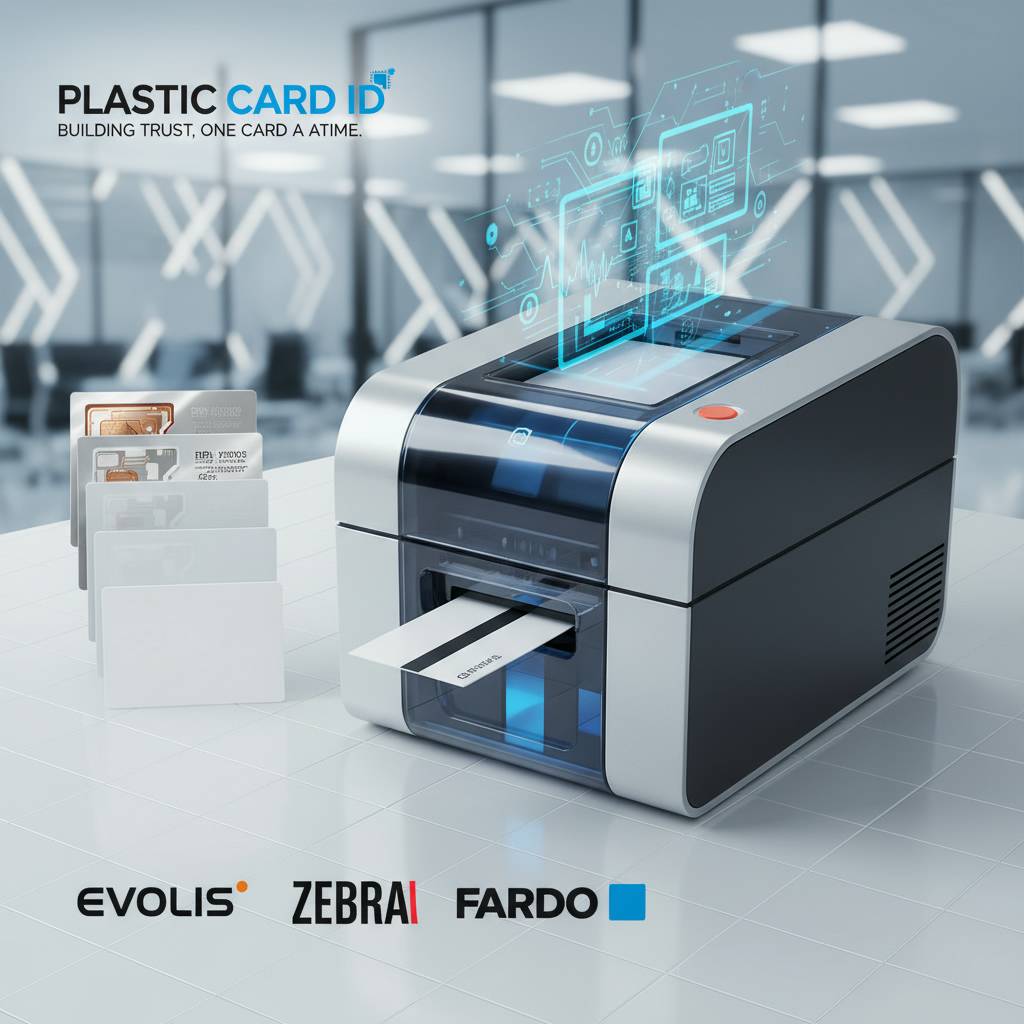 Encoding a blank plastic card for secure access requires hardware that matches your technology. The right card printer does not just print - it writes magnetic stripe data, reads and writes RFID credentials, and in some configurations handles smart chip encoding in a single automated pass. Investing in the right printer at program launch prevents costly mid-program upgrades.
The major printer brands stocked by Plastic Card ID each have strengths suited to different program types. Evolis printers are known for compact, user-friendly designs ideal for mid-size programs. Zebra delivers industrial-grade throughput for high-volume issuance environments. Fargo (now part of HID Global) is synonymous with government and enterprise-grade security printing, including encoding options for some of the most demanding credential programs in the country.
Matching Printer Capabilities to Encoding Requirements
Every encoding technology requires a specific module or mechanism inside the printer. Magnetic stripe encoding uses a write head positioned at the card's stripe location during transport through the printer. RFID encoding uses an antenna in the printing mechanism that communicates with the card's embedded inlay. Smart chip encoding requires a dedicated contact station or contactless encoding coil.
Not every base printer model includes all these modules by default - which is why it is critical to specify your encoding requirements when selecting a printer, not after. A printer ordered without a magnetic stripe encoding module cannot be upgraded in the field in most cases. The CPE team helps clients select printers with the exact module configuration their program requires, eliminating expensive surprises.
Printer Supplies That Keep Encoding Programs Running
- Printer ribbons - Matched to your specific printer model; YMCKO ribbons for full-color output, monochrome ribbons for high-speed single-color printing
- Cleaning kits - Essential for maintaining encoding accuracy; contaminated print heads and transport rollers directly cause encoding errors
- Card sleeves and carriers - Protect finished cards during distribution and prevent surface damage that can affect magnetic stripe readability
- Lamination overlays - Add durability and protection to printed card surfaces, extending card life in high-use access control applications
- Card affixing and mailing services - For programs that distribute cards by mail, full-service fulfillment keeps the operation streamlined
Maintaining a supply inventory alongside your card inventory ensures your program never stalls. A ribbon that runs out mid-batch or a dirty encoder that starts producing failed credentials stops issuance cold. Stocking supplies proactively is a basic operational discipline that experienced card program managers never neglect.
Contact Plastic Card ID About Printer Selection
If you are unsure which printer model and module configuration matches your encoding program requirements, the right move is to speak directly with someone who has matched thousands of programs to the correct hardware. CPE has seen every configuration challenge and can help you avoid the most common and costly mistakes in printer selection.
Reach the team directly at 800.835.7919 to discuss your specific encoding needs, card volumes, and security requirements. A brief conversation can save your organization significant time and capital before you commit to a hardware investment.
Access Control Applications - Where Encoding Makes or Breaks the Program
Secure access is perhaps the highest-stakes application for encoded plastic cards. When a card controls entry to a server room, a hospital pharmacy, a school building, or a casino gaming floor, encoding errors are not inconveniences - they are security failures. The precision of your encoding process directly determines the integrity of your physical security perimeter.
Organizations deploying access control cards need to think beyond the card itself. The card is part of a system - readers, controllers, software, and policies all interact with the encoded credential. Sourcing cards from a supplier with deep encoding knowledge, like Plastic Card ID, means the card side of that system is handled correctly from day one.
Employee Badge and ID Card Programs
Employee badges are the most common in-house card program in America, and for good reason. A printed and encoded employee ID communicates authority, belongs in access control systems, and creates a visual security layer that anyone in a facility can immediately recognize. A laminated, professionally printed badge with a functioning encoded stripe or proximity chip signals that your organization takes security seriously.
Encoding employee badges with unique identifiers tied to your access control database allows granular control - different access levels for different roles, time-based access restrictions, and instant revocation when an employee departs. That level of control is simply not possible with a paper-based or purely visual system.
Hotel Key Cards and Hospitality Access Programs
Hotel key cards occupy an interesting middle ground in encoding complexity. They need to be fast to issue (a guest should not wait long at check-in), reliable during the stay, and easily re-encoded for the next guest. LoCo magnetic stripe cards have served this application for decades, though many modern hotel properties are upgrading to contactless RFID key cards for added convenience and durability.
The encoding in a hotel key card must match the lock system precisely - different vendors use different encoding protocols, and the card stock must meet the mechanical tolerances of the lock reader. CPE helps hospitality clients identify the correct blank card specification and encoding format to match their existing or planned lock infrastructure.
Casino Player Cards and High-Security Venue Access
Casino player cards represent one of the most sophisticated card program categories. A single casino card may carry a player's unique identifier, loyalty tier, spending history access permissions, and contactless transaction capabilities - all encoded on one card that sees extremely heavy use. These programs demand cards and encoding precision that tolerates high-volume reads and frequent handling without degradation.
MIFARE DESFire and other high-frequency smart card technologies are increasingly standard in casino environments precisely because of their security architecture and data capacity. Plastic Card ID supplies the blank smart cards and supports clients in understanding encoding compatibility requirements for these demanding applications.
Frequently Asked Questions About Encoding Blank Plastic Cards
Organizations entering the encoded card space for the first time often share the same core questions. Addressing those questions directly is one of the most useful things a true card program partner can do - and it reflects the kind of expertise Plastic Card ID has developed over more than 25 years and 100,000 customers.
Can I Encode Cards Without a Dedicated Card Printer?
Technically, separate encoding hardware exists for specific technologies - standalone magnetic stripe writers, RFID desktop encoders - but combining printing and encoding in a single card printer is almost always more efficient and less error-prone. When a printer handles both processes in a single card pass, there is no risk of misalignment between the printed card face and the encoded credential.
For organizations that print cards externally and only need encoding, standalone encoders can work - but the operational complexity increases. For most programs, a properly configured in-house card printer is the cleanest, most reliable solution.
What Is the Difference Between Pre-Encoded and Blank-Encoded Cards?
Pre-encoded cards arrive from the manufacturer with data already written to the stripe or chip - typically used in high-volume, uniform deployments like transit passes or access cards for large standardized systems. Blank-encoded cards (cards with encoding-ready components but no data yet written) give the organization full control to write unique credentials at issuance, which is essential for access control programs where every card must carry a unique identifier.
Most businesses running internal ID, loyalty, or access programs want blank-encoded cards - cards with the magnetic stripe or RFID inlay ready, but no data written until they run the card through their printer-encoder at issuance. That workflow gives you maximum flexibility and security over your credential database.
How Many Cards Should I Keep in Inventory?
- Estimate your average monthly issuance volume and multiply by three to four months as a baseline stock level
- Account for spoilage - encoding errors, print failures, and damaged cards that need replacing run approximately 2-5% of total volume for well-maintained programs
- Factor in seasonal spikes - retail programs see enrollment surges around holidays, hospitality programs spike in travel seasons
- Consider lead time from your supplier and build a buffer that prevents program interruptions during high-demand periods
- Store cards flat, in controlled temperature conditions, away from strong magnetic fields to preserve the encoding-ready components
A conversation with CPE about your program scale helps establish the right inventory strategy from the beginning. Getting caught short on cards during a high-enrollment period is an avoidable problem that damages program credibility with the people trying to enroll.
Partner With Plastic Card ID for Every Encoding Challenge Your Program Faces
Encoding blank plastic cards for secure access is not a commodity transaction. It is a technical decision with real consequences for your organization's security posture, operational efficiency, and user experience. Working with a partner that has navigated more than 50 million cards across every encoding technology and application category is not a minor advantage - it is the foundation of a program that works reliably from day one.
From selecting the right blank card substrate and encoding technology, to matching printer hardware and module configurations, to maintaining the supply inventory that keeps the program running without interruption - Plastic Card ID supports the full lifecycle of your card program. Not as a one-time vendor, but as a strategic partner invested in your program's success at every scale and every stage of growth.
Ready to build or upgrade your encoded plastic card program? Contact Plastic Card ID today at 800.835.7919 - where 25 years of card program expertise is ready to work for your organization.
Previous Page