How Many Blank Plastic Cards Do I Need to Order?
Table of Contents []
- How Many Blank Plastic Cards Do I Need to Order? A Practical Guide from Plastic Card ID
- Understanding the Core Variables That Drive Your Order Quantity
- Why Ordering in Higher Quantities Almost Always Saves Money
- Special Use Cases That Require a Different Calculation
- Card Printers, Ribbons, and the Supply Chain You Need Behind Your Cards
- Frequently Asked Questions About Blank Plastic Card Order Quantities
- Ready to Order? Plastic Card ID Makes It Simple
How Many Blank Plastic Cards Do I Need to Order? A Practical Guide from Plastic Card ID
It sounds like a simple question. You need plastic cards - maybe for your employees, your loyalty program, your gym members, or your next big event. But when you sit down to actually place an order, the number suddenly feels complicated. Order too few and you're scrambling to reorder in two weeks. Order too many and you've got a stack gathering dust. Getting this calculation right saves you money, time, and real operational headaches.
After serving over 100,000 customers and supplying more than 50 million cards across the United States, CPE has seen every ordering scenario imaginable. This guide distills that experience into something genuinely useful - a framework you can apply to your specific program, your specific volume, and your specific budget.
| Card Program Type | Typical Monthly Volume | Suggested Starting Order |
|---|---|---|
| Small Business Employee IDs | 10-30 cards | 200-500 cards |
| Retail Loyalty Program | 100-500 cards | 1,000-5,000 cards |
| Gym or Fitness Club Membership | 50-200 cards | 500-2,000 cards |
| Event Access or Credentials | Varies by event | Event size 10-15% buffer |
| Hotel Key Cards | 200-1,000 cards | 2,000-10,000 cards |
| Gift Card Program | 300-2,000 cards | 2,500-10,000 cards |
Understanding the Core Variables That Drive Your Order Quantity
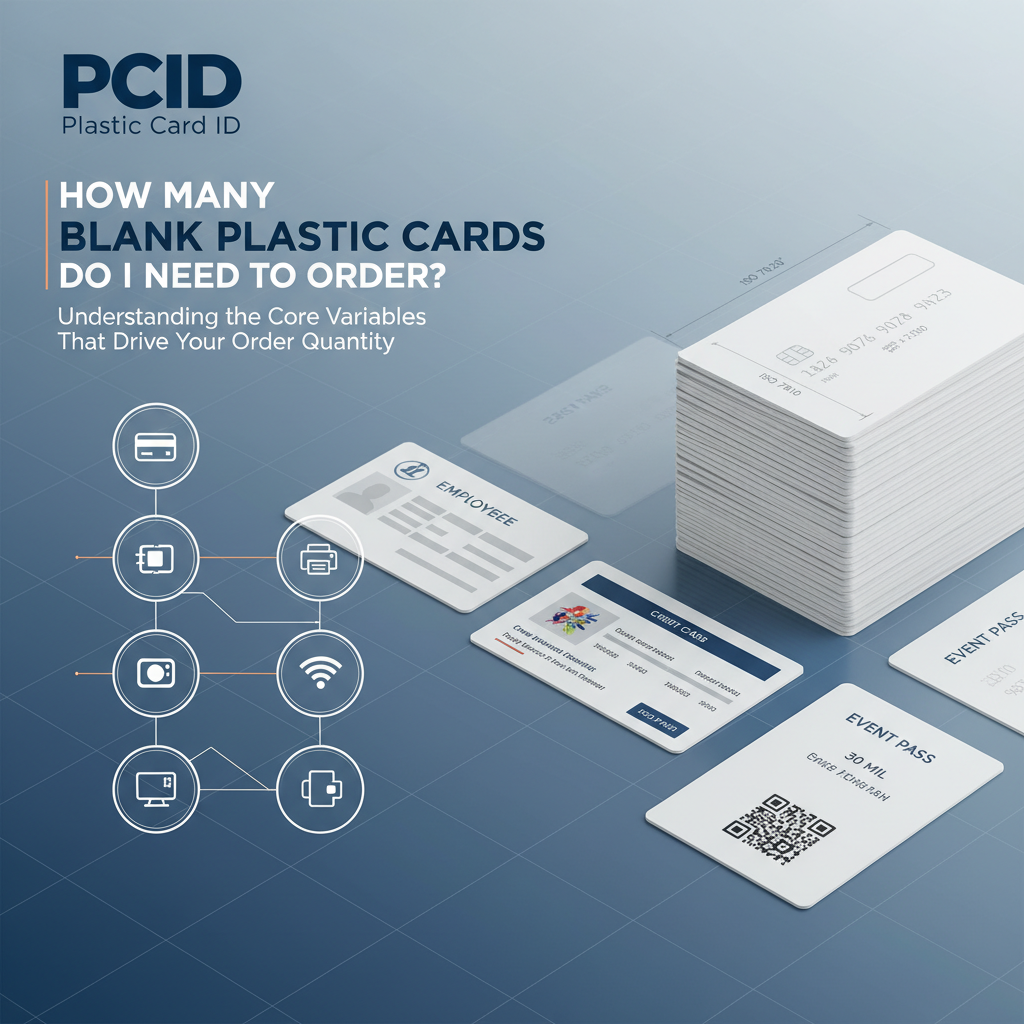 There is no universal magic number. The right order quantity depends on a constellation of factors - some obvious, some surprisingly easy to overlook. Before you pick a number out of thin air, it pays to understand what actually drives volume in a card program. The organizations that run the smoothest programs are always the ones that thought this through before placing their first order.
Your current active user count is your anchor point, but it is never the whole story. You also need to account for attrition, replacements, new enrollments, seasonal demand spikes, and the inevitable card that gets lost, demagnetized, or chewed by the office dog. Each of those scenarios requires a card on hand - and if you don't have one, your program grinds to a halt.
Your Active Base: The Starting Number
Start by counting the people, doors, or transactions your card program serves right now. A company with 80 employees running an ID badge program needs at least 80 cards. A loyalty program with 400 enrolled members needs at least 400. This is your floor - the minimum below which you simply cannot function. Everything else gets added on top of it.
Don't confuse your active base with your historical signups. If your gym has enrolled 1,200 members since opening but only 600 are currently active, your active base is 600. New cards replace lost or damaged ones among those 600, and new issuances come from fresh memberships - not from re-counting people who left two years ago.
Replacement Rate: The Number Most People Underestimate
Cards get lost. They get demagnetized by sitting next to a phone in a pocket. They fade, crack, or simply disappear into the void of someone's couch cushions. A realistic replacement rate for most programs runs between 10% and 25% of the active base per year, depending on how heavily the cards are used and who is carrying them.
For high-traffic programs - think retail loyalty cards or hotel key cards used daily - that rate can push even higher. Plan for it. A hotel with 500 rooms should not be ordering 500 key cards once and calling it done. They should be ordering enough to cover turnover for months at a time, because running out mid-week is not an option any front desk manager wants to face.
Growth Projections and Seasonal Peaks
If your business is growing - or if you are launching a program for the first time - you need to project forward, not just look at the present. A retail gift card program launching in October absolutely needs to account for holiday demand. Ordering conservatively only to face a stockout in December is the kind of mistake that costs real revenue. Retailers who move from paper to plastic gift cards routinely see sales increases of 35-50%, which means demand can spike fast.
Think about what the next 6 to 12 months look like for your organization. Are you opening new locations? Expanding your membership drive? Hosting a large annual event? Build your growth projection into your order quantity and add a buffer - because the cost of ordering slightly more than you need is almost always lower than the cost of an emergency reorder or a program interruption.
Why Ordering in Higher Quantities Almost Always Saves Money
The economics of blank plastic cards strongly reward volume. The per-card cost drops significantly as quantities increase, which means the difference between ordering 500 cards and ordering 2,000 cards is often surprisingly small in total dollars - but enormous in per-unit cost. Smart buyers understand this and order accordingly.
It's not just about the card cost itself either. Every time you place a reorder, there is administrative time, shipping cost, and a potential gap in your supply. Consolidating your purchases into larger, less-frequent orders reduces overhead and keeps your program running without interruption. Over the course of a year, that adds up to real savings - not theoretical ones.
The True Cost of an Emergency Reorder
Running out of cards in the middle of a campaign or at the start of a busy season forces you into expensive decisions. Rush shipping costs more. Processing a small emergency order may not qualify for bulk pricing. And beyond the dollars, there is the operational chaos - employees without badges, customers without loyalty cards, events without credentials. None of that is free.
The most efficient organizations treat blank card inventory the way a smart retailer treats physical product inventory. They maintain a minimum stock level, they track usage rates, and they reorder before they hit zero. It is a simple discipline, and it saves money every single year.
Bulk Pricing Thresholds Worth Knowing
Most blank PVC card pricing tiers shift meaningfully at key quantity breakpoints. Common thresholds include 100, 500, 1,000, 2,500, 5,000, and 10,000 cards. Ordering just below a breakpoint can mean paying significantly more per card than you would by ordering just a bit more. Always check the pricing tier above your initial estimate - the incremental cost of bumping up to the next tier is often justified by the per-card savings alone.
For organizations running ongoing programs, calculating a 6-month supply and ordering that in one shot is frequently more economical than placing two or three smaller orders. The math is simple, and CPE can help you work through it when you reach out to discuss your program needs.
Comparing Card Types and Their Volume Implications
Different card types carry different usage patterns and different replacement realities. A standard blank CR80 PVC card used as an employee ID badge might last years if treated carefully. A magnetic stripe loyalty card swiped daily at a point-of-sale terminal will wear out faster. An RFID proximity card used for door access might be replaced if an employee leaves or a keyholder changes.
- Blank CR80 PVC cards - longest lifespan, lowest per-card cost, ideal for low-wear applications like membership or ID programs
- Magnetic stripe cards (HiCo and LoCo) - HiCo stripes resist demagnetization better and suit high-use programs; LoCo works well for short-term applications
- RFID and proximity cards - typically longer-lived but replaced when access permissions change; plan for organizational turnover
- Smart chip cards - durable but more complex to manage; volume planning should account for IT provisioning timelines
- Clear and frosted cards - same physical dimensions as CR80, used for specialty branding applications where visual impact matters
- Hotel key cards - high replacement volume due to daily use and frequent room changeovers; order generously
Special Use Cases That Require a Different Calculation
 Most card programs follow the framework above - but some scenarios demand a different kind of thinking. Events, seasonal campaigns, new program launches, and multi-location rollouts each carry unique variables that can make a straightforward volume calculation a bit more involved. Getting these right the first time avoids costly course corrections later.
The good news is that CPE has worked through virtually every use case in the book. From single-location small businesses running their first loyalty program to national chains managing tens of thousands of cards per month, the underlying logic is consistent - even when the numbers look very different.
Event Credentials and One-Time Programs
For events - conferences, trade shows, concerts, galas - your target quantity is your expected attendance plus a buffer. A buffer of 10-15% above expected headcount is a professional standard that covers registration line chaos, last-minute additions, damaged cards, and the inevitable handful of extras the event team needs to function. Print a few test cards before the event to verify your printer setup, and count those in your total.
Event cards are often not reused after the event, so leftover inventory has limited value. However, ordering slightly too many is still better than running short. The cost difference between ordering 1,000 and 1,100 cards is trivial. The operational embarrassment of turning attendees away because you ran out of credentials is not.
New Program Launches: When to Order More Than You Think You Need
Launching a new loyalty or membership program? Resist the temptation to start small as a test. If your marketing push is successful - and you want it to be - you need cards ready. A new program that cannot hand out cards at signup loses momentum fast, and recovering lost momentum is harder than simply ordering an adequate supply upfront.
A practical rule of thumb for new program launches: estimate your 90-day enrollment target, double it as your order quantity, and add 20% for replacements and operational buffer. You may not use every card in the first three months, but you will have the supply to support real growth without interruption. Unused cards stored properly remain fully usable for years.
Multi-Location and Enterprise Card Programs
Organizations with multiple locations need to think about centralized versus distributed inventory. Ordering one large consolidated supply and distributing it internally tends to be more economical than having each location place its own small order. It also keeps card stock consistent across locations - which matters for branding.
For enterprise-scale programs, CPE can support production in the tens of thousands of cards, with options for centralized delivery or staged fulfillment. Working with a strategic partner rather than a transactional vendor makes a real difference at this scale, where coordination complexity increases and the cost of getting supply chains wrong is higher.
Card Printers, Ribbons, and the Supply Chain You Need Behind Your Cards
Blank cards don't print themselves. If you're running an in-house card program, your volume calculation must account for your printer capacity, your ribbon supply, and your cleaning kit schedule. Each of these has its own consumption rate, and running out of ribbons when you have a stack of blank cards and a dozen employees waiting on badges is its own special kind of frustrating.
Your card printer's output capacity should match or exceed your peak issuance needs - not just your average daily volume. Printers from Evolis, Zebra, and Fargo each carry different throughput ratings and ribbon yields, so factor your specific printer model into your operational planning. CPE supplies the full lineup of printers, ribbons, cleaning kits, and accessories to keep your program running cleanly.
Matching Ribbon Yield to Card Volume
Most color YMCKO ribbons yield between 200 and 500 prints per ribbon panel set, depending on card coverage and printer model. If you are printing 300 cards per month, you need at least one full ribbon per month, likely more. Stock a minimum of two to three ribbons in reserve so a single delay in supply doesn't halt production.
Monochrome ribbons yield significantly more prints per roll - often 1,000 or more - making them cost-effective for programs where color printing on both sides isn't required. Knowing your ribbon type and yield relative to your monthly card volume is just as important as knowing your blank card inventory level.
Cleaning Kits and Printer Longevity
A card printer that isn't cleaned regularly produces inconsistent print quality and wears out faster. Most manufacturer guidelines recommend running a cleaning card through the printer every 250 prints or whenever print quality degrades. Factor cleaning card kits into your supply orders alongside your blank cards and ribbons - it's a small investment that protects a much larger one.
Card carriers and sleeves are worth including in your supply chain conversation as well, particularly for programs where cards are mailed to members or distributed in retail environments. A professional card carrier elevates the unboxing experience and protects the card in transit. Small details like packaging can meaningfully affect how recipients perceive and retain their cards.
Call Plastic Card ID to Build Your Supply Plan
If you're managing a card program of any size and want to get your supply chain set up properly from the start, reaching out to CPE directly is the fastest path to a solid plan. Call 800.835.7919 to speak with a team member who can walk through your program specifics, help you calculate the right starting quantity, and ensure you have the cards, printer, ribbons, and accessories to run without interruption.
Frequently Asked Questions About Blank Plastic Card Order Quantities
Some questions come up consistently when organizations are planning their card programs for the first time - or when they're scaling an existing program and trying to right-size their inventory. The answers below reflect real-world guidance developed over 25 years and more than 50 million cards supplied across the United States.
These are the questions buyers actually ask, and they deserve direct answers rather than vague generalities. If your specific question isn't answered here, CPE is always available to work through the details with you one-on-one.
What Is the Minimum Order Quantity for Blank PVC Cards?
Blank CR80 PVC cards are available in quantities as low as 100 cards per order, making them accessible for the smallest organizations. However, even small programs benefit from ordering at least 200-500 cards at a time. The per-card cost improvement between 100 and 500 cards is typically substantial, and having adequate stock on hand prevents the disruption of frequent small reorders.
For specialty cards - magnetic stripe, RFID, smart chip, clear, frosted, or custom formats - minimum quantities may vary. Checking with CPE on current minimums for your specific card type ensures you're working with accurate numbers from the start.
How Long Can Blank Cards Be Stored Before Use?
Blank PVC cards stored properly - in a cool, dry environment away from direct sunlight and away from magnetic sources - maintain their print quality and functional integrity for years. There is no meaningful expiration concern for standard blank cards. Organizations that order a 12-month supply upfront are not taking any real risk from a card quality perspective.
Magnetic stripe cards should be stored away from strong magnets, including those found in some storage systems or equipment. Smart chip and RFID cards should similarly be stored in conditions that protect their embedded technology from static or physical damage. Standard storage practices are sufficient for the vast majority of environments.
Can I Mix Card Types in a Single Order?
Yes - and many programs benefit from doing exactly that. An organization might order standard blank PVC cards for temporary visitor badges, magnetic stripe cards for their loyalty program, and RFID proximity cards for employee access control, all in the same purchase. Consolidating orders reduces administrative overhead and shipping costs.
CPE stocks a broad catalog that covers blank PVC, magnetic stripe in both HiCo and LoCo formats, RFID and proximity, smart chip, clear, frosted, colored stock, and specialty options including casino player cards, hotel key cards, and custom formats. One order, one relationship, one point of contact for your entire program.
Ready to Order? Plastic Card ID Makes It Simple
Twenty-five years. Over 100,000 customers. More than 50 million cards shipped across the United States. That track record exists because CPE treats every client as a program partner - not just a transaction. Whether you need 200 cards to launch a small employee ID program or 50,000 cards for a national loyalty rollout, the approach is the same: understand your program, help you calculate the right quantity, and make sure you have everything you need to succeed.
The right order quantity is the one that keeps your program running smoothly, costs you the least per card over time, and ensures you're never caught short at a critical moment. Use the frameworks in this guide to build your estimate, then reach out to confirm and refine it with an expert who has seen your kind of program dozens of times before.
Contact Plastic Card ID today at 800.835.7919 - your strategic card program partner for blank PVC cards, magnetic stripe, RFID, smart chip, hotel key cards, loyalty cards, ID cards, card printers, ribbons, and more. Let's build your program right from the start.
Previous Page