Blank Plastic Cards Made in the USA: Quality You Can Trust
Table of Contents []
- Why Plastic Card ID Is the Trusted Source for Blank Plastic Cards Made in the USA
- The CR80 Standard: What Makes a Blank Card a Workhorse
- Magnetic Stripe Cards: Encoding the Blank
- RFID and Smart Chip Cards: Beyond the Swipe
- Loyalty and Membership Cards: The Business Case for Plastic
- Card Printers, Ribbons, and Accessories: The Complete Picture
- Specialty Cards for Demanding Applications
- Partner with Plastic Card ID for Your USA Blank Plastic Card Program
Why Plastic Card ID Is the Trusted Source for Blank Plastic Cards Made in the USA
Walk into almost any business in America and you will find plastic cards doing quiet, essential work. Access badges open doors. Loyalty cards fill wallets. Membership cards signal belonging. Behind a surprising number of those cards is a single, focused supplier that has been doing this longer than most of its customers have been in business. Plastic Card ID has spent over 25 years sending blank and custom plastic cards to organizations of every size, in every industry, across all fifty states.
What sets this kind of longevity apart is not just volume, though the numbers are striking. More than 50 million cards shipped. Over 100,000 customers served. What matters more is that those customers keep coming back, year after year, because they found a partner that treats a 50-card order with the same seriousness as a run of 50,000. That consistency is rare. In a market crowded with here-today suppliers, it is genuinely valuable.
Blank plastic cards made in the USA are the backbone of in-house card programs across retail, hospitality, healthcare, education, government, and beyond. This page is your complete guide to understanding what blank cards can do for your organization, how to choose the right stock, and why sourcing from an experienced domestic partner changes the outcome of your card program entirely.
| Card Type | Key Feature | Common Applications |
|---|---|---|
| Blank PVC CR80 (White) | ISO standard size, 30 mil | ID badges, loyalty, membership |
| Magnetic Stripe HiCo | High coercivity, durable encoding | Hotel keys, gift cards, access |
| Magnetic Stripe LoCo | Low coercivity, shorter-term use | Event passes, short-term access |
| RFID / Proximity Cards | Contactless technology | Building access, smart ID |
| Clear / Frosted PVC | Translucent finish options | VIP cards, brand differentiation |
| Smart Chip Cards | Embedded IC chip | Secure ID, campus credentials |
The CR80 Standard: What Makes a Blank Card a Workhorse
 Not all plastic cards are created equal, and the differences matter the moment you run a card through a printer or swipe it at a reader. The CR80 format, measuring 3.375 inches by 2.125 inches at 30 mil thickness, is the global standard defined by ISO 7810. It fits every standard card printer, every badge holder, every wallet slot. That universality is not accidental. It is the result of decades of industry standardization, and it is the reason CR80 blank cards dominate in-house card programs.
When CPE supplies blank CR80 cards, those cards are ready to accept full-color dye-sublimation printing, thermal transfer printing, or direct-to-card printing depending on your printer model. The surface is engineered for adhesion. The core is engineered for durability. A well-made blank card will run cleanly through hundreds of print cycles without jamming, streaking, or warping. That reliability is what keeps card programs running smoothly day after day.
PVC Composition and Why It Matters for Print Quality
PVC, or polyvinyl chloride, is the material of choice for blank plastic cards because it balances flexibility, rigidity, and printability in a way that no other common substrate matches. The card surface accepts dye-sublimation inks by allowing dye particles to temporarily enter the material under heat, creating images that are embedded in the card rather than sitting on top of it. That means sharper photos, richer colors, and images that do not scratch off over time.
For organizations printing employee ID cards, the difference between a properly surfaced PVC blank and a cheap off-brand substitute shows up immediately. Skin tones print accurately. Text stays sharp at small sizes. Barcodes scan reliably. These are not minor aesthetic concerns. They are functional requirements for professional card programs, and they are why card stock quality deserves serious attention at the purchasing stage.
Thickness Standards: 30 Mil vs. 10 Mil and When Each Applies
The standard 30 mil card is the right choice for most applications. It feels substantial in the hand, holds up to daily handling, and works with all major card printer brands. There are situations where thinner cards make sense. Temporary event passes, insert cards, or loyalty cards that will be laminated into a carrier sometimes call for 10 mil stock. Knowing the difference protects you from ordering the wrong product for your printer.
Always verify card thickness compatibility with your specific printer model before placing a large order. Most Evolis, Zebra, and Fargo printers are calibrated for 30 mil standard cards. Using thinner or thicker cards in a printer not designed for them causes feed errors, print misalignment, and potentially printer damage. A good supplier will help you get this right before the order ships, not after.
Choosing the Right Surface Finish for Your Application
Blank PVC cards come in gloss and matte finishes, and the choice affects both print appearance and card feel. Gloss cards produce vivid, photo-quality output that commands attention. They are the natural choice for customer-facing cards where appearance drives perceived value. Matte finish cards offer a more subdued, professional look that handles fingerprints better and works well for internal ID badges where practicality outweighs flash.
Clear and frosted cards represent a third category entirely. These translucent blanks allow designers to incorporate the card's transparency as a design element, layering opaque printed elements over the see-through substrate for an effect that is genuinely striking. VIP cards, premium membership cards, and brand-forward loyalty programs use clear cards to stand out in a crowded wallet. CPE carries both clear and frosted options to support the full range of creative programs.
Magnetic Stripe Cards: Encoding the Blank
A blank magnetic stripe card is one step away from being a fully functional access credential, loyalty card, hotel key, or event pass. The magnetic stripe, running along the back of the card, stores encoded data that card readers interpret instantly. That simplicity is the reason magnetic stripe technology has remained dominant for decades despite the rise of contactless alternatives. It works, it is cheap to implement, and virtually every reader in the field supports it.
The distinction between HiCo and LoCo cards trips up a lot of first-time buyers, and getting it wrong creates real operational problems. High coercivity stripes require stronger magnetic fields to encode and read, which makes them resistant to accidental erasure from everyday magnetic sources like security systems and phone cases. Low coercivity stripes are easier to encode but more vulnerable to demagnetization. HiCo is almost always the right choice for any card program expected to last, while LoCo cards make sense for short-term applications where cards will be used briefly and discarded.
HiCo vs. LoCo: Practical Decision Guide
Hotel key cards are a classic HiCo application. Guests carry them near phones, wallets full of other cards, and elevator panel magnets. If those keys demagnetized every time a guest walked through a lobby, the front desk would be overwhelmed with re-encoding requests. HiCo stripes survive that environment without complaint. The same logic applies to employee access cards, gift cards, and any loyalty card that a customer will carry for months or years.
LoCo applications are genuinely narrow. Temporary event credentials, one-day visitor passes, and cards inserted into ticket-style mailers where encoding happens at the last moment before use can work with LoCo. The encoding cost is marginally lower, but the savings rarely justify the risk in any sustained card program. When in doubt, HiCo is the safer specification.
Tracks 1, 2, and 3: Understanding Stripe Data Capacity
Most people treat the magnetic stripe as a single storage element, but it actually contains up to three distinct tracks, each with different data capacities and read/write characteristics. Track 1 holds alphanumeric data at higher density and is commonly used for cardholder name and account information in hospitality and loyalty programs. Track 2 is numeric only but is the most universally readable track and the one most access control systems rely on. Track 3 is less commonly used in most business card programs but supports read-write applications in some specialized systems.
Understanding which tracks your system uses helps you specify the right card and ensure your encoder is writing to the correct track at the correct format. This is one of those technical details that matters enormously in practice and almost never comes up until something goes wrong. Sourcing from a supplier with deep technical knowledge prevents costly encoding mismatches before cards ever reach your readers.
Pairing Magnetic Stripe Cards with the Right Printer
Not every card printer encodes magnetic stripes. Standard dye-sublimation printers handle print only. To write data to a magnetic stripe in-house, you need a printer equipped with a magnetic encoding module, a feature available on many Evolis, Zebra, and Fargo models. This combination of printing and encoding in a single pass is one of the most efficient setups for mid-volume card programs, eliminating the need for a separate encoder and reducing handling time per card.
For organizations that buy pre-encoded cards from a fulfillment supplier, the printer needs to handle print only, which opens up a wider range of printer options at lower price points. Either approach works. The right choice depends on your volume, your data management process, and whether encoding in-house is operationally feasible. Reach out to CPE at 800.835.7919 to get a recommendation based on your actual workflow, not just a generic spec sheet.
RFID and Smart Chip Cards: Beyond the Swipe
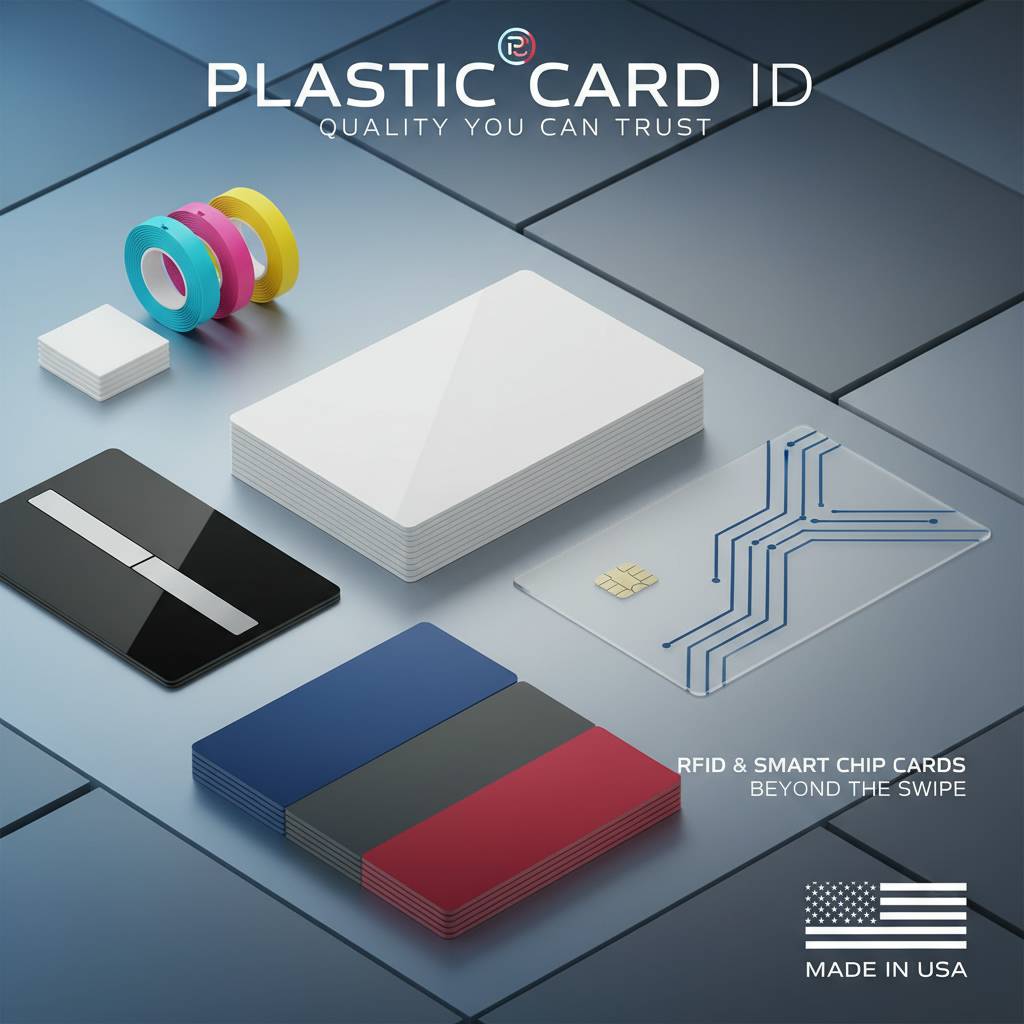 Contactless card technology has moved from novelty to necessity in a remarkably short time. RFID cards and smart chip cards now handle building access, campus identification, cashless payment on closed networks, and a growing range of enterprise applications that demand more security and more data capacity than a magnetic stripe can provide. The blank card category has expanded accordingly, and CPE carries a range of contactless blanks to serve those requirements.
Proximity cards, which operate at 125 kHz and are associated with widely deployed formats like HID and EM4100, remain the workhorses of commercial building access. They are rugged, readable from a few inches without contact, and supported by an enormous installed base of readers. MIFARE cards operating at 13.56 MHz offer greater data capacity and the ability to store application-specific data beyond a simple ID number, making them the right choice for multi-application programs combining access control with loyalty, transit, or cashless vending.
MIFARE DESFire: High-Security Smart Cards for Demanding Applications
At the top of the smart card hierarchy sits MIFARE DESFire, a platform that combines the convenience of contactless operation with encryption strong enough for sensitive applications. DESFire cards use AES 128-bit encryption and support multiple independent applications on a single card, each with its own access keys and data structure. That architecture is what allows a single university ID card to handle building access, library services, dining credits, and printing quotas without any function interfering with another.
Casino player cards represent another high-value application for advanced contactless technology. Player tracking systems in regulated gaming environments demand cards that are difficult to clone, easy to read at speed, and reliable under heavy daily use. MIFARE DESFire meets all of those requirements while supporting the tiered loyalty programs that drive repeat visits and player engagement. It is a serious technology for serious card programs.
Proximity Cards and Building Access Integration
The 125 kHz proximity card market is enormous, and for good reason. The technology is proven, inexpensive, and compatible with access control systems from virtually every major manufacturer. Blank proximity cards work with Wiegand-based readers found in millions of commercial buildings across the country. They can be printed on the face just like any other PVC card, allowing organizations to combine professional-looking employee ID cards with seamless access control credentials in a single card.
For organizations upgrading from older proximity technology to 13.56 MHz smart cards, dual-frequency cards offer a migration path. These cards contain both a proximity and a smart card chip, allowing them to work with both old and new readers during a transition period. That flexibility protects infrastructure investment while allowing a phased upgrade at a manageable pace.
Ordering Smart Card Blanks: What to Specify
- Chip type: Specify the exact chip platform required by your access control or application software (for example, MIFARE Classic, MIFARE DESFire EV2, or HID iCLASS).
- Frequency: 125 kHz for legacy proximity, 13.56 MHz for modern smart card applications.
- Format: Confirm whether cards need to be pre-programmed with a site code or facility code, or supplied blank for in-house programming.
- Print surface: Confirm that the card surface is compatible with your printer model and ribbon type.
- Volume: Smart card blanks are available in quantities from small pilot runs to production volumes in the tens of thousands.
Loyalty and Membership Cards: The Business Case for Plastic
The research on this is clear enough that it should settle the question once and for all. Retailers who switch from paper punch cards or digital-only loyalty programs to physical plastic loyalty cards consistently report meaningful increases in program participation and spending. Numbers in the range of 35-50% sales increases have been documented for businesses making the transition from paper gift cards to plastic. The card in the wallet is a persistent reminder. The app on the phone that gets buried in a folder is not.
Membership cards carry a different kind of weight. When someone receives a well-made plastic card identifying them as a member of an organization, gym, club, or association, the card communicates permanence and legitimacy in a way that a paper certificate simply cannot replicate. Plastic membership cards signal that the program is real and that the organization behind it is serious. That signal influences how members perceive their membership and how likely they are to engage, renew, and refer others.
Gift Cards That Drive Real Revenue
Blank plastic gift card stock gives retailers the ability to load and reload cards at the point of sale using their own systems, without paying per-card fees to third-party processors. The blank card itself costs a fraction of a finished custom-printed card, and buying in volume reduces that cost further. Organizations that print their own gift cards in-house using a card printer keep full control over card design, activation timing, and inventory management.
Gift cards also have a well-documented breakage component, meaning a percentage of loaded value that is never redeemed. While that is not the primary reason to run a gift card program, it is a real financial consideration for program economics. More importantly, gift cards bring new customers into stores, drive spending above the card value, and create natural opportunities for loyalty program enrollment at the point of redemption.
Loyalty Programs Built on Blank Card Infrastructure
The infrastructure for a plastic loyalty card program starts with the card itself, but it does not end there. Magnetic stripe encoding, barcode printing, or RFID chips turn a blank card into a scannable, trackable credential that integrates with point-of-sale systems. CPE supplies the full range of card types needed to support these programs, from simple white PVC blanks printed with a member number and barcode to more sophisticated encoded cards that communicate directly with loyalty software.
The economics favor plastic from the first year of operation. A properly managed loyalty card program increases average transaction value and visit frequency among enrolled customers. Those gains compound over time as the enrolled customer base grows. The card is the physical anchor of the relationship, and keeping that anchor in wallets, not in recycling bins, is what sustains program performance over months and years.
Case Study: From Paper Punch Cards to Plastic in a Regional Retail Chain
A regional specialty retailer running twenty locations across three states had been operating a paper punch card loyalty program for years. Participation was inconsistent, cards were frequently lost or damaged, and there was no data infrastructure to track program performance. The switch to blank PVC loyalty cards printed in-house with barcodes linked to a simple CRM database changed the program's measurability and durability overnight.
Within the first year, program enrollment increased because plastic cards felt worth keeping. Average transaction value among enrolled members rose because the card served as a visible reminder of points accumulated. The data infrastructure that came with barcode scanning gave the marketing team insights they had never had before. The investment in blank card stock and a card printer paid for itself in the first quarter. This is not an unusual outcome. It is a repeatable one when the program is set up correctly.
Card Printers, Ribbons, and Accessories: The Complete Picture
A blank plastic card program needs more than cards. It needs the means to print them, the supplies to keep printing running smoothly, and the accessories to get finished cards into the right hands. Plastic Card ID has built a complete product ecosystem around the blank card, stocking printer ribbons, cleaning kits, card carriers, sleeves, and card affixing and mailing services alongside its core card inventory. That means a single purchase order can cover everything a card program needs to operate.
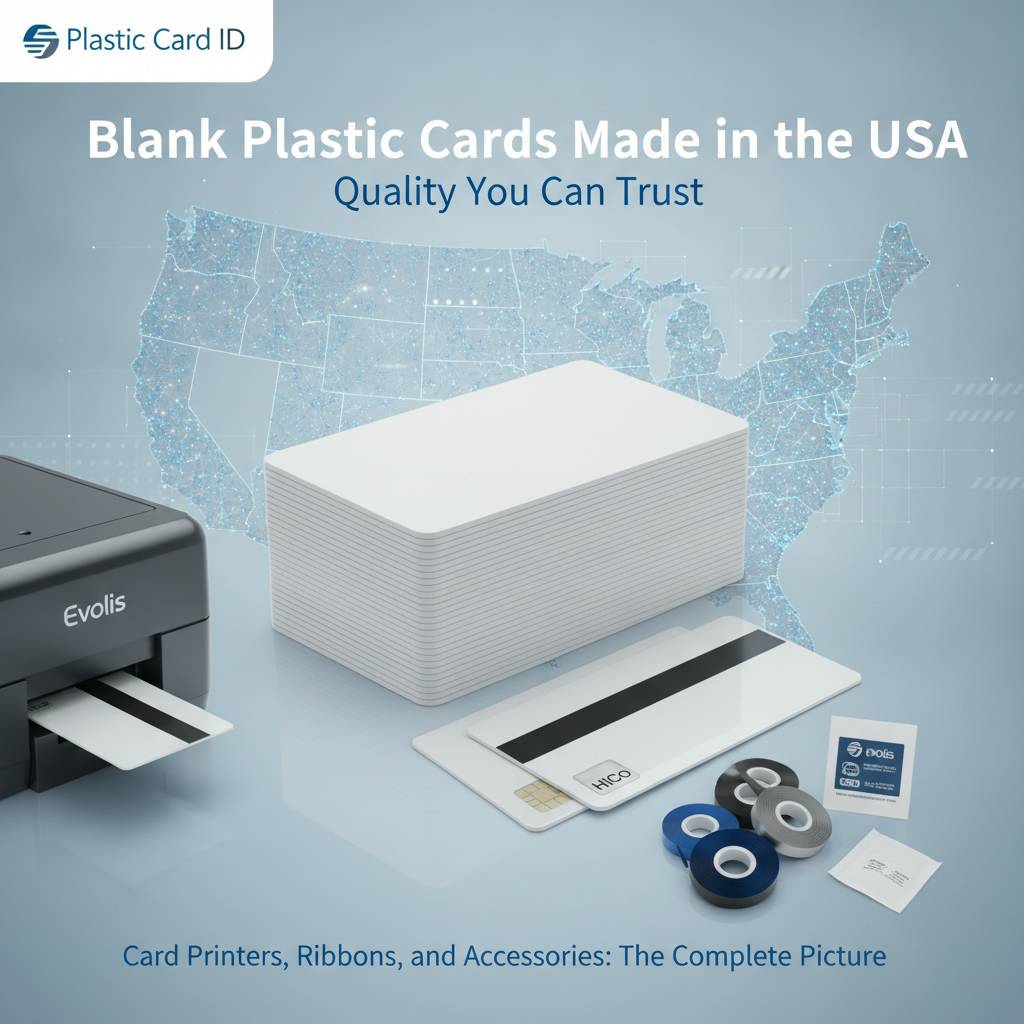
The printer brands in the lineup, Evolis, Zebra, and Fargo, represent the top tier of the card printing industry. Each brand has strengths that make it the right choice in different contexts. Evolis printers are known for elegant design, quiet operation, and excellent color output, making them popular in customer-facing environments like hotel front desks and membership offices. Zebra printers are workhorses built for high-volume, demanding environments. Fargo printers offer deep customization options and strong performance in security card applications.
Choosing a Card Printer for Your Program Volume
Volume is the first filter for printer selection. Programs printing fewer than 500 cards per month have very different needs than programs running 5,000 cards monthly. Entry-level printers in the Evolis Primacy or Zebra ZC100 range are well-suited to smaller programs and offer excellent print quality at accessible price points. Mid-volume programs benefit from dual-sided printing capability and higher-capacity card hoppers that reduce operator intervention. High-volume programs need robust feeders, fast print speeds, and durable mechanisms that hold up under continuous use.
Contact 800.835.7919 to discuss your volume, your application requirements, and your budget before committing to a printer purchase. The right printer for a 200-card-per-month loyalty program is a very different machine from the right printer for a 10,000-card-per-month employee badge operation, and the cost difference is significant. Getting this decision right at the start prevents expensive regrets within the first year.
Ribbons, Cleaning Kits, and Consumables
Printer ribbons are consumables that directly determine print quality. Using the correct ribbon for your printer model and your card application is not optional. Color YMCKO ribbons produce full-color output with a clear overlay that protects the printed image. Monochrome ribbons in black, silver, gold, and other colors handle single-color printing at much lower cost per card. Resin ribbons are the right choice for printing on cards that will be used in environments with higher temperature or humidity exposure, where standard dye-sublimation panels would degrade more quickly.
Cleaning kits are the most undervalued consumable in any card printing operation. Dust, card debris, and ribbon residue accumulate inside printers and degrade print head performance over time. Regular cleaning cycles using manufacturer-approved cleaning cards and swabs extend print head life dramatically. A print head replacement on a professional card printer is a significant expense. A cleaning kit costs a fraction of that. Consistent preventive maintenance is the cheapest printer insurance available.
Card Carriers, Sleeves, and Mailing Services
Getting finished cards to cardholders is its own operational challenge. Mailing a bare plastic card creates risks of damage and loss. Card carriers, which are folded paper inserts that hold cards securely for mailing, protect cards in transit and provide a surface for personalized messaging, activation instructions, or terms and conditions. Card sleeves serve a similar protection function and are widely used for issued ID badges and access cards that need to be protected before activation.
For organizations that do not want to manage card mailing in-house, CPE offers card affixing and mailing services that handle the fulfillment side of the program. Cards are mounted to carriers, inserted into envelopes, and mailed directly to cardholders using supplied address lists. This service is particularly valuable for membership organizations issuing renewal cards, retailers launching new loyalty programs, or any organization needing to reach a large cardholder base at once without building an internal fulfillment operation.
Specialty Cards for Demanding Applications
Standard white PVC blanks handle the majority of card program needs, but the category does not stop there. Clear plastic cards, frosted cards, custom die-cut shapes, and luxury metal cards in stainless steel, brass, and gold occupy a different tier of the product range, one defined by premium materials and elevated perceived value. These are the cards that get noticed, kept, and talked about.
Metal cards, in particular, have moved from novelty to genuine business tool in sectors where premium positioning matters. A stainless steel membership card communicates something categorically different from a plastic equivalent. The weight is tangible. The finish is distinctive. The card does not flex, fade, or show wear in the normal way plastic does. For VIP programs, executive membership tiers, luxury hospitality, and high-value client retention applications, metal cards deliver a physical brand statement that commands attention.
Clear and Frosted Cards for Premium Programs
Clear PVC cards are a design tool as much as a card substrate. The transparency becomes part of the design, allowing creative teams to create visual effects impossible on opaque stock. A clear card printed with an architectural image of a building becomes an artistic credential for a real estate company. A frosted card with a club name printed in white creates a sophisticated VIP pass that feels premium in a way standard cards simply do not.
Frosted cards split the difference between full transparency and opacity, offering a softened, matte-like translucent finish that works beautifully with minimalist design approaches. Both clear and frosted cards are available in standard CR80 dimensions and print on compatible printers with appropriate ribbon settings. They are a genuine upgrade for any program where card appearance drives perceived program value.
Custom Die-Cut Shapes and Unusual Formats
Not every card needs to be a rectangle. Key tag cards, mini cards, and fully custom die-cut shapes allow organizations to match card format to brand identity or functional requirement in ways that standard CR80 cards cannot. Key tags attach to keyrings and keep loyalty cards accessible in contexts where wallet cards would be forgotten. Mini cards fit in spaces where full-size cards are inconvenient. Custom shapes create memorable physical brand touchpoints for marketing campaigns and events.
These specialty formats typically require minimum order quantities higher than standard blanks, and lead times reflect the custom manufacturing involved. For organizations with the volume to justify them, the investment in non-standard formats delivers measurable differentiation. A card that no one else in your category is using becomes a conversation starter and a retention tool simultaneously.
Casino and Hospitality Cards
Casino player cards and hotel key cards are among the most demanding card applications in terms of durability, encoding reliability, and volume requirements. Player cards in regulated gaming environments are issued in large quantities, handled daily, subjected to electronic reading multiple times per visit, and expected to maintain both print quality and encoding integrity over months of use. Hotel key cards face similar durability requirements with the added complication of exposure to demagnetizing sources in guest environments.
Both applications benefit from HiCo magnetic stripe encoding and high-quality PVC stock. Casino cards increasingly incorporate RFID chips for contactless player tracking at table games, requiring smart card blanks compatible with the casino management system in use. CPE has deep experience supplying both sectors and can match card specifications to the exact reader and system requirements of specific properties, reducing the risk of compatibility issues that disrupt operations.
Partner with Plastic Card ID for Your USA Blank Plastic Card Program
 Twenty-five years of experience does not just mean a long history. It means a catalog built by listening to what real card programs actually need. It means technical knowledge that goes beyond reading spec sheets. It means relationships with card program managers who have seen what works and what fails across every industry and every scale of operation. When you source blank plastic cards from Plastic Card ID, you are not buying commodity product from a faceless warehouse. You are engaging a strategic partner with a genuine stake in your program's success.
Whether you are launching a new loyalty program from scratch, scaling an existing card operation to meet growing demand, or upgrading an aging access control infrastructure, the path forward starts with the right card stock, the right printer, and the right supplier relationship. Plastic Card ID has supplied over 50 million cards to more than 100,000 customers across the United States, and the operational knowledge embedded in that experience is available to every customer, from the smallest nonprofit running a 50-card membership program to the enterprise operation printing badges for tens of thousands of employees.
Call Plastic Card ID today at 800.835.7919 to speak with a card program specialist and get exactly the right blank plastic cards, printers, and supplies for your USA-based operation. Your program deserves a partner who takes it as seriously as you do.
Previous Page