What Questions to Ask Before Ordering Plastic Cards
Table of Contents []
- Smart Buyers Ask These Questions Before Ordering Plastic Cards - Plastic Card ID
- What Exactly Will These Cards Be Used For?
- Do You Understand Card Specifications Before You Order?
- What Quantity Do You Actually Need - And How Often?
- Are You Equipped to Print and Encode In-House?
- Frequently Asked Questions About Ordering Plastic Cards
- Ready to Order the Right Cards for Your Program? Plastic Card ID Has Answers
Smart Buyers Ask These Questions Before Ordering Plastic Cards - Plastic Card ID
Most people approach their first plastic card order the same way: they know what they want, roughly, and they figure the details will sort themselves out. Then the cards arrive. Maybe the magnetic stripe encoding is wrong. Maybe the card stock is thinner than expected. Maybe the quantity minimum meant ordering 500 cards when 100 would have sufficed. Getting the right answers before you place your order isn't just smart - it's the difference between a card program that works and one that costs you twice.
At Plastic Card ID, we've spent over two decades working alongside businesses of every size - from boutique gyms printing 50 membership cards a month to regional retailers running loyalty programs in the tens of thousands. The questions below reflect real conversations with real buyers. Work through them before you order, and your card program will be better for it.
| Card Type | Common Use Case | Key Feature to Clarify |
|---|---|---|
| Blank PVC CR80 | Employee badges, event credentials | Thickness (30 mil standard), finish |
| Magnetic Stripe (HiCo/LoCo) | Loyalty cards, gift cards, hotel keys | Coercivity level, track encoding |
| RFID / Proximity | Access control, smart campus | Frequency (125kHz vs 13.56MHz) |
| Smart Chip / MIFARE | Casino player cards, transit, premium loyalty | Chip type, compatibility with readers |
| Clear / Frosted PVC | Luxury membership, VIP credentials | Opacity level, printability |
| Metal Cards | Executive IDs, luxury brand marketing | Material (stainless, brass, gold), weight |
What Exactly Will These Cards Be Used For?
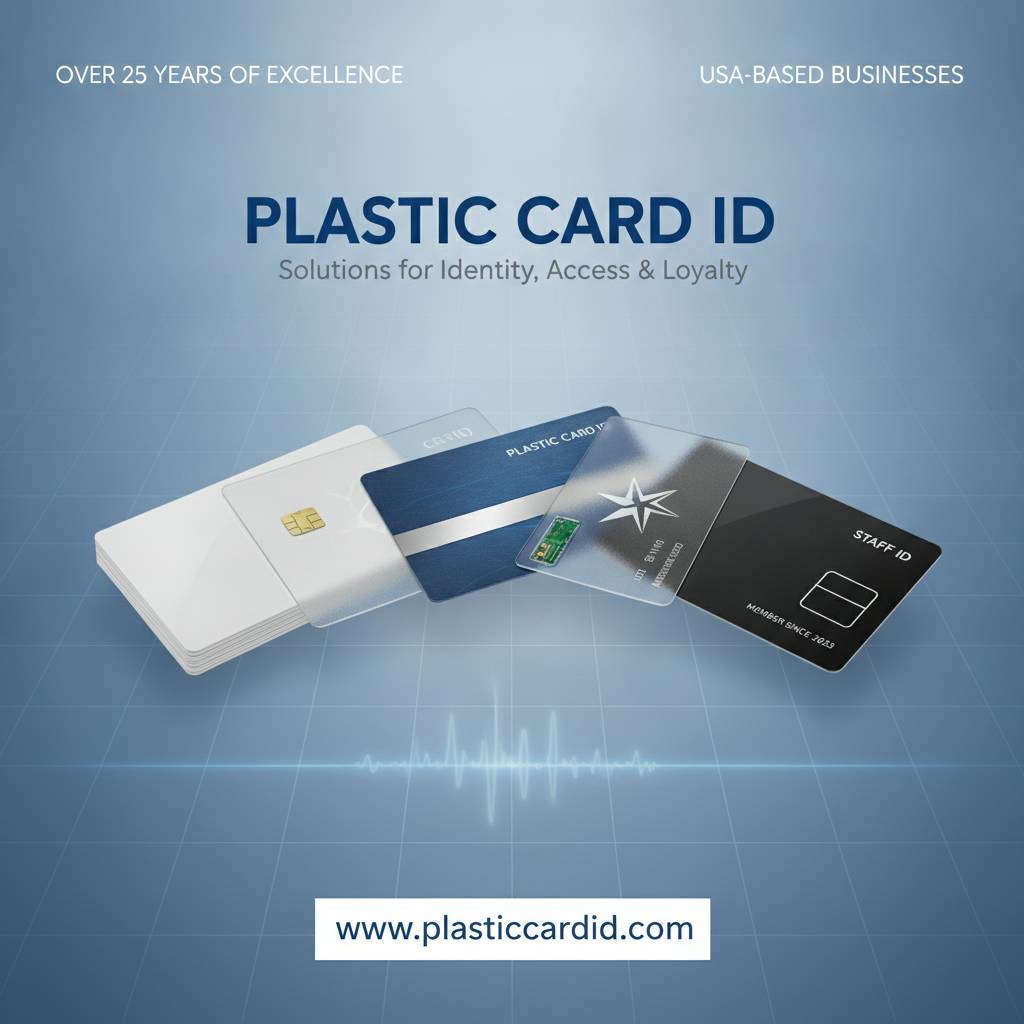 It sounds obvious, but defining the primary purpose of your card program before ordering shapes every decision that follows. A card meant for employee access control has completely different requirements than a retail gift card. Knowing your end use case is not optional - it's the foundation of a smart order. Proximity cards for building access run on specific frequencies. Loyalty cards benefit from magnetic stripe encoding. Gift cards require entirely different handling than event credentials.
The use case also determines the lifespan you're designing for. A one-day event badge doesn't need the same durability as a hotel key card used hundreds of times. If your cards will live in wallets alongside other cards and coins, you'll want to know that 30 mil CR80 PVC is the ISO 7810 standard that holds up - not flimsier alternatives. Start with purpose, and the right card type will reveal itself quickly.
Identity and Access Applications
Employee ID cards, contractor badges, and visitor passes all fall under the identity umbrella. These cards are often printed in-house using card printers from brands like Evolis, Zebra, or Fargo - which means ordering the right blank card stock matters as much as picking the right printer. The card and printer must be compatible for results that look professional and last long-term.
Access control adds another layer. If your facility uses proximity readers or smart card readers, the card itself needs to carry the right embedded technology - whether that's a 125kHz proximity chip or a MIFARE DESFire contactless chip. Ordering generic blank cards for an access system that requires encoded credentials is a costly mistake. Clarify your reader infrastructure before ordering a single card.
Loyalty, Membership, and Gift Card Programs
Retailers who switch from paper punch cards to plastic loyalty cards routinely see measurable increases in repeat customer behavior. The reason is simple: a plastic card lives in a wallet and generates recall every time someone reaches for their keys or credit cards. Paper gets lost, torn, or forgotten. Plastic loyalty cards that live in wallets outperform paper alternatives in virtually every metric that matters to business owners.
Gift card programs deserve particular attention. Research consistently shows that retailers switching from paper gift certificates to plastic gift cards see sales increases in the range of 35-50%. That number alone makes the conversation about card type worth having carefully. Magnetic stripe encoding on gift cards requires clarity about which tracks will be used and whether your point-of-sale system is compatible with HiCo or LoCo encoding.
Events, Hospitality, and Specialty Programs
Casino player cards, hotel key cards, and event credential passes represent some of the most specialized applications in the plastic card world. Casino programs, for instance, often use smart chip cards with MIFARE DESFire technology for tier tracking and secure player identification. Hotel keys require encoding compatibility with specific lock systems - the card stock alone isn't enough. Specialty applications demand specialty expertise, not just a product catalog search.
Event organizers frequently underestimate how much card design and encoding needs to sync with the event management software or access readers at the venue. Clear plastic cards and custom die-cut shapes can elevate the perceived value of a VIP credential dramatically. Before ordering, map out exactly what technology or software will interact with the card during its operational life.
Do You Understand Card Specifications Before You Order?
Card specifications are where most first-time buyers get tripped up. The terminology sounds technical but the concepts are accessible once someone explains them plainly. CR80 refers to the standard credit card size - 3.375 inches by 2.125 inches - and 30 mil refers to the thickness (0.030 inches). These are the baseline specs for virtually every standard plastic card application in the United States and internationally under ISO 7810. Understanding card specs isn't about becoming an expert - it's about knowing enough to ask the right follow-up questions.
Beyond size and thickness, specifications include finish (glossy vs. matte), core color (white, clear, frosted, or colored stock), and whether the card needs to be compatible with a specific card printer and ribbon type. Ordering glossy cards for a printer optimized for matte laminate cards can produce subpar print quality regardless of design quality. These are easy mistakes to avoid - once you know to look for them.
HiCo vs. LoCo Magnetic Stripes
High coercivity (HiCo) magnetic stripes require more magnetic force to encode, which also makes them more resistant to accidental erasure from everyday magnets. LoCo stripes encode more easily but are more vulnerable to common magnetic fields. For most business applications - loyalty cards, gift cards, access badges - HiCo is the safer long-term choice. Hotel key cards are typically LoCo because hotel lock systems are designed to encode them quickly at check-in, and security duration is less critical.
The practical question to ask your supplier: which coercivity does my existing card reader or encoder support? If you're building a new program from scratch, HiCo is generally recommended as the default. At CPE, the team can help match coercivity to your specific use case so there are no surprises once encoding begins.
Call CPE at 800.835.7919 to clarify magnetic stripe specifications before you finalize your order.
RFID Frequencies and Chip Compatibility
Contactless cards operate at different frequencies depending on the application. 125kHz is the standard for most proximity access control systems and is compatible with a wide range of commercial readers. 13.56MHz is used for more advanced smart card applications including MIFARE Classic, MIFARE DESFire, and ISO 14443 compliant systems. Ordering a card at the wrong frequency means it simply won't communicate with your readers - a completely avoidable problem.
Before ordering RFID or proximity cards, document the make and model of your access readers or the smart card system you're integrating with. This single step eliminates the most common source of technical incompatibility in contactless card orders. Your supplier should be asking you this question; if they're not, that's a signal worth paying attention to.
Card Dimensions Beyond CR80
While CR80 is the dominant standard, there are other card formats in active use. CR79 cards are slightly smaller and designed to be inserted into a badge holder with an overlay. CR100 cards are larger - used for some hotel key applications and specialty credentials. Custom die-cut shapes go beyond rectangles entirely, enabling loyalty cards shaped like your logo or access badges shaped to match brand identities. Specialty shapes can be a powerful brand differentiator when used thoughtfully.
The key question here is whether a non-standard format is compatible with your intended card printer. Standard desktop card printers from Evolis, Zebra, or Fargo are calibrated for CR80. Printing non-standard shapes may require manual feeding or different equipment entirely. Always confirm format compatibility with both your card supplier and your printer before committing to a specialty shape.
| Specification | Standard Option | Alternative Options |
|---|---|---|
| Size | CR80 (3.375" x 2.125") | CR79, CR100, custom die-cut |
| Thickness | 30 mil | 20 mil, 10 mil (overlay) |
| Finish | Glossy white | Matte, clear, frosted, colored |
| Magnetic Stripe | HiCo (2750 Oe) | LoCo (300 Oe) |
What Quantity Do You Actually Need - And How Often?
 Ordering quantity is rarely as simple as "how many cards do I need right now." Volume pricing tiers mean that ordering slightly more than you immediately need can dramatically reduce your per-card cost. But over-ordering on encoded or personalized cards creates obsolescence risk if details change. The smart approach is to think in terms of your card program's cadence, not just its current snapshot. Businesses serving 50 cardholders a month have very different ordering strategies than those running mass programs in the tens of thousands.
Blank cards offer the most ordering flexibility. Because they're printed in-house, you order the quantity you need, print what you need now, and store the rest. There's no encoding that can become outdated, no personalization that expires. For programs with variable data - names, ID numbers, encoded credentials - understanding how frequently that data changes shapes your order quantity strategy significantly.
Volume Tiers and Per-Card Cost
The economics of plastic cards are straightforward: per-card cost drops as volume increases. The jump between ordering 500 cards and 1,000 cards can reduce per-unit cost by 20-40% depending on card type. For blank PVC cards without encoding, this makes a strong case for ordering to cover six months of anticipated need rather than month by month. Understanding your volume tier is one of the simplest ways to optimize the cost structure of any card program.
Encoded cards with static data - like standard magnetic stripe gift cards with no personalization - also benefit from volume ordering. The encoding setup cost is amortized across the full run. Where you need to be cautious is with personalized or variable-data cards, where producing more than you'll use creates waste without financial benefit.
Planning for Program Growth
A common scenario: a business launches a loyalty program with 200 members and orders 250 cards. Within three months, membership doubles. The card design has been updated. Now they're reordering at a price point that makes the original order look inefficient in hindsight. Building a 12-month demand forecast before your first order is not overthinking - it's protecting your budget.
At Plastic Card ID, clients ranging from small independent retailers to multi-location franchise groups benefit from a supplier relationship that helps them think about their card program as an ongoing operation rather than a one-time purchase. Strategic partners ask about your growth plans. Transactional suppliers just take the order.
Reorder Timelines and Inventory Management
Production and shipping timelines vary by card type and order complexity. Standard blank PVC cards often ship faster than encoded or specialty cards that require additional processing. If your card program has peak seasons - a retail holiday rush, annual membership renewals, a conference with 3,000 attendees - building reorder lead time into your planning calendar is essential. Running out of cards during peak demand is a business disruption that's entirely avoidable with basic planning.
Consider maintaining a safety stock of blank cards for in-house printing programs. A buffer of 200-500 cards printed on demand provides operational flexibility without significant capital tied up in finished inventory. For higher-complexity cards requiring external encoding, build in at minimum two weeks of buffer before your projected need date.
Are You Equipped to Print and Encode In-House?
Blank cards are only half the equation for organizations running in-house card programs. The card printer, the ribbon type, the cleaning kit, and the encoding software all need to work together. Buyers who source cards from one vendor and printers from another sometimes discover compatibility issues that could have been avoided with a single conversation. A true one-stop card program supplier saves you the coordination headache and keeps all variables under one roof.
Plastic Card ID carries card printers from Evolis, Zebra, and Fargo - three of the most widely used brands in commercial card printing - along with matching printer ribbons, cleaning kits, card carriers, and card sleeves. Having access to all these components from a single supplier means that when a question arises about why print quality dropped, the answer doesn't require triangulating between three different vendors.
Choosing the Right Card Printer
The right card printer depends on print volume, card type, and encoding requirements. Entry-level desktop printers from Evolis handle single-sided printing for low-to-medium volume programs efficiently. Mid-range Zebra models add duplex printing and magnetic stripe encoding in one pass. Fargo printers are known for high-resolution output and robust lamination options for security-conscious applications. Matching printer capability to your program's actual requirements prevents both under-spending and over-spending on equipment.
For programs encoding RFID or smart chip cards, the printer must include the appropriate encoding module. These are not afterthoughts - they're configuration decisions made at purchase. Buying a printer without an encoding module and then discovering your application requires it means either buying a new printer or adding a separate encoding station.
Reach the team directly at 800.835.7919 to get a printer recommendation matched to your specific card program requirements.
Ribbons, Cleaning Kits, and Consumables
Printer ribbons are the consumable most frequently underestimated in card program budgeting. Ribbon yield - the number of cards printable per ribbon panel set - varies by printer model and ribbon type. Full-color YMCKO ribbons yield fewer cards per ribbon than monochrome ribbons used for simple text printing. Underestimating ribbon consumption is one of the most common reasons card programs run over budget in their first year.
Cleaning kits matter more than most buyers expect. Dust and debris inside a card printer degrade print quality gradually - the kind of degradation that's easy to attribute to ribbon quality or card stock rather than its actual source. Regular cleaning cycles extend printer life, maintain print quality, and protect the investment in both equipment and consumables. Include cleaning kits in every order conversation.
Card Carriers, Sleeves, and Mailing Services
For programs distributing cards to members, employees, or customers by mail, the presentation and protection of the card during transit matters. Card carriers provide a branded touchpoint alongside the card itself - they communicate professionalism and purpose at the moment of delivery. Card sleeves protect magnetic stripes and printed surfaces during storage and mailing. The unboxing moment for a loyalty or membership card is a brand experience - don't shortchange it with bare envelopes.
CPE also offers card affixing and mailing services, streamlining the fulfillment process for organizations that don't want to handle distribution in-house. For a membership organization mailing 1,000 new member cards quarterly, outsourcing this step removes significant labor from an already full administrative plate.
Frequently Asked Questions About Ordering Plastic Cards
Some questions come up in nearly every buyer conversation. Rather than leaving you to discover these through trial and error, the answers are collected here to accelerate your decision-making. The most prepared buyers close the fastest - and get the best outcomes from their card programs.
What Is the Minimum Order Quantity?
Minimum order quantities vary by card type. Blank PVC cards are generally available in quantities as low as a single box (typically 100-500 cards depending on the product). Encoded cards - magnetic stripe, RFID, or smart chip - may carry higher minimums due to production setup requirements. For most small business applications, there's a workable minimum that doesn't require over-committing on initial inventory.
When evaluating minimums, remember that per-card cost at the minimum quantity is at its highest. Running a quick cost analysis comparing the minimum order to the next volume tier often reveals that ordering slightly more is the better financial decision even if you don't immediately need the additional cards.
Can Cards Be Ordered Pre-Encoded or Ready to Print Blank?
Both options are available, and the right choice depends on your infrastructure. Pre-encoded cards arrive ready for immediate distribution - useful for programs without in-house encoding capability. Blank cards with magnetic stripes arrive with the stripe unencoded, ready for in-house encoding via a card printer with an encoding module.
- Pre-encoded cards work best for programs with static data (e.g., standard gift card values) or where in-house encoding equipment is not available.
- Blank encodable cards work best for programs encoding variable data (employee IDs, unique member numbers) in-house.
- Pure blank cards with no stripe are ideal for visual ID programs using only printed information.
- Smart chip and RFID cards typically require specialized encoding equipment or pre-encoded ordering depending on the application.
- Clarify the encoding workflow before ordering to avoid receiving cards you cannot immediately use.
What Happens If Cards Don't Work With My Existing Readers?
Incompatibility between cards and readers is almost always a specification mismatch - wrong frequency for RFID, wrong coercivity for magnetic stripe, wrong chip format for a smart card reader. In the vast majority of cases, the incompatibility was preventable with a pre-order conversation. This is precisely why working with a knowledgeable supplier who asks the right questions matters more than shopping purely on price.
If you're unsure of your reader specifications, check the documentation for your access control system or POS system before ordering. Alternatively, contact the manufacturer of your reader hardware directly - most can confirm compatible card specifications in minutes. Bring that information to your card order conversation and compatibility issues become a non-issue.
Ready to Order the Right Cards for Your Program? Plastic Card ID Has Answers
The questions in this guide aren't meant to complicate a straightforward transaction - they're meant to make it more successful. Fifty million cards sold across more than 100,000 customers over 25-plus years generates a lot of pattern recognition about what makes card programs succeed and what makes them stumble. The businesses that ask these questions before ordering consistently build card programs that perform better, cost less per card over time, and require fewer painful course corrections.
Whether your program needs 50 cards a month or tens of thousands in a single production run, the range of card types, printers, and services available through Plastic Card ID covers the full spectrum. From standard blank CR80 PVC to luxury metal cards in stainless steel, brass, or gold - from proximity access cards to MIFARE DESFire smart chips - the catalog and the expertise exist in one place so you don't have to piece together solutions from multiple sources.
Contact Plastic Card ID today at 800.835.7919 and talk through your card program requirements with a team that has seen every scenario, answered every question, and helped businesses like yours build card programs that actually deliver results. The first conversation is free - the clarity it provides is invaluable.
Previous Page