Blank Plastic Cards for Time and Attendance Systems
Table of Contents []
- Blank Plastic Cards for Time and Attendance Systems - Plastic Card ID
- Why Your Time and Attendance Program Needs Plastic - Not Paper
- Understanding the Card Types Available for Attendance Tracking
- Choosing the Right Quantity and Reorder Strategy
- Card Printers and Accessories - Completing Your In-House Setup
- FAQ - Blank Plastic Cards for Time and Attendance Systems
- Partner with Plastic Card ID for Your Time and Attendance Card Program
Blank Plastic Cards for Time and Attendance Systems - Plastic Card ID
Time slips get lost. Paper sign-in sheets pile up, fade, smear, and create audit nightmares. If your organization is still relying on manual methods to track when people arrive and leave, the gap between what you record and what actually happened grows wider every single day. Blank plastic cards for time and attendance systems are the foundational fix - simple, scalable, and far more reliable than anything made from paper.
What makes a blank CR80 PVC card so powerful in this context is its flexibility. It starts as nothing - literally a plain white rectangle - and becomes whatever your system needs it to be. Print an employee photo and name on one side. Encode a magnetic stripe with a unique ID. Load an RFID chip for tap-based clock-ins. The card does not care. Your printer, your encoder, your rules. Plastic Card ID has spent over 25 years supplying exactly these cards to businesses across every state, and the volume tells its own story: more than 50 million cards shipped, more than 100,000 customers served.
| Card Type | Best Use Case | Encoding Method |
|---|---|---|
| Blank PVC (CR80) | In-house printing and custom badging | Print only |
| HiCo Magnetic Stripe | Swipe-based clock-in terminals | Magnetic encode |
| LoCo Magnetic Stripe | Low-interference environments | Magnetic encode |
| RFID / Proximity | Contactless tap-to-clock systems | Chip / antenna |
| Smart Chip (ISO) | Multi-function access and attendance | Chip contact / contactless |
Why Your Time and Attendance Program Needs Plastic - Not Paper
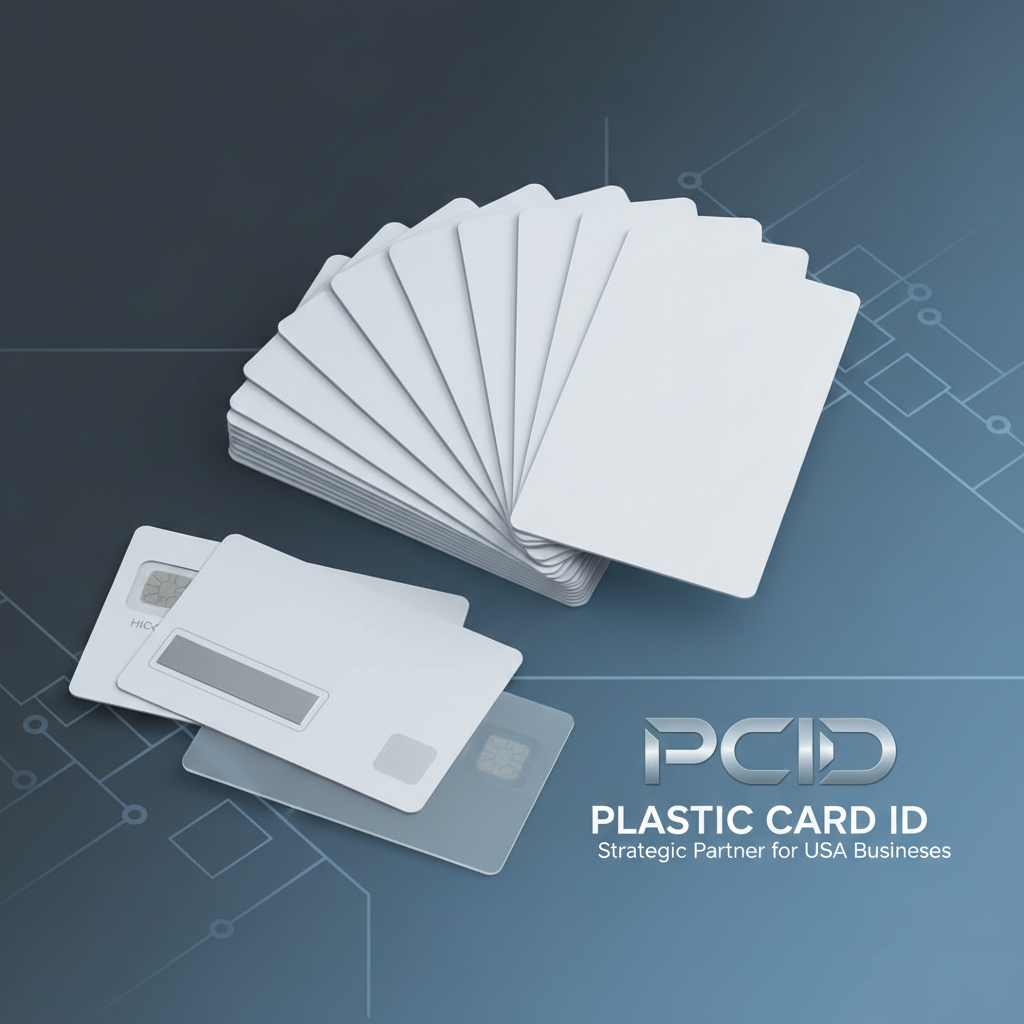 There is a reason facilities managers, HR directors, and operations teams consistently upgrade from paper-based tracking: the cost of inaccuracy is not abstract. Buddy punching alone - where one employee clocks in for another - costs U.S. businesses billions annually. A plastic card uniquely tied to one individual, whether by printed photo, encoded ID, or embedded chip, creates an accountability layer that paper punch cards simply cannot replicate.
Durability matters more than people expect. A card that will be swiped, tapped, or inserted into a reader dozens of times per week needs to survive that friction. Standard CR80 cards at 30 mil thickness hold up to daily handling without cracking, curling, or becoming illegible. The ISO 7810 standard is not just a spec number - it is a guarantee that the card will fit every reader, every badge holder, every wallet slot designed for a standard ID card.
The Hidden Cost of Manual Time Tracking
Paper timesheets require someone to enter data, check for errors, reconcile discrepancies, and chase down missing signatures. Every one of those steps costs time, and time costs money. Switching to a card-based system eliminates the manual data-entry layer and creates a digital record the moment an employee swipes or taps in.
The administrative savings compound fast. For a company with 40 employees, cutting even 15 minutes of manual reconciliation per day per manager adds up to over 90 hours per year - hours that go back into productive work instead of paperwork archaeology.
Plastic Cards as Identity Anchors
An employee who carries a plastic ID card with their photo, name, and company logo does not just have a time-tracking tool. They have a credential. That card signals legitimacy, whether they are walking through a security checkpoint, entering a restricted area, or simply arriving at the front desk. Paper badges peel, fade, and fall apart within days. Plastic endures.
This identity function doubles the value of the card without doubling the cost. One card, printed and encoded correctly, becomes both an attendance tracker and an official identification document recognized across the entire facility. CPE supplies the cards - you supply the purpose.
Compatibility with Major Time Clock Systems
Most modern time and attendance terminals accept standard CR80 magnetic stripe cards, proximity cards, or both. Whether you run Kronos, ADP Time and Attendance, Paychex Flex, or a proprietary in-house system, the blank card format you choose must match your reader type. That is why Plastic Card ID stocks HiCo and LoCo magnetic stripe blanks alongside 125 kHz proximity cards and RFID options - so there is always a match.
Need help identifying which card format your system requires? Call 800.835.7919 and a product specialist will walk you through the options based on your terminal specifications.
Understanding the Card Types Available for Attendance Tracking
Blank cards are not one-size-fits-all, even though they are physically the same size. The internal construction - or lack thereof - determines everything about how the card interacts with your system. Choosing the wrong type means cards that will not read, readers that get damaged, or data that fails to transmit. Understanding the options is not optional; it is the difference between a smooth rollout and a frustrating one.
The good news is that the landscape is not complicated once you know what to look for. Plastic Card ID carries the full spectrum, from the simplest blank white PVC to sophisticated smart cards with dual-interface chip technology. Each has a clear purpose, a clear price point, and a clear use case in a time and attendance environment.
HiCo vs. LoCo Magnetic Stripe Cards
High-coercivity (HiCo) magnetic stripe cards are the workhorses of swipe-based attendance systems. HiCo stripes resist accidental erasure from nearby magnets - a real concern in manufacturing floors, warehouses, and facilities with heavy equipment. The data encoded on a HiCo stripe stays intact through thousands of swipes.
Low-coercivity (LoCo) cards encode and re-encode more easily, making them a fit for controlled environments where the card content changes frequently. For most time and attendance programs, HiCo is the right choice - but LoCo has its place, particularly when the system needs to rewrite card data on the fly.
RFID and Proximity Cards for Contactless Clock-In
Tap-to-clock systems are growing fast, and for good reason. An employee walking through a doorway with a 125 kHz proximity card can clock in without stopping, slowing down, or touching anything. Proximity cards improve throughput at shift changes, reduce wear on physical readers, and are far more hygienic in food service, healthcare, and other environments where contact matters.
For more advanced applications, MIFARE DESFire and other smart card technologies offer encrypted, multi-application capability - the same card can handle time tracking, access control, and cafeteria payments. CPE stocks both entry-level proximity blanks and advanced RFID options for organizations ready to scale their card program.
Plain Blank PVC Cards for In-House Printing
Sometimes the best tool is the simplest one. A plain white blank CR80 card, printed in-house with a desktop card printer, gives organizations complete control over design, data, and timing. No waiting on outside print orders. No minimum quantities that exceed what you need. Print one card for a new hire today and ten tomorrow - the flexibility is total.
Blank PVC cards are the lowest cost per card of any option in the lineup. Combined with a reliable card printer from Evolis, Zebra, or Fargo, organizations can run a fully self-sufficient badging and attendance card program at a fraction of what outsourced custom printing costs over time.
Choosing the Right Quantity and Reorder Strategy
 One of the most common mistakes organizations make when setting up a card-based time and attendance system is underordering on the first run. Cards get lost, damaged, or need to be reprinted due to employee data changes. Building in a buffer - typically 15-20% above your active headcount - avoids the scramble when a new hire shows up and there are no blank cards on hand.
Buying in bulk reduces your per-card cost significantly. A box of 500 blank HiCo magnetic stripe cards costs considerably less per unit than ordering 50 at a time. For organizations running ongoing card programs, the math on bulk ordering almost always favors stocking up, especially given the storage simplicity - cards stack flat, take up minimal space, and have essentially unlimited shelf life when stored properly.
Tiered Buying Guide for Time and Attendance Cards
- Small teams (under 50 employees): Order 100-200 blank cards per run. Keep a small surplus for replacements and new hires.
- Mid-size operations (50-250 employees): A 500-card order typically covers a full program rollout with replacement buffer. Review quarterly.
- Large facilities (250 employees): Order in 1,000 increments to maximize per-card savings. Consider establishing a standing reorder schedule with Plastic Card ID.
- Seasonal workforces: Time seasonal orders to arrive 2-3 weeks before your peak hiring window. Account for cards needing encoding and printing before employees start.
- Multi-location organizations: Centralize card procurement for consistency and pricing leverage, then distribute to locations as needed.
Getting your order cadence right from the start means fewer emergency orders, lower per-card costs, and a card program that runs without friction. CPE serves programs ranging from 50 cards a month to tens of thousands - whatever your scale, there is a purchasing strategy that fits.
Card Replacement Planning
Cards in active use in a time and attendance program get replaced for several reasons: employees leave, cards get damaged, data needs to be updated, or readers reject worn cards. Planning for a 10-15% annual replacement rate is a reasonable starting point for most workforces, though high-turnover industries may run considerably higher.
Building replacement cards into your regular supply order, rather than treating them as emergency purchases, keeps your per-card cost stable and your program running without interruption. A standing account with Plastic Card ID makes this straightforward - the same card spec, ordered on your schedule, delivered fast.
Storage and Handling Best Practices
Blank PVC cards should be stored flat, away from direct sunlight and heat sources. Magnetic stripe cards are particularly sensitive to strong magnetic fields, so keep bulk stock away from motors, speakers, and other electromagnetic sources. Proximity and RFID cards are more resilient but should still be kept in stable conditions.
Card sleeves and protective carriers - both available from Plastic Card ID - extend the working life of issued cards significantly. An employee badge that gets tossed loose in a locker every day will show wear far faster than one kept in a sleeve. The card is cheap; the printing, encoding, and administrative effort to replace it is not.
Card Printers and Accessories - Completing Your In-House Setup
A blank card program for time and attendance only works as well as the printer behind it. Desktop card printers from Evolis, Zebra, and Fargo are the industry standard for in-house ID card production, and Plastic Card ID carries a full lineup alongside the ribbons, cleaning kits, and supplies needed to keep them running correctly. A printer that jams, streaks, or encodes inconsistently defeats the purpose of bringing card production in-house.
Matching the right printer to your program is a function of volume, encoding needs, and whether you require single-sided or dual-sided printing. Entry-level models handle low daily volumes and basic printing. Higher-volume models include built-in magnetic stripe encoders, contact smart card stations, or RFID encoding modules - the right choice depends on which card types your attendance system requires.
Ribbons and Consumables - What You Actually Need
YMCKO ribbons - Yellow, Magenta, Cyan, Black, and Overlay - are the standard for full-color ID card printing. Using genuine ribbons matched to your printer model ensures print quality, color accuracy, and card longevity. Generic ribbons may cost less upfront but frequently cause feed errors, faded prints, and premature printhead wear.
Cleaning kits are not optional accessories - they are maintenance essentials. A card printer that goes uncleaned accumulates dust, card debris, and ribbon residue that degrades print quality and shortens the lifespan of expensive components. Plastic Card ID stocks cleaning kits for all major printer brands alongside ribbons in the correct formats for your model.
Card Carriers and Mailing Services
For organizations distributing time and attendance cards to remote locations or mailing them to employees during onboarding, card carriers and professional card affixing and mailing services remove the logistics headache entirely. Cards arrive presentation-ready, properly protected, and in a format employees can put to use immediately.
This service is particularly valuable for multi-location businesses, staffing agencies, and organizations with distributed workforces where cards cannot be handed out in person. Ask about card mailing and fulfillment options when you call 800.835.7919.
FAQ - Blank Plastic Cards for Time and Attendance Systems
Buyers who are new to card-based time tracking ask a predictable set of questions. Answering them up front saves everyone time and prevents the most common ordering mistakes.
What is the standard card size for time and attendance readers?
CR80 is the universal standard - 3.375 inches by 2.125 inches at 30 mil thickness. Every major time clock manufacturer builds their card readers around this format, and every card Plastic Card ID stocks matches this specification precisely. Do not order non-standard sizes without confirming compatibility with your terminal manufacturer.
The 30 mil thickness matters because some readers have tolerance specifications. Cards that are too thin flex inconsistently through the read head; cards that are too thick may jam. Standard CR80 at 30 mil eliminates both problems.
Can I print on RFID and magnetic stripe cards?
Yes - and you should. An attendance card that carries an employee photo and name alongside its encoded data is significantly harder to misuse or accidentally swap. Printing on encoded cards is standard practice and does not affect the encoding as long as you use a compatible printer model with the appropriate encoding module installed.
Most desktop card printers sold by Plastic Card ID can be configured with magnetic stripe encoding modules, contact smart card stations, or RFID encoding capabilities depending on the model. Print and encode in a single pass for maximum efficiency and minimum handling.
What if my time clock uses a proprietary card format?
Some legacy time clock systems use proprietary encoding schemes or card formats. In these cases, you will need to verify the card specifications with your terminal vendor before ordering. Most modern systems, however, use industry-standard magnetic stripe or proximity formats that any blank card from Plastic Card ID can be encoded to match.
If you are unsure, bring your terminal model number to the conversation when you contact CPE. The product team can often identify the correct card spec based on the reader type and help you avoid an incompatible order.
Partner with Plastic Card ID for Your Time and Attendance Card Program
Plastic Card ID is not a card catalog you scroll through once and forget. It is the kind of supplier relationship that makes a card program run smoothly for years - consistent product quality, reliable fulfillment, and a team that understands what happens when the cards stop working on a Monday morning shift change. Over 25 years and 50 million cards shipped, that kind of operational trust is the product as much as the card itself.
Whether you are launching a new time and attendance card program from scratch, replacing a paper-based system, or scaling an existing program to new locations, Plastic Card ID has the card types, the accessories, the printers, and the expertise to support every stage. Blank PVC, HiCo magnetic stripe, RFID proximity, smart chip - the full catalog is ready, and orders ship across the United States.
Ready to build a smarter time and attendance card program? Call 800.835.7919 today and let Plastic Card ID put over 25 years of card program expertise to work for your organization.