ISO Standard Plastic Card Thickness: 30 Mil vs 20 Mil
Table of Contents []
- What Plastic Card ID Knows About Plastic Card Thickness That Most Buyers Miss
- The ISO Standard Explained: Why 30 Mil Is the Benchmark
- Understanding 20 Mil Cards: Where They Fit and Where They Fall Short
- Card Thickness Across Product Categories
- Choosing the Right Thickness for Your Card Program
- Frequently Asked Questions About Card Thickness
- Why Plastic Card ID Is the Right Partner for Your Card Program
What Plastic Card ID Knows About Plastic Card Thickness That Most Buyers Miss
Walk into any conversation about plastic cards and thickness rarely comes up first. People ask about printing, about magnetic stripes, about how many cards they need. But card thickness? It quietly determines whether your card program feels professional or falls apart under everyday use. At Plastic Card ID, we have watched this play out across more than 50 million cards and over 100,000 customers - and the pattern is consistent.
The two measurements that matter most are 30 mil and 20 mil. These are not arbitrary numbers. They are rooted in international standards, printer compatibility requirements, and the very real demands of real-world card programs. Understanding what separates them will change how you order, how you budget, and how your customers, employees, or members perceive your brand the moment they hold your card.
This page breaks it all down - clearly, honestly, and with the kind of detail that only comes from decades of working with businesses that depend on plastic cards to operate. Whether you are running 50 cards a month or scaling into the tens of thousands, the thickness question matters more than most people realize.
| Feature | 30 Mil (CR80) | 20 Mil |
|---|---|---|
| ISO 7810 Standard | Yes (ID-1) | No |
| Fits Standard Card Printers | Yes | Some models only |
| Wallet Thickness | Same as credit card | Thinner, more flexible |
| Perceived Quality | Premium | Economy |
| Common Applications | ID, loyalty, access, membership | Temporary, short-run, bulk |
| Best For | Ongoing card programs | Events, trials, handouts |
The ISO Standard Explained: Why 30 Mil Is the Benchmark
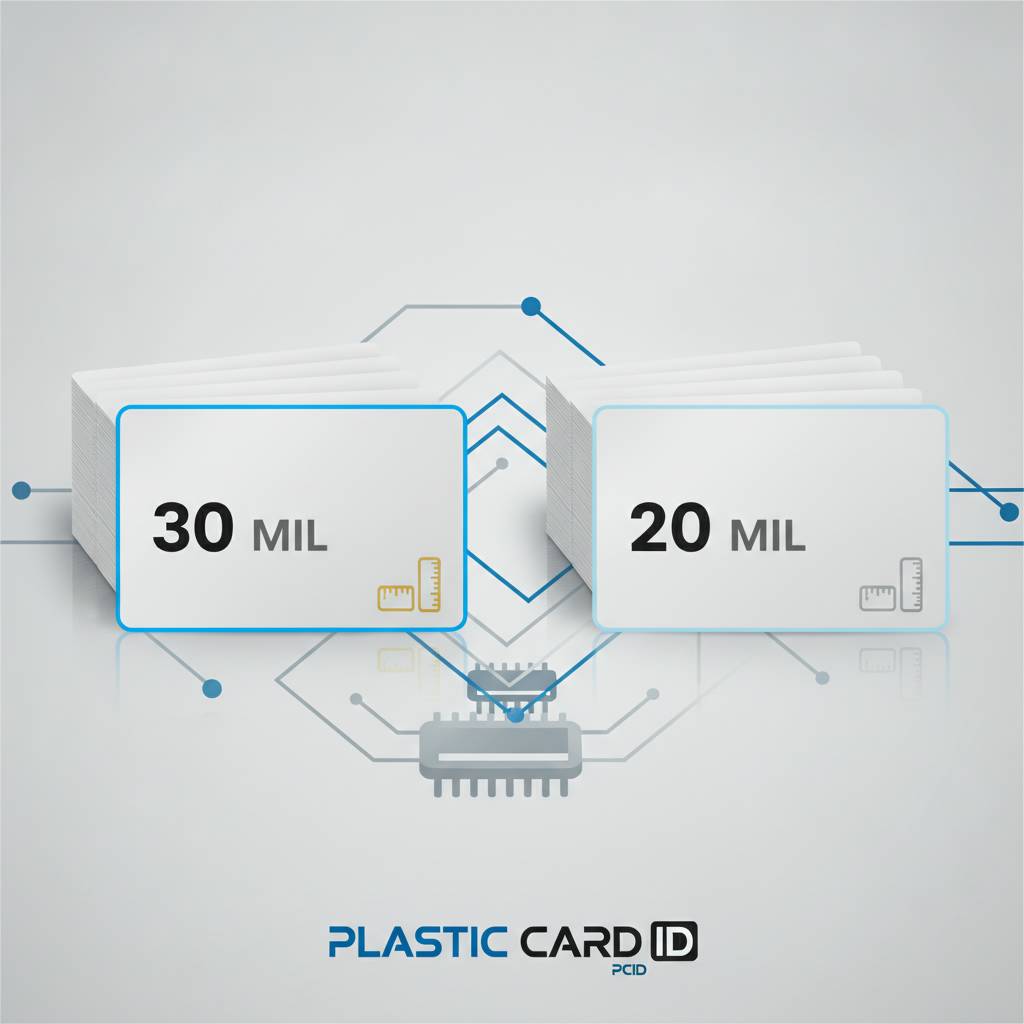 ISO 7810 is the international standard that defines the physical dimensions of identification cards. The ID-1 format specifies a card that is 85.6mm wide, 53.98mm tall, and 0.76mm thick - which translates directly to 30 mil in the measurement system used across North America. Every credit card in your wallet, every driver's license in your pocket, every hotel key you have ever used - all of them are built to this specification.
That standardization is not bureaucratic red tape. It has enormous practical consequences. Card printers are engineered around it. Card readers are sized for it. Wallet slots are designed to hold it. When your card matches the ISO standard, everything downstream works the way it should. When it does not, friction appears in unexpected places - and in a card program, friction is expensive.
What 30 Mil Actually Means in Practice
The term "mil" refers to one-thousandth of an inch. So 30 mil equals 0.030 inches, or approximately 0.76 millimeters. It is the exact thickness of a standard credit card and the specification around which the entire global card industry has organized itself. When CPE supplies blank CR80 cards in 30 mil, we are delivering something that integrates seamlessly into existing infrastructure.
This matters profoundly for businesses running in-house card programs with desktop card printers. Evolis, Zebra, and Fargo printers - the professional-grade lines we carry - are all calibrated to feed, print, and eject 30 mil cards reliably. Load them up with standard ISO stock and the machine runs smoothly through thousands of cards without a jam. Reliability at scale is not accidental; it is engineered into the standard.
The Credential Perception Effect
There is a psychological dimension to card thickness that does not show up in spec sheets but absolutely shows up in business results. When someone receives a card that feels identical to their credit card - same weight, same flex resistance, same confident rigidity - they categorize it differently than a flimsy piece of thin plastic. It signals permanence. It signals that the organization issuing it is serious.
Retailers who switched from paper loyalty programs to plastic loyalty cards built on 30 mil CR80 stock have reported sales increases of 35-50%. That lift is not purely about card thickness, but the physicality of the card plays a role - a wallet-resident card generates repeat visits that a paper punch card simply cannot. The card that lives in the wallet is the card that drives behavior.
Standards Compliance for ID and Access Programs
For employee ID cards, student credentials, and physical access control systems, ISO compliance is frequently a system requirement rather than a preference. Proximity card readers and smart card terminals are built to engage with cards of a specific thickness. A 20 mil card slipped into a reader designed for 30 mil can cause read errors, mechanical wear, or complete non-function. When your card program involves real security infrastructure, standard thickness is non-negotiable.
Contact 800.835.7919 if your program involves access control, RFID, or smart chip technology. Our team can confirm compatibility requirements for your specific hardware and help you select the right card stock before you order - not after a frustrating discovery at your card reader terminal.
Understanding 20 Mil Cards: Where They Fit and Where They Fall Short
Twenty mil cards occupy a legitimate space in the card market, even if that space is narrower than some suppliers let on. At 0.020 inches thick - roughly two-thirds the thickness of a standard credit card - these cards are more flexible, lighter, and typically less expensive per unit. For the right application, that combination of properties is genuinely useful.
The mistake is treating 20 mil as a universal cost-saving swap for 30 mil. It is not. The applications where 20 mil performs well are specific, and outside those applications, the trade-offs in perceived quality, printer compatibility, and durability become real operational problems. CPE works with clients across all kinds of card programs, and we have seen both outcomes.
Applications Where 20 Mil Makes Sense
Short-duration programs are the natural home for 20 mil cards. Event credentials designed for a single day or weekend, trial membership cards handed out at a promotional event, visitor passes that need to be tracked and discarded - these are cases where the lower per-card cost of 20 mil makes practical sense without sacrificing program effectiveness.
High-volume bulk handouts are another strong fit. If you are distributing thousands of cards at a trade show and expecting perhaps 10% to be redeemed, investing in full 30 mil stock for all of them may not be the best use of budget. The card's job in that scenario is to carry information and survive long enough to prompt a visit or a call - not to last three years in a wallet.
The Printer Compatibility Problem
Here is where 20 mil cards cause the most unexpected trouble. Most desktop card printers - including popular models from Evolis, Zebra, and Fargo - are optimized for 30 mil stock. Some accept a range that includes 20 mil; many do not. Feeding non-standard thickness cards through a printer that was not designed for them can result in misfeeds, skewed prints, incomplete encoding, and in some cases, physical damage to the printer's feed rollers.
Before ordering 20 mil cards for use with an in-house printer, verify your printer's accepted thickness range. This is not a minor technical footnote - it is the difference between a smooth card production run and a frustrating afternoon on the phone with tech support. Our team at CPE can help you cross-reference card stock with your specific printer model to avoid this entirely.
Longevity and Wear Resistance Compared
The physics here are straightforward: thinner cards flex more under the same stress. In daily use - sliding in and out of wallets, being handled repeatedly at point-of-sale, passing through magnetic stripe readers - 20 mil cards accumulate wear faster than their 30 mil counterparts. The print surface and any encoding on the card are more vulnerable to delamination and physical degradation.
For a card program where the cards are intended to be held and used for months or years - employee ID programs, long-term membership programs, hotel key cards for extended stays - the durability difference between 20 mil and 30 mil is a meaningful factor in total cost of ownership. Replacing cards more frequently because they wear out ahead of schedule erases the per-unit savings quickly.
Card Thickness Across Product Categories
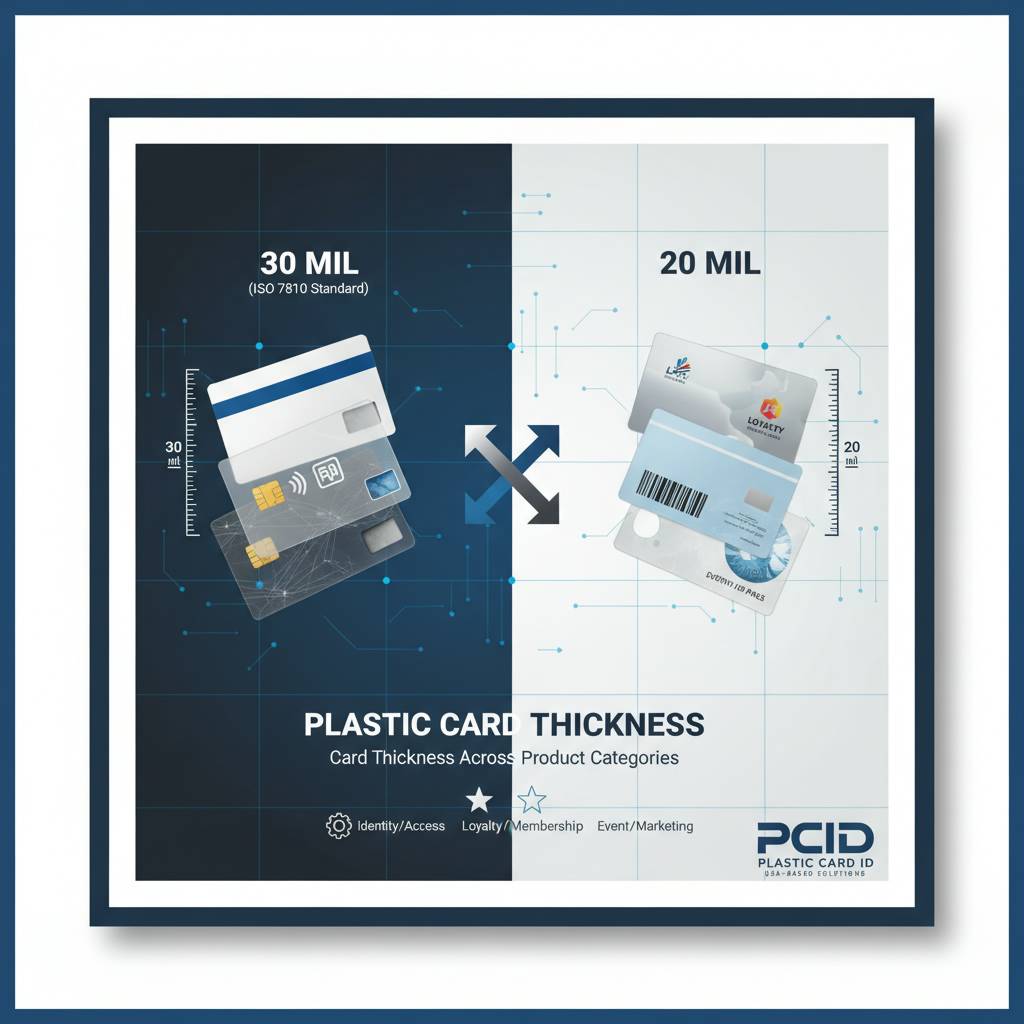 Different card types come with their own thickness profiles, and understanding how standard measurements interact with specialized card technologies helps you build a smarter program. The blank CR80 at 30 mil is the baseline, but the products built on and around that standard vary significantly in construction and application.
At Plastic Card ID, the product catalog is built around this reality. Whether you are sourcing blank white PVC cards, magnetic stripe cards in HiCo or LoCo configurations, proximity access cards, RFID smart cards, or specialty options like clear and frosted stock, knowing how thickness interacts with each technology helps you order with confidence the first time.
Magnetic Stripe Cards and Thickness Standards
HiCo (High Coercivity) and LoCo (Low Coercivity) magnetic stripe cards are manufactured on standard 30 mil PVC stock. The magnetic stripe itself adds negligible thickness - it sits within a groove on the card surface and does not meaningfully alter the overall card dimensions. This means magnetic stripe cards are fully ISO 7810 compliant and compatible with all standard card printers and readers that support mag stripe encoding.
HiCo stripes are rated for longer read life and greater resistance to accidental erasure from everyday magnetic exposure - the right choice for cards that will be used frequently over extended periods, like employee badges or gift cards that may take months to redeem. LoCo cards work well in lower-traffic applications. Both formats run perfectly on standard 30 mil stock.
RFID, Proximity, and Smart Chip Cards
Here is where thickness gets more nuanced. Proximity cards and RFID cards embed an antenna and chip within the card body itself. The resulting card is typically still close to 30 mil in overall thickness, but the internal construction is entirely different from a plain PVC card. The ISO standard tolerances accommodate this, but it is worth confirming with your specific access control system vendor.
Smart chip cards - including contactless options using MIFARE DESFire technology - follow the same general profile. These are the cards powering modern physical access control systems, transit systems, and high-security facility management programs. Casino player cards and hotel key cards fall into related categories. All of these products at CPE are designed around standard CR80 dimensions for maximum hardware compatibility.
Specialty Cards: Clear, Frosted, and Metal
Clear and frosted plastic cards, custom die-cut shapes, and luxury metal cards in stainless steel, brass, and gold each carry their own thickness specifications. Metal cards in particular are substantially thicker and heavier than standard PVC - the premium feel is part of the product's value proposition for VIP programs, exclusive membership tiers, and high-end brand experiences. These are not printer-fed cards; they are typically pre-produced with branding applied during manufacturing.
Clear and frosted PVC cards match standard 30 mil dimensions and run through desktop card printers normally. They offer a distinctive visual effect for membership cards, event credentials, and loyalty programs where standing out from a wallet full of white cards provides genuine marketing value.
Choosing the Right Thickness for Your Card Program
The decision between 30 mil and 20 mil is not always obvious from a catalog listing. It requires a clear-eyed look at how the cards will be used, how long they need to last, what hardware they will interact with, and what impression you want them to make. Plastic Card ID has helped organizations work through exactly this question tens of thousands of times across 25 years of card program consulting.
A structured approach helps. Think about the card's lifecycle - from production through daily use to eventual replacement. Think about the systems it will interact with. Think about who will be holding it and what conclusion you want them to draw from the physical experience of holding it. Those questions map directly onto the thickness decision.
A Practical Decision Framework
- Use 30 mil when: cards will be used daily, carried in wallets, or passed through card readers and printers regularly
- Use 30 mil when: the card represents your organization's brand and professional credibility to employees, customers, or members
- Use 30 mil when: the card interacts with access control systems, smart card terminals, or magnetic stripe readers in a production environment
- Use 30 mil when: the card program is intended to run for months or years with the same cards in circulation
- Consider 20 mil when: the card is a one-time event credential, promotional handout, or short-duration pass with no encoding requirements
- Consider 20 mil when: your printer manufacturer explicitly supports the thinner stock in their specifications
- Always verify printer compatibility before ordering any non-standard thickness stock for in-house printing programs
Volume and Budget Considerations
At meaningful scale - think 5,000 cards or more - the per-unit cost difference between 30 mil and 20 mil may appear significant on a spreadsheet. But the right comparison is not just purchase price. Factor in the cost of reprinting cards that wear out prematurely, the cost of troubleshooting printer jams caused by incompatible stock, and the cost of brand damage when a customer receives a card that feels cheap. Total cost of ownership consistently favors 30 mil for ongoing programs.
For truly high-volume programs in the tens of thousands, CPE offers pricing structures that make premium 30 mil stock economically competitive. Call 800.835.7919 to discuss volume pricing on blank white PVC, colored stock, or any of our specialty card formats. The conversation takes minutes and can save meaningful budget over the lifecycle of your program.
How Printers and Cards Work Together
The relationship between card stock and card printer is a system, not two independent choices. Evolis printers, Zebra printers, and Fargo printers each have defined feed tolerances, ribbon calibration profiles, and thermal transfer settings that are optimized for standard 30 mil PVC. Running the right cards through the right printer produces sharp, durable, professional results every time - and that consistency is what makes in-house card production a genuinely cost-effective strategy for organizations running ongoing programs.
When clients pair non-standard stock with a printer that was not designed for it, the results are inconsistent at best and damaging at worst. Our team can advise on compatible card and printer pairings across the full lineup we carry, ensuring that your investment in printing hardware performs as expected from the first card to the ten-thousandth.
Frequently Asked Questions About Card Thickness
After thousands of conversations with buyers at every stage of the card program journey, certain questions come up consistently. The answers below reflect both the technical reality and the practical experience of running real card programs at real organizations.
If your question is not covered here, CPE is a phone call away. Our team does not read from scripts - we bring genuine expertise to every conversation, whether you are ordering 50 cards or 50,000.
Can I Mix 30 Mil and 20 Mil Cards in the Same Order?
Yes, you can order different thicknesses as separate line items. The cards are manufactured and packaged separately. What you cannot do is run them through the same printer hopper simultaneously - the feed mechanism is set for a specific thickness range and mixing stock within a single print run will cause jams and print quality issues. Keep your stock organized by thickness and load your printer accordingly.
For organizations running multiple card types - say, a 30 mil employee ID program alongside a 20 mil temporary visitor pass program - the practical workflow is to run each type as a separate print session with the appropriate stock loaded. Most organizations find this easy to manage once it becomes part of their standard operating procedure.
Does Card Thickness Affect Print Quality?
Indirectly, yes. Print quality in thermal transfer card printing is a function of proper surface contact between the ribbon and the card. A card that matches the printer's calibrated thickness tolerance sits against the printhead correctly, producing sharp, vibrant, consistent color. A card that is too thin may not make full contact uniformly, resulting in faded areas, incomplete coverage, or banding artifacts across the printed surface.
The cleanest prints consistently come from pairing manufacturer-recommended card stock with properly maintained printers. This is one of the reasons Plastic Card ID sells not just cards but the full ecosystem - printer ribbons, cleaning kits, and printer hardware - so that every element of your card production process is working in the same direction.
What Is the Right Thickness for Hotel Key Cards?
Hotel key cards are almost universally produced to 30 mil ISO standard. They need to interact reliably with door lock hardware, hold up to being pulled in and out of plastic key card sleeves hundreds of times during a guest's stay, and survive the general abuse of travel. Twenty mil cards would flex and potentially delaminate under this use pattern in short order.
Hotel key card programs also frequently involve RFID or magnetic stripe encoding, both of which are standard on 30 mil stock. If you are managing a hospitality property or building a key card program for a multi-unit facility, the 30 mil specification is the correct starting point every time. Contact 800.835.7919 to discuss hotel key card options, encoding formats, and volume pricing for hospitality programs.
Why Plastic Card ID Is the Right Partner for Your Card Program
There are plenty of places to buy blank plastic cards. What separates Plastic Card ID from a commodity supplier is the depth of knowledge and genuine partnership that comes from over 25 years of building card programs with more than 100,000 customers across the United States. We do not just process orders - we help you build something that works.
The difference shows up in the details. When a client calls with an unusual requirement - a non-standard card size, a specialty encoding format, a hybrid card that combines magnetic stripe with RFID - we have the experience to advise on what will work and what will not before any money changes hands. That kind of expertise is what turns a supplier relationship into a strategic partnership.
The Full Ecosystem Advantage
A card program is not just cards. It is the printers that produce them, the ribbons that carry the color, the cleaning kits that keep the printers running cleanly, the card carriers and sleeves that protect them in the mail, and in many cases the card affixing and mailing services that get them to your customers or members in the first place. Plastic Card ID covers all of it - a genuine one-stop shop for the entire card program lifecycle.
This matters practically because it eliminates the coordination complexity of working with multiple vendors. Your card stock, your printer hardware, your ribbons, your finishing supplies - all sourced from one relationship, one account, one team that understands how every piece fits together. When something needs troubleshooting or upgrading, we already know your program and can advise quickly and accurately.
Serving Programs of Every Scale
Some of our customers order 50 cards a month. Others run production programs in the tens of thousands. The approach is consistent across both: understand the program's goals, recommend the right products for those goals, and build a supply relationship that supports growth over time. We do not steer small programs toward overbuilt solutions or large programs toward shortcuts that create downstream problems.
Blank CR80 cards at 30 mil are the workhorse of in-house card programs precisely because they give organizations total control over design and encoding while keeping per-card costs manageable at scale. A single stock item becomes an employee badge, a loyalty card, a membership card, or an event credential depending on what you print and encode onto it. Flexibility at the blank card level is the foundation of an efficient card program.
Ready to Talk Through Your Requirements?
Whether you are building a card program from scratch or optimizing one that has been running for years, the conversation with our team is always worth having. We bring 25 years of program-building experience to every inquiry - no sales scripts, no unnecessary upsells, just honest expertise applied to your specific situation.
Call 800.835.7919 today and speak with a card program specialist who can help you determine the right thickness, format, and volume for exactly what you are building.
Plastic Card ID has spent more than 25 years and 50 million cards earning the trust of businesses across the United States. Call 800.835.7919 now and put that experience to work for your card program.
Previous Page