Cheap Blank Plastic Cards vs Quality: What to Look For
Table of Contents []
- Cheap Blank Plastic Cards vs. Quality: What Every Smart Buyer Needs to Know - Plastic Card ID
- Why the CR80 Standard Is the Baseline You Should Never Compromise On
- Magnetic Stripe Cards: Where "Cheap" Can Seriously Backfire
- RFID, Smart Chip, and Proximity Cards: Quality Gaps That Can Shut Down Your System
- Blank Card Varieties: Matching the Right Product to Your Program
- Evaluating Suppliers: Red Flags and Green Lights in the Blank Card Market
- Building a Card Program That Performs: Strategic Advice for Long-Term Success
Cheap Blank Plastic Cards vs. Quality: What Every Smart Buyer Needs to Know - Plastic Card ID
You've landed on this page probably because someone quoted you a price that seemed almost too good - or maybe you got burned by a card order that warped, faded, or jammed your printer. Either way, you're asking the right question. Not all blank plastic cards are created equal, and the difference between cheap and quality isn't always obvious until something goes wrong.
This guide breaks down what separates a great blank card from a problematic one, what specs actually matter, and how to make a purchasing decision that serves your business for the long haul - not just your budget this week. If you're running a loyalty program, issuing employee badges, managing access credentials, or building out any kind of card-based system, this is essential reading.
| Feature | Cheap / Low-Quality Cards | Quality CR80 PVC Cards |
|---|---|---|
| Thickness (standard) | Inconsistent, often under 30 mil | 30 mil (ISO 7810 standard) |
| Printer Compatibility | Frequent jams and skips | Engineered for Evolis, Zebra, Fargo |
| Print Surface | Uneven, prone to smearing | Smooth, receptive, consistent |
| Dimensional Accuracy | Warping and size variance | Precision-cut to CR80 spec |
| Magnetic Stripe Quality | Unreliable encoding, dropouts | HiCo/LoCo verified, consistent |
| Long-Term Durability | Fading, delamination, cracking | Durable, long-lasting PVC construction |
Why the CR80 Standard Is the Baseline You Should Never Compromise On
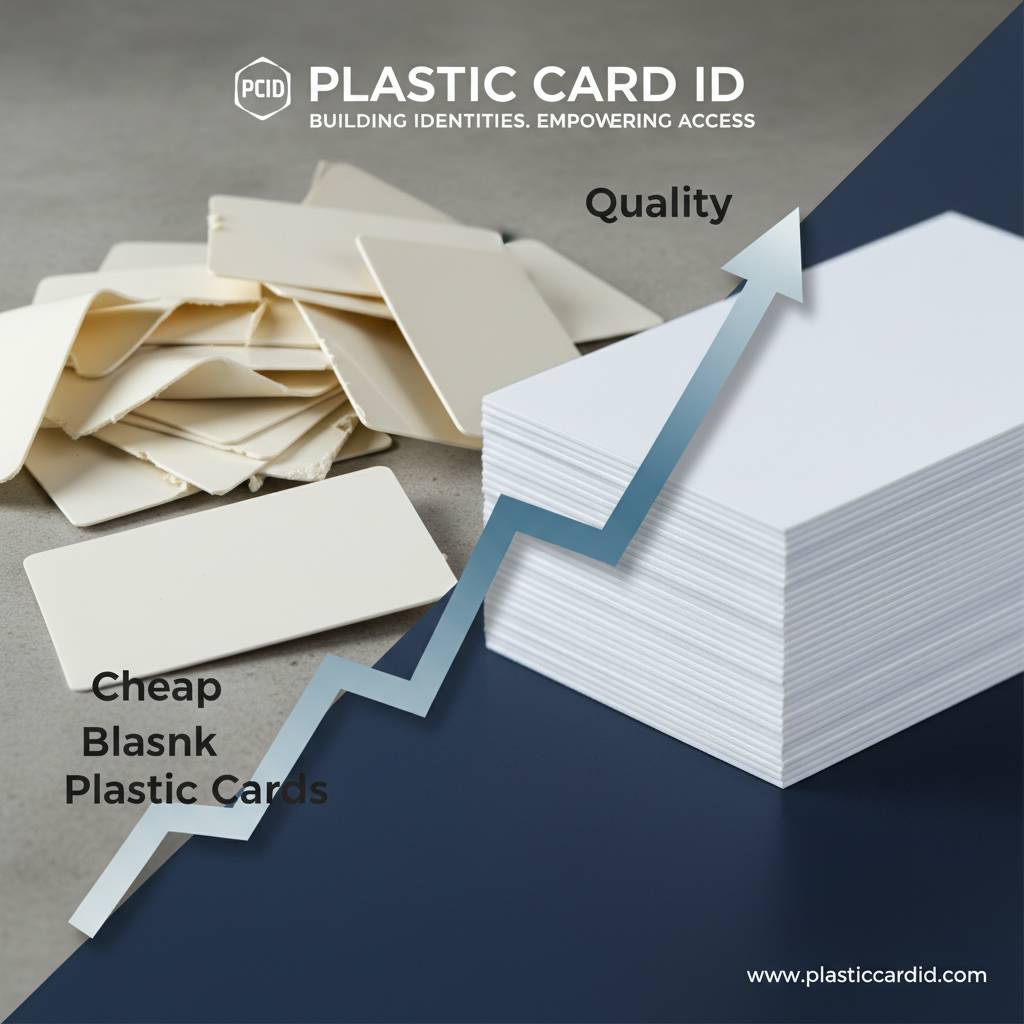 The CR80 standard - 3.375 inches by 2.125 inches, 30 mil thick - exists for a reason. It's the universal spec that card printers, card holders, wallets, and card readers are designed around. When a card deviates from this standard even slightly, problems cascade: printing misalignments, reader errors, jammed feeders, and cards that simply don't fit where they're supposed to go.
Cheap blank plastic cards frequently cut corners on dimensional precision. They may be close to 30 mil, but "close" causes real-world headaches. A card that's 28 mil thick may slip through a printer's rollers inconsistently. A card that's 32 mil may not feed at all. Over thousands of cards, these tolerances add up to wasted ribbons, wasted time, and wasted money - far exceeding any savings from buying bargain stock.
What ISO 7810 Actually Guarantees
ISO 7810 is the international standard governing identification card dimensions, physical characteristics, and construction quality. Cards built to this spec must meet exact tolerances for thickness, flatness, and surface uniformity. When a supplier says their cards are "ISO 7810 compliant," that's a meaningful claim - provided they can back it up.
Quality suppliers test their cards against this standard in real conditions. That means verifying that cards don't warp in heat, don't delaminate under normal use, and maintain dimensional accuracy throughout the full run. A cheap supplier might cite ISO compliance on a data sheet while shipping product that fails in the field. Always ask for samples before committing to a large order.
The Hidden Cost of Non-Standard Thickness
Here's something most buyers don't think about: your printer ribbon has a fixed life cycle measured in cards. When cards jam - even partially - ribbons get wasted, or worse, damaged. A $30-$60 ribbon consumed by a bad card run is a very real cost. Multiply that across a year of printing and the "savings" from cheap cards evaporate quickly.
Card printers from trusted brands like Evolis, Zebra, and Fargo are precisely calibrated. They're engineered to work with cards that meet real tolerances, not approximate ones. Feeding substandard cards through a premium printer is like putting discount fuel in a precision engine - it works, until it doesn't, and then the repair bill is steep.
Thickness, Flexibility, and Structural Integrity
A quality 30 mil blank card has a specific flex profile. It bends slightly under pressure but returns to flat. Cards that are too thin flex too easily and can permanently deform in a wallet or under stack weight. Cards that are too rigid may be over-laminated or made from non-standard composite materials that behave poorly when printed or encoded.
Structural integrity also matters for cards that carry functional layers - magnetic stripes, proximity antennas, or embedded chips. These components need a stable substrate that won't crack, separate, or introduce read errors due to deformation. Quality PVC construction provides that stability reliably, throughout the card's working life.
Magnetic Stripe Cards: Where "Cheap" Can Seriously Backfire
Blank magnetic stripe cards add a functional layer that cheap production can devastate. The magnetic stripe itself - whether HiCo (high coercivity) or LoCo (low coercivity) - must be bonded to the card uniformly, positioned precisely, and manufactured to accept encoding reliably. A poor-quality mag stripe card can encode incorrectly, drop data, or fail entirely after minimal use.
These aren't hypothetical risks. Businesses running loyalty programs, hotel key systems, access control, or time-and-attendance solutions have experienced real failures from bargain mag stripe cards. When a hotel guest's key doesn't work or an employee can't badge in, the downstream cost in support calls, re-issues, and customer frustration far outweighs the per-card savings.
HiCo vs. LoCo: Choosing the Right Stripe for Your Application
HiCo (high coercivity) stripes require more magnetic force to encode but hold data more reliably in environments with other magnetic fields. They're the right choice for hotel keys, access credentials, and any card that will live near phones, magnets, or other cards with stripes. LoCo stripes encode more easily and work well for low-volume, low-exposure applications like membership cards or gift cards in controlled environments.
The problem with cheap mag stripe cards is that the designation - HiCo or LoCo - may not accurately reflect the actual stripe material used. A card mislabeled as HiCo but manufactured to LoCo tolerances will demagnetize prematurely. Reliable sourcing is the only protection against this kind of specification fraud.
Encoding Consistency Across the Full Run
When you encode a card, your encoder applies magnetic fields at precise points along the stripe. Quality cards ensure the stripe is perfectly uniform - same coercivity, same thickness, same bonding strength - from the first card to the last card in a batch of thousands. Cheap cards introduce variability that causes encoding errors mid-batch, which means re-encoding, reprinting, and re-issuing.
For businesses running high-volume card programs, this consistency is non-negotiable. The per-card cost difference between premium and bargain mag stripe cards is typically a few cents. The cost of a failed encoding run - in labor, materials, and customer impact - can be hundreds of dollars. The math is not complicated.
Call Us Before You Order a Bulk Mag Stripe Run
If you're planning a large order of magnetic stripe cards, talking to an expert first can save significant time and money. CPE has specialists available to help you select the right stripe type, encoding format, and card spec for your specific application. Reach us at 800.835.7919 before you commit to a bulk purchase.
Buying the right product from the start is always less expensive than fixing a bad order. Our team can walk you through exactly what your card program needs and match you with a product that will perform reliably across your full print and encode workflow.
RFID, Smart Chip, and Proximity Cards: Quality Gaps That Can Shut Down Your System
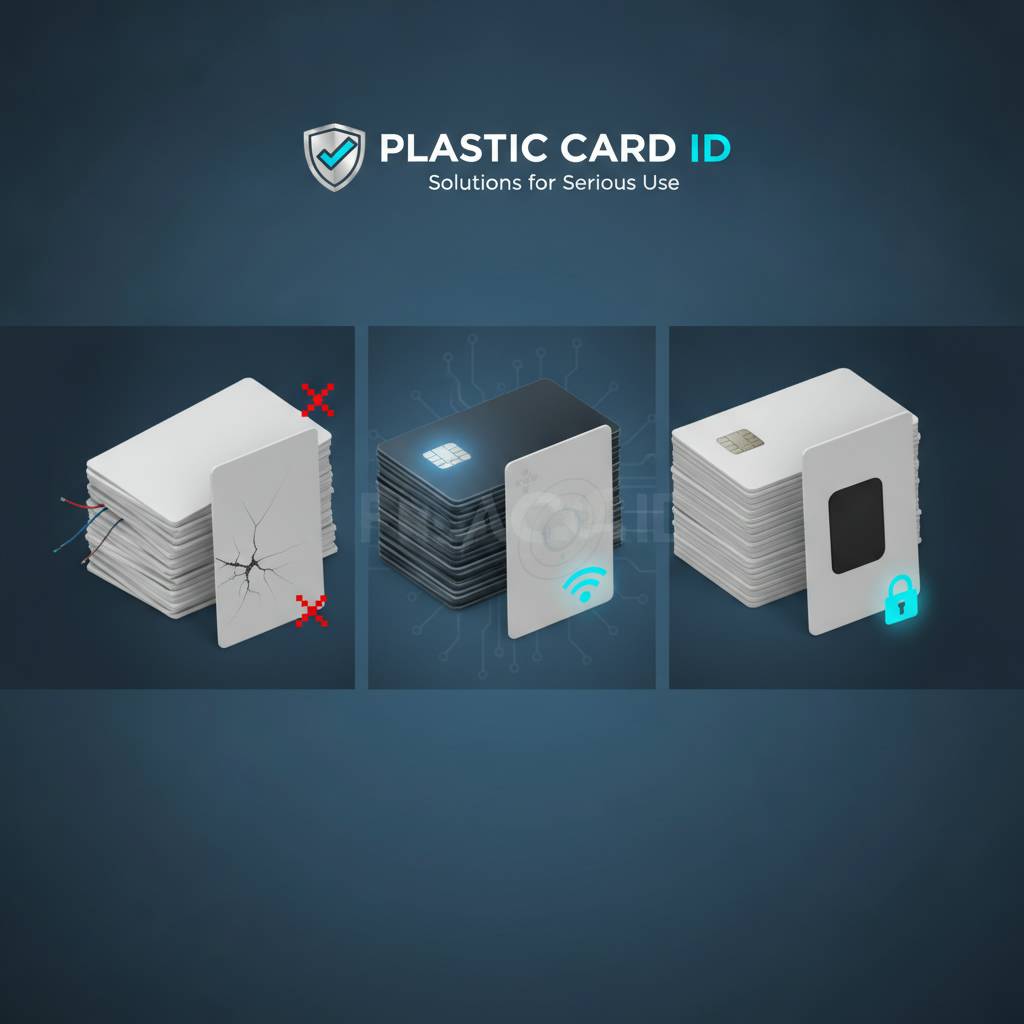 The stakes get higher when you move into RFID, proximity, and smart chip cards. These aren't just substrate - they're functional electronic devices embedded in card form. The antenna, chip, and bonding layers must all be manufactured to precise tolerances. Cheap construction in this category doesn't just mean poor print quality - it can mean a card that fails to communicate, encodes incorrectly, or simply stops working after minimal use.
Whether you're deploying a proximity access system, issuing contactless smart cards for a campus, or building out a hotel key infrastructure, the card itself is a critical node in your system. Incompatibility with your readers - even at the protocol level - can mean an entirely unusable card run. This is an area where sourcing from a trusted supplier isn't optional; it's essential.
MIFARE DESFire and Contactless Technology Standards
Advanced applications like MIFARE DESFire require cards that are manufactured to very specific NFC standards. These cards support encrypted, multi-application data storage and are used in high-security environments like corporate access control, transit systems, and casino player card programs. A card that looks the same but is manufactured to lower tolerances will simply not function in these systems.
Quality RFID and smart card manufacturing involves precision antenna placement, chip bonding quality control, and protocol testing across read/write cycles. CPE sources cards that meet real-world performance standards for these applications - not just paper specifications from offshore suppliers with no accountability chain.
Proximity Cards for Access Control
Standard 125 kHz proximity cards are widely deployed in office buildings, apartment complexes, and industrial facilities. The quality variable here is read range consistency and durability over the card's lifecycle. Cheap proximity cards may read inconsistently - requiring multiple swipes or specific angles - causing bottlenecks and user frustration in high-traffic entry points.
A quality proximity card maintains consistent read performance across its full working life, even with the physical wear of daily credential use. For organizations managing dozens to thousands of access credentials, that consistency directly impacts operational efficiency. One reliable card swipe per entry is the standard your team deserves.
Casino, Hotel, and Specialty Card Applications
Casino player cards and hotel key cards represent some of the most demanding use cases in the card industry. These cards are handled constantly, exposed to varied environments, and expected to function flawlessly in high-throughput reader systems. Cheap construction fails under these conditions - leading to player tracking errors, failed room entries, and operational disruption at exactly the wrong moments.
Quality construction for these specialty applications means verified chip and stripe performance, precision lamination, and substrate durability that holds up under real-world conditions. These aren't luxury specs - they're baseline requirements for any card program that runs at scale in demanding environments.
| Card Type | Common Application | Key Quality Factor |
|---|---|---|
| Blank CR80 PVC | Employee ID, loyalty, membership | ISO 7810 compliance, print surface |
| Magnetic Stripe (HiCo/LoCo) | Hotel keys, access, gift cards | Encode reliability, stripe uniformity |
| Proximity (125 kHz) | Office access control | Read range consistency |
| RFID / Smart Chip | High-security access, transit | Protocol accuracy, antenna precision |
| Clear / Frosted PVC | Specialty branding, VIP cards | Material clarity, print adhesion |
| Metal Cards (Steel, Brass, Gold) | Luxury membership, VIP programs | Finish quality, reader compatibility |
Blank Card Varieties: Matching the Right Product to Your Program
One of the advantages of working with a serious blank card supplier is access to a full catalog - not just the standard white PVC card. Different card programs have different needs, and choosing the right card variety from the start prevents costly reprints, reader failures, and program restarts. Understanding what's available is the first step to making the right call.
From basic white PVC blanks to colored stock, clear cards, frosted cards, and specialty formats, the variety available from a quality supplier lets you match both functional and aesthetic requirements precisely. This flexibility is particularly valuable for organizations running multiple card programs simultaneously - employee badges, loyalty cards, event credentials - each with distinct requirements.
Clear and Frosted Cards for Specialty Branding
Clear and frosted PVC cards create striking visual effects that standard white card stock simply can't achieve. A loyalty card printed on a frosted substrate with a clean minimal design reads as premium - and that perception directly influences how customers treat and keep the card. Cards that stay in wallets are cards that stay in programs.
Quality clear cards must have excellent print adhesion - a technical challenge, since the transparent substrate requires specific ink chemistry to hold graphics reliably. Cheap clear cards often exhibit peeling graphics, smearing, or incomplete coverage that undermines the premium aesthetic entirely. Sourcing from a supplier who understands these technical nuances matters considerably.
Colored Stock and Custom Die-Cut Options
Pre-colored card stock - available in a range of solid colors - can simplify in-house card programs by providing visual differentiation without additional printing. A red card for temporary access, blue for full staff, yellow for contractors: simple color coding reduces errors and speeds up visual verification at checkpoints.
Custom die-cut cards take differentiation further, offering shapes that break from the CR80 rectangle entirely. These specialty formats require quality substrate construction to maintain structural integrity through the cutting process. Cheap materials crack or delaminate at cut edges, compromising both appearance and durability. Quality construction ensures clean edges and lasting integrity regardless of shape.
Luxury Metal Cards: When Premium Positioning Matters
Stainless steel, brass, and gold metal cards occupy a distinct tier. These are deployed in VIP programs, exclusive membership clubs, premium loyalty tiers, and high-end hospitality settings where the physical card itself communicates value. A metal card handed to a customer says something a paper punch card or even a standard plastic card simply cannot.
Quality in this category means finish consistency, reader compatibility (metal cards must be engineered to work with standard card readers), and edge and surface precision. The weight and feel of a quality metal card is immediately distinctive - and that tangible quality directly reinforces the brand message it's meant to carry.
Evaluating Suppliers: Red Flags and Green Lights in the Blank Card Market
The blank plastic card market has no shortage of suppliers willing to offer rock-bottom pricing on large orders. Some of these suppliers produce perfectly acceptable product. Many do not. Knowing how to evaluate a supplier before committing a significant order is one of the most valuable skills any procurement or operations manager can develop.

The questions you ask, the samples you request, and the specifications you verify before ordering are your protection against a failed card run. This section outlines what to look for - and what to run from - when evaluating potential suppliers.
Sample Testing: The Only Reliable Quality Check
Any reputable blank card supplier will provide samples before a bulk order. Test those samples rigorously in your actual print and encode environment. Run them through your printer at normal settings and verify that feeding is smooth, print registration is accurate, and output quality meets your standards. For mag stripe cards, encode and verify a sample batch before ordering thousands.
If a supplier won't provide samples, that's a significant red flag. If their samples perform inconsistently - some cards fine, others jamming or printing poorly - that inconsistency will appear at scale. Batch-to-batch consistency is as important as individual card quality. A supplier who can't demonstrate it isn't a supplier worth trusting with a large order.
Specifications That Should Always Be Verified
- Thickness: Confirmed 30 mil (0.030 inches) with stated tolerance range.
- Dimensions: CR80 standard 3.375" x 2.125" verified dimensionally.
- Surface finish: Gloss or matte uniformly applied, no surface defects.
- Magnetic stripe coercivity: HiCo (2750 Oe) or LoCo (300 Oe) verified with equipment.
- Chip/RFID protocol: Confirmed compatibility with your reader hardware.
- Print surface compatibility: Confirmed with your printer ribbon chemistry.
- Flatness and warp tolerance: Cards should lie flat under normal storage conditions.
Getting written confirmation of these specifications from your supplier creates accountability. Quality suppliers welcome this conversation because they know their product meets the spec. Suppliers who resist providing written specs or cite "proprietary" reasons for not disclosing technical details are signaling that scrutiny is unwelcome for a reason.
Contact CPE to Discuss Your Specific Needs
At Plastic Card ID, the conversation about quality starts before the order, not after a problem surfaces. Our team has helped over 100,000 customers select the right card product for programs of every size - from 50 cards a month to tens of thousands. We know the specs, we know the printers, and we know what failure looks like when it's prevented. Call us at 800.835.7919 to talk through your program requirements directly.
Whether you're building a new card program from scratch or replacing a supplier who's been letting you down, we're positioned to help you get it right the first time. The right card at the right spec costs less in the long run than the wrong card at the lowest price.
Building a Card Program That Performs: Strategic Advice for Long-Term Success
A card program is not a one-time purchase - it's an ongoing operational system. The cards you issue today need to perform consistently, integrate with your printing and encoding equipment, and support the experience you're delivering to employees, members, guests, or customers. Treating card sourcing as a strategic decision rather than a commodity procurement changes the outcomes dramatically.
Organizations that invest in quality card stock, the right printer hardware, and a reliable supply relationship don't just avoid problems - they build programs that scale efficiently, maintain brand consistency, and deliver measurable results. Retailers switching from paper to plastic gift cards reliably see sales increases of 35-50%. Loyalty cards carried in wallets outperform paper punch cards by nearly every metric. Membership and ID cards signal legitimacy and permanence. The card itself is doing strategic work.
Pairing Cards with the Right Printer Hardware
Card quality and printer quality are interdependent. Evolis, Zebra, and Fargo printers are precision instruments that deliver excellent results when fed excellent materials. Running quality blank cards through a quality printer produces professional output consistently. Running cheap cards through a quality printer produces jams, misprints, and wasted ribbons - and potentially damages the printer over time.
Selecting printer hardware and card stock together - rather than optimizing each independently - is the smarter approach. A supplier who offers both, and who understands how their cards perform in specific printer models, is a far more valuable partner than a card-only supplier who can't speak to printer compatibility at all.
Ribbons, Cleaning Kits, and Supporting Consumables
The full card production workflow depends on more than just the card. Ribbon quality directly affects print output - cheap ribbons produce banding, color inconsistency, and premature failure. Cleaning kits maintain printer performance over time, preventing contamination that degrades print quality. Card carriers and sleeves protect finished cards through distribution and first use.
Sourcing these supporting consumables from the same supplier as your cards creates simplicity, accountability, and compatibility assurance. CPE stocks a full lineup of ribbons, cleaning kits, card carriers, and sleeves alongside the complete card catalog - making it genuinely possible to source everything your card program needs in one place, from one partner who knows how it all works together.
Scaling Your Program: From 50 Cards to 50,000
One of the practical advantages of working with a supplier who has served over 100,000 customers across 25 years is access to expertise across every program scale. A loyalty program that starts with 50 cards a month needs different guidance than a mass-production event credential run in the tens of thousands - but both need the same commitment to quality sourcing and reliable supply.
As programs scale, new challenges emerge: batch consistency across larger orders, logistics timing, encoding volume, and card inventory management. A strategic supplier relationship means having a partner who anticipates these challenges and helps you navigate them proactively. That's the difference between a vendor and a partner - and it's the difference Plastic Card ID has been delivering for over 25 years.
Ready to upgrade your card program with quality you can count on? Call 800.835.7919 today and speak with a blank card specialist at Plastic Card ID.
Plastic Card ID - your strategic partner for blank plastic cards, card printers, and everything your card program needs to succeed. Call 800.835.7919 now.
Previous Page