Minimum Order Quantities for Blank Plastic Cards Explained
Table of Contents []
- What Plastic Card ID Wants You to Know About Minimum Order Quantities for Blank Plastic Cards
- The CR80 Standard: Why Blank Cards Are the Backbone of In-House Card Programs
- Magnetic Stripe, RFID, and Smart Chip Cards: Minimum Orders for Advanced Card Types
- Volume Pricing and When It Makes Sense to Order More Than the Minimum
- Specialty Card Options and Their Minimum Order Considerations
- Card Printers, Ribbons, and the Full Program Ecosystem from Plastic Card ID
- Ready to Start or Scale Your Card Program? Connect With Plastic Card ID Today
What Plastic Card ID Wants You to Know About Minimum Order Quantities for Blank Plastic Cards
Somewhere between "I need a few cards for my small business" and "we're ordering by the tens of thousands," there's a question nearly every buyer asks before they've even browsed a catalog: how many cards do I actually have to order? It's a fair question - and one that deserves a real answer, not a runaround. Minimum order quantities for blank plastic cards vary by card type, supplier, and program structure, but understanding them upfront saves time, money, and a lot of frustration.
Plastic Card ID has worked with over 100,000 customers across the United States, supplying everything from starter packs of 50 blank CR80 cards to mass production runs in the tens of thousands. The range is intentional. Not every organization is a national retailer. Some are launching a pilot loyalty program. Others are running a hotel, a gym, a school, or a local event series. Flexibility in order quantities isn't a perk here - it's the foundation of how serious card programs actually get built.
This page breaks down what minimum orders look like across different card types, what drives cost per card, when it makes sense to order more than your minimum, and how CPE helps organizations at every scale get the most from their blank plastic card investment.
| Card Type | Typical Minimum Order | Common Use Cases |
|---|---|---|
| Blank White PVC CR80 Cards | As low as 50 cards | Employee badges, ID cards, loyalty cards |
| Magnetic Stripe Cards (HiCo/LoCo) | Typically 100-500 cards | Hotel key cards, gift cards, membership cards |
| RFID / Proximity Cards | Usually 100-200 cards | Access control, time and attendance |
| Smart Chip Cards | 100-250 cards depending on chip type | Secure ID, campus credentials, loyalty programs |
| Colored / Frosted / Clear PVC Cards | Typically 100-500 cards | VIP cards, event credentials, branded memberships |
| Specialty / Metal Cards | Varies - contact for quote | Luxury membership, premium brand identity |
The CR80 Standard: Why Blank Cards Are the Backbone of In-House Card Programs
 Most people don't think twice about the dimensions of the card sitting in their wallet, but there's precision behind it. The CR80 format - 3.375 by 2.125 inches, 30 mil thickness - is the ISO 7810 standard that governs credit cards, ID cards, and virtually every plastic card used professionally in the United States. When CPE supplies blank CR80 PVC cards, they're supplying something that fits every standard card printer, badge holder, wallet slot, and card reader on the market.
Blank cards give organizations total creative and operational control. Print what you need, when you need it, in-house. Update designs without reprinting an entire inventory. Encode only the cards that need encoding. For organizations managing employee rosters, event registrations, or membership databases that change frequently, this flexibility is genuinely strategic - not just convenient.
CR80 Minimum Orders: Entry Points for Small and Growing Programs
For standard blank white PVC CR80 cards, Plastic Card ID offers entry-level quantities starting as low as 50 cards. That's not a trial pack - that's a real, usable quantity for a small business launching a loyalty program or a nonprofit issuing member credentials for the first time. Fifty cards is enough to run a pilot, prove a concept, and understand how a card program functions before scaling up.
The per-card cost at 50 units is higher than at 500, which is higher than at 5,000. This is simply how volume pricing works in manufacturing. But the important thing is that the door is open at a low entry point, and organizations can grow their order quantities - and reduce their per-card costs - as their programs mature and demand becomes more predictable.
Why the 30 Mil Thickness Matters for Printers and Longevity
Thirty mil cards are the industry standard for a reason. They feed cleanly through card printers from Evolis, Zebra, and Fargo without jamming, warping, or misfeeding. Thinner cards can cause inconsistent prints and printer damage. Thicker cards won't feed correctly through standard card slot mechanisms. The 30 mil blank CR80 card is the intersection of print quality, mechanical compatibility, and physical durability.
A card that lasts is a card that keeps working for your program. Blank PVC cards are designed for long-term, repeated use - they hold up in wallets, badge holders, lanyards, and magnetic stripe readers without degrading under normal conditions. Organizations that invest in quality blank cards spend less on reprints, replacements, and printer maintenance over time.
Blank Cards vs. Pre-Printed Cards: Which Route Makes Sense?
Pre-printed cards require you to know exactly what you want before you commit to an order. If anything changes - a logo update, a staff member's name, a program tier - you're reprinting. Blank cards let you print on demand, encode on demand, and adjust on demand. For organizations with more than minimal turnover or design variability, the blank card model typically wins on cost-efficiency and flexibility.
That said, for programs with stable, high-volume needs and little variation - think event tickets for a fixed event or a single-design gift card run - pre-printed cards can be cost-effective. The right answer depends on your program's lifecycle, not a blanket rule. Plastic Card ID helps buyers think through both options honestly, because the goal is a card program that works, not just a card sale.
Magnetic Stripe, RFID, and Smart Chip Cards: Minimum Orders for Advanced Card Types
Not all blank plastic cards are plain white PVC. Many programs require cards that do more - store data, unlock doors, trigger software events, or interface with point-of-sale systems. These functional card types carry their own minimum order considerations, largely driven by the cost of the embedded technology and the complexity of encoding or programming required before or during production.
Understanding the difference between HiCo and LoCo magnetic stripe, proximity and RFID, and smart chip cards isn't just technical trivia - it determines which cards are compatible with your existing hardware, what encoding your system can read, and what your real total cost looks like per card at different order volumes.
Magnetic Stripe Cards: HiCo vs. LoCo and What It Costs
High coercivity (HiCo) magnetic stripe cards hold data more reliably and resist accidental erasure from common magnetic fields - making them the preferred choice for hotel key cards, membership programs, and any application where the card will see repeated use over time. Low coercivity (LoCo) cards are typically used for shorter-term applications and can be erased and rewritten more easily.
Minimum orders for magnetic stripe cards typically start around 100-500 units depending on the specific product and configuration. At these quantities, per-card pricing reflects the cost of the magnetic stripe layer integrated into the card substrate. For organizations running hotel programs, access systems, or loyalty platforms that require stripe encoding, ordering a thoughtful buffer above the minimum reduces per-card cost meaningfully and ensures a stock reserve for replacements.
RFID and Proximity Cards for Access Control Programs
Proximity cards and RFID cards communicate wirelessly with card readers - no swipe, no insert, just a tap or a wave. They're the backbone of modern access control systems in office buildings, residential complexes, campus facilities, and event venues. The technology embedded in each card raises the base cost compared to plain PVC, which is why minimum orders in this category typically start at 100-200 cards.
For organizations managing access across multiple entry points or departments, ordering above the minimum and maintaining a card inventory is genuinely cost-effective - both in per-unit pricing and in the operational reality that access cards get lost, damaged, and need to be issued to new personnel regularly. CPE carries standard 125 kHz proximity cards as well as more advanced RFID options including contactless smart cards with MIFARE DESFire technology for higher-security applications.
Smart Chip Cards and Contactless Technology
Smart chip cards contain an integrated circuit that stores and processes data, enabling secure authentication, encryption, and multi-application functionality that magnetic stripe cards simply cannot match. Casino player cards, campus ID systems, and enterprise security programs increasingly rely on smart chip and contactless card technology for the depth of control and security they provide.
Minimum orders for smart chip cards vary based on chip type and programming requirements, typically starting at 100-250 cards. Contact 800.835.7919 to discuss your specific chip card requirements, encoding needs, and program scale so Plastic Card ID can identify the right product configuration and realistic order quantity for your situation.
| Order Volume | Per-Card Cost Trend | Best For |
|---|---|---|
| 50-100 cards | Higher per-card cost | Pilots, small businesses, first-time programs |
| 100-500 cards | Moderate per-card cost | Growing programs, annual replenishment |
| 500-2,500 cards | Noticeably lower per-card cost | Mid-size businesses, active loyalty or ID programs |
| 2,500-10,000 cards | Significant volume pricing | Enterprises, retailers, large events, mass programs |
Volume Pricing and When It Makes Sense to Order More Than the Minimum
 The minimum order is the floor, not the ceiling. And in most cases, the most cost-conscious move is to order meaningfully above the minimum once you have a clear picture of your program's ongoing card consumption. Volume pricing tiers mean that the difference in per-card cost between 100 cards and 500 cards can be significant - often enough to offset the carrying cost of a small inventory buffer with ease.
Think about card consumption over 12 months, not just your immediate need. If your organization issues 30-40 cards per month on average, ordering 500 cards upfront at a lower per-card cost makes more financial sense than placing 5 separate orders of 100 cards throughout the year and paying a higher per-card price each time, plus repeated shipping costs.
Calculating Your Realistic Annual Card Volume
Start with your current headcount or membership base. Add estimated growth. Factor in replacement cards - lost, damaged, or expired credentials need to be reissued, and in most programs that replacement rate runs anywhere from 10-25% of your active card population annually. Sum those numbers and you have a useful estimate of your annual card demand, which should guide your order quantity decisions.
For event-driven card programs - annual conferences, seasonal promotions, membership renewal cycles - the calculation is different. Know your peak event size, build in a 10-15% overage for on-site reprints and last-minute additions, and consider whether leftover blank card stock can carry over to the next cycle. Blank cards have a long shelf life when stored properly, so carrying a modest surplus rarely goes to waste.
Buyer Tips: Getting the Most From Your Card Order
- Order at a volume tier, not at the exact minimum - even a modest increase in order quantity can drop your per-card cost noticeably.
- Store blank PVC cards in a cool, dry environment away from direct sunlight to preserve print quality and card integrity.
- Keep a reorder point in mind - don't wait until you've issued your last card to reorder, as production and shipping time can leave gaps in your program.
- If you're also purchasing a card printer, factor printer ribbon yield into your card quantity planning - ribbons typically print 200-500 cards per ribbon, depending on card design complexity.
- Consider card carriers, sleeves, and mailing services if your program involves distributing cards to members, customers, or employees remotely.
- Test your card printer settings with a small sample before committing a large batch to print - color calibration and alignment can vary by printer model and card stock.
How Card Program Scale Affects Your Strategic Approach
A 50-card program and a 50,000-card program are managed very differently, but both benefit from the same underlying principle: consistent card stock, reliable supply, and a supplier relationship that scales with demand. Starting small doesn't mean thinking small. Many of the largest card programs Plastic Card ID supports today began as modest pilots years ago.
The transition from a small program to a medium or large one is smoother when your supplier is already familiar with your card types, your encoding requirements, and your operational rhythm. This is precisely why CPE operates as a strategic partner rather than a transactional vendor - the institutional knowledge built over time has real value when your program grows, changes, or needs to adapt quickly.
Specialty Card Options and Their Minimum Order Considerations
Beyond standard white PVC, Plastic Card ID supplies a range of specialty card types that serve specific branding, security, and functional purposes. Colored card stock, frosted and clear PVC, custom die-cut shapes, and luxury metal cards in stainless steel, brass, and gold each carry their own minimum order structures - reflecting production complexity and material costs distinct from standard blank cards.
These aren't niche novelty products. Clear and frosted PVC cards have genuine functional and aesthetic applications in VIP programs, premium membership tiers, and event credentials where visual distinction matters. A card that looks different signals that it is different - and for programs built around exclusivity or premium positioning, that signal carries real brand value.
Clear, Frosted, and Colored PVC Cards
Clear plastic cards offer a unique visual effect that standard white PVC simply cannot replicate - the transparency creates a premium aesthetic that stands out in any wallet or badge holder. Frosted PVC offers a softer, diffused look that pairs well with certain printing techniques. Colored core cards - available in a range of stock colors - eliminate the need to print a solid color background on every card, which can extend ribbon life and reduce per-card printing cost.
Minimums for these specialty card stocks typically start at 100-500 cards depending on the specific type. For programs where visual differentiation is part of the brand strategy, the modest premium over standard white PVC cards is usually well justified by the impression the finished card creates.
Metal Cards for Premium and Luxury Programs
Stainless steel, brass, and gold-tone metal cards represent the top tier of the card hierarchy. They're heavier, more durable, and carry an unmistakable premium feel that no plastic card - however well designed - can fully replicate. For luxury membership programs, high-net-worth client retention strategies, casino VIP programs, and exclusive access credentials, a metal card communicates value before it's even handed over.
Metal card minimum orders and pricing vary based on material, finish, and configuration. These are not commodity items and are quoted individually based on program specifications. Contact CPE directly to discuss metal card programs - the lead time, minimum quantity, and customization options are all conversation-dependent.
Casino Player Cards and Hotel Key Cards
Casino player cards are a specialized application where encoding accuracy, card durability, and consistent magnetic stripe performance are non-negotiable. These cards interact with slot systems, point-of-sale terminals, and player tracking platforms - failures are costly and disruptive. Plastic Card ID supplies casino player cards configured to meet the magnetic stripe encoding requirements of major casino management systems.
Hotel key cards similarly require precise HiCo magnetic stripe specifications to interface reliably with door lock systems from leading manufacturers. A key card that fails at check-in is a guest experience problem, not just a logistics inconvenience. Minimum orders for hotel key programs reflect the need for a reliable ongoing supply - typically 100-500 cards as a starting point, with many properties ordering in quantities of 1,000-5,000 to maintain operational stock levels.
Card Printers, Ribbons, and the Full Program Ecosystem from Plastic Card ID
Blank plastic cards are one side of an in-house card program equation. The other side is the hardware and consumables that turn blank stock into finished, functional cards. Plastic Card ID carries a full lineup of card printers from Evolis, Zebra, and Fargo - the three most widely trusted brands in professional card printing - along with the printer ribbons, cleaning kits, card carriers, sleeves, and accessories that keep programs running without interruption.
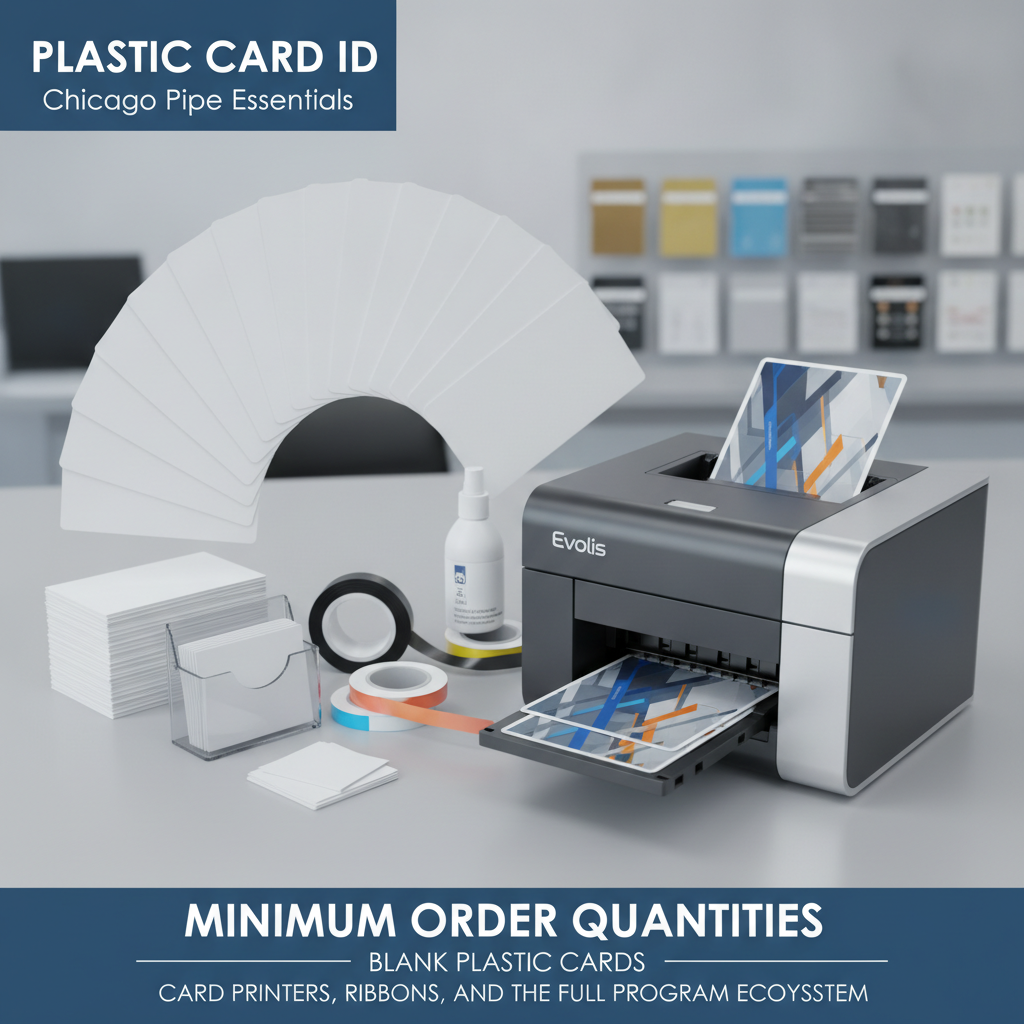
Buying blank cards from one vendor and a printer from another is a workable approach, but it introduces coordination friction. When your printer ribbon needs replacing, when your cleaning kit runs out, when you need to troubleshoot a print quality issue - having a single source that knows your card stock, your printer model, and your program specifications is genuinely easier. That one-stop-shop model is one of the core reasons CPE has maintained relationships with the same customers over years and decades.
Choosing the Right Card Printer for Your Volume
Entry-level single-sided card printers are ideal for programs issuing up to a few hundred cards per month. Mid-range duplex printers handle two-sided printing and higher monthly volumes efficiently. High-throughput systems from Zebra and Fargo are designed for organizations printing thousands of cards per month in continuous production environments. The right printer depends on your volume, your card design complexity, and whether you require on-card encoding.
Contact 800.835.7919 to discuss which printer model is appropriate for your projected card volume and program type. Getting the printer right from the start avoids the cost and disruption of upgrading too soon - or purchasing an oversized system that doesn't match your actual needs. Plastic Card ID helps buyers make that match honestly.
Ribbons, Cleaning Kits, and Ongoing Consumables
A card printer without the right ribbon is a paperweight. Ribbon compatibility is model-specific - YMCKO, YMCK, monochrome black, and specialty ribbon types each serve different printing scenarios. Over-ordering ribbon creates waste; under-ordering creates supply gaps. Plastic Card ID stocks ribbons for the printer models it sells, making reorder simple and ensuring ribbon and card stock compatibility is never in question.
Printer maintenance is often overlooked until a problem occurs. Cleaning kits - cleaning cards, rollers, and swabs - extend printer life significantly and maintain consistent print quality over time. Incorporating a regular cleaning cycle into your card printing workflow is a low-cost habit that protects a meaningful hardware investment.
Card Affixing, Mailing, and Distribution Services
For organizations that distribute cards to customers, members, or employees by mail rather than in person, Plastic Card ID offers card affixing and mailing services that take the production-to-distribution workflow off your plate. Cards can be affixed to carrier stock, inserted into sleeves or mailers, and sent directly to recipients - a genuinely useful capability for loyalty program launches, membership renewal cycles, and remote workforce credential issuance.
This kind of value-added service is what separates a strategic card partner from a commodity supplier. The ability to handle volume, logistics, and distribution at scale means organizations can focus on running their programs rather than managing fulfillment details. For high-volume programs especially, this service can represent a meaningful operational savings.
Ready to Start or Scale Your Card Program? Connect With Plastic Card ID Today
Whether you're ordering 50 blank PVC cards for a small business loyalty pilot or building out a 10,000-card enterprise access program, Plastic Card ID has the products, the knowledge, and the operational depth to support your program at every stage. Over 25 years, more than 100,000 customers, and 50 million cards later - the experience behind every order is real and substantial.
Don't let uncertainty about minimum order quantities be the thing that delays launching a card program that could deliver measurable results for your organization. Retailers who shift from paper to plastic gift cards see sales increases of 35-50%. Loyalty programs with wallet-ready plastic cards outperform paper punch cards consistently. The card you put in a customer's hand is a daily brand impression - make it count.
Call Plastic Card ID at 800.835.7919 today - get honest answers about minimum orders, volume pricing, card types, and program setup. The right card solution starts with the right conversation.
Previous Page