Blank Plastic Card Pricing Guide: What You Need to Know
Table of Contents []
- Your Complete Blank Plastic Card Pricing Guide from Plastic Card ID
- Understanding the CR80 Standard and Why It Matters for Pricing
- Magnetic Stripe Cards: HiCo vs. LoCo and What You Are Really Paying For
- RFID and Smart Card Pricing: Where Technology Meets Cost
- How Volume Buying Changes Your Blank Card Pricing Math
- Specialty Cards, Metal Cards, and Premium Blank Options
- Building a Complete Card Program with Plastic Card ID
Your Complete Blank Plastic Card Pricing Guide from Plastic Card ID
Buying blank plastic cards sounds simple - until you realize there are a dozen variables that quietly reshape your per-card cost before you even click checkout. Card thickness, magnetic stripe grade, RFID technology, order volume, and card type all stack together to produce a final number that can range from a few cents per card to several dollars. This guide cuts through the confusion.
Plastic Card ID has served over 100,000 customers and shipped more than 50 million cards across the United States. That kind of track record means we have seen every budget, every use case, and every misconception about card pricing. What follows is an honest, practical breakdown of what blank plastic cards actually cost - and how to make sure you are paying the right price for your program.
| Card Type | Typical Price Range (per card) | Common Use |
|---|---|---|
| Blank CR80 PVC (White) | $0.08-$0.25 | Employee IDs, loyalty cards |
| LoCo Magnetic Stripe | $0.15-$0.40 | Gift cards, membership |
| HiCo Magnetic Stripe | $0.18-$0.50 | Hotel keys, access control |
| Proximity / RFID | $0.90-$3.50 | Access control, smart systems |
| Smart Chip (Contact) | $1.20-$4.50 | Secure ID, campus programs |
| Clear / Frosted PVC | $0.25-$0.75 | Premium branding, VIP |
| Luxury Metal Cards | $4.00-$12.00 | VIP, executive membership |
Understanding the CR80 Standard and Why It Matters for Pricing
 The CR80 specification - 3.375 inches by 2.125 inches, 30 mil thick - is the universal credit-card-size format recognized under ISO 7810. When you see a blank PVC card described as "standard," that is almost always what is meant. Getting this measurement right the first time saves you from costly reprints and card-printer incompatibility issues. Not all cards are created equal even within this format, and thickness tolerances, PVC grade, and surface finish each play a quiet role in final cost.
A case of 500 blank white CR80 cards typically runs anywhere from $40-$125 depending on the supplier and quantity tier. Buy 5,000 and the per-card math shifts dramatically. This is where many buyers leave money on the table - they order small batches repeatedly rather than calculating their annual consumption and locking in a better volume rate. CPE helps clients do exactly that calculation before they place a single order.
Card Thickness: 30 Mil vs. Thinner Alternatives
Standard 30 mil PVC is the workhorse of corporate card programs for good reason - it survives wallet friction, daily badge scans, and years of handling without delaminating or cracking. Thinner cards (20 mil) cost less upfront but fail sooner, effectively raising your real cost-per-use over time. For programs with high card-turnover rates, like event credentials or short-term visitor passes, thinner stock can make economic sense.
Full 30 mil cards also feed more reliably through most desktop card printers from Fargo, Zebra, and Evolis. Printer jams caused by undersized or warped cards waste ribbon, waste time, and damage equipment. When calculating blank card pricing, always factor in the downstream cost of the printing consumables you will use with them.
PVC Grade and Surface Finish
Not every white blank card has the same surface. Glossy PVC accepts dye-sublimation printing with richer color saturation, while matte or textured finishes suit certain retransfer printing methods. Premium-grade PVC with consistent surface coating costs roughly 10-20% more per case than commodity-grade alternatives, but the print quality difference is visible to the naked eye - especially on photo ID cards or loyalty cards where brand impression matters.
If you are printing in-house with a desktop card printer, the PVC surface quality directly impacts how long your ribbon lasts and how many passes it takes to achieve the desired print density. Cheap cards eat ribbons faster. That hidden cost does not show up on the card line of your invoice - it shows up on your ribbon reorder frequency.
Colored Stock Cards and Specialty Blanks
Blank cards are not limited to white. Colored stock PVC - in red, blue, yellow, green, black, and other hues - typically costs $0.10-$0.35 per card depending on volume and color. Color-coded cards are a smart operational tool for organizations that need to distinguish departments, access tiers, or membership levels at a glance without printing anything on the card at all.
Clear and frosted PVC blanks command a modest premium in the $0.25-$0.75 per card range. These specialty finishes create a premium visual impression that is genuinely difficult to replicate on standard white stock, making them popular for VIP membership programs, salon loyalty cards, and boutique retail applications.
Magnetic Stripe Cards: HiCo vs. LoCo and What You Are Really Paying For
Magnetic stripe cards split into two camps based on coercivity - the measure of how strongly the magnetic particles resist being erased or rewritten. High coercivity (HiCo) cards at 2750 Oersteds are more durable and resistant to accidental demagnetization from everyday magnets. Low coercivity (LoCo) cards operate at 300 Oersteds and are fine for shorter-lifecycle applications. The price difference between the two is modest - usually $0.03-$0.12 per card - but choosing the wrong type costs you in card-replacement frequency.
Magnetic stripe blank cards are priced above plain PVC because of the manufacturing step required to laminate or embed the stripe during production. A case of 500 blank HiCo cards typically runs $90-$250 versus $60-$125 for a comparable plain white case. CPE stocks both HiCo and LoCo in CR80 format, and the team can help you match stripe type to application so you are not over-specifying - or under-specifying - for your use case.
LoCo Applications and When to Choose Them
Low coercivity magnetic stripe cards are the standard choice for hotel key cards, short-term event credentials, and gift card programs where the card lifecycle is intentionally brief. They encode and re-encode easily with standard card printers, and their lower coercivity means your encoding hardware does not need to work as hard. For high-volume, short-cycle programs, LoCo blanks deliver excellent cost efficiency.
Gift card programs are a prime example. A retailer issuing 2,000 gift cards per month does not need cards that survive five years. LoCo stock at $0.15-$0.35 per card is entirely appropriate - and the cost savings over HiCo at scale add up to real dollars. Retailers switching from paper gift certificates to plastic cards typically see a 35-50% increase in gift card sales, which means the card cost pays for itself quickly.
HiCo Applications: Access, Identity, and Long-Term Programs
When a card is going to live in someone's wallet for two or three years, pass through electronic readers dozens of times per week, and survive the inevitable encounter with a smartphone or refrigerator magnet, HiCo is the right call. Employee ID cards, university student cards, fitness club memberships, and building access credentials all belong in this category. The small premium for HiCo stock is one of the most defensible cost decisions in card program management.
HiCo cards also encode more reliably during high-speed batch encoding operations. If you are running a card printer at volume - encoding 500 or 1,000 cards in a session - the consistency of HiCo encoding reduces verification failures and the labor cost of re-encoding rejected cards. Call 800.835.7919 to discuss which stripe grade fits your specific program requirements.
Combo Cards: Magnetic Stripe Plus Chip or RFID
Some programs require both a magnetic stripe for legacy reader compatibility and an embedded chip or RFID antenna for newer access systems. These combo cards are available but priced accordingly - typically $1.50-$5.00 per card depending on the chip specification and stripe coercivity. Hybrid cards future-proof access programs without requiring a full infrastructure replacement all at once.
Organizations upgrading from mag stripe systems to contactless access often transition gradually, issuing combo cards that work with both old and new readers simultaneously. This eliminates the need to replace all door hardware before issuing new credentials - a significant capital expense reduction for multi-site organizations.
| Order Quantity | Estimated Per-Card Cost | Estimated Case Cost |
|---|---|---|
| 100 cards | $0.20-$0.30 | $20-$30 |
| 500 cards | $0.12-$0.20 | $60-$100 |
| 1,000 cards | $0.09-$0.15 | $90-$150 |
| 5,000 cards | $0.06-$0.11 | $300-$550 |
| 10,000 cards | $0.05-$0.09 | $500-$900 |
RFID and Smart Card Pricing: Where Technology Meets Cost
 RFID and proximity cards occupy a different price tier entirely, and for good reason - they contain embedded electronics. A proximity card carries a small antenna coil and an integrated circuit that communicates with a reader wirelessly, eliminating the need for physical contact. This technology adds manufacturing complexity that is directly reflected in the per-card price. Entry-level 125kHz proximity cards start around $0.90-$1.50 each in volume; high-frequency MIFARE DESFire EV2 smart cards run $2.50-$4.50 or higher depending on memory configuration.
The pricing jump from a plain PVC card to an RFID card is substantial - but so is the jump in capability. Contactless cards enable door access, time-and-attendance tracking, cashless vending, and logical network login all from a single credential. For organizations that require that level of functionality, the per-card cost is trivially small compared to the infrastructure value it supports.
125kHz Proximity Cards for Access Control
The 125kHz proximity card is the legacy standard of physical access control - hundreds of millions of these credentials are in active use across corporate campuses, apartment complexes, parking garages, and government facilities. They are read-only, simple, and reliable. Blank 125kHz proximity cards priced at $0.90-$2.00 per card represent one of the most cost-efficient access control credentials available.
Because they carry a fixed, factory-encoded ID number, these cards work with access control systems from nearly every major vendor. They require no encoding step on your end - you simply register the card's ID number in your access control software and assign permissions. For organizations running Wiegand-protocol door readers, these cards remain the easiest and most affordable credential solution available.
13.56MHz Smart Cards: MIFARE and Beyond
High-frequency smart cards operating at 13.56MHz - including the MIFARE Classic, MIFARE DESFire, and ISO 15693 families - support read/write capability, encrypted communication, and multi-application use on a single card. A student ID can simultaneously serve as a library card, cafeteria payment credential, and dormitory access card. That multi-function capability justifies a per-card cost of $1.50-$4.50 comfortably when the alternative is issuing three separate cards.
MIFARE DESFire EV2 and EV3 variants are the current security standard for high-assurance applications including casino player cards, healthcare facility access, and enterprise logical access control. These cards support AES-128 encryption and sectored memory partitioning, allowing multiple independent applications to coexist securely on the same card. Call 800.835.7919 to discuss smart card specifications for your program.
Hotel Key Cards and Hospitality Pricing
Hotel key cards are a specialized segment of the RFID and magnetic stripe market. Most modern hotel systems use RFID-based door locks - either MIFARE or proprietary formats from Saflok, Assa Abloy, or similar vendors. Blank hotel key cards compatible with these systems are priced at $0.80-$2.50 per card depending on technology and volume. Hospitality operations that reuse and re-encode key cards can dramatically reduce their annual card spend compared to single-use alternatives.
The blank card format gives hotel properties the flexibility to print their own branding, promotional messaging, or QR codes in-house using a desktop card printer - turning a functional credential into a marketing touchpoint at no additional per-card cost beyond ribbon and labor.
How Volume Buying Changes Your Blank Card Pricing Math
Volume pricing is the single most powerful lever available to organizations managing ongoing card programs. The difference between buying 500 cards and 5,000 cards can reduce your per-card cost by 40-60% - which, annualized across a program issuing thousands of cards per year, translates to hundreds or thousands of dollars in direct savings. The organizations that treat blank card purchasing strategically - rather than reactively - consistently pay less per card over time.
The key discipline is calculating your rolling 12-month card consumption accurately. Many organizations underestimate because they only count primary card issuance and forget replacements, new-hire ramp, seasonal volume spikes, and card losses. CPE recommends adding a 15-20% buffer to your estimated annual consumption before selecting a volume tier.
Tiered Pricing Structures and Break Points
Most blank card pricing structures use quantity break points - specific thresholds at which the per-card price drops. Common break points are at 100, 250, 500, 1,000, 2,500, 5,000, and 10,000 units. Buying just below a break point is one of the most common and costly purchasing mistakes in card program management. An order for 480 cards that could have been 500 cards for only a few dollars more is a missed opportunity that repeats every ordering cycle.
Reviewing your order history and aligning purchases to break point quantities is a simple optimization that most organizations can implement immediately. CPE makes volume break points transparent so clients can make informed quantity decisions rather than guessing.
Stocking Up: Storage and Shelf Life Considerations
Blank PVC cards store well. Kept in their original packaging, away from direct sunlight and extreme temperatures, standard CR80 cards remain printable and encodable for years without performance degradation. Buying a six-month or twelve-month supply at a favorable volume price point is a legitimate cost strategy - not overstocking - for programs with predictable consumption patterns.
Magnetic stripe and RFID cards have the same storage durability as plain PVC when handled correctly. Avoid stacking heavy objects on card cases and keep storage areas reasonably climate-controlled. A standard office or stockroom environment is entirely appropriate for long-term blank card storage.
Frequently Asked Questions About Blank Card Pricing
- What is the minimum order quantity for blank PVC cards? Most standard blank cards are available in quantities as low as 100-500 units, with some specialty cards requiring minimum orders of 250 or 500.
- Do magnetic stripe cards cost significantly more than plain PVC? Typically $0.05-$0.15 more per card in volume, which is modest relative to the added functionality of encoded data storage.
- Are RFID cards compatible with all access control systems? Compatibility depends on frequency and protocol. 125kHz Wiegand-format cards work with most legacy systems; 13.56MHz cards require a compatible reader and software.
- How do I calculate my annual card spend? Multiply your monthly card issuance volume by 12, add a 15-20% replacement buffer, then match to the nearest favorable volume tier.
- Can I buy blank cards and print them in-house? Absolutely. That is the core value proposition of blank cards - total design control, immediate issuance capability, and lower per-card cost at scale than pre-printed alternatives.
Specialty Cards, Metal Cards, and Premium Blank Options
Not every card program runs on commodity white PVC. Certain applications demand - or benefit enormously from - specialty card formats that command premium pricing. Understanding where that premium comes from helps you decide whether it is justified for your specific use case. A luxury metal card handed to a VIP client communicates value in a way no paper certificate ever could.
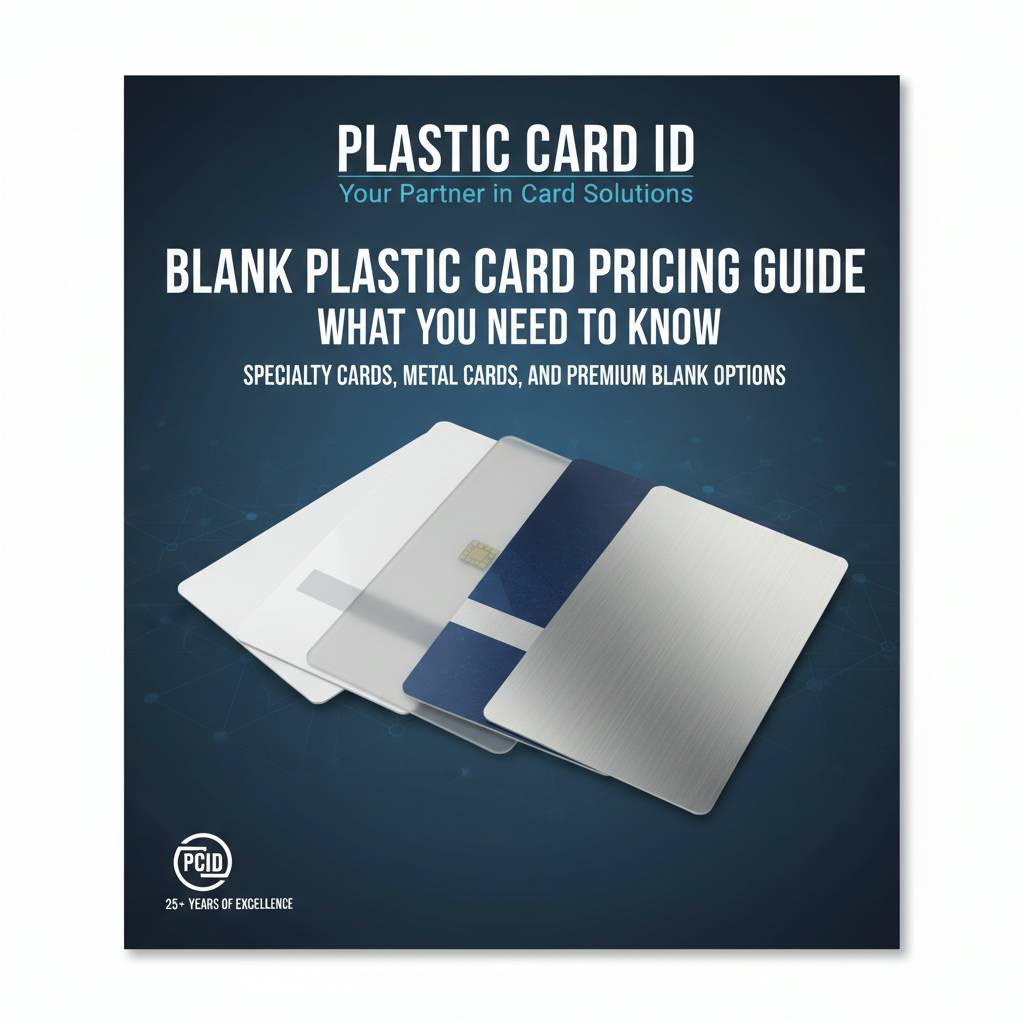
Premium blank card options include clear PVC, frosted PVC, colored stock, custom die-cut shapes, and full metal cards in stainless steel, brass, and gold-finish variants. Each format has a legitimate use case and a pricing structure that reflects its manufacturing complexity. CPE supplies all of these formats for USA-based programs.
Clear and Frosted PVC Blanks
Clear plastic cards create a striking visual effect - printed elements appear to float without a background, and layered printing techniques can produce genuinely premium-looking results. Frosted variants diffuse light slightly, softening the look while retaining the see-through quality. These cards price at $0.25-$0.75 per card and deliver a perceived value well above their cost - a common outcome in marketing-driven card programs.
Salon loyalty programs, boutique retail membership, and VIP event credentials are frequent applications. The card itself becomes part of the brand experience rather than just a functional token. In-house printing on clear stock requires attention to printer settings and ribbon type, but the results are consistently impressive.
Custom Die-Cut Shapes and Oversized Formats
CR80 is the standard, but it is not the only option. Custom die-cut cards in shapes that match a brand logo, product silhouette, or creative concept are available as blanks or pre-cut to specification. Pricing for die-cut shapes typically starts at $0.50-$1.50 per card and scales with the complexity of the cut and order volume. For event marketing, product launches, and novelty loyalty programs, a shaped card creates immediate tactile engagement that rectangular cards cannot match.
Oversized CR79 or undersized mini cards serve specific functional needs - certain printer models accept non-standard sizes, enabling creative credential formats for trade shows, conferences, and brand activation events. Call 800.835.7919 to discuss non-standard card formats and whether they are compatible with your existing printer hardware.
Metal Cards for Premium Programs
Stainless steel, brass, and gold-finish metal cards are the pinnacle of the blank card product line. Priced at $4.00-$12.00 per card depending on material and finish, they are not appropriate for every program - but for executive membership, casino VIP credentials, high-end loyalty programs, and luxury hospitality, they deliver an unmistakable tactile and visual signal of exclusivity. Metal cards are kept, displayed, and talked about in ways plastic cards rarely are.
Metal cards can be laser-engraved, printed via UV flatbed, or combined with embedded chip technology for functional access or identification use alongside their premium aesthetic role. Organizations considering metal cards typically find that the reduced need for replacement alone offsets a significant portion of the premium - metal cards are not discarded the way standard plastic cards sometimes are.
Building a Complete Card Program with Plastic Card ID
A blank card is the beginning of a program, not the end of one. The card feeds a printer, which requires ribbons and cleaning kits. The printed card goes into a holder, sleeve, or carrier before reaching the cardholder. Some programs require affixing cards to mailers for fulfillment. Plastic Card ID supplies every element of this chain - which means you can consolidate vendors, simplify reordering, and ensure compatibility across your entire card production workflow.
Card printers from Evolis, Zebra, and Fargo are stocked alongside the consumables they require. Purchasing your blank cards and your printer ribbons from the same supplier eliminates the compatibility guesswork that arises when buying from multiple sources. It also creates a single point of contact for troubleshooting when print quality issues arise - a practical advantage that saves time at exactly the moments when time is shortest.
Card Printers and Ribbon Compatibility
The blank card you choose must be compatible with your printer's feed mechanism, platen roller pressure, and ribbon chemistry. Desktop card printers from leading brands are engineered around CR80 30 mil stock, but performance varies when non-standard cards are introduced. Sourcing cards and printers from the same supplier is the simplest way to guarantee compatibility.
CPE carries full ribbon inventories for Evolis Primacy, Zebra ZC and ZXP series, and Fargo HDP and DTC series printers. Ribbon pricing varies by type - YMCKO full-color ribbons for 250-500 print jobs typically run $50-$150 per roll - and matching ribbon to card surface is as important as matching the cards themselves to your printer model.
Card Accessories: Sleeves, Holders, and Mailers
Card carriers, badge holders, lanyards, and protective sleeves are the frequently overlooked accessories that complete a professional card program. A beautifully printed employee badge presented in a flimsy sleeve undermines the investment made in the card itself. Matching accessory quality to card quality is a mark of a well-managed program.
For mailing programs, card affixing and mailing services take the burden of fulfillment off your team entirely. Loyalty cards mailed directly to customers at enrollment or renewal see higher activation rates than cards distributed in-store, because the physical arrival of a card in the mail creates a distinct moment of engagement with your brand.
Strategic Partnerships Over Transactional Purchasing
Organizations that treat their card supplier as a strategic partner - rather than a commodity vendor to be price-shopped on every order - consistently run more efficient and more successful card programs. Understanding your supplier's full catalog, lead times, and volume structures allows you to plan rather than react. Planning produces better pricing, better inventory management, and fewer program disruptions.
CPE has supported programs ranging from 50 cards per month for small businesses to tens of thousands of cards per month for large enterprises. That range of experience means the advice you receive is grounded in real-world program management, not just product specifications. The right blank card at the right price, paired with the right printer and the right accessories, is what makes a card program run smoothly year after year.
Ready to price out your blank card program? Contact Plastic Card ID today at 800.835.7919 and speak with a card program specialist who can match you to the right card type, volume tier, and accessories for your specific needs.
Plastic Card ID - your strategic partner in blank plastic cards, card printers, and complete card program solutions across the United States. Call 800.835.7919 now and let's build something that lasts.
Previous Page