Blank Plastic Card Materials Compared: Which Is Right for You?
Table of Contents []
- Blank Plastic Card Materials Compared: What Every Buyer Should Know Before Ordering
- Standard PVC: The Backbone of Blank Card Programs
- Composite PVC/PET Cards: Built for Heavy-Use Printer Programs
- Clear and Frosted Plastic Cards: Premium Aesthetics With Practical Applications
- RFID, Smart Chip, and Proximity Cards: Technology Built Into the Card
- Metal Cards and Specialty Options: When Plastic Is Not Enough
- Choosing the Right Blank Card Material: A Practical Buyer's Framework
Blank Plastic Card Materials Compared: What Every Buyer Should Know Before Ordering
Walk into almost any business that runs a card program and you will find a surprisingly wide range of card stock sitting in the printer tray. Not all blank plastic cards are built from the same stuff, and choosing the wrong material can mean cards that crack, fade, delaminate, or simply fail to encode properly. The material underneath your design matters just as much as the design itself.
Whether you are setting up an employee badge program, launching a retail gift card, or issuing membership credentials, understanding blank plastic card materials gives you a serious operational advantage. Plastic Card ID has spent over 25 years helping more than 100,000 U.S. businesses navigate exactly these decisions, and the insights below reflect real-world experience across millions of cards.
| Card Material | Thickness | Best Use Case | Magnetic Stripe Compatible | RFID/Chip Compatible |
|---|---|---|---|---|
| Standard PVC | 30 mil (CR80) | ID badges, loyalty, membership | Yes | Yes |
| Composite PVC/PET | 30 mil (CR80) | High-volume printer programs | Yes | Yes |
| Clear/Frosted PVC | 30 mil (CR80) | Specialty, premium, VIP | Yes | Limited |
| Metal (Stainless/Brass/Gold) | Varies | Luxury membership, VIP, rewards | Specialty only | Specialty only |
| RFID/Smart Chip PVC | 30 mil (CR80) | Access control, hospitality, transit | Combo options available | Yes |
Standard PVC: The Backbone of Blank Card Programs
 There is a reason standard PVC dominates the blank card market. Polyvinyl chloride offers a near-perfect combination of printability, durability, and cost efficiency that no other material has managed to fully displace. At 30 mil thickness and CR80 dimensions (3.375" x 2.125"), a standard PVC card conforms to ISO 7810 specifications, meaning it fits every wallet, badge holder, and card printer on the market.
When CPE talks about workhorse cards, this is what they mean. A blank CR80 PVC card is fundamentally neutral, a canvas. You decide what gets printed on it, what gets encoded onto it, and how it gets used. That flexibility is why the same card stock shows up in employee badge programs, hotel front desks, school libraries, and retail loyalty programs simultaneously.
Surface Finish and Print Quality
Standard PVC blanks come in gloss and matte finishes. Gloss surfaces produce vivid, photo-quality prints when run through dye-sublimation printers from brands like Evolis, Zebra, and Fargo, making them ideal for photo ID applications. Matte finishes reduce glare and are often preferred for cards that recipients will write on or that will be viewed under fluorescent lighting.
Print adhesion on standard PVC is excellent across retransfer, direct-to-card, and inkjet-compatible formats. Organizations running in-house card programs with desktop printers will find standard PVC consistently reliable, card after card, without the surface inconsistencies that cheaper alternatives sometimes introduce.
Laminate Overlay and Durability
A significant advantage of standard PVC is its compatibility with holographic and clear laminate overlays. These overlays, applied by a printer's laminating module, dramatically extend the life of a printed card and add a layer of security that discourages tampering. Cards with laminate overlays regularly outlast unlaminated cards by two to three times in daily-use badge environments.
Without lamination, a standard PVC card used as a daily employee badge can expect a useful life of twelve to eighteen months under normal wear. Add a laminate overlay and that figure climbs considerably. For organizations issuing annual membership cards or multi-year employee credentials, laminate compatibility is not optional, it is essential.
Magnetic Stripe Integration on PVC Stock
Standard PVC blank cards are available with pre-applied magnetic stripes in both HiCo (high coercivity) and LoCo (low coercivity) formats. HiCo stripes, measured at 2750 Oe, resist accidental erasure from everyday magnetic sources like phone cases and bag clasps. LoCo stripes at 300 Oe work well in controlled environments like event access or short-term hotel keys where data is frequently rewritten.
Choosing the right stripe is not just technical preference; it directly affects how often cards need to be re-encoded and how reliably data is read at point-of-contact. For retail gift card programs, HiCo is almost always the better choice. For temporary access cards that are wiped and reused daily, LoCo performs perfectly well and costs slightly less per unit.
Composite PVC/PET Cards: Built for Heavy-Use Printer Programs
Step up from standard PVC and you reach composite cards, a laminated construction that bonds PVC outer layers to a polyester (PET) core. The result is a card that resists cracking and delamination under the heat and pressure cycles of retransfer card printers. Composite cards are specifically engineered for programs that process thousands of cards through a single printer annually.
The distinction matters operationally. High-volume card programs, think hospital systems issuing patient ID cards, universities issuing student credentials, or large retailers managing gift card inventory, put significant mechanical stress on card stock. Composite construction handles that stress without the micro-fractures that eventually appear in standard PVC under sustained thermal printing cycles.
Why Retransfer Printers Demand Composite Cards
Retransfer printers, such as those in the Fargo HDP line and Zebra's ZXP Series 8, print an image onto a clear film that is then heat-transferred onto the card surface. This process generates more heat than direct-to-card printing. Standard PVC cards can warp or blister under repeated retransfer cycles. Composite cards absorb and dissipate this heat far more effectively, delivering edge-to-edge printing without distortion.
For organizations that prioritize print quality above all else, retransfer printing on composite stock is the gold standard. The image wraps fully over card edges, producing a seamless, professional finish that is visually distinct from anything achievable with direct-to-card printing on standard PVC.
Cost Considerations for Composite Stock
Composite cards carry a modest premium over standard PVC, typically in the range of ten to twenty percent per card depending on volume. For most high-volume programs, this premium is offset by reduced card waste, fewer reprints, and longer card life in the field. When your per-card cost includes a reprint, composite pays for itself quickly.
Organizations printing fewer than a few hundred cards per month may not see enough benefit to justify composite over standard PVC. But once a program crosses into the thousands of cards per year, running the math almost always favors composite. CPE can help clients model these costs against their specific printer and volume profile before committing to a material.
Printer Compatibility Checklist
- Evolis Primacy 2 and Zenius: Optimized for standard PVC; composite compatible
- Zebra ZC300 and ZC350: Standard PVC recommended; retransfer models require composite
- Fargo HDP5000 and HDP6600: Composite cards strongly recommended
- Zebra ZXP Series 8: Composite cards required for optimal performance
- Evolis Avansia: Designed specifically for retransfer; composite is the standard stock
Clear and Frosted Plastic Cards: Premium Aesthetics With Practical Applications
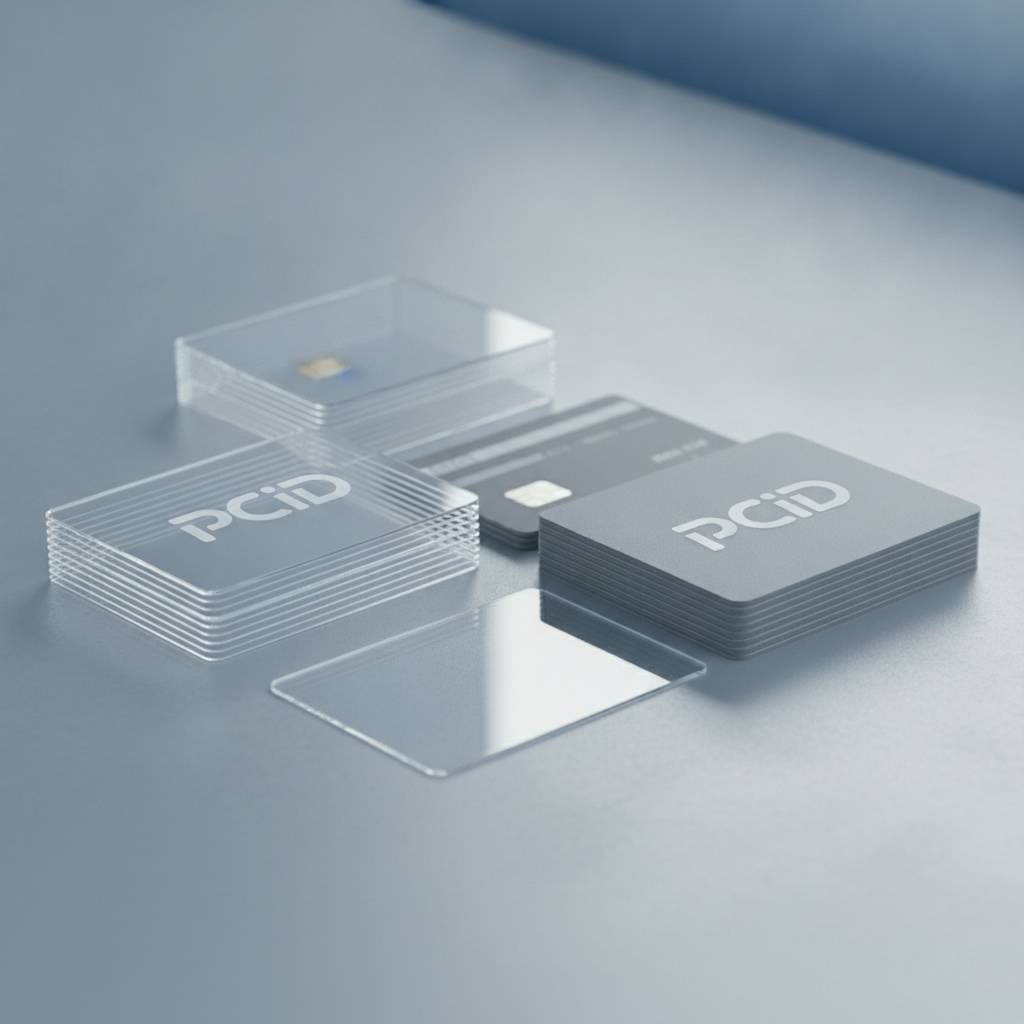 Transparency in a card is not just a visual choice; it is a statement. Clear and frosted PVC cards communicate exclusivity, creativity, and premium positioning in ways that opaque white stock simply cannot. When a VIP membership card or a high-end loyalty program card arrives in a customer's hands and the background of the card is genuinely transparent, the reaction is measurably different from receiving a standard card.
Retailers, nightclubs, spas, boutique fitness studios, and upscale restaurants have all leveraged clear card stock to differentiate their programs. The card becomes a conversation piece rather than just a credential, which in loyalty and membership programs translates directly into higher carry rates and better top-of-wallet positioning.
Print Behavior on Clear Stock
Printing on clear PVC requires a different approach than printing on white stock. Because there is no white background layer, colors print differently, lighter colors become translucent rather than solid, and the full effect depends on thoughtful design that embraces rather than fights the transparency. White ink printing, available on select Evolis and Fargo models, is often used in combination with standard colors on clear stock to create controlled opacity where needed.
Frosted cards offer a semi-transparent appearance with a soft, diffused surface that handles standard color printing more predictably than fully clear stock. They are often chosen by organizations that want the premium aesthetic without the design complexity of working with full transparency. Both options are available in standard CR80 dimensions and 30 mil thickness.
Magnetic Stripe and Encoding on Clear Cards
Clear cards can be produced with magnetic stripes, though the stripe is visually more prominent against a transparent background than on opaque white stock. For programs where encoding is required alongside the clear aesthetic, pre-encoded clear cards with HiCo stripes are a practical option. RFID integration on clear stock is more limited due to antenna embedding constraints, so buyers running access control programs should discuss compatibility with Plastic Card ID before specifying clear stock.
The visual prominence of a magnetic stripe on a clear card is worth considering in the design phase. Many programs use the stripe as a design element, incorporating it intentionally into the card's visual layout rather than treating it as a technical afterthought.
When to Choose Clear or Frosted Over Standard White
The choice comes down to program goals and audience expectations. If your card program's primary objective is operational efficiency at scale, standard white PVC delivers the best cost-performance ratio. If your program's primary objective is brand differentiation and customer delight, clear or frosted stock earns its premium. Luxury loyalty programs, VIP access credentials, and high-end membership cards benefit most from clear and frosted options.
Programs that issue cards infrequently, or to a small, high-value audience, often find the per-card premium on clear stock entirely justified. A boutique hotel issuing twenty premium membership cards per month will spend more per card on clear stock but gain a brand impression that compounds over time.
| Feature | Clear PVC | Frosted PVC | Standard White PVC |
|---|---|---|---|
| Visual Impact | Very High | High | Standard |
| Design Complexity | High | Moderate | Low |
| Cost per Card | Higher | Moderate | Lowest |
| Mag Stripe Option | Yes | Yes | Yes |
RFID, Smart Chip, and Proximity Cards: Technology Built Into the Card
Some applications demand more than a printed surface or a magnetic stripe. Access control systems, hotel room management, transit programs, and campus security all rely on cards that communicate wirelessly with readers. RFID and smart chip cards embed technology directly into the card body, enabling contactless data exchange that is faster, more secure, and more versatile than magnetic stripe alone.
The blank card in this category is not blank in the traditional sense. It carries an embedded antenna and chip that define its capabilities before any printing occurs. Choosing the right technology standard, whether 125 kHz proximity, 13.56 MHz MIFARE, or more advanced MIFARE DESFire encryption, is a system-level decision that must align with your reader infrastructure.
Proximity Cards vs. Smart Chip Cards
Proximity cards operate at 125 kHz and are the workhorses of older access control systems. They transmit a fixed facility code and card number, which is sufficient for door access but offers limited data capacity and no encryption. Hundreds of thousands of buildings across the United States still run on proximity technology, making these cards the most commonly requested RFID stock in the market.
Smart chip cards, operating at 13.56 MHz, offer dramatically more capability. MIFARE Classic and MIFARE DESFire standards support encrypted data storage, multiple applications on a single card, and mutual authentication between card and reader. For organizations building new access control infrastructure or managing complex multi-application programs, smart chip is the platform to build on.
Hotel Key Cards and Hospitality Applications
Hotel key cards represent one of the highest-volume RFID card applications in the country. Most modern hotel lock systems use 13.56 MHz RFID, encoding room access, floor permissions, and amenity access onto a single card that is re-encoded for each new guest. The blank hotel key card must meet strict dimensional and encoding tolerances to perform reliably across thousands of swipe cycles and re-encoding sessions.
Beyond room access, hospitality operators use the same card stock for spa access, pool credentials, dining credits, and loyalty program integration. The card becomes the guest's entire hotel experience in a single piece of plastic. Sourcing reliable blank stock from a partner that understands these requirements is critical to operational consistency across properties.
Contacting Plastic Card ID About RFID Card Specifications
RFID and smart card procurement is more technically complex than ordering standard PVC blanks. Frequency, memory capacity, encryption standard, and reader compatibility all need to be confirmed before placing an order. Matching card technology to existing reader infrastructure prevents costly re-procurement and system incompatibilities.
Call 800.835.7919 to speak directly with a specialist who can help confirm compatibility between your reader system and the correct card stock. CPE maintains inventory across the major RFID formats and can ship samples for system testing before full orders are placed.
Metal Cards and Specialty Options: When Plastic Is Not Enough
There are moments when a plastic card, even a premium one, does not fully convey the message a program needs to send. Metal cards, available in stainless steel, brass, and gold finishes, occupy a distinct tier of perceived value that is immediately communicated the moment a recipient holds one. The weight alone registers differently than any plastic card ever could.
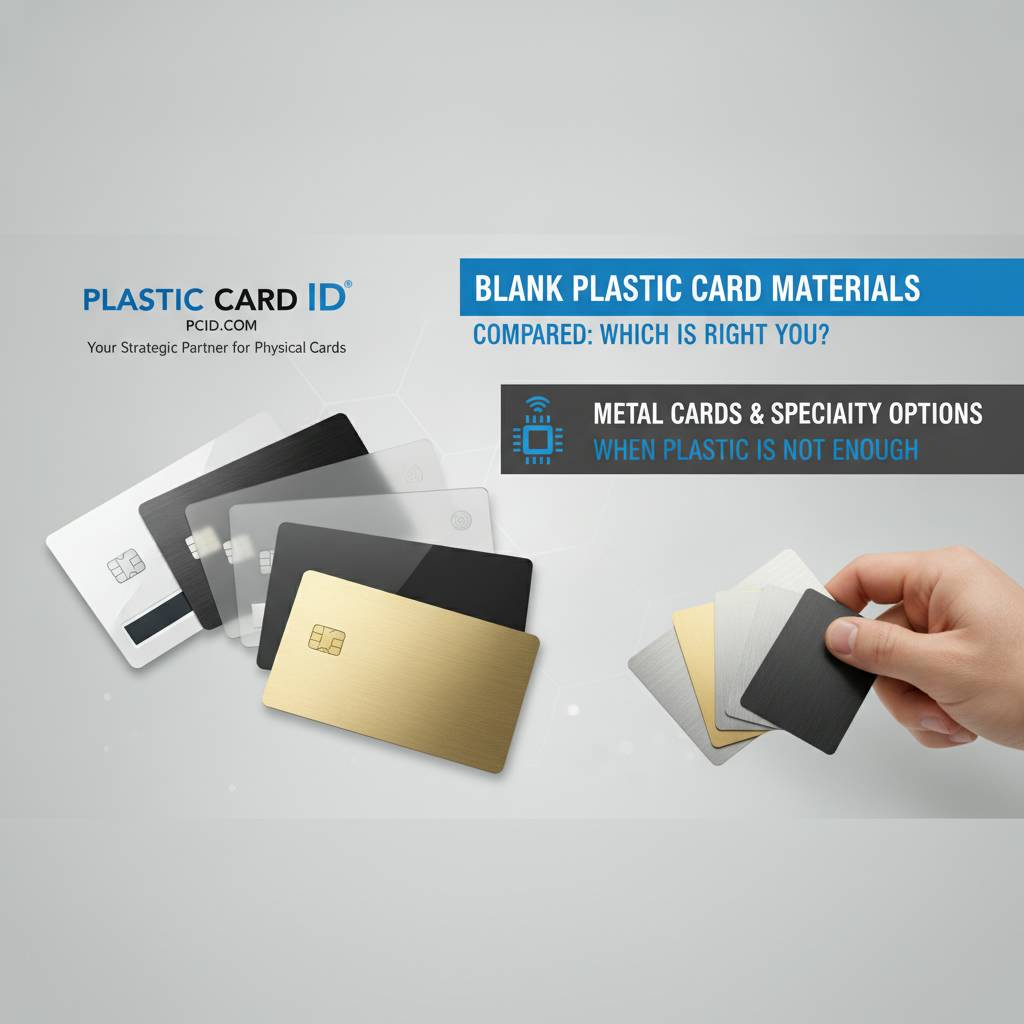
Luxury rewards programs, exclusive membership clubs, high-end casino player cards, and corporate recognition programs are all natural homes for metal card stock. These are situations where the card itself is part of the value proposition, where the tactile experience reinforces the message that this membership, this relationship, this status, is genuinely premium.
Casino Player Cards and Custom Die-Cut Options
Casino player cards are an interesting intersection of technology and aesthetics. They need to encode player data reliably across thousands of swipes while also looking distinctive enough to encourage players to carry and present them. Custom finishes, die-cut shapes, and specialty materials help casino operators build card programs that reinforce brand identity on the gaming floor.
Die-cut cards, shaped outside standard CR80 dimensions, are available for programs that want maximum visual differentiation. A card shaped like a key, a logo, or a custom silhouette stands out in a wallet and makes a lasting impression. These specialty options require longer lead times and typically have higher minimum quantities, but for the right program, the investment is justified.
Colored Stock and Non-White Base Cards
Not every card needs to start from a white base. Colored stock PVC cards, available in black, red, blue, gold, and other pre-colored finishes, allow programs to achieve base colors without the cost and complexity of full-surface printing. A black base card with white or metallic printing creates a visual contrast that standard white-base cards simply cannot replicate, and it does so at a lower per-card cost than full-color custom printing.
Pre-colored stock works particularly well for programs with consistent, long-term card designs that do not change frequently. When you know your brand color and card design are stable, ordering colored base stock in volume makes excellent economic sense and delivers a consistently striking result.
Choosing the Right Blank Card Material: A Practical Buyer's Framework
After reviewing the materials above, the decision framework becomes clearer. Your card material choice should flow directly from three core questions: How will the card be used, how long does it need to last, and what impression does it need to create? Everything else, cost, compatibility, finish, encoding, follows from honest answers to those three questions.
Organizations building scalable in-house card programs benefit most from starting with standard PVC CR80 stock and a reliable desktop printer. As programs grow in volume and complexity, composite cards, specialty stock, and advanced encoding technologies can be layered in. Plastic Card ID has guided programs through exactly this evolution across virtually every industry vertical in the United States.
Frequently Asked Questions: Blank Card Materials
What is the most common blank card size? CR80 at 30 mil thickness is the ISO 7810 standard and fits virtually all desktop card printers and badge holders. It is the default choice for the vast majority of card programs. Most organizations should start here unless they have a specific reason to choose otherwise.
Can I print on RFID cards with a standard card printer? Yes, provided the printer supports the card thickness and the RFID chip does not interfere with the print head path. Most standard desktop printers handle 13.56 MHz and 125 kHz cards without modification. Confirm with your printer manufacturer before running a full batch.
Buyer Tips for First-Time Card Program Managers
- Order a sample pack before committing to a full volume purchase; verify print quality on your specific printer model
- Confirm HiCo vs. LoCo requirements with your card reader or terminal vendor before ordering magnetic stripe cards
- Factor in ribbon type and yield when calculating true per-card cost across different materials
- For RFID programs, request a compatibility matrix from your access control vendor before specifying card stock
- Consider laminate overlay availability for any card that will be handled daily over twelve months or more
- Run small pilot batches when switching card materials within an existing program to verify system compatibility
Starting a new card program with the right material from day one avoids costly mid-program switches and the credentialing headaches that come with them. Take the time to spec correctly upfront.
Volume Pricing and Program Scaling With Plastic Card ID
One of the most consistent advantages of working with a dedicated card supplier is access to volume pricing that reflects actual program needs. Programs ordering 50 cards a month and programs ordering 50,000 cards a month both deserve pricing that scales appropriately rather than one-size-fits-all retail rates. CPE structures pricing to reward volume while keeping smaller programs competitively priced.
As programs grow, material upgrades, composite stock, specialty finishes, RFID integration, can be phased in without disrupting existing infrastructure. Call 800.835.7919 to discuss volume pricing for your specific material and encoding requirements. The right conversation at the procurement stage saves time, money, and operational headaches down the road.
Ready to match the right card material to your program? Plastic Card ID has the inventory, the expertise, and the track record to help you get it right the first time. Call 800.835.7919 today.
Previous Page