Blank Plastic Cards for Magnetic Stripe Encoding Explained
Table of Contents []
- Blank Plastic Cards for Magnetic Stripe Encoding - Your Complete Source at Plastic Card ID
- Understanding HiCo vs. LoCo: The Encoding Decision That Drives Everything
- The CR80 Standard: Why Blank PVC Cards Are the Right Canvas
- Card Printers That Encode and Print in a Single Pass
- Applications: Where Blank Magnetic Stripe Cards Deliver Real Results
- Value-Added Products and Services That Complete Your Card Program
- Why Plastic Card ID Is the Strategic Partner Your Card Program Deserves
Blank Plastic Cards for Magnetic Stripe Encoding - Your Complete Source at Plastic Card ID
Walk into any modern business and you will find them everywhere - key cards sliding through door readers, loyalty cards scanned at checkout, employee badges tapped against access panels. Behind each of those cards is a decision somebody made about substrate, encoding format, and procurement. If you are reading this, that decision is yours to make, and getting it right the first time saves real money. This page is built specifically to help you understand blank plastic cards for magnetic stripe encoding, how they work, what distinguishes one card from another, and why sourcing from Plastic Card ID makes measurable sense for USA-based programs of any scale.
Magnetic stripe technology has been a reliable workhorse in card programs for decades. It is not flashy, but it is dependable, cost-effective, and universally compatible with an enormous installed base of readers across retail, hospitality, healthcare, education, and corporate environments. Blank CR80 PVC cards with magnetic stripes give you the raw material to run those programs entirely in-house - printing, encoding, and distributing cards exactly when and how you need them.
Plastic Card ID has spent over 25 years supplying these cards to businesses across the United States. More than 100,000 customers and 50 million cards later, the depth of catalog, pricing structure, and customer knowledge here is genuinely hard to match.
| Card Type | Stripe Standard | Coercivity | Best Use Case |
|---|---|---|---|
| CR80 PVC White | ISO 7811 | HiCo (2750 Oe) | Employee badges, access cards |
| CR80 PVC White | ISO 7811 | LoCo (300 Oe) | Gift cards, loyalty cards |
| CR80 Colored PVC | ISO 7811 | HiCo or LoCo | Branded loyalty or membership |
| CR80 Clear / Frosted | ISO 7811 | HiCo | Premium branding, VIP programs |
| CR80 PVC with Chip Stripe | ISO 7811 / ISO 7816 | HiCo | Multi-technology access programs |
Understanding HiCo vs. LoCo: The Encoding Decision That Drives Everything
 Before a single card is ordered, you need to settle one foundational question: High Coercivity or Low Coercivity? This is not a minor technical footnote. Choosing the wrong coercivity wastes your entire card investment because readers and encoders are calibrated for one or the other. Coercivity measures how much magnetic force is required to encode data onto the stripe, and it directly affects how resistant that data is to accidental erasure.
HiCo cards at 2750 Oersteds hold their data firmly against everyday magnetic interference - proximity to other cards, security sensors at store entrances, casual contact with smartphones. If your card will be used repeatedly over months or years, HiCo is the professional standard. LoCo cards at 300 Oersteds are perfectly adequate for shorter lifecycle programs like hotel keys or single-event applications where the card is retired quickly anyway. Both formats are encoded using the same ISO 7811 track structure, so your reader infrastructure stays consistent.
HiCo Cards: Built for Durability and Daily Use
Employee ID programs, access control systems, frequent-shopper cards, casino player cards - these applications demand HiCo. A card swiped dozens of times per week must retain clean, readable data month after month. HiCo cards deliver that consistency. The slightly higher per-card cost versus LoCo is negligible when spread across the operational lifespan of a card that outlasts five LoCo alternatives.
Corporate environments especially benefit from HiCo encoding. When badge readers are installed at building entrances, parking gates, and server rooms, the last thing a facilities manager wants is a failed scan because a card's magnetic data degraded. HiCo eliminates that variable entirely and keeps your access control running without friction.
LoCo Cards: Ideal for Short-Lifecycle Programs
Hotel key cards are the quintessential LoCo application. A guest checks in on Monday and checks out Friday. The card is encoded at the front desk, used perhaps a dozen times at the room door and elevator, then discarded or reprogrammed for the next guest. There is no need to pay HiCo pricing for that lifecycle. LoCo's cost efficiency at scale is genuine and significant for hospitality operations running thousands of guest cards per month.
Gift card programs at smaller retail operations similarly fit the LoCo profile. A gift card is purchased, gifted, and redeemed over a short window. The encoding is simple - a card number linked to a balance in your POS system. LoCo handles that cleanly. When CPE advises clients on card selection, matching coercivity to actual program lifecycle is always step one.
Tracks 1, 2, and 3: What Gets Encoded and Where
ISO 7811 defines three tracks on the magnetic stripe, each with different capacity and formatting rules. Track 1 holds alphanumeric data - up to 79 characters. Track 2 is numeric only but more universally read - up to 40 characters. Track 3 is less commonly used in modern programs but supports read-write operations. Most card programs use Track 2 as their primary data track because virtually every card reader manufactured in the last 30 years supports it reliably.
Understanding track structure matters when you configure your card printer's encoding module and write your card management software. Ordering blank cards that physically support all three tracks gives you maximum flexibility, even if your current program only writes to Track 2. Blank magnetic stripe cards from Plastic Card ID are formatted to ISO 7811 standards across the full three-track stripe.
The CR80 Standard: Why Blank PVC Cards Are the Right Canvas
CR80 is the ISO 7810 standard card size - 3.375 inches by 2.125 inches, 30 mil thick. That is the same size as a standard credit card, and it matters because every card printer, every card wallet slot, every card reader, and every card sleeve on the market is built around this dimension. Deviating from CR80 means sourcing custom hardware and packaging. For the vast majority of card programs, CR80 blank PVC is the intelligent default.
Blank means you control what goes on the card. Your logo, your color scheme, your employee's photo, your membership tier designation, your encoded data - all applied in-house at your timeline, not a print vendor's production queue. Organizations running dynamic programs where information changes frequently find blank cards dramatically more flexible and cost-effective than pre-printed stock that becomes obsolete whenever a design refreshes.
PVC Durability That Matches Real-World Demands
PVC cards at 30 mil thickness are engineered for daily handling. They flex without cracking, resist moisture, and maintain print clarity through hundreds of swipes and taps. The professional look and feel of a plastic card communicates legitimacy in a way paper simply cannot replicate. When a new employee receives a PVC badge or a loyal customer is handed a plastic membership card, the physical quality of that card is part of the brand message.
Retailers who switched from paper punch cards to plastic loyalty cards have documented sales increases of 35-50%. That number has an intuitive explanation: a plastic card lives in a wallet and gets handled daily. A paper card gets stuffed in a drawer and forgotten. The substrate is not a trivial detail - it is a driver of program performance.
Specialty Substrates for Elevated Programs
Standard white PVC is the workhorse, but Plastic Card ID's catalog goes considerably further. Clear and frosted PVC cards create striking visual effects when printed - especially useful for VIP membership programs, premium loyalty tiers, or brand-forward event credentials where distinction matters. A frosted card with selective color printing reads immediately as premium, communicating value to the cardholder before they have even swiped it.
Colored stock cards - available in a range of base colors - allow organizations to implement visual tiering without printing. A gold-colored base card for a premium loyalty tier, a standard white for entry level. Color-coded access cards simplify security management in complex facilities. These options are stocked and ready to ship, not custom-order-only items with long lead times.
Quantity Flexibility from 50 Cards to Mass Production
Not every organization needs a pallet of cards. CPE supports programs from as few as 50 cards per month all the way to tens of thousands at a time. Small nonprofits running modest membership programs, regional retailers building a new loyalty initiative, large healthcare networks deploying staff badges across multiple campuses - all of these are served. Volume pricing scales intelligently, so the per-card cost drops meaningfully as quantities increase, rewarding organizations that consolidate their card purchasing.
This flexibility matters because card programs grow. A retail client might start ordering 200 blank HiCo cards per month for a pilot loyalty program and scale to 5,000 monthly within a year as the program proves itself. Having a supplier who accommodates both ends of that journey without changing vendors is a genuine operational advantage.
| Substrate | Finish | Magnetic Stripe Available | Typical Application |
|---|---|---|---|
| Standard White PVC | Gloss | Yes - HiCo or LoCo | Employee ID, loyalty, gift cards |
| Clear PVC | Gloss / Matte | Yes - HiCo | VIP, premium branding |
| Frosted PVC | Frosted Matte | Yes - HiCo | Luxury loyalty, event credentials |
| Colored PVC Stock | Gloss | Yes - HiCo or LoCo | Tiered membership, access control |
| PVC with Smart Chip | Gloss | Yes - HiCo combo | Multi-tech access, transit, campus |
Card Printers That Encode and Print in a Single Pass
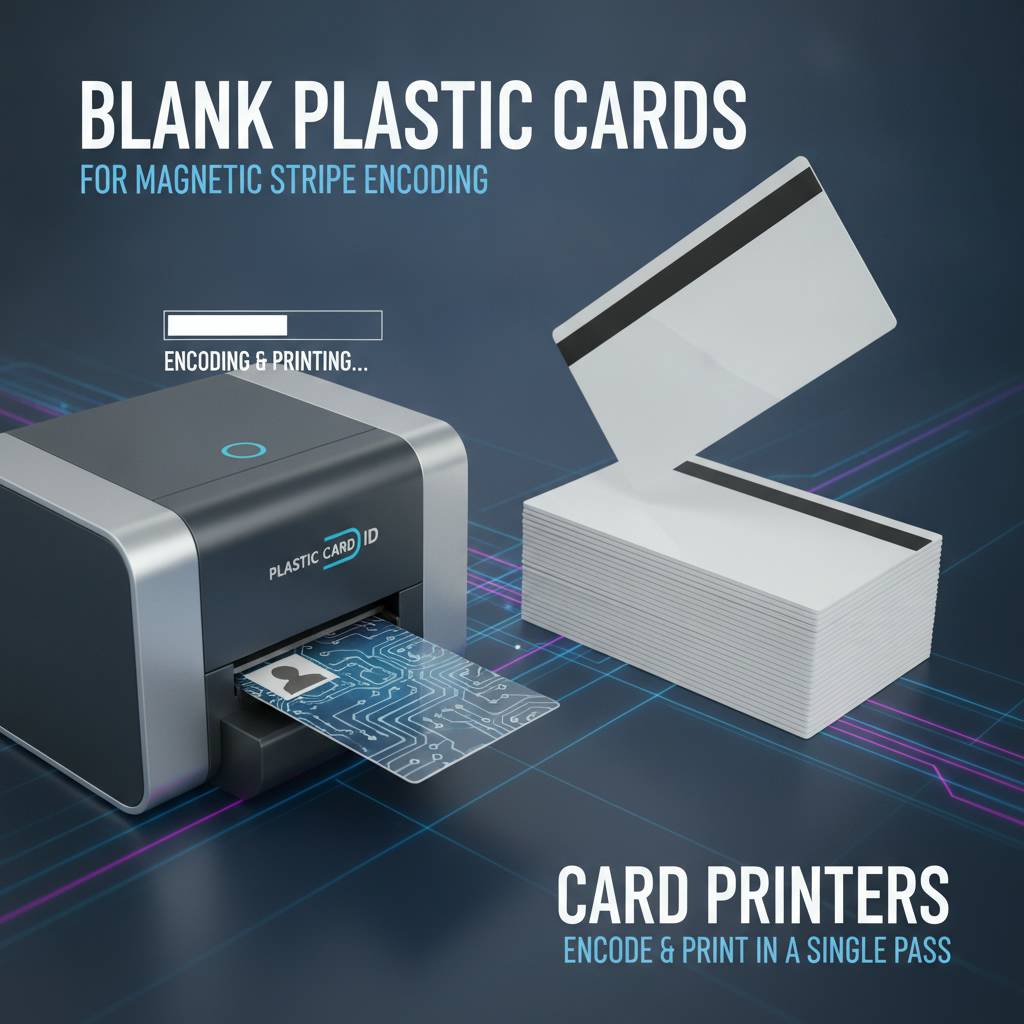 Blank magnetic stripe cards are only as useful as the printer-encoder system behind them. Plastic Card ID carries a full lineup of card printers from three industry-leading brands - Evolis, Zebra, and Fargo - each offering integrated magnetic stripe encoding modules that print and encode in one continuous operation. Single-pass print-and-encode dramatically reduces production time for organizations issuing cards at volume, and it eliminates the handling errors that come with separate print and encode steps.
Choosing the right printer is a function of your expected card volume, required print quality, encoding needs (single-sided vs. dual-sided, HiCo vs. LoCo modules), and budget. Entry-level desktop printers handle programs from 50-500 cards per month efficiently. Mid-range models scale to 1,000-5,000 monthly cards without strain. High-throughput printers designed for enterprise and government programs churn through tens of thousands of cards with automated feeding and output stacking.
Evolis Printers: Reliability and Elegance in One Package
Evolis has built a reputation for quiet, reliable, compact printers that deliver excellent output quality at reasonable price points. Their Primacy and Zenius lines are popular choices for organizations that need professional card output without dedicating significant floor space to the hardware. Evolis printers with HiCo encoding modules are a natural pairing with Plastic Card ID's blank magnetic stripe card inventory.
For organizations with limited IT resources, Evolis's plug-and-play driver architecture reduces installation complexity. Cards feed smoothly, ribbons are straightforward to replace, and the print quality on both white and colored substrates is consistently sharp. Cleaning kit maintenance cycles are well-documented and easy to follow.
Call 800.835.7919 to discuss which Evolis model aligns with your encoding and print volume requirements. Guidance from CPE makes the selection process faster and more confident.
Zebra Printers: Enterprise-Grade Performance
Zebra card printers are the benchmark in high-volume, high-durability card production environments. Their ZC and ZXP Series printers are found in government agencies, large healthcare networks, university campuses, and corporate headquarters where card issuance is a daily operational function, not an occasional task. Zebra's encoding accuracy and ribbon yield at volume make them the cost-per-card leader in high-throughput deployments.
The ZXP Series 7 and ZXP Series 9, in particular, support dual-sided printing with simultaneous magnetic stripe encoding, smart chip encoding, and lamination - all in a single pass. For organizations running multi-technology card programs that include both magnetic stripe and RFID, Zebra's combo encoding modules are the professional standard.
Fargo Printers: Trusted for Identity and Access Programs
Fargo printers, manufactured by HID Global, have long been associated with secure identity card issuance. Their HDP series uses retransfer printing technology - printing onto a film that is then laminated onto the card surface - producing edge-to-edge print coverage that is especially crisp on cards with embedded chips or uneven surfaces. For government-issued IDs, secure facility badges, and multi-layered access cards, Fargo remains a top-tier choice.
HDP retransfer also means the print head never contacts the card surface directly, significantly extending printhead life compared to direct-to-card models. Organizations with tight security requirements and high card durability standards consistently choose Fargo hardware paired with HiCo blank magnetic stripe cards for their core badge programs.
Applications: Where Blank Magnetic Stripe Cards Deliver Real Results
The range of programs running on blank magnetic stripe PVC cards is broader than most people initially assume. Loyalty programs, employee access, student IDs, membership clubs, event management, hospitality, healthcare, and retail gift programs all share a common platform. The versatility of a blank card is precisely what makes it such a strategic asset - the same card stock serves ten different programs, simplifying procurement and inventory management.
Loyalty and Gift Card Programs
For retailers, restaurants, and service businesses, loyalty programs built on plastic magnetic stripe cards outperform paper alternatives by every measurable metric. Customers carry plastic cards in their wallets, meaning the card - and the brand - stays visible. Magnetic stripe encoding ties each card to a customer account in your POS or loyalty platform, enabling points tracking, redemption, tier management, and purchase history analysis. That data is what separates a loyalty program from a discount program.
Gift cards follow the same architecture. A card number encoded on Track 2 links to a balance in your gift card management system. When a customer presents the card at checkout, the reader pulls the card number, your system checks the balance, and the transaction completes. It is a straightforward, proven workflow that has driven documented sales increases of 35-50% for retailers making the switch from paper.
Employee ID and Access Control
Corporate security teams managing building access, time-and-attendance tracking, and cafeteria payment systems often run all three functions on a single HiCo magnetic stripe card. The stripe carries the employee's unique identifier, which your access control and HR systems use to authorize door entry, log clock-in times, and deduct meal credits. One card, three functions, zero redundancy.
- HiCo encoding ensures data integrity across daily badge swipes over the card's multi-year lifespan.
- Blank CR80 white PVC stock allows in-house photo ID printing with full-color dye-sublimation.
- Replacement cards can be printed and encoded on-demand without vendor lead times.
- Colored stock variants enable visual security tiering - red for contractors, blue for staff, gold for executive access.
- Dual-sided printing on compatible printers places employee data on the front and access zone information on the reverse.
Membership, Healthcare, and Education Cards
Gyms, private clubs, professional associations, libraries, and universities all issue magnetic stripe membership cards. The card number encoded on the stripe is the key that unlocks your member database - pulling up accounts, logging visits, verifying credentials, and processing transactions. A plastic membership card signals permanence and institutional seriousness that a printed paper certificate or laminated sheet simply cannot project.
Healthcare applications include patient identification cards, employee access credentials for controlled medication areas, and facility visitor management systems. Universities issue student IDs that carry magnetic stripe encoding for library access, meal plan deduction, dormitory entry, and printing credits - all from a single card issued at enrollment and valid for the student's academic career.
Value-Added Products and Services That Complete Your Card Program
Blank magnetic stripe cards are the core, but a functioning card program requires more than just the cards themselves. Plastic Card ID operates as a genuine one-stop shop, stocking every ancillary product and service that brings a card program from concept to daily operation. Consolidating your card program supply chain with a single vendor reduces administrative overhead, simplifies purchasing, and ensures product compatibility across components.

Printer Ribbons and Cleaning Kits
Your card printer is only as good as its consumables. Using compatible, high-quality ribbons - YMCKO for full-color printing, KO for monochrome text and barcodes, overlay-only ribbons for lamination passes - ensures print quality and protects your printhead from premature wear. Plastic Card ID stocks ribbons compatible with Evolis, Zebra, and Fargo printers across their full product lines. Running your printer with mismatched or low-grade ribbons is the single fastest way to degrade print quality and increase maintenance costs.
Cleaning kits - swabs, cleaning cards, and cleaning rollers calibrated for each printer model - are essential maintenance consumables. Printers that are cleaned on schedule as specified in the manufacturer's maintenance guide deliver measurably longer printhead life and more consistent encoding accuracy. Skipping cleaning cycles is a common and costly mistake that CPE consistently advises against.
Contact 800.835.7919 for ribbon and cleaning kit recommendations matched to your specific printer model and monthly card volume.
Card Carriers, Sleeves, and Mailing Services
Distributing cards to customers, members, or employees requires packaging that presents the card professionally and protects it during transit. Card carriers - folded paper or cardstock holders designed to hold a CR80 card - are the standard retail and mail distribution format. They provide space for activation instructions, terms and conditions, or promotional messaging. A well-designed card carrier elevates the entire card program experience from the moment a customer opens their mailbox.
Poly sleeves and card protectors extend card life for cards that will be carried in wallets or clipped to lanyards without a holder. For organizations distributing cards by mail at volume, Plastic Card ID offers card affixing and mailing services - a turnkey solution that eliminates the labor of inserting, sealing, and posting thousands of individual card mailings.
Frequently Asked Questions About Blank Magnetic Stripe Cards
Buyers new to in-house card programs consistently ask the same core questions. Below are direct, practical answers that clarify the most common points of confusion before a first order is placed.
- Can I encode blank magnetic stripe cards with any card printer? Only printers with a magnetic stripe encoding module can encode cards. Confirm your printer model includes an MSE (magnetic stripe encoder) before ordering encoded card stock.
- What is the difference between HiCo and LoCo for a gift card program? LoCo works well for gift cards with short lifecycles. If your gift cards are reloadable and used over years, HiCo is the better choice for data stability.
- Do blank cards come with data pre-encoded? No. Blank magnetic stripe cards have an empty, formatted stripe ready to receive encoding from your printer's MSE module. Data is written during your card issuance process.
- What is the minimum order quantity? Plastic Card ID serves programs from as few as 50 cards per order, scaling to mass production quantities without requiring you to change vendors as you grow.
- Are RFID and magnetic stripe available on the same card? Yes. Combo cards with both magnetic stripe encoding and RFID or smart chip technology are available, ideal for multi-technology access programs.
Why Plastic Card ID Is the Strategic Partner Your Card Program Deserves
After 25 years and more than 50 million cards delivered to over 100,000 customers across the United States, the operational knowledge embedded in Plastic Card ID's team is substantial. This is not a catalog company that ships boxes and moves on. The relationship model here is built around your program's long-term success - understanding what you are trying to accomplish, matching you to the right card stock and printer combination, and supporting you as your program evolves and scales.
The catalog covers every meaningful card technology in use today: blank white PVC with HiCo and LoCo stripes, clear and frosted specialty substrates, colored stock, RFID proximity cards, MIFARE DESFire smart cards for contactless applications, combo stripe-and-chip cards, casino player cards, hotel key cards, and specialty formats including custom die-cut shapes and luxury metal cards in stainless steel, brass, and gold. Whatever your card program requires today - and whatever it grows into tomorrow - the inventory and expertise are here.
A Proven Track Record Across Every Industry
Retailers, healthcare networks, universities, government agencies, hospitality groups, casinos, fitness clubs, professional associations, corporate campuses, event management companies - Plastic Card ID's customer base spans virtually every sector where card programs add operational value. That cross-industry experience translates directly into better advice for your specific program context. A casino player card program has different encoding and durability requirements than a university student ID, and that difference is reflected in the product recommendations made here.
Long-term customer relationships are the metric CPE measures itself against. When a loyalty program manager reorders blank HiCo cards for the eighth consecutive year, that is the proof point. When a corporate security team upgrades their printer and buys compatible card stock in the same call, that is the one-stop-shop value working in practice.
Ordering, Pricing, and What to Expect
Pricing on blank magnetic stripe cards scales with quantity in a transparent, predictable structure. Small program operators running 50-500 cards per month will find competitive per-card pricing that makes in-house issuance economically sensible versus outsourced card production. High-volume buyers ordering in the thousands receive meaningful per-card cost reductions that compound significantly at annual program scale. Total cost of ownership - cards plus ribbons plus printer maintenance - is always the right frame for evaluating a card program investment.
Orders ship from US-based inventory, avoiding the international sourcing delays and quality inconsistencies that plague lower-cost overseas alternatives. For programs with time-sensitive issuance needs - an event credential deadline, a system-wide badge replacement, a new store opening loyalty launch - domestic stock availability is not a minor convenience; it is an operational necessity.
Get Your Card Program Running the Right Way
Whether you are launching a new card program from scratch, upgrading aging card stock, sourcing a new printer, or scaling a successful program to the next volume tier, the right conversation starts with understanding your specific requirements. Matching the right blank magnetic stripe card to your encoder, reader infrastructure, and program lifecycle is what separates a card program that works flawlessly from one that creates constant maintenance headaches.
The team at CPE is ready to walk through your specifications, recommend the right HiCo or LoCo card stock, confirm substrate compatibility with your printer model, and structure an order quantity that balances per-card pricing with your actual consumption rate. This is a conversation worth having before you order, not after.
Call 800.835.7919 now and put Plastic Card ID's 25 years of blank plastic card expertise to work for your program - from your first 50 cards to your fifty-thousandth.
Previous Page
Next Page