Things to Know Before Buying Blank Plastic Cards
Table of Contents []
- What Every Smart Buyer Should Know Before Purchasing Blank Plastic Cards - From Plastic Card ID
- Understanding Card Specifications: Size, Thickness, and Material
- Magnetic Stripe Cards: HiCo vs. LoCo - A Decision That Actually Matters
- RFID, Proximity, and Smart Chip Cards: When Standard Plastic Is Not Enough
- Quantities, Pricing, and Program Scaling
- Card Printers, Ribbons, and the Complete In-House Card Printing System
- Specialty Card Options: When Standard Cards Are Not the Right Fit
- Partner With Plastic Card ID for Your Complete Card Program
What Every Smart Buyer Should Know Before Purchasing Blank Plastic Cards - From Plastic Card ID
Blank plastic cards look simple. A flat rectangle of white PVC, uniform edges, standard thickness - how complicated could it really be? Surprisingly, quite a bit more than most first-time buyers expect. The decisions you make before placing your first order will shape the performance, cost, and longevity of your entire card program for years to come.
Whether you are launching an employee ID system, standing up a retail loyalty program, or printing event credentials for thousands of attendees, the fundamentals matter. CPE has helped over 100,000 organizations across the United States get those fundamentals right - and this guide distills the most critical knowledge into one resource.
| Card Type | Key Feature | Common Application |
|---|---|---|
| Standard White PVC CR80 | Universal printability, 30 mil thickness | Employee badges, ID cards, membership cards |
| HiCo Magnetic Stripe | 2750 Oe, high data retention | Gift cards, loyalty cards, access control |
| LoCo Magnetic Stripe | 300 Oe, standard coercivity | Hotel key cards, short-term access |
| RFID / Proximity Card | Contactless read range | Door access, time and attendance |
| Smart Chip Card | Embedded IC, MIFARE DESFire capable | Secure access, campus cards, casino player cards |
| Clear / Frosted PVC | Transparent or semi-opaque finish | Premium membership, specialty branding |
Understanding Card Specifications: Size, Thickness, and Material
 The CR80 format - 3.375 inches by 2.125 inches at 30 mil thickness - is the globally recognized standard for plastic cards. It matches the dimensions of a credit card exactly, which means it fits every wallet slot, badge holder, and card printer designed for that form factor. This standardization is not accidental; it is the foundation of a reliable card program.
Thickness matters more than most buyers initially appreciate. At 30 mil, a card has the rigidity to withstand daily handling, repeated swiping, and years of use without warping. Thinner cards cost marginally less but sacrifice durability. When you multiply a small quality difference across 10,000 cards over 18 months, the performance gap becomes very real.
The CR80 Standard Explained
ISO 7810 defines the CR80 format that virtually every card printer on the market is designed to accept. Deviating from this standard - whether in dimensions or thickness - can cause feed errors, printhead misalignment, or encoding failures. Matching your card stock to your printer specification is the single most important compatibility decision you will make.
Cards that meet the ISO 7810 standard also perform predictably in magnetic stripe encoders, lamination systems, and holographic overlay equipment. Consistency in card stock means consistency in card output, and that reliability is what separates professional-grade card programs from frustrating ones.
PVC Composition and Surface Quality
Not all PVC cards are manufactured to the same standard. High-quality blank cards feature a smooth, matte-receptive surface that accepts dye-sublimation and resin thermal transfer inks without banding, fading, or adhesion issues. Lower-grade cards may appear identical in the box but produce inferior print results immediately.
Surface coatings also affect laminate adhesion. If your card program uses overlay laminates or topcoats for durability, the base card material must be compatible with your chosen laminate chemistry. Sourcing cards and laminate from the same trusted supplier dramatically reduces compatibility risk.
Colored Stock and Specialty Finishes
White is the default, but it is far from the only option. Colored PVC stock - black, red, blue, green, and more - provides a distinctive base that enhances certain design approaches, particularly for premium membership tiers or event credentials. Clear and frosted cards introduce visual complexity that feels genuinely upscale to the cardholder.
CPE stocks a wide range of colored and specialty options precisely because card appearance influences cardholder behavior. A card that feels premium gets kept; a card that feels cheap gets discarded. For gift card and loyalty programs especially, that distinction has measurable revenue implications.
Magnetic Stripe Cards: HiCo vs. LoCo - A Decision That Actually Matters
Magnetic stripe technology remains the most widely deployed card encoding method in North America. Understanding the difference between High Coercivity and Low Coercivity configurations is not optional for buyers who plan to encode data on their cards - it is essential to making sure the right data stays in the right place.
Coercivity measures how resistant a magnetic stripe is to accidental erasure from external magnetic fields. Get this wrong and your cards lose data in real-world use - a frustrating and costly problem that is entirely avoidable with the right specification from the start.
High Coercivity (HiCo) Cards
HiCo cards operate at 2750 Oersteds, meaning they require a significantly stronger magnetic field to write or erase data. This makes them far more resistant to everyday magnetic interference - proximity to phones, other cards, or retail demagnetizers. For gift cards, loyalty programs, and any application where the card will be used repeatedly over months or years, HiCo is the correct choice.
The slight premium over LoCo cards is negligible at scale. When the alternative is a customer standing at your checkout counter with a card that suddenly will not read, the cost calculation becomes obvious. CPE strongly recommends HiCo for the majority of retail and membership card applications.
Low Coercivity (LoCo) Cards
LoCo cards at 300 Oersteds are appropriate for applications where data changes frequently or the card has a short service life. Hotel room keys are the classic use case - the card is encoded fresh at check-in, used for a few days, and returned. The low coercivity makes re-encoding fast and requires less robust encoding hardware.
Using LoCo cards in a long-term loyalty or gift card application, however, is a common and costly mistake. The stripe degrades faster under normal wallet conditions, leading to read failures that erode customer trust. Match coercivity to intended use life - always.
Encoding Equipment Compatibility
Your card printer or standalone encoder must support the coercivity level of the cards you purchase. A printer configured for LoCo encoding will not successfully write to HiCo cards, and attempting to do so produces unreliable or blank stripes. Confirm encoder capability before ordering card stock, or contact 800.835.7919 to verify compatibility with your existing equipment.
Many organizations discover mid-program that their printers need a hardware upgrade to handle HiCo encoding. Knowing this upfront allows you to budget correctly and avoid disruptive mid-program equipment changes. Planning the full system - cards, printer, and encoder - as a unified purchase decision always produces better outcomes.
RFID, Proximity, and Smart Chip Cards: When Standard Plastic Is Not Enough
 Some applications demand more than a printed surface and a magnetic stripe. Access control systems, campus card programs, casino player tracking, and high-security environments require embedded technology that passive card stock simply cannot deliver. Understanding your options here is critical before you invest in infrastructure.
The good news is that contactless and smart card technology has become far more accessible in terms of cost and availability than it was even a decade ago. What was once reserved for enterprise-level deployments is now a practical solution for mid-sized organizations across every industry sector.
Proximity and RFID Access Cards
Proximity cards use radio frequency identification technology to communicate with readers at close range without physical contact. Standard 125 kHz proximity cards are the workhorse of commercial access control - compatible with the vast majority of installed reader infrastructure across the United States. They are durable, reliable, and straightforward to deploy.
Higher-frequency 13.56 MHz RFID cards enable faster read speeds and more sophisticated data transactions. These are commonly used in time-and-attendance systems, cashless payment within closed environments, and multi-application campus cards. The right frequency depends entirely on your reader infrastructure and application requirements.
Smart Chip Cards and MIFARE DESFire
Smart chip cards embed an integrated circuit capable of storing and processing data. MIFARE DESFire cards represent the current high-water mark in contactless smart card security, offering AES encryption, multiple application support, and a transaction speed that makes them practical for high-throughput environments like casino floors and transit systems.
For organizations managing complex multi-function card programs - where a single card handles building access, loyalty points, cashless spending, and identity verification - smart chip technology is the enabling platform. CPE supplies these cards to organizations across the country that demand serious security without sacrificing cardholder convenience.
Hotel Key Cards and Specialty Encoding
Hotel key cards represent a specialized subset of the magnetic stripe and RFID card market. These cards are typically LoCo magnetic stripe or RFID-encoded at the property management system level and must meet specific physical and performance standards to work reliably with door lock hardware from major manufacturers.
Buying blank hotel key cards from a knowledgeable supplier rather than a generic commodity source ensures the cards meet the physical tolerances your lock system requires. Thickness variation, surface hardness, and stripe placement all affect how the card interacts with the reader mechanism. Precision in specification prevents costly compatibility failures in the field.
Quantities, Pricing, and Program Scaling
One of the most common questions buyers ask is how many cards to order. The answer depends on several intersecting factors: monthly issuance volume, card lifespan, program growth trajectory, and storage capacity. Getting this balance right matters because over-ordering ties up capital and under-ordering triggers costly small rush orders.
Blank PVC cards are priced on volume tiers, meaning per-unit cost decreases meaningfully as order size increases. Understanding your true annual consumption before placing your first order allows you to select the optimal tier - often saving a significant percentage on per-card cost without requiring you to hold excessive inventory.
Calculating Your True Card Volume
Start with your current active cardholder base and add anticipated growth. Factor in replacement rates - cards get lost, damaged, and demagnetized. For loyalty programs, attrition is real; not every card issued remains active. A reasonable planning estimate includes 15-25% additional volume above your active cardholder count to cover replacements and new enrollments.
Organizations running programs of 50 cards per month operate very differently from those producing tens of thousands per month, but both benefit from strategic supplier relationships. CPE works with clients at every scale, offering pricing structures and service models appropriate to each program's actual needs rather than pushing unnecessary volume.
Balancing Inventory Against Freshness
Blank PVC cards have a long shelf life when stored properly - away from direct sunlight, in stable temperature and humidity conditions. Ordering a 6-12 month supply at a volume price break is generally smart economics for established programs with predictable card demand. The cost savings from volume pricing typically far exceed the carrying cost of the inventory.
The calculus shifts for programs where card design or encoded data elements change frequently. If you anticipate a rebrand or a technology upgrade within your planning horizon, ordering conservatively and taking smaller breaks may be smarter than locking in large quantities of cards that could become obsolete mid-program.
Frequently Asked Questions About Card Quantities
- Is there a minimum order quantity? Minimums vary by card type. Standard white PVC cards are available in quantities starting as low as 100-500 cards, while specialty cards like RFID and smart chip cards may have higher floor quantities.
- Can I mix card types in one order? Yes. Organizations often order a core supply of standard white PVC alongside smaller quantities of specialty cards for specific applications within the same program.
- How far in advance should I order? Standard PVC cards ship quickly from inventory. Specialty cards with custom encoding or embedded technology may have longer lead times - plan accordingly to avoid program gaps.
- What is the price difference between HiCo and LoCo? HiCo cards carry a modest premium, but the per-card difference at volume is minimal. The operational cost of card read failures from improperly specified LoCo cards far exceeds any initial savings.
- Do volume breaks apply to mixed orders? In many cases, yes. Discuss your full order with your account team to understand how combined quantities affect per-card pricing across different card types.
Card Printers, Ribbons, and the Complete In-House Card Printing System
Blank cards are only half of an in-house card program. The printer, ribbon, and supporting accessories determine the actual quality, speed, and cost-per-card of your finished output. Buying cards from a supplier who also knows card printers intimately is a significant operational advantage - and it is one of the reasons organizations return to CPE program after program.
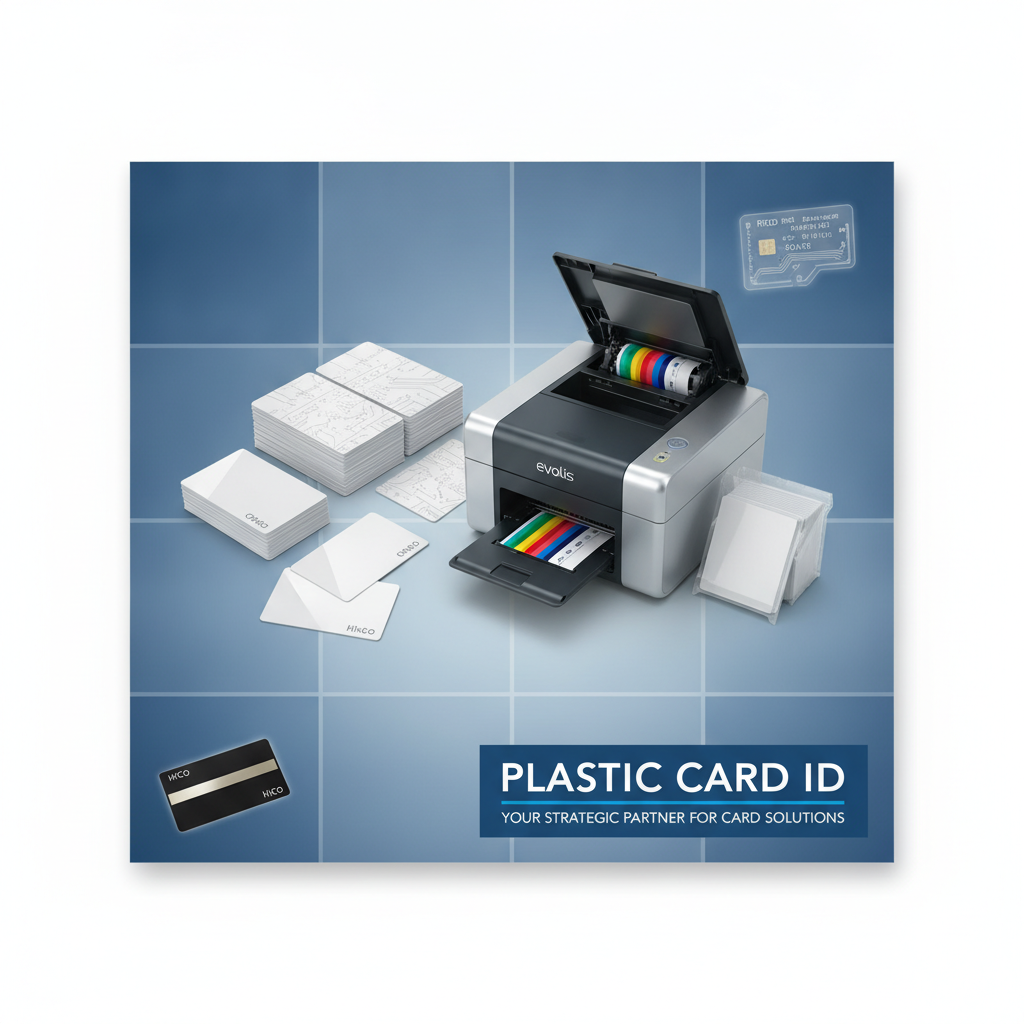
The three primary card printer brands in professional use are Evolis, Zebra, and Fargo. Each has distinct strengths across entry-level, mid-range, and high-volume production segments. Selecting the right printer for your volume, quality requirements, and budget is a decision worth getting expert input on before committing.
Matching Printer Capability to Card Stock
Every card printer has a specified card thickness tolerance and surface type recommendation. Running cards outside those tolerances produces mechanical feed errors, uneven print coverage, and premature printhead wear. Sourcing cards and printers from the same informed supplier eliminates the compatibility guesswork entirely.
Dye-sublimation printing - the dominant technology in professional card printers - requires a smooth, receptive card surface and the correct ribbon formulation for that card stock. Mismatched combinations produce washed-out colors, inadequate black density, or overlay adhesion failures. When card stock, ribbon, and printer are specified together as a system, print quality is consistently high.
Ribbons, Cleaning Kits, and Consumables
Printer ribbons are consumable items with a direct impact on per-card cost and print quality. Genuine ribbons from your printer manufacturer - or from a knowledgeable authorized supplier - are formulated to exact printer tolerances. Third-party ribbons sometimes appear attractive on price but frequently produce quality or reliability issues that cost more to resolve than the initial savings were worth.
Regular printer cleaning is non-negotiable for sustained print quality and hardware longevity. Cleaning kits remove dust, adhesive residue, and debris that accumulate through normal use and cause progressive quality degradation if left unaddressed. A disciplined cleaning schedule, typically aligned with ribbon changes, keeps your printer performing at specification consistently. Reach out at 800.835.7919 for guidance on maintenance schedules appropriate to your print volume.
Card Carriers, Sleeves, and Mailing Services
The journey of a card from your printer to the cardholder's wallet involves more touchpoints than many program managers initially consider. Cards issued in-person at a counter have different presentation and protection requirements than cards mailed to cardholders at home. Presentation quality at the moment of card delivery shapes the cardholder's initial impression of your program - and that impression is lasting.
Card carriers and sleeves protect printed cards during handling and add a professional visual presentation layer. For programs that mail cards, CPE offers card affixing and mailing services that handle the logistics of getting cards to cardholders efficiently and professionally. This service is particularly valuable for high-volume loyalty or membership programs where in-house mailing operations would be impractical.
| Printer Tier | Typical Volume | Best For |
|---|---|---|
| Entry-Level | Up to 500 cards/month | Small businesses, single-location ID programs |
| Mid-Range | 500-3,000 cards/month | Multi-location retail, mid-sized organizations |
| High-Volume | 3,000 cards/month | Enterprise, mass production, fulfillment operations |
Specialty Card Options: When Standard Cards Are Not the Right Fit
Most card programs run perfectly well on standard white PVC. But certain applications - premium membership tiers, VIP event credentials, corporate gifting, casino player programs, and high-security identity environments - benefit meaningfully from stepping beyond the standard catalog. Specialty cards are not just a novelty; they are a strategic tool that signals value, exclusivity, and seriousness to the cardholder.
Understanding what specialty options exist, and when they genuinely add value versus when they are simply additional expense, is an important part of making smart buying decisions. CPE carries an extensive specialty lineup and brings the program experience to help clients choose options that earn their cost.
Clear and Frosted PVC Cards
Clear plastic cards create a visual effect that standard white PVC simply cannot replicate. The transparency interacts with printed elements and the cardholder's background in ways that feel premium and distinctive. Frosted cards add a diffused, semi-opaque quality that conveys sophistication without full transparency. Both finishes photograph well and create memorable first impressions in wallet and hand.
Print characteristics on clear and frosted cards differ from standard white stock, so correct printer configuration and ribbon selection are especially important. Working with a supplier who knows these nuances prevents a lot of trial and error in achieving the output quality that makes specialty cards worth their premium.
Custom Die-Cut Shapes and Luxury Metal Cards
Die-cut cards in non-standard shapes - keys, house profiles, brand silhouettes - deliver a tactile and visual brand statement that rectangular cards cannot match. Event credentials, VIP passes, and high-end retail promotions are natural applications. The unusual shape itself becomes a conversation piece that reinforces brand memory and cardholder engagement.
Luxury metal cards in stainless steel, brass, and gold represent the apex of physical card programs. The weight and finish of a metal card communicates premium value in a way that no paper or plastic alternative can approach. For elite membership programs, concierge services, or corporate gifting contexts, a metal card is not just a card - it is a physical brand statement that holders rarely discard.
Casino Player Cards and Closed-Loop Program Cards
Casino player tracking cards occupy a specialized niche that combines the visual requirements of branded membership cards with the technical requirements of high-reliability data encoding. These cards are issued in high volumes, used in demanding environments, and must perform consistently across a variety of reader and encoding systems on the casino floor.
CPE has extensive experience supplying casino program cards that meet both the performance and presentation standards this sector demands. Whether your program requires standard magnetic stripe encoding, smart chip technology, or a combination of both, the right card specification makes a measurable difference in program uptime and player satisfaction.
Partner With Plastic Card ID for Your Complete Card Program
 Every card program, regardless of scale, runs better when the supplier understands the full picture - not just the cards themselves, but the printers, the encoding equipment, the consumables, the delivery logistics, and the business objectives the program is designed to serve. Plastic Card ID has spent over 25 years building exactly that depth of knowledge, serving over 100,000 customers and supplying more than 50 million cards across the United States.
The goal has never been to move product. It has always been to help clients build card programs that perform - programs that drive loyalty, enforce access, establish identity, and generate revenue in measurable, sustainable ways. Retailers who switch from paper to plastic gift cards see sales increases of 35-50%. Loyalty programs with cards that live in wallets outperform punch cards by every meaningful metric. Physical cards work, and they work best when every specification decision behind them is correct from the start.
Whether you are buying 500 cards for the first time or scaling a program to tens of thousands of cards per month, the knowledge in this guide gives you the foundation to make those decisions confidently. When you are ready to move forward - or when you have questions that go beyond what any guide can answer - the team at Plastic Card ID is ready to help. Call 800.835.7919 today and get your card program built on the right foundation.
Previous Page