Security Features Available on Blank Plastic Cards
Table of Contents []
- Security Features Available on Blank Plastic Cards - Plastic Card ID
- Why the Physical Card Is Your First Line of Defense
- Magnetic Stripe Technology: HiCo vs. LoCo Explained
- RFID, Proximity, and Smart Chip Cards
- Visual and Covert Security Features for Printed Cards
- Specialty Card Formats and Advanced Security Options
- Building a Layered Security Program with Plastic Card ID
Security Features Available on Blank Plastic Cards - Plastic Card ID
Walk into any serious organization running a card program and you will find something interesting: the cards doing the most work are often the ones that started blank. That might sound counterintuitive, but blank plastic cards are far more than empty pieces of PVC. They arrive loaded with security architecture - built-in features, optional upgrades, and encoding technologies that transform a simple CR80 card into a verified, tamper-resistant credential. Understanding what is actually available before you print a single design changes how you plan your entire program.
Plastic Card ID has spent over 25 years supplying blank and custom plastic cards to businesses across the United States. With more than 50 million cards sold and over 100,000 customers served, the team understands one thing clearly: the security of a card program begins at the card itself, not at the printer, not at the design, and not at the software. Knowing which security features are available - and which ones your program actually needs - is where smart procurement starts.
| Security Feature | Card Type | Best Use Case | Security Level |
|---|---|---|---|
| Magnetic Stripe (HiCo) | Mag Stripe Cards | Access control, loyalty | Moderate |
| RFID / Proximity | Smart / Proximity Cards | Keyless entry, time tracking | High |
| MIFARE DESFire Chip | Smart Chip Cards | Government, enterprise, casino | Very High |
| Signature Panel | Most CR80 Cards | ID, membership, employee | Basic |
| Holographic Overlaminates | Printed Cards | ID badges, credentials | High Visual Deterrent |
| UV / Fluorescent Ink | Custom Printed Cards | Event credentials, anti-fraud | Covert / High |
Why the Physical Card Is Your First Line of Defense
 Security is often discussed in terms of software firewalls, encrypted databases, or digital authentication systems. Those things matter. But for organizations issuing physical credentials, the card in someone's hand is the first verification point - and it either passes scrutiny or it does not. A card that can be easily duplicated, altered, or forged is a liability regardless of how good the backend system is.
Blank plastic cards built to the CR80 ISO 7810 standard are the foundation of nearly every in-house card program in the country. At 30 mil thickness, they match the dimensions of a standard credit card - universally compatible with card printers and readers. But the real story is what gets layered on top of, or embedded within, that PVC substrate before the card ever reaches a printer.
The CR80 Standard and What It Guarantees
CR80 cards are not arbitrary in their dimensions. The ISO 7810 standard ensures that cards manufactured to this specification are consistent in size, thickness, and material quality across every manufacturer. That consistency is itself a security feature - counterfeit cards produced outside proper manufacturing often fail dimensional checks, card reader tests, or lamination inspections that trained staff recognize immediately.
Cards produced to this standard also hold printed security elements better. Dye-sublimation printing, retransfer printing, and thermal printing all interact with the PVC substrate in specific ways. A card that does not meet spec will show inconsistencies in print quality, color saturation, and edge definition - telltale signs for anyone who knows what a legitimate card looks like.
Material Integrity as a Passive Security Layer
PVC plastic is not simply chosen for convenience. Its material properties - flexibility, surface hardness, resistance to moisture, and thermal stability - contribute directly to the longevity and integrity of whatever security features are added on top. A card that warps, cracks, or delaminates is a card that has lost its security value, regardless of how many features it started with.
Composite cards, which blend PVC with polyester layers, take this further. They are more resistant to cracking under repeated flexing, hold laminate overlays more securely, and are generally required in programs where cards are expected to last three or more years under daily use. Choosing the right material composition is part of the security conversation, not separate from it.
Thickness, Laminate, and Tamper Evidence
Standard 30 mil cards represent the baseline. But specialty overlaminates applied during the printing process - particularly those with holographic patterns, microtext, or UV-reactive elements - bond permanently with the card surface. Any attempt to peel, scratch, or transfer the printed layer will destroy the card visually, making tampering immediately apparent.
This tamper-evident quality is not an add-on. It is inherent to how cards are manufactured and finished. Organizations running employee ID programs, membership programs, or event credentialing systems benefit enormously from this without needing sophisticated reader hardware - just trained eyes.
Magnetic Stripe Technology: HiCo vs. LoCo Explained
Magnetic stripe cards remain one of the most widely deployed card security technologies in the United States. Despite being decades old, the technology has evolved considerably, and the difference between a HiCo and a LoCo card matters more than most buyers initially realize. Getting this choice wrong creates operational problems that compound over time.
Plastic Card ID supplies both HiCo and LoCo magnetic stripe cards, and CPE takes time to walk clients through which format makes sense for their environment. The encoding format, the read reliability, and the resistance to accidental erasure are all different between the two - and in a busy card program, those differences show up fast.
High-Coercivity (HiCo) Magnetic Stripes
HiCo cards operate at 2750 Oersteds, which means they require a stronger magnetic field to encode but also resist accidental demagnetization far more effectively than their LoCo counterparts. HiCo cards are the right choice for any program where cards will be near magnets, electronics, or other cards - which is to say, most real-world programs. Employee badges clipped near computers, hotel key cards stored with phones, loyalty cards sitting in crowded wallets all benefit from HiCo's superior magnetic stability.
The data encoded on a HiCo stripe can include cardholder ID numbers, account references, access tier data, or any alphanumeric sequence your system requires. Up to three tracks of data can be encoded simultaneously, giving programs significant data density within a single swipe interaction.
Low-Coercivity (LoCo) Magnetic Stripes
LoCo cards operate at approximately 300 Oersteds. They are easier and less expensive to encode, which makes them suitable for short-term applications where cards will not be reused extensively. Temporary event passes, single-use promotional cards, and short-run programs are where LoCo cards find their appropriate place. They should not be used in programs where cards are expected to remain active for more than a few months.
LoCo stripes are typically brown or black in color and are visually distinguishable from HiCo stripes, which are usually black and slightly higher gloss. Knowing which type you are ordering matters when you are purchasing blank cards for in-house encoding, because the encoder in your card printer must match the coercivity of the card to write data successfully.
Encoding and Program Integration
Magnetic stripe cards ship blank from Plastic Card ID and are encoded in-house using compatible card printers from Evolis, Zebra, or Fargo. This gives organizations complete control over what data is written to each card, when it is written, and whether encoding is done in batch or on demand. Call 800.835.7919 to confirm encoder compatibility with your existing printer model before ordering.
The security benefit of in-house encoding is significant. Cards are not pre-encoded by a third party, which means sensitive access codes, employee numbers, or loyalty account identifiers are never exposed outside your facility. Each card is a blank security token until you choose to activate it.
RFID, Proximity, and Smart Chip Cards
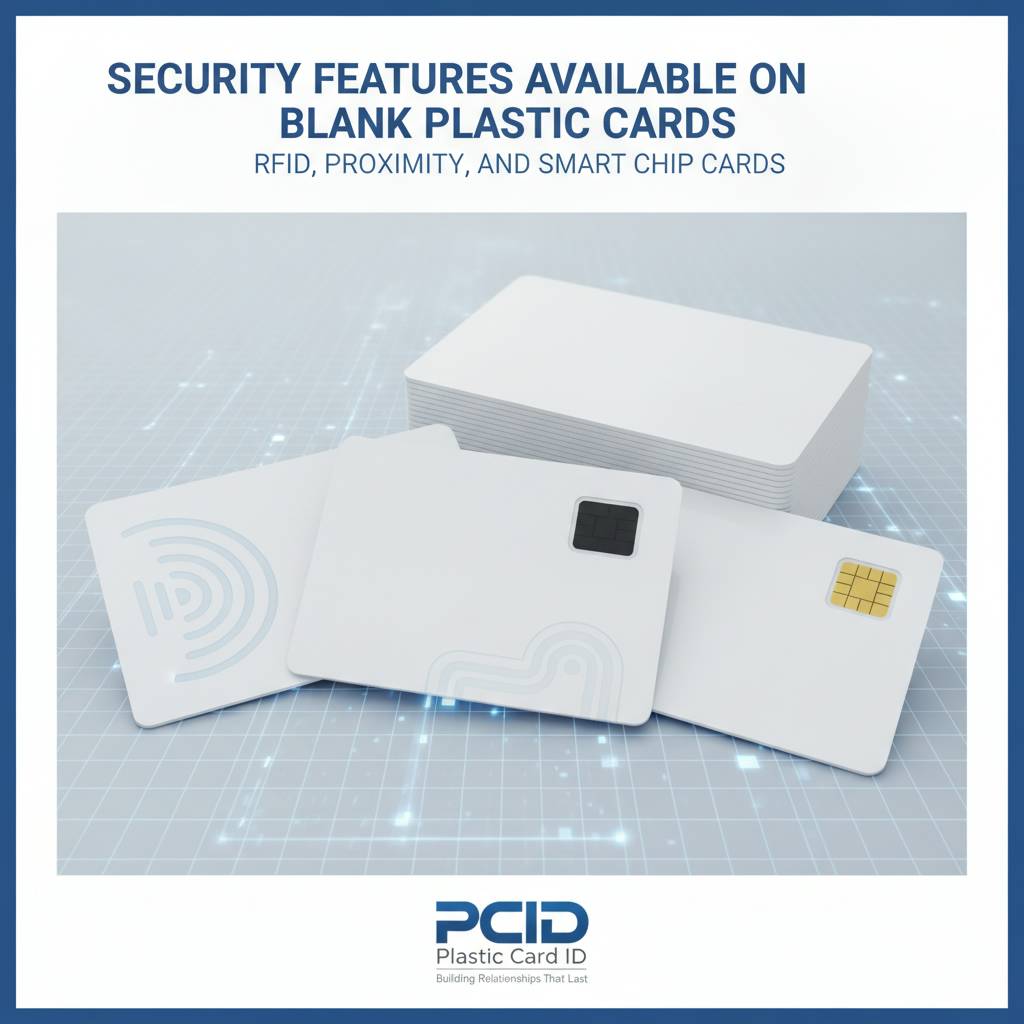 When magnetic stripe technology is not enough, the next tier of card security involves embedded electronics. RFID and proximity cards communicate wirelessly with readers, eliminating the need for a physical swipe entirely - and introducing a fundamentally different security architecture that is far more difficult to clone or counterfeit than a magnetic stripe.
Smart chip cards go even further, carrying an onboard microprocessor capable of executing cryptographic operations. These cards do not just store data - they actively participate in authentication, validating their own legitimacy before granting access. This is the technology behind some of the most secure credential programs in the world, now available for organizations of any size through Plastic Card ID.
Proximity Cards: 125 kHz Access Control
Proximity cards operate at 125 kHz and are the standard for basic contactless access control. Tap the card near a compatible reader and the embedded antenna transmits a unique identifier - no battery, no swipe, no physical contact required. Most commercial door access systems, time-and-attendance terminals, and parking gate systems in the United States are designed to work with 125 kHz proximity cards.
These cards are available blank, allowing organizations to print their own branding and employee information using an in-house card printer, while the internal electronics handle access control silently. The card's ID number is factory-programmed and cannot be altered, which is a security feature in itself - the credential is fixed at manufacture.
RFID Smart Cards and MIFARE DESFire
High-frequency RFID cards operating at 13.56 MHz represent a significant step up in security capability. MIFARE DESFire technology, in particular, is one of the most secure contactless card platforms available for commercial use. It supports AES-128 and 3DES encryption, mutual authentication between card and reader, and application-level security that prevents unauthorized access to specific data partitions on the card.
Casino player cards, enterprise access programs, government facility credentials, and university campus cards all increasingly rely on MIFARE DESFire for precisely this reason. The cryptographic operations happen on the card itself - so even if someone intercepts the wireless communication between card and reader, the data they capture is encrypted and operationally useless without the corresponding keys.
Choosing the Right Contactless Technology for Your Program
Not every program needs MIFARE DESFire. Matching the technology tier to actual program risk and operational requirements is the smartest way to manage cost and complexity. A gym membership program may be perfectly served by a basic 125 kHz proximity card. A hospital with multiple restricted zones, sensitive patient data, and regulatory compliance requirements needs something closer to DESFire.
- 125 kHz Proximity: Best for single-site door access, time tracking, and low-sensitivity environments
- 13.56 MHz MIFARE Classic: Suitable for multi-application programs with moderate security requirements
- MIFARE DESFire EV2/EV3: Required for high-security enterprise, casino, government, and healthcare environments
- Dual-Interface Cards: Both contact chip and contactless RFID in a single card, for programs requiring maximum flexibility
- Magnetic RFID Combo: Cards carrying both a magnetic stripe and an RFID antenna for backward compatibility during system transitions
CPE can help identify which contactless format aligns with your existing reader infrastructure and security requirements. 800.835.7919 connects you directly with the team.
Visual and Covert Security Features for Printed Cards
Not all security features communicate through electronics. Some of the most effective deterrents are visual - design elements that are difficult to reproduce, easy to verify, and immediately suspicious when absent or distorted. Visual security features are your program's first line of defense against casual fraud, which represents the majority of card-related security incidents most organizations will ever encounter.
When organizations print cards in-house using Evolis, Zebra, or Fargo printers, they unlock access to a range of visual and covert security print options. These features can be layered on top of the blank card during the printing process, turning a standard CR80 card into a sophisticated credential without requiring specialized manufacturing.
Holographic Overlaminates and Security Laminates
Holographic overlaminates are clear films bonded permanently to the printed card surface during the lamination stage. They contain optical variable patterns that shift color and depth when viewed at different angles - features that are essentially impossible to reproduce on standard office printing equipment. Custom holographic laminates can incorporate logos, text, or geometric patterns unique to your organization.
Security laminates also serve as a physical barrier between the printed card surface and the external environment, protecting against scratching, UV fading, and moisture. A card with a proper security laminate will outlast an unlaminated card significantly in daily use, while simultaneously carrying its anti-tamper properties throughout its useful life.
UV Fluorescent Ink and Hidden Elements
UV-reactive inks print invisibly under normal light but become vivid under ultraviolet inspection. This is one of the most powerful covert security tools available in card printing because it adds a verification layer that is completely invisible to a casual observer yet immediately apparent to anyone running a standard UV check. Event credentials, employee badges, and membership cards all benefit from UV security elements.
Common UV security elements include hidden serial numbers, organization logos, validation codes, or barcodes that serve as a secondary authentication reference. Because UV printing is not visible to the naked eye, counterfeiters rarely know it is present - and even if they do, reproducing it accurately requires UV-rated inks and compatible print hardware that is not commonly available.
Microtext, Fine-Line Printing, and Guilloche Patterns
Microtext consists of tiny printed text - often smaller than one millimeter in height - that is legible only under magnification. Printed correctly, it appears as a decorative line or border element to the naked eye. Reproducing microtext accurately requires print resolution that standard desktop printers cannot achieve, making it an effective anti-counterfeiting element.
Guilloche patterns are intricate, mathematically generated line patterns that appear frequently on official documents and credentials. Their complexity makes them extremely difficult to reproduce without the original digital file. When combined with holographic overlaminates and UV elements, microtext and guilloche create a layered visual security stack that significantly raises the cost and complexity of counterfeiting any card in your program.
Specialty Card Formats and Advanced Security Options
Beyond the standard CR80 white PVC card, there is an entire world of specialty formats that carry their own security implications. Clear and frosted cards, custom die-cut shapes, and luxury metal cards all serve specific program needs while simultaneously making duplication more difficult through material and form factor complexity alone.
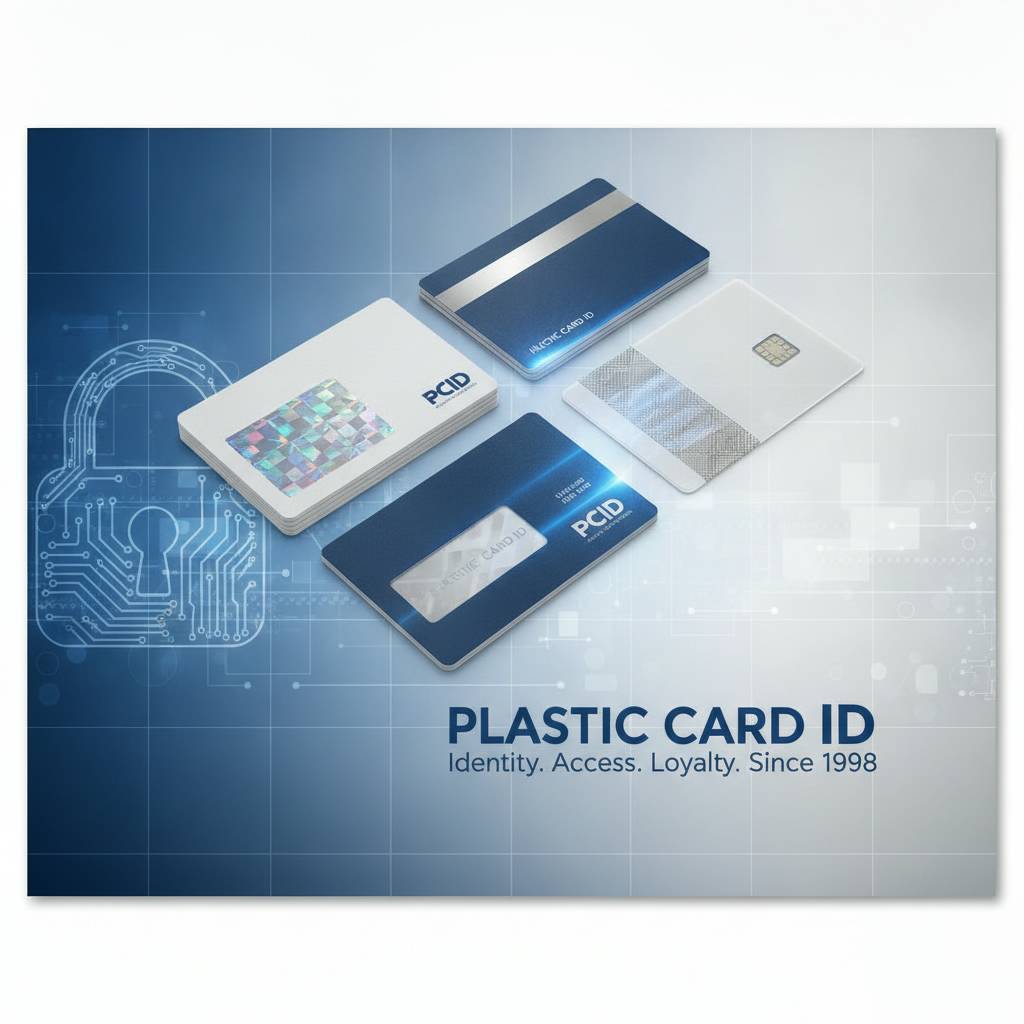
These are not novelty items. Organizations using clear plastic cards for VIP membership programs, for example, benefit from the fact that clear card printing requires calibrated print settings that most casual counterfeiters cannot easily replicate. Metal cards in stainless steel, brass, or gold are essentially impossible to reproduce without industrial manufacturing equipment.
Clear and Frosted Plastic Cards
Clear cards are manufactured from transparent PVC and present a distinctive visual profile that standard white cards cannot replicate. When printed, text and graphics appear to float within the card, creating an effect that is visually striking and difficult to fake convincingly. Frosted cards offer a translucent satin finish that adds texture-based verification - the surface feel is distinctive and immediately different from standard PVC.
Both formats are available in the standard CR80 size and are compatible with most card printers, though print settings require adjustment for transparency. Organizations running premium loyalty programs, VIP access programs, or high-value membership programs consistently find that clear and frosted cards generate stronger cardholder engagement and lower fraud rates due to their distinctive appearance.
Metal Cards: Stainless Steel, Brass, and Gold
Metal cards occupy the highest tier of physical credential security. Available in stainless steel, brass, and gold finishes, these cards are manufactured to the same CR80 dimensions as standard plastic cards and are compatible with card readers that do not require magnetic encoding. The physical weight, surface texture, and material properties of a metal card are essentially uncounterfeitable at any accessible cost level.
Metal cards communicate prestige and permanence in membership and loyalty programs where cardholder psychology matters. A metal card is not discarded. It is kept. That retention rate translates directly into program engagement and brand visibility. For programs targeting high-value customers or members, metal cards represent a meaningful investment with measurable return.
Custom Die-Cut Shapes and Unique Form Factors
Die-cut cards can be manufactured in virtually any shape - a key fob, a specific brand silhouette, an unusual geometric form. Non-standard shapes are inherently harder to counterfeit because the die tooling required to produce them is custom and expensive. Beyond security, unusual card shapes generate strong cardholder recall and brand association that standard rectangular cards rarely achieve.
Mini cards, key tag cards, and thumb-drive-style cards all serve specific distribution contexts while maintaining the core security architecture of standard PVC cards. They can carry magnetic stripes, RFID antennae, barcodes, and printed security elements just like full-size CR80 cards, giving programs the flexibility to deploy security features in whatever form factor makes the most operational sense.
Building a Layered Security Program with Plastic Card ID
No single security feature is sufficient on its own. The strongest card programs combine multiple layers - physical material properties, encoded electronic data, visual deterrents, and covert verification elements - into a credential that is both difficult to duplicate and easy to verify quickly. This layered approach is what separates a professional card program from a basic one, and it is available to organizations of any size ordering from Plastic Card ID.
Whether you are running 50 cards a month for a small membership club or producing tens of thousands of cards for a national retail loyalty program, CPE builds programs around your actual security requirements, not a generic template. The catalog covers every security feature discussed on this page, and the team has the experience to help you combine them intelligently.
Assessing Your Program's True Security Needs
Security requirements vary enormously between programs. A gym issuing membership cards faces different risks than a hospital issuing employee access badges. Over-engineering security adds cost without value; under-engineering it creates real operational and financial risk. The right starting point is an honest assessment of what your cards are protecting, who might want to compromise them, and what verification infrastructure you have in place.
Plastic Card ID has worked with programs across virtually every industry segment over 25 years. That experience translates into practical guidance - not upselling - when clients ask which security features actually matter for their specific use case.
Scalable Ordering for Programs of Any Size
One of the consistent advantages of working with Plastic Card ID is the ability to scale. Programs starting at 50 cards a month can access the same card technology as programs ordering 50,000 cards in a single run. Security features do not require minimum order quantities that are out of reach for smaller organizations. HiCo magnetic stripe cards, proximity cards, and RFID smart cards are all available in quantities that match where your program actually is today.
- Blank white PVC cards for in-house printing programs of any scale
- HiCo and LoCo magnetic stripe cards in quantities from small batches to bulk production
- Proximity and RFID cards compatible with major access control platforms
- MIFARE DESFire smart chip cards for high-security enterprise applications
- Card printers from Evolis, Zebra, and Fargo with encoder options
- Printer ribbons, cleaning kits, card sleeves, and card carriers
- Card affixing and mailing services for programs with distribution needs
Your Next Step Starts with a Conversation
The best card programs are built intentionally. They start with a clear understanding of what the card needs to do, what it needs to prevent, and what the cardholder experience should be. That conversation is exactly what the Plastic Card ID team is built for. With over a quarter century of experience and more than 50 million cards shipped, there are very few card program questions they have not encountered and solved.
Reach the team directly at 800.835.7919 to discuss your program requirements, request samples, or get volume pricing. Whether you are starting from scratch or upgrading an existing card program, CPE is ready to help you build something that works - and lasts.
Contact Plastic Card ID today at 800.835.7919 - your trusted source for secure blank plastic cards, advanced card technology, and complete card program support across the United States.
Previous Page