UV Ink Printing on Plastic Cards Explained
Table of Contents []
- UV Ink Printing on Plastic Cards: What Plastic Card ID Wants You to Know
- Card Types That Work Best With UV Ink Printing
- Printer Technology That Supports UV Ink Printing
- Security Applications: Where UV Ink Printing Delivers Real Value
- Frequently Asked Questions About UV Ink Printing on Plastic Cards
- Building a Complete UV Card Program With Plastic Card ID
UV Ink Printing on Plastic Cards: What Plastic Card ID Wants You to Know
Most people never think about what makes a plastic card glow under a black light - until they need that exact feature and suddenly realize they have no idea where to start. UV ink printing on plastic cards is one of those technologies that sounds niche, almost exotic, until you discover how many industries rely on it daily. Event venues, universities, casinos, healthcare facilities, and membership clubs all use UV printing to add a layer of security or branding that ordinary printing simply cannot replicate.
At Plastic Card ID, we have spent more than 25 years supplying businesses across the United States with plastic cards built for real-world programs. UV printing is one of the more specialized capabilities we help clients understand and deploy effectively. Whether you are running a large-scale access control program or printing 50 VIP event credentials per month, knowing how ultraviolet ink works - and when to use it - can make a meaningful difference in your card program's security posture and perceived value.
This guide breaks it all down: the mechanics of UV ink, the card types it works best on, the security applications, the printer technology involved, and the practical decisions you will face when adding UV features to your card program. Read on.
The Basic Science Behind UV Ink on Plastic
Ultraviolet ink contains phosphorescent or fluorescent compounds that absorb UV light and re-emit it as visible light. Under normal lighting conditions, the ink is either completely invisible or subtly tinted - depending on the formulation. Hold the card under a UV lamp (commonly called a black light), and hidden text, logos, patterns, or barcodes become dramatically visible. This reaction is instantaneous and unmistakable.
There are two primary categories: invisible UV ink, which shows no trace under normal light, and visible UV ink, which appears as a faint color or sheen in daylight and glows brilliantly under UV. Each serves different use cases. Invisible ink is the security standard - counterfeiters cannot replicate what they cannot see. Visible UV ink is often used for decorative purposes, adding a glowing accent to a logo or card border that customers find impressive under club or event lighting.
The plastic substrate matters enormously here. Standard white CR80 PVC cards - the ISO 7810 workhorse used in virtually every card program - accept UV inks readily when processed through the right printer or overlay system. Clear and frosted PVC cards also work, though the visual contrast of the UV reveal is different and often used intentionally for premium aesthetic effects.
Why Invisible Does Not Mean Undetectable
There is a persistent misconception that invisible UV ink is somehow fragile or easily defeated. In practice, the opposite is true. A well-applied UV ink layer on a laminated PVC card is extraordinarily durable, surviving thousands of swipes, drops, wallet compression, and years of daily handling. The fluorescent compounds are chemically stable under normal use conditions and do not fade or wash out the way paper-based UV stamps do.
When a card issuer applies a UV varnish or ink layer during production, it is typically sealed beneath a protective overlaminate. This means the UV feature is physically protected - not just sitting on the surface. Attempting to chemically strip or alter the UV marking without destroying the card entirely is effectively impossible, which is exactly what makes it valuable as an anti-counterfeiting measure.
UV Printing Versus Standard CMYK Card Printing
Standard card printing uses CMYK dye-sublimation or thermal transfer processes to produce full-color imagery. UV printing is a separate, additive process - it does not replace your card's visible design, it augments it. A card can be fully printed in vibrant CMYK and still carry a UV security layer that is entirely invisible in normal light. These two processes operate in parallel, not in competition.
The cost difference is real but often overstated. Adding a UV ink feature to a card program does increase per-card cost, but the security and authentication value it delivers typically far outweighs the incremental expense. For organizations issuing cards worth protecting - employee ID badges, high-value membership cards, event credentials with controlled access - the investment is straightforward to justify.
| Feature | Standard CMYK Printing | UV Ink Printing |
|---|---|---|
| Visible in Normal Light | Yes | No (invisible formulation) |
| Visible Under UV Light | No | Yes - vivid fluorescent reveal |
| Anti-Counterfeiting Value | Low to moderate | High |
| Durability on PVC | High with overlaminate | High with overlaminate |
| Primary Use Cases | Branding, ID, loyalty | Security, authentication, premium branding |
| Typical Cost Impact | Baseline | Moderate premium |
Card Types That Work Best With UV Ink Printing
 Not every card format is created equal when it comes to UV printing compatibility. The substrate, surface finish, and any pre-encoding already on the card all influence how UV features are best applied. Understanding this upfront prevents costly reprints and program delays. At Plastic Card ID, we walk clients through compatibility before any order is placed.
The good news is that the most common card formats are also the most UV-compatible. Standard white CR80 PVC cards at 30 mil thickness - the same cards used for employee badges, loyalty programs, and membership credentials - provide the ideal contrast surface for invisible UV ink reveals. The white background makes the fluorescent glow under UV light pop dramatically.
Blank PVC Cards and UV Overlay
Blank CR80 cards give organizations complete design control, and that extends to UV features. When you print in-house using a compatible card printer, UV panels or UV varnish ribbons allow you to add invisible security features at the time of printing. The card design, the cardholder's name or photo, and the UV security element are all applied in one production pass. This is the approach most organizations with active card printers already in place prefer.
The efficiency of in-house UV printing is compelling. Rather than pre-ordering specialty cards with factory-applied UV features - and waiting weeks for fulfillment - your team can print personalized cards with UV elements on demand. A new employee starts Monday; their badge, complete with UV security layer, is ready in minutes. That kind of operational agility is genuinely difficult to overstate for fast-moving organizations.
Magnetic Stripe Cards and UV Security Layers
HiCo and LoCo magnetic stripe cards are the backbone of access control, loyalty, and hotel key programs nationwide. Adding a UV security layer to a magnetic stripe card is entirely compatible and increasingly common. The magnetic stripe occupies a defined physical space on the card; UV ink features are applied to the printable face area and do not interfere with stripe encoding or read performance.
Casino player cards are an excellent example of this combination in action. These cards encode loyalty point data on the magnetic stripe while also carrying UV authentication features that allow staff to instantly verify card legitimacy. The same principle applies to hotel key cards, transit passes, and employee access badges where both machine-readable data and human-verification security are required simultaneously.
Smart Chip and RFID Cards With UV Features
Smart chip cards - including contactless RFID cards using technologies like MIFARE DESFire - represent the highest tier of card-based security. Adding UV printing to these cards layers a visible physical authentication method on top of the card's embedded electronic credentials. An attacker who somehow obtained a cloned RFID signal would still fail to produce a physical card that passes UV inspection.
Proximity access cards used in commercial buildings and secure facilities benefit from this layered approach as well. When CPE works with clients deploying RFID card programs, we frequently recommend UV features as a low-cost, high-impact addition to cards that are already being produced. The marginal cost is small; the security uplift is meaningful.
Clear, Frosted, and Specialty Card Formats
Clear and frosted PVC cards present interesting UV printing opportunities. On a clear card, invisible UV ink creates a nearly magical effect - the card appears completely blank until placed under UV light, at which point logos, text, or security patterns emerge from what appeared to be empty space. This effect is particularly striking for premium membership cards, VIP credentials, and luxury event passes.
Frosted cards produce a softer UV glow, with the semi-opaque substrate diffusing the fluorescent reveal into a subtler but still visually impressive effect. Custom die-cut cards and luxury metal cards in stainless steel, brass, or gold can also incorporate UV features, though the application methods differ from standard PVC processes and should be discussed with Plastic Card ID during order planning.
Printer Technology That Supports UV Ink Printing
The card printer you choose determines whether UV printing is available to your program at all. Not every printer in the market supports UV ink panels or UV varnish ribbons. The three major brands carried by Plastic Card ID - Evolis, Zebra, and Fargo - each offer models with UV printing capability, but the specific model matters. Buying the wrong printer is a frustrating and expensive mistake that we help clients avoid every day.
UV printing in a card printer is typically delivered through one of two mechanisms: a dedicated UV panel in the printer ribbon, or a separate UV station in the printer's hardware. Ribbon-based UV (a UV panel in the YMCKU or YMCFK ribbon) is the more common approach in mid-range desktop printers. Hardware-based UV stations are found in higher-throughput models designed for production-volume card printing.
Evolis Printers and UV Capability
Evolis produces some of the most elegant and technically capable desktop card printers available. Models like the Evolis Primacy 2 and the Evolis Avansia support UV panel ribbons, allowing in-house printing of invisible UV security features alongside standard CMYK card printing. For organizations printing hundreds to a few thousand cards per month, these printers deliver excellent UV quality without requiring production-floor infrastructure.
The Evolis ribbon ecosystem is well-designed for UV applications. YMCKU ribbons include a dedicated UV panel (the "U" in the ribbon designation) that applies UV varnish in a programmable pattern. Your card design software controls exactly where the UV ink lands, allowing precise security overlays - a UV-printed serial number, a logo that glows, a hidden barcode - rather than a generic full-card UV coat.
Zebra and Fargo UV Printing Options
Zebra's ZC and ZXP series include models with UV printing support. The ZXP Series 9, for instance, is a production-grade retransfer printer with optional UV capabilities suited for high-volume programs. Fargo's HDP5000 and HDPii printers also support UV panel ribbons within their HDP retransfer printing process, which produces notably durable cards because the print layer is applied beneath a clear overlaminate film rather than directly to the card surface.
Fargo's retransfer process has a specific advantage for UV printing: because the image transfer happens under heat and pressure, the UV ink layer is effectively sealed beneath the retransfer film as part of the lamination process. This creates one of the most tamper-resistant UV card constructions available from a desktop printer system - a detail that matters greatly for high-security ID programs.
Reach CPE at 800.835.7919 to discuss which printer model is the right match for your UV printing requirements before making a purchase decision.
Printer Ribbons, Cleaning Kits, and UV Program Maintenance
UV printing programs require the right consumables to maintain quality. UV panel ribbons are formulated specifically for their respective printer models - using a generic or incompatible ribbon will produce inconsistent UV results or damage the print head. Plastic Card ID stocks printer ribbons for Evolis, Zebra, and Fargo printers, including UV-capable ribbon formats, ensuring your supply chain is simple and reliable.
Card printer cleaning is not optional when UV printing is in use. Dust contamination, roller debris, and residual card particles interfere with UV panel application in ways that are not always visible until the card is examined under UV light. Regular cleaning kit use - typically every 500 cards or as recommended by the manufacturer - keeps UV output consistent and extends print head life significantly.
Security Applications: Where UV Ink Printing Delivers Real Value
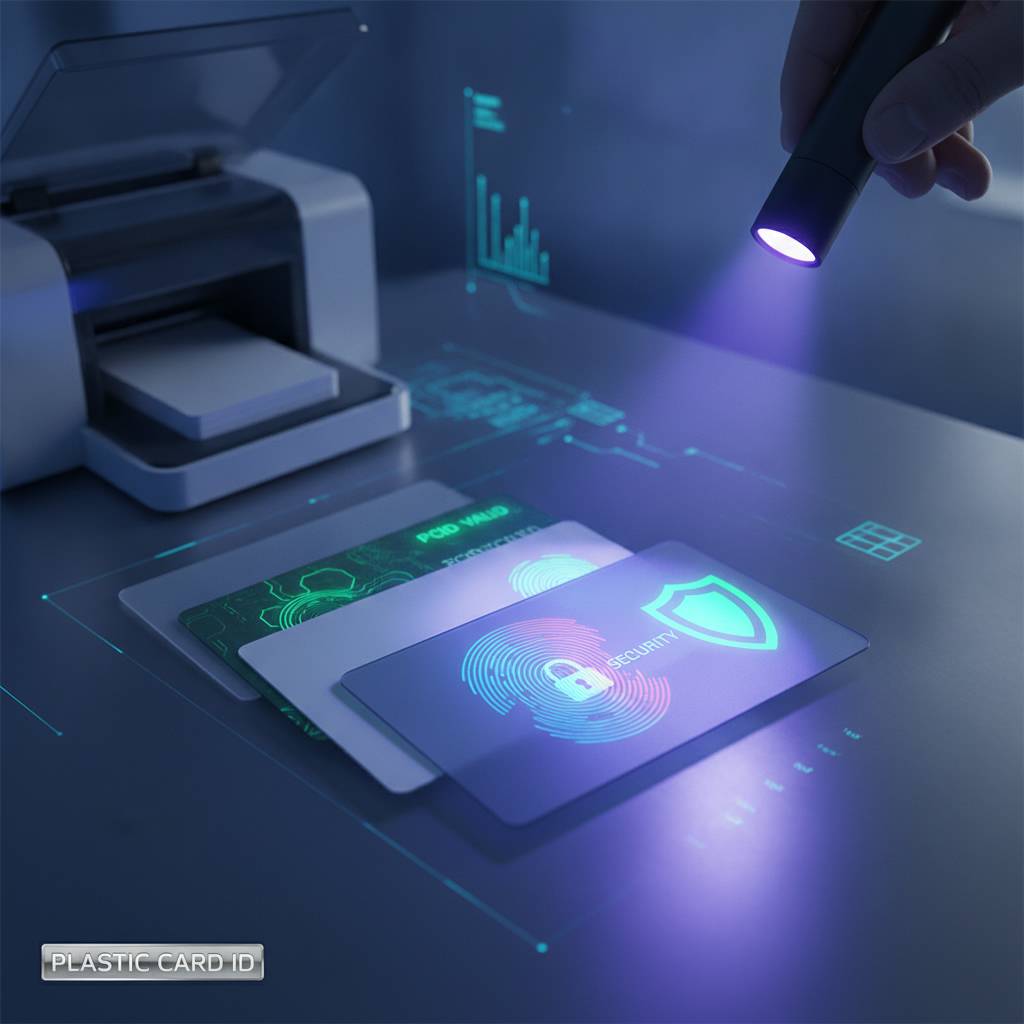 Security is the original and still primary driver of UV ink adoption in card programs. The combination of a machine-readable credential (magnetic stripe, RFID chip) and a human-verifiable UV security feature creates a two-factor physical authentication system that is surprisingly difficult to defeat without access to both the encoding equipment and the UV printing system used by the issuer.
Industries that have adopted UV card security most aggressively are not random. They are industries where fraudulent credentials carry real consequences: casinos where player card fraud means unearned comps and gaming credits; healthcare where fake staff ID badges represent genuine safety risks; event venues where counterfeit VIP passes mean lost revenue and potential overcrowding. UV ink printing is not a cosmetic feature in these environments - it is a risk management tool.
Event Credentials and Access Control
Single-day and multi-day event credentials are a prime UV printing application. Paper wristbands and punch cards are trivially duplicated; a plastic card with a UV security element requires specific equipment to replicate. For festivals, corporate events, sports venues, and conference credentials, UV-printed plastic cards raise the counterfeiting bar to a level that casual fraud attempts simply cannot clear.
The operational workflow at event entry points is straightforward: staff equipped with a small UV flashlight (inexpensive and widely available) can authenticate credentials in seconds. No software, no scanner, no network connection required. This simplicity is one of UV authentication's greatest practical strengths - it works everywhere, instantly, regardless of infrastructure.
Employee ID Badges and Campus Credentials
Employee ID programs benefit enormously from UV security layers. A badge that glows with a company logo or serial number under UV light is far more difficult to fake than a standard printed badge. For facilities with controlled access, the combination of a photo ID badge, a UV security element, and a proximity card chip provides multiple independent layers of verification - any one of which can flag a fraudulent credential.
University and campus ID programs operate at significant scale - tens of thousands of cards annually - with substantial security requirements. UV printing at this scale is typically handled through production-volume card printers or card personalization bureaus. Plastic Card ID supports programs at both ends of the volume spectrum, from the 50-card-per-month departmental program to the mass-production institutional rollout.
Casino Player Cards and Loyalty Program Security
Casino player cards occupy a unique intersection of loyalty program mechanics and high-stakes fraud prevention. Fraudulent player cards can be used to accumulate comps, redeem rewards, or access facilities under false identities - all of which represent direct financial losses for the property. UV authentication on player cards adds a layer that cashier staff and floor personnel can verify quickly without interrupting gameplay or guest flow.
The loyalty card market broadly benefits from UV features as well. A retailer running a tiered loyalty program where platinum or VIP tier cards carry real value - free services, exclusive discounts, priority access - has genuine motivation to protect those cards from duplication. Retailers who move from paper punch cards to plastic loyalty cards see sales increases of 35-50%; protecting that investment with UV security is a logical extension of the upgrade.
Frequently Asked Questions About UV Ink Printing on Plastic Cards
Over 25 years of supplying plastic cards to businesses across the United States, Plastic Card ID has fielded a predictable set of questions about UV printing. The following addresses the most common ones directly.
What Does UV Ink Printing Actually Cost?
The cost of UV printing depends on several variables: whether you are printing in-house or ordering pre-printed cards, the card volume, the printer model in use, and the complexity of the UV design. For in-house programs, the primary cost is the UV-capable ribbon, which typically runs higher per-card than standard YMCK ribbons. UV panel ribbons for mid-range Evolis or Fargo printers generally produce cards at an added cost of $0.15-$0.75 per card depending on yield.
For organizations considering a UV-capable printer, expect to budget accordingly for the printer itself - UV-capable models typically start at a higher price point than basic YMCK printers. The total program cost should be evaluated over the printer's expected card volume lifecycle, not just the upfront hardware cost. CPE helps clients model this accurately before purchase.
Can UV Features Wear Off Over Time?
UV features on properly laminated PVC cards do not wear off under normal use conditions. The UV ink layer is sealed beneath overlaminate during production, protecting it from physical abrasion, moisture, and UV exposure from ambient light. Cards carried in wallets, used daily for access control, or handled repeatedly in loyalty card programs retain their UV properties for the typical 2-5 year card lifecycle without degradation.
The primary risk to UV feature durability is improper production - specifically, insufficient overlaminate adhesion or incompatible ribbon-to-printer combinations. Quality control at the production stage is the most important factor in UV print longevity. This is one reason working with experienced suppliers like Plastic Card ID rather than experimenting with untested combinations matters practically.
Do UV Cards Require Special Handling or Storage?
- Store blank UV-printable card stock in sealed packaging away from direct sunlight and fluorescent lighting before printing.
- Avoid prolonged exposure of finished cards to intense UV light sources - while the ink is stable under normal conditions, sustained intense UV exposure is unnecessary.
- Use card sleeves and carriers for issued cards when possible; Plastic Card ID supplies both as part of a complete card program kit.
- Follow standard card printer cleaning protocols to maintain UV panel application quality during production.
- Inspect UV output periodically under a UV lamp as part of routine quality control - early detection of ribbon or printer issues prevents card program disruptions.
These precautions are straightforward and add no meaningful complexity to a well-run card program. Most organizations already follow the relevant storage and handling best practices as part of general card stock management.
Building a Complete UV Card Program With Plastic Card ID
A UV card program is not just a printer and a ribbon. It is a complete system: the right card stock, the right printer, compatible ribbons, quality control tools, and a supply partner who understands the full chain. That is precisely what Plastic Card ID has built over 25 years and more than 50 million cards sold.

Our catalog covers every component your UV card program requires. Blank PVC CR80 card stock in white, clear, frosted, and colored formats. UV-capable card printers from Evolis, Zebra, and Fargo. UV panel ribbons, cleaning kits, card carriers, and sleeves. And if your program includes mailing - sending cards to members, employees, or customers by post - our card affixing and mailing services handle that entirely in-house.
Choosing the Right Card Stock for UV Printing
White CR80 30 mil PVC cards are the default recommendation for UV printing programs because white provides maximum contrast for the UV reveal. Clear cards are the right choice when the invisible-until-UV-lit effect is the intended design feature. Colored card stock - red, blue, gold, black, and more - interacts with UV ink differently depending on the base color, and our team at CPE will advise you on the specific UV visibility results for each format before you commit to a stock choice.
Card thickness matters too, particularly for programs using card printer models with specific thickness tolerances. Standard 30 mil CR80 cards work in every major printer model we carry. Thicker specialty cards require verification of printer compatibility before ordering. Getting this right before placing a large order is the kind of detail that distinguishes a smooth card program launch from a costly setback.
Scaling From Pilot to Production
Many organizations start UV card programs as pilots - a department, a single location, a seasonal event series - before scaling to full deployment. This approach makes practical sense and Plastic Card ID accommodates it fully. Programs can start at 50 cards per month with a single desktop printer and scale to tens of thousands of cards monthly as the program grows, adding additional printer capacity or transitioning to higher-throughput production models as volume justifies.
The economics of UV card programs improve at scale. Per-card UV ribbon costs decrease as ribbon yield is maximized through consistent print volume. Card stock pricing improves with larger order quantities. And the administrative overhead of managing a card program - ordering stock, managing printer maintenance schedules, handling distribution - becomes more efficient as processes mature. Plastic Card ID is a strategic partner across that entire growth curve, not just a box-shipper for the initial order.
Support, Expertise, and Long-Term Partnership
Over 100,000 customers across the United States have trusted Plastic Card ID with their card programs. That experience translates directly into practical knowledge: which printer-ribbon combinations produce the best UV output, which card stocks work best for specific applications, how to design UV features that authenticate effectively without complicating your visible card design. This institutional knowledge is genuinely difficult to find elsewhere and is available to every client who calls us.
Long-term relationships are how Plastic Card ID operates. We do not measure success by single order volume; we measure it by how effectively your card program performs over years. That means proactively flagging when a ribbon or printer model has been updated, advising on UV printing advancements as they become available in the product lines we carry, and being available when questions come up - because in any card program, questions always come up.
Ready to add UV ink printing to your plastic card program? Talk to Plastic Card ID today at 800.835.7919 and let us help you build a card security strategy that works.
From blank CR80 stock to fully specified UV-capable printer systems, Plastic Card ID has everything your program needs - and the 25-year track record to back it up. Call 800.835.7919 now.
Previous Page