Blank Plastic Cards for Barcode Scanning: What You Need
Table of Contents []
- Blank Plastic Cards for Barcode Scanning - Plastic Card ID
- Why Card Surface Quality Directly Affects Barcode Scan Performance
- The Complete Catalog of Blank Cards That Support Barcode Programs
- Industries That Depend on Blank Plastic Barcode Cards
- Card Printers and Supplies That Complete Your Barcode Program
- Frequently Asked Questions About Blank Plastic Cards for Barcode Scanning
- Specialty Card Options for Advanced Barcode Programs - Plastic Card ID
Blank Plastic Cards for Barcode Scanning - Plastic Card ID
Walk into almost any modern operation - retail, healthcare, logistics, library, event management - and somewhere in that workflow, a barcode is being scanned. The card carrying that barcode matters far more than most buyers initially realize. A card that warps, fades, or jams your printer costs you far more than the savings you thought you were getting. That is where blank plastic cards engineered specifically for barcode scanning become not just a purchase, but a strategic decision.
Plastic Card ID has supplied blank and custom plastic cards to businesses across the United States for over 25 years, and the question we hear constantly is deceptively simple: what card should I use for barcode scanning? The answer involves card construction, surface finish, encoding compatibility, print quality, and how the card actually moves through your scanner's field. Let us break all of it down clearly.
| Card Type | Best Use Case | Barcode Compatibility | Notable Feature |
|---|---|---|---|
| Blank PVC CR80 (30 mil) | Employee ID, loyalty, membership | 1D and 2D (QR, Code 39, Code 128) | ISO 7810 standard size |
| Magnetic Stripe (HiCo) | Access control, hotel key | Combined barcode mag stripe | High coercivity, data retention |
| Clear / Frosted PVC | Premium membership, VIP cards | Printed barcode on opaque panel | High visual impact |
| RFID / Proximity Card | Contactless access control | Barcode RFID dual functionality | MIFARE DESFire options available |
| Colored Stock PVC | Event credentials, department sorting | 1D barcodes on light-colored stock | Instant visual identification |
Why Card Surface Quality Directly Affects Barcode Scan Performance
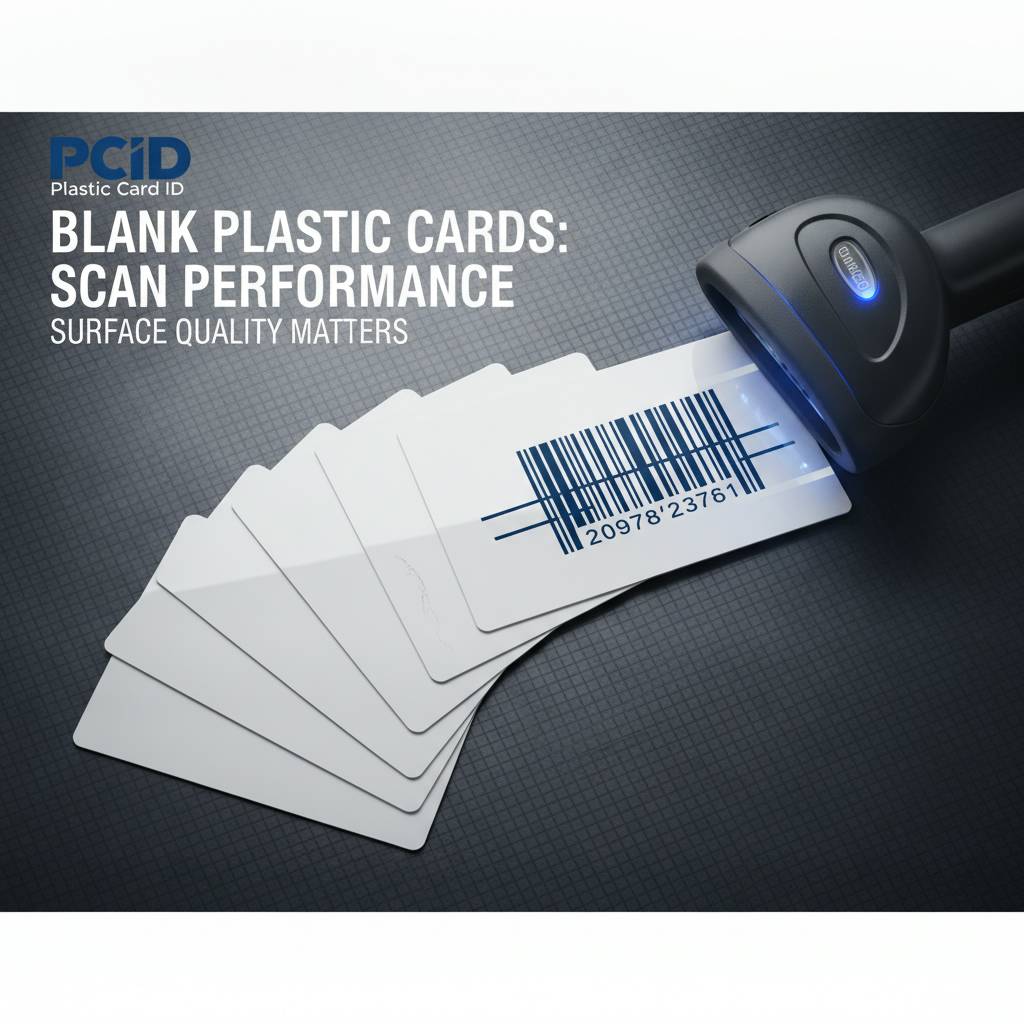 Barcode scanners are deceptively simple devices that rely on a surprisingly precise relationship between light, contrast, and reflection. A glossy card surface with contamination, micro-scratches, or inconsistent ink absorption will cause read errors that slow down your entire operation. The material composition of the card determines how well your card printer deposits ink and how cleanly a scanner can read what is printed.
Blank PVC cards manufactured to the CR80 standard - measuring 3.375 inches by 2.125 inches at 30 mil thickness - provide the consistent surface that high-resolution barcode printing demands. When you purchase cards from CPE, you get cards manufactured to tight tolerances, not random stock that arrived on a container ship and sat in a warehouse at fluctuating humidity. Card quality is not marketing language here. It is physics.
Understanding Surface Finish Options
Glossy and matte surface finishes behave very differently under a scanner's laser or imaging sensor. Glossy surfaces reflect light intensely, which works beautifully for visual appeal but can introduce glare interference in certain scanner angles. Matte finishes diffuse light more evenly, making them an excellent choice for environments where cards are scanned repeatedly at varying orientations.
The ink absorption characteristics of the card surface determine whether barcode lines are sharp or bleed slightly at their edges. Bleed, even subtle bleed, widens barcode bars and narrows the white-space gaps, which is exactly what causes read errors. Premium blank PVC cards from Plastic Card ID maintain the surface consistency required for crisp barcode edges every single print run.
Card Thickness and Rigidity Matter More Than You Think
A 30 mil card - the standard CR80 thickness - resists the warping that thinner cards suffer when subjected to heat from printers or simple pocket storage. Warped cards create focal length problems for stationary barcode readers and cause jams in automated scanning equipment. This is not a theoretical concern. Operations that run hundreds of card scans per day notice the difference immediately when card stock quality drops.
Thinner card stock, sometimes sold as a cost-saving measure, also flexes during the printing process, which distorts barcode geometry. Dimensional accuracy in barcode printing is measured in thousandths of an inch, and a card that flexes mid-print introduces errors that no amount of scanner calibration can fully correct. Rigidity is a feature, not an accident of manufacturing.
How Card Color Affects Barcode Readability
White-base blank PVC cards provide the highest contrast ratio for printed barcodes. Standard 1D barcodes (Code 39, Code 128, Interleaved 2 of 5) rely on the contrast between dark bars and light spaces, and white card stock maximizes that contrast. Colored card stock can still work well for barcode applications, but the color selection requires thought - yellow, light blue, and light green stock reads well; darker stock does not.
For operations that use colored cards for visual department sorting or event credentials, CPE recommends printing barcodes on a white or near-white panel within the card design, rather than directly on the colored background. This simple design decision eliminates scanner compatibility issues entirely without sacrificing the visual identification benefits that colored stock provides.
The Complete Catalog of Blank Cards That Support Barcode Programs
Not all card programs are alike, and a single catalog entry rarely tells the full story. The right blank card for a university library differs from the right card for a casino player rewards program, which differs again from the card needed for a corporate access control system - even if all three print barcodes onto the card surface. Plastic Card ID stocks a range specifically chosen to cover these use cases without forcing customers into unnecessary product complexity.
What separates a serious card supplier from a commodity vendor is the depth of the catalog combined with the expertise to match product to application. After 25 years and more than 50 million cards shipped, CPE has seen every variation of the barcode card use case, and the catalog reflects that experience directly.
Blank CR80 PVC Cards - The Workhorse Option
Blank white CR80 cards at 30 mil thickness are the foundation of in-house card programs across every industry. They accept dye-sublimation printing, resin thermal transfer printing, and direct-to-card printing with equal reliability. Every major card printer brand - Evolis, Zebra, Fargo - is engineered to run these cards, and the consistency of quality blank stock is what keeps ribbon consumption predictable and print heads performing at rated lifespan.
Buying blank cards and printing in-house gives organizations full design control, variable data capability (meaning each card can carry a unique barcode), and significantly lower per-card cost compared to ordering pre-printed custom cards for every small batch update. For operations that change card designs seasonally or need to add new employee cards on demand, blank cards paired with an in-house printer represent the most cost-efficient and operationally flexible approach available.
Magnetic Stripe Cards with Barcode Printing Capability
Magnetic stripe cards - available in both HiCo (high coercivity, 2750 Oe) and LoCo (low coercivity, 300 Oe) formats - add a second data encoding layer to any barcode card program. A single card can carry a printed barcode on its surface while simultaneously storing encoded data in the magnetic stripe, giving organizations dual-read flexibility depending on the scanning equipment at each touchpoint.
Hotel key cards, casino player cards, and multi-purpose access-and-loyalty cards almost always use this combination. HiCo magnetic stripes are strongly preferred for any application where the card will be stored near other cards, cell phones, or magnetic closures - because LoCo stripes can lose data under those conditions. Plastic Card ID carries both, and the choice should be made based on the storage environment and card lifespan requirements of the specific program.
RFID and Smart Chip Cards with Printed Barcodes
Contactless RFID cards and smart chip cards can carry printed barcodes on their surface exactly like standard PVC cards, making them compatible with operations that use both scanning methods at different access points or different stages of a workflow. A single card might be scanned as a barcode at a retail checkout, tapped at an RFID access door, and read by a chip reader at a secure workstation - all with the same physical card.
MIFARE DESFire options offer encrypted data storage for high-security access control environments. Proximity access cards (125 kHz) serve general access control needs at a lower cost point. The key understanding is that RFID technology and barcode printing are not mutually exclusive - they coexist on the same card when the application demands it, and CPE stocks the full range of dual-technology options to serve that need.
Industries That Depend on Blank Plastic Barcode Cards
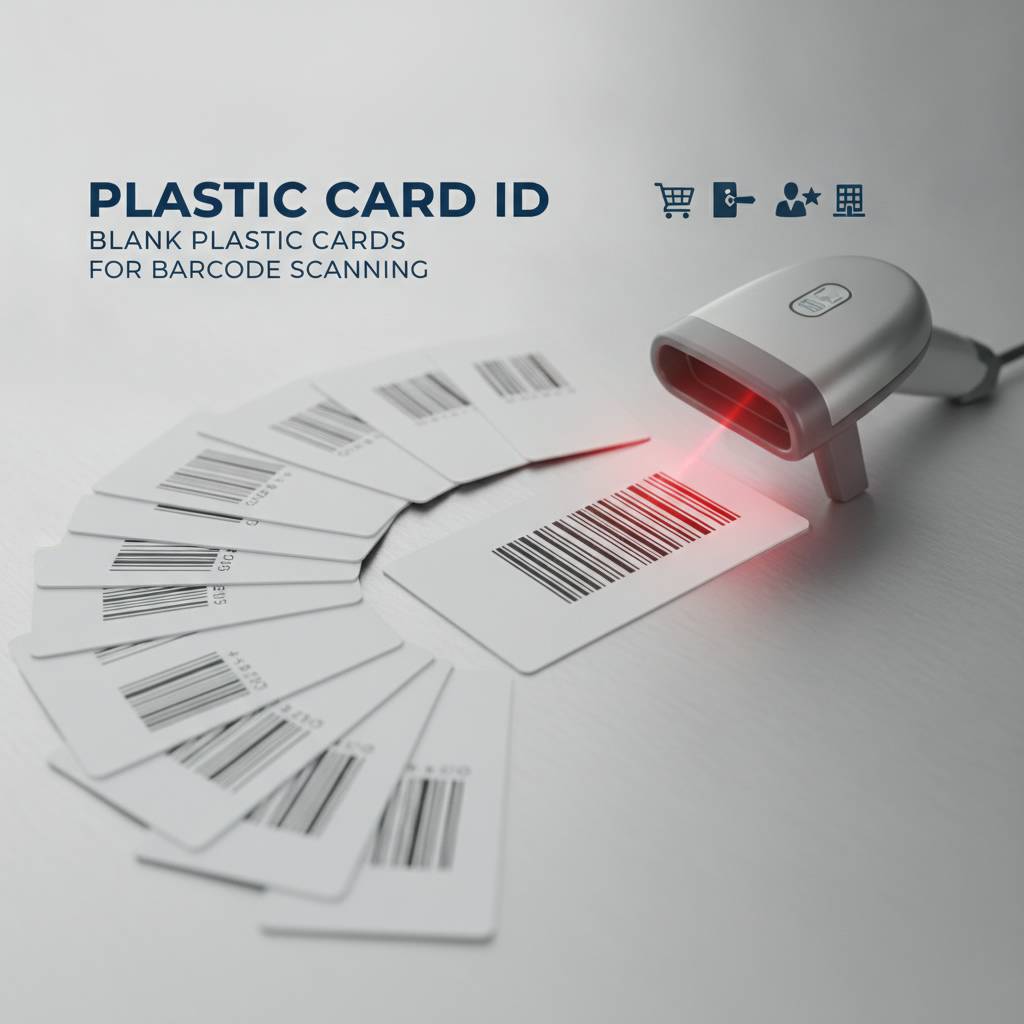 The breadth of industries relying on barcode-capable plastic cards is genuinely broad. Understanding where your use case fits among established applications helps clarify both product selection and the program structure that will perform best long-term. Plastic Card ID has served customers across all of the following sectors with consistent supply and expert guidance built from decades of real-world program experience.
Retail and Loyalty Programs
Retailers who made the switch from paper punch cards or paper gift cards to plastic cards report sales increases in the range of 35-50% for gift card programs specifically. The reason is not mysterious - plastic cards live in wallets. Paper punch cards live in junk drawers, get lost, get wet, get forgotten. A plastic loyalty card with a scannable barcode that fits in a wallet slot becomes a recurring purchase trigger every time the customer reaches for payment.
Blank cards printed in-house with a unique barcode linked to customer loyalty accounts give retailers complete flexibility to enroll new members instantly, replace lost cards on the spot, and update program branding without ordering new stock from an outside vendor. The operational independence that comes from an in-house card printing setup is one of the most underrated advantages in retail operations management.
Call 800.835.7919 to discuss retail loyalty card programs tailored to your volume and budget requirements.
Healthcare and Patient Identification
Patient ID cards with printed barcodes or 2D QR codes that link to electronic health records represent one of the fastest-growing applications for blank plastic card programs. Unlike paper wristbands or laminated paper cards, plastic ID cards resist moisture, withstand handling, and maintain barcode readability across repeated scans throughout a patient's care cycle.
Healthcare organizations printing patient or staff ID cards in-house benefit from the ability to issue cards immediately at registration or onboarding rather than waiting for external fulfillment. Speed of issuance in healthcare settings directly affects operational efficiency and patient experience - and blank cards with an in-house printer make same-day issuance the standard rather than the exception.
Libraries, Education, and Event Management
Library cards have been barcode cards for decades, and the model proves itself continuously. A plastic barcode library card lasts years; a paper card lasts weeks under normal use. Educational institutions use the same card format for cafeteria accounts, library access, facility access, and student ID - all unified by the barcode that links the card to the student record in the institution's database.
Event management organizations use barcode plastic cards as event credentials, VIP passes, and multi-day access tokens. Plastic credentials scan faster at entry gates than paper tickets, survive outdoor environments better than any paper alternative, and can serve double duty as collectible memorabilia that attendees actually keep - extending the brand impression well beyond the event itself.
Card Printers and Supplies That Complete Your Barcode Program
Plastic Card ID supplies not just the blank cards but the complete ecosystem needed to run a successful in-house card printing program. Card printers from Evolis, Zebra, and Fargo represent the three dominant professional-grade brands in the market, each with distinct strengths depending on volume, encoding requirements, and operational environment. Selecting the right printer is as important as selecting the right card.
Beyond the printer itself, a complete card program requires ribbons matched to the card stock and print technology, cleaning kits to maintain print head performance at rated lifespan, card carriers and sleeves for issuance and storage, and in some cases card affixing and mailing services for high-volume programs that distribute cards to cardholders by mail rather than in person. CPE provides all of these components under one account relationship, eliminating the fragmentation that comes from managing multiple vendors for a single program.
Choosing the Right Printer for Barcode Printing Quality
Barcode print quality is a function of printer resolution, ribbon type, and card stock consistency working together. Direct-to-card printers at 300 dpi produce barcodes that read reliably on standard scanning equipment. High-resolution printers at 600 dpi produce tighter barcode lines that are particularly important for small-format 2D codes like QR codes and Data Matrix symbols that need to carry significant data in a compact physical space.
Retransfer printers - which print onto a film layer that is then fused to the card surface - produce the sharpest possible barcode edges because the print process never directly contacts the card surface. For high-security applications or programs where barcode read reliability is operationally critical, retransfer technology is the professional standard. Matching printer technology to application requirements is exactly where the guidance Plastic Card ID provides pays for itself.
Ribbons and Cleaning Kits for Consistent Barcode Output
A printer running a degraded or incompatible ribbon produces inconsistent ink density in barcode bars - the single most common cause of scan failures in in-house card programs. Ribbons must be matched not just to the printer model but to the specific card stock being used, because different PVC formulations interact differently with dye-sublimation and resin transfer inks.
Cleaning kits maintain the print head, transport rollers, and card feed path in the condition required for consistent output. A dirty print head introduces contamination artifacts directly into the barcode printing area. Scheduled cleaning cycles - typically every ribbon change - are the simplest and most cost-effective quality control measure available to any in-house card operation, and the supplies to do it properly are stocked and ready at CPE.
Card Carriers, Sleeves, and Mailing Services
Once printed, barcode cards need to reach their intended cardholders in scan-ready condition. Card carriers and sleeves protect cards from surface contamination and scratching during mailing and distribution. For organizations running membership or loyalty programs that mail cards to new enrollees, this last-mile packaging step determines whether the card arrives ready to use or requiring replacement before it has been used even once.
For high-volume programs, Plastic Card ID offers card affixing and mailing services that handle the fulfillment step professionally. Rather than managing a manual card-stuffing and mailing operation in-house, program administrators can ship printed cards to CPE for professional bulk mailing. Outsourcing the fulfillment step while retaining in-house printing control gives organizations the best of both operational models.
| Barcode Type | Format | Typical Application |
|---|---|---|
| Code 39 | 1D Linear | Employee ID, inventory |
| Code 128 | 1D Linear | Loyalty, library, shipping |
| QR Code | 2D Matrix | Mobile scanning, healthcare, events |
| PDF417 | 2D Stacked | Driver's license format, secure ID |
| Data Matrix | 2D Matrix | High-density data, small format |
Frequently Asked Questions About Blank Plastic Cards for Barcode Scanning
After serving more than 100,000 customers across the United States, the questions that come up around barcode card programs are remarkably consistent. Here are the answers to the questions that buyers ask most often, answered with the directness that only comes from genuine program experience.
What card stock should I use for printing barcodes with my existing printer?
The short answer is: CR80 white blank PVC cards at 30 mil thickness from a consistent manufacturer. The longer answer involves confirming that the cards you purchase are manufactured to tight dimensional tolerances and consistent surface finish - because printer-to-card compatibility problems most often trace back to card quality variation rather than printer malfunction. Contact 800.835.7919 and tell us what printer you are running; CPE can match you to the right card stock for your specific printer model.
If your program requires variable data - meaning each card carries a unique barcode tied to an individual record - confirm that your printer software supports variable data printing before ordering cards. All blank cards from Plastic Card ID are compatible with variable data workflows, but the software and printer configuration need to be set up correctly on your end for the workflow to function as intended.
Can I print 2D barcodes like QR codes on standard blank PVC cards?
Yes - with the right printer and ribbon combination. QR codes and other 2D symbologies require tighter print precision than 1D linear barcodes because the data density is higher and the individual elements smaller. A 300 dpi printer running a quality resin ribbon on consistent blank PVC card stock will produce scannable QR codes reliably. For very small QR codes or high-density 2D codes, upgrading to a 600 dpi printer is the most reliable path to consistent scan performance.
Card surface smoothness matters more for 2D codes than for 1D codes. Any surface texture variation that disrupts the regularity of the module grid in a QR code introduces read errors that cannot be corrected at the scanner. Premium blank PVC cards manufactured to tight surface specifications eliminate this variable from the equation entirely.
How many blank cards should I order at one time?
Order quantity decisions for blank card programs involve balancing per-card cost against storage capacity and design change frequency. Larger orders carry lower per-card pricing - a standard industry reality. However, organizations whose card designs change frequently should not over-commit to large blank card inventories if those cards will become obsolete before they are used.
For programs running 50-500 cards per month with stable designs, ordering three to six months of supply at once typically optimizes the cost-per-card while keeping inventory manageable. For mass production programs in the tens of thousands, CPE works with clients to structure supply arrangements that maintain consistent availability without requiring enormous single-purchase commitments. The right order quantity is the one that fits your operational rhythm, not just the price break schedule.
Specialty Card Options for Advanced Barcode Programs - Plastic Card ID
Standard white CR80 PVC cards handle the majority of barcode card applications effectively. But not every program is standard. Some applications demand card formats that communicate premium value, serve specialized environments, or carry security features beyond what basic card stock provides. Plastic Card ID stocks specialty options that serve these advanced requirements without requiring customers to source from multiple vendors.
Clear and frosted PVC cards offer a visually distinctive alternative to white stock while still supporting printed barcodes on designated opaque panel areas. Luxury metal cards in stainless steel, brass, and gold communicate premium membership status in ways that PVC simply cannot - and they can carry laser-engraved or printed barcodes. Casino player cards, hotel VIP cards, and high-tier loyalty program cards benefit enormously from the weight and permanence that metal cards provide.
Clear and Frosted Cards for Premium Barcode Programs
Clear PVC cards create a visual impression that stands out immediately in a wallet alongside conventional cards. For loyalty programs, membership organizations, and VIP programs where card quality is itself a brand statement, clear or frosted cards elevate the member experience in a way that directly influences retention and engagement. A member who values their card keeps it longer, uses it more frequently, and identifies more strongly with the program it represents.
Barcode printing on clear cards requires a white underprint layer in the barcode area to create the contrast necessary for scanner readability. This is a standard technique in professional card printing software, and cards printed with this approach scan as reliably as standard white-base cards. Plastic Card ID can advise on the specific ribbon and software settings needed to achieve correct white underprint output on your printer model.
Metal Cards with Encoded Barcodes
Luxury metal cards represent the top of the physical card hierarchy. Stainless steel, brass, and gold-finish metal cards carry a tactile weight and acoustic quality - the sound of a metal card placed on a countertop - that communicates value instantly. For programs where the card itself is part of the member benefit, a metal card transforms the card from a functional tool into a status object that members actively want to present and display.
Metal cards can be laser-engraved with barcode symbologies or produced with a combined construction that includes a functional barcode panel. The specific construction approach depends on the scanning technology in use and the overall program design. CPE works with program administrators to select the metal card construction that meets both the aesthetic objectives and the functional scanning requirements of the program.
Custom Die-Cut and Non-Standard Formats
When the standard CR80 card shape does not serve the application - whether for novelty purposes, form factor constraints, or brand differentiation - custom die-cut cards provide shapes beyond the standard rectangle. Loyalty keychain cards, rounded-corner cards with specific radius specifications, and cards with custom cutouts are all achievable within a professional plastic card program.
Die-cut cards with printed barcodes need to be designed with scanner clearance in mind - the barcode must be positioned within the card area with adequate quiet zone margins to prevent read errors at the card edge. Bringing Plastic Card ID into the design conversation early eliminates the problem of discovering barcode placement conflicts after cards are already produced. Early coordination between physical design and functional requirements is exactly where long-term supplier relationships pay dividends.
Ready to build a barcode card program that actually performs? Contact Plastic Card ID today at 800.835.7919 and speak directly with an expert who has helped thousands of organizations structure successful card programs across every industry.
Plastic Card ID - your strategic partner for blank plastic cards for barcode scanning and every card program need across the United States. Call 800.835.7919 now and put 25 years of card program expertise to work for your organization.
Previous Page