Blank Plastic Cards for Security Access Control Systems
Table of Contents []
- Blank Plastic Cards for Security Access Control - Plastic Card ID
- Why Blank PVC Cards Are the Backbone of In-House Access Programs
- Magnetic Stripe Cards for Access Control Applications
- RFID and Proximity Cards for Modern Access Control
- Specialty Card Formats for Advanced Security Programs
- Card Printers, Ribbons, and Complete Program Supplies
- Buyer's Guide - Selecting Blank Plastic Cards for Security Access Control
- Partner with Plastic Card ID for Blank Plastic Cards and Security Access Solutions
Blank Plastic Cards for Security Access Control - Plastic Card ID
What separates a facility that runs smoothly from one that scrambles with badge replacements, printer jams, and half-measures held together with lanyards and tape? Often, it comes down to the card itself. Blank plastic cards built for security access control are the invisible infrastructure behind thousands of working access programs across the United States - and choosing the right supplier makes all the difference between a system that holds up and one that quietly erodes your confidence.
Plastic Card ID has spent over 25 years supplying blank and custom plastic cards to businesses, institutions, and organizations of every size across the country. More than 100,000 customers. Over 50 million cards shipped. Not a paper company dabbling in plastic - a dedicated partner for organizations that take identity and access seriously.
| Card Type | Common Access Use | Encoding Option | Print-Ready |
|---|---|---|---|
| Blank CR80 PVC | Employee ID, Visitor Badge | None (print only) | Yes |
| HiCo Magnetic Stripe | Time & Attendance, Door Access | Mag Stripe Read/Write | Yes |
| Proximity Card (125kHz) | Building Entry, Parking | RFID Contactless | Yes |
| MIFARE DESFire Smart Card | High-Security Facility Access | Encrypted RFID | Yes |
| Smart Chip Card | Multi-Application ID Programs | Contact Chip Optional RFID | Yes |
Why Blank PVC Cards Are the Backbone of In-House Access Programs
 There is something genuinely powerful about a blank card. It sounds counterintuitive - why celebrate something without content on it? But the blank CR80 card, measuring 3.375 x 2.125 inches at 30 mil thickness and conforming to ISO 7810 standards, represents total organizational control. You decide what goes on it, who gets one, when it expires, and what it does. That flexibility is priceless for organizations managing dynamic workforces, rotating visitors, or multi-tier access levels.
In-house card printing reduces costs dramatically over time. When you purchase blank cards in volume and print them on-demand using a desktop card printer, you eliminate the lead time and per-card premium of outsourcing every badge run. Organizations issuing 50 to 500 cards monthly find the economics compelling almost immediately. Those issuing thousands find it transformative.
The CR80 Standard and Why It Matters for Security Cards
CR80 is not just a size designation - it is the globally recognized standard for cards that work inside wallets, badge holders, card readers, and printers. When your access cards deviate from CR80, you start encountering feed problems, reader misalignments, and employee frustration. Standardization matters at scale, especially when a single malfunctioning card can leave an employee locked out during a critical shift.
The 30 mil thickness specification ensures the card survives daily handling without warping, cracking, or delaminating. PVC construction offers a smooth, printable surface that accepts dye-sublimation printing with sharp, professional results. When you are issuing an employee ID that also serves as a security credential, the quality of the card surface directly affects the quality of the printed identity data on it.
Print-On-Demand vs. Pre-Printed Card Stock
Organizations new to in-house card programs sometimes ask whether to order pre-printed cards or blank stock. For security access control applications, blank cards almost always win. Pre-printed stock becomes outdated when logos change, access tiers are redesigned, or compliance requirements shift. Blank cards remain perpetually usable, waiting for whatever your current program demands.
The exception is high-volume programs with stable, standardized designs - in those cases, custom pre-printed cards can reduce printer wear and speed up issuance. CPE helps clients work through this decision based on their actual card volume, turnover rates, and design stability. It is a strategic conversation, not just a product order.
Volume Pricing and Scalability for Any Organization
A nonprofit issuing 50 volunteer badges per quarter has different needs than a manufacturing plant cycling through 3,000 contractor IDs per month. Both deserve a supplier that scales with them without penalizing smaller runs or creating chaos for larger ones. Plastic Card ID supports both extremes and everything between, offering volume pricing that rewards organizations as their programs grow.
Ordering blank PVC cards in quantities of 500, 1,000, or 5,000 unlocks meaningful per-unit savings that compound over time. For security-focused buyers, cost-per-credential matters - especially when badges are issued for temporary contractors, event participants, or rotating shift workers who may only need a card for a defined period.
Magnetic Stripe Cards for Access Control Applications
Magnetic stripe technology remains one of the most reliable, cost-effective technologies for access control, time and attendance tracking, and facility credentialing. The technology is mature, reader infrastructure is widely deployed, and the cards themselves are straightforward to encode with standard card printers. For organizations that do not need contactless speed or encrypted RFID, mag stripe is often the smart choice.
Plastic Card ID supplies both HiCo (High Coercivity) and LoCo (Low Coercivity) magnetic stripe cards. Understanding which one you need is not optional - choosing the wrong coercivity can result in cards that demagnetize prematurely or fail to encode properly in the first place.
HiCo vs. LoCo - Choosing the Right Magnetic Stripe
High Coercivity cards resist demagnetization, making them the standard choice for access control, employee ID programs, and any application where cards will be carried near phones, magnetic closures, or other field-generating devices. HiCo cards require a higher encoding field strength to write data, but that same resistance protects the data once written. For security badges that need to last 12-36 months of daily use, HiCo is nearly always the correct specification.
LoCo cards encode at lower field strengths and are more appropriate for short-duration applications - think temporary passes, single-event credentials, or situations where cards are reissued frequently and longevity is less critical. Mixing up HiCo and LoCo cards in an access system is a common mistake that creates reader failures and frustrated administrators. The CPE team helps buyers specify correctly from the start.
Encoding Options and Printer Compatibility
Magnetic stripe encoding happens at the printer level in most in-house programs. Card printers from Evolis, Zebra, and Fargo - all carried by Plastic Card ID - include optional magnetic stripe encoding modules that write data to the card during the print cycle. This means you can print a full-color employee photo badge and encode the access data in a single pass, dramatically improving issuance speed and consistency.
Track configuration matters too. Most access control applications use Track 1, Track 2, or both. Understanding your reader's track requirements before ordering cards ensures you purchase cards with the correct track layout. This is the kind of detail that trips up first-time buyers and costs organizations time and money - and it is exactly why working with an experienced supplier pays dividends from day one.
Reach the CPE Team for Magnetic Stripe Specifications
Selecting magnetic stripe cards for a live access control system involves more than clicking "add to cart." The wrong specification can mean a complete re-order and weeks of delay. The CPE team is available to walk through your reader specifications, encoding requirements, and volume needs before you commit to an order. Call 800.835.7919 to speak with someone who actually understands the difference between a 2750 Oe card and a 300 Oe card and why it matters to your program.
Organizations running hybrid programs - where some doors use mag stripe readers and others use newer contactless readers - can often find combination cards that support both technologies. These dual-interface cards add flexibility to legacy-plus-modern infrastructure without requiring a full system overhaul.
RFID and Proximity Cards for Modern Access Control
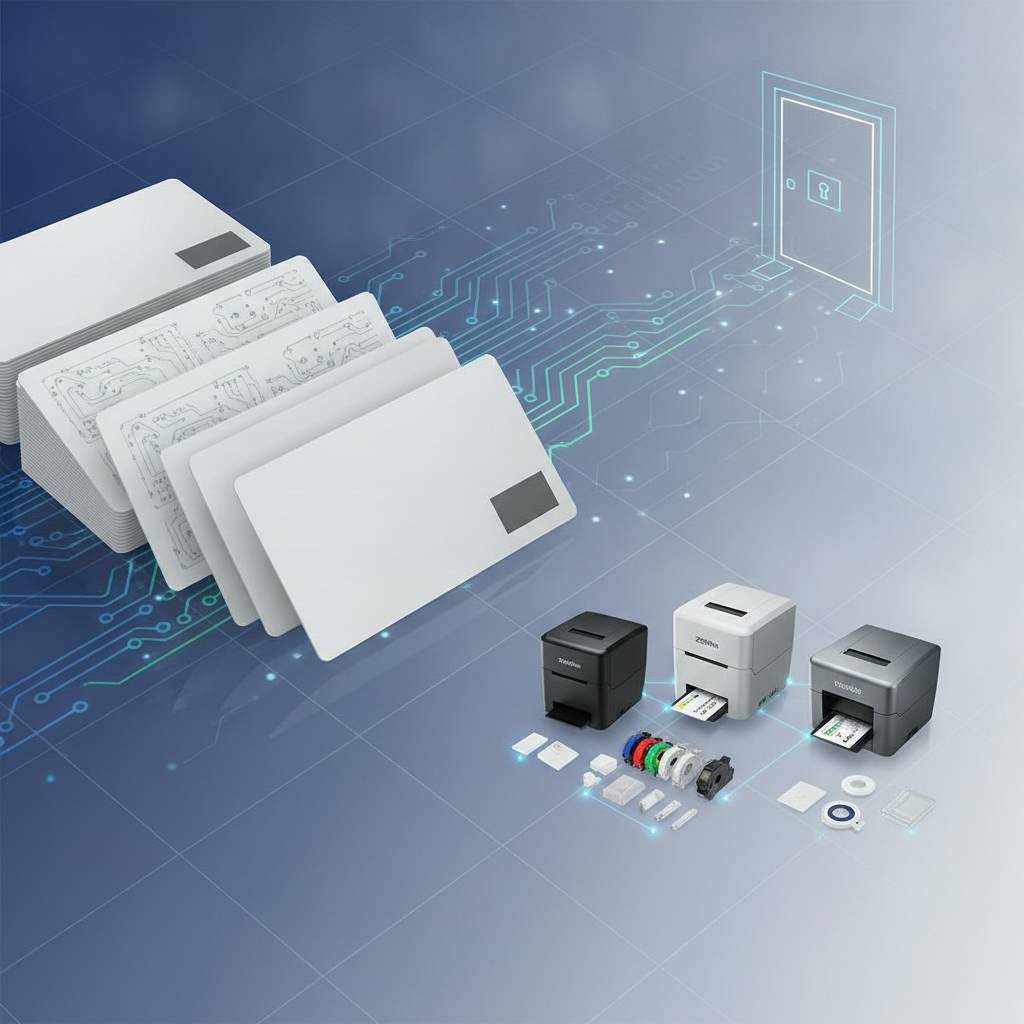 Walk through any modern corporate campus, hospital, hotel, or university, and you will see contactless access control in action. A card tap, a beep, a green light - and the door opens. Proximity cards and RFID smart cards have become the dominant credential format for organizations that prioritize speed, hygiene, and scalability. Plastic Card ID supplies a comprehensive range of contactless card technologies across multiple frequency standards.
Contactless access credentials eliminate the wear-and-tear of insertion-style readers and reduce contact points in high-traffic environments. They also enable faster throughput at entry points - critical for facilities where hundreds of employees badge in during shift changes or where visitor queues need to move efficiently.
125kHz Proximity Cards - The Workhorse of Physical Access
Proximity cards operating at 125kHz are the most widely deployed contactless credential format in commercial access control. HID-compatible proximity cards work with the vast installed base of HID readers found in office buildings, manufacturing plants, healthcare facilities, and government sites across the country. If your organization already has card readers installed, proximity cards in the correct format let you populate credentials without changing infrastructure.
These cards contain a passive RFID chip and antenna embedded within the card body. No battery, no moving parts, no maintenance. When presented to a reader, the card harvests energy from the reader's RF field and transmits its unique identifier. The system processes that ID against its access table and grants or denies entry in milliseconds. Simple, proven, reliable - and blank proximity cards from Plastic Card ID are print-ready for full photo ID integration.
MIFARE DESFire and High-Security Smart Card Options
When security requirements escalate beyond basic proximity - think government contractors, data centers, pharmaceutical facilities, or multi-site enterprises - the conversation shifts to encrypted RFID technologies. MIFARE DESFire operates at 13.56MHz and uses AES-128 encryption to protect the communication between card and reader. Cloning a DESFire card is not a casual undertaking. That matters when credential duplication represents a genuine threat model.
Smart cards running MIFARE DESFire EV2 or EV3 architectures support multiple applications on a single card. Access control credentials can share card space with time-and-attendance data, cashless vending balances, or library access - all securely partitioned from one another. For organizations building converged identity programs, this multi-application capability is enormously valuable and eliminates the card wallet problem for employees carrying four different credentials for four different systems.
Casino Player Cards and Specialty High-Volume RFID Programs
Beyond standard corporate access, Plastic Card ID supplies RFID cards for specialized high-volume programs including casino player tracking systems. Casino player cards must survive frequent handling, exposure to various environments, and continuous reader interactions while maintaining accurate data integrity. The combination of durable PVC construction and properly specified RFID components makes purpose-built cards for this application essential.
Hotel key cards represent another high-velocity application where card quality and RFID specification precision directly affect guest experience. A hotel key card that fails on the third day of a five-day stay is not a minor inconvenience - it is a front desk queue, a frustrated guest, and a staff intervention. CPE understands these stakes and supplies cards that meet hospitality-grade durability expectations.
Specialty Card Formats for Advanced Security Programs
Standard white PVC is not always the right answer. Organizations with specific aesthetic requirements, unusual form factors, or advanced security needs have access to a broader range of card materials and formats than most buyers realize. Plastic Card ID catalogs specialty options that go well beyond the basic white card, serving clients who need their credentials to communicate authority, exclusivity, or technical sophistication.
Clear and Frosted Plastic Cards for Layered Visual Security
Clear and frosted PVC cards introduce a visual dimension that white cards cannot replicate. Printed on clear stock, design elements appear to float on a transparent substrate - creating a distinctive credential that is immediately visually distinguishable from standard badges. Security managers sometimes use this visual distinction as a first-pass check: a clear card in a sea of white cards instantly signals a different access tier or visitor status.
Frosted cards offer a sophisticated matte surface that reduces glare, accepts printing beautifully, and carries a tactile quality that communicates premium status. For executive access programs, VIP credentials, or organizations where badge aesthetics are part of the brand experience, frosted cards deliver a level of polish that standard stock simply cannot match.
Metal Cards for Executive and High-Security Credentials
Stainless steel, brass, and gold-finish metal cards occupy a category of their own. Heavy, distinctive, and unmistakable in a card reader or a hand, metal cards are issued when the credential itself needs to communicate importance. Executive ID programs, high-tier membership credentials, and prestige access cards all benefit from the weight and permanence of metal construction. When an employee or member receives a metal card, the implicit message is clear: this credential matters.
Metal cards are not mere novelties - they are engineered to work in standard CR80 form factor readers and can be specified with RFID or magnetic stripe encoding depending on the system requirements. The combination of striking physical presence and genuine functional capability makes metal cards a legitimate security and identity tool for the right application.
Custom Die-Cut Card Shapes for Unique Programs
Standard CR80 rectangles work for almost everything - but not everything. Organizations running event-specific credentials, promotional access cards, or brand-forward ID programs sometimes benefit from custom die-cut shapes that reinforce the card's identity. A conference lanyard card shaped like a keynote speaker's logo. A VIP backstage pass with a distinctive silhouette. A parking credential cut to a specific form that physically differentiates it from general access cards.
Custom shapes require planning around reader compatibility and printer handling, but for the right application, the differentiation value is immediate and measurable. CPE works with clients to evaluate whether custom shapes are practical for their specific reader and printer infrastructure before committing to production.
Card Printers, Ribbons, and Complete Program Supplies
A blank card is only as useful as the equipment and supplies that complete the credential. Plastic Card ID operates as a true one-stop supplier - not just for cards but for the full ecosystem that makes an in-house card program function. Card printers from Evolis, Zebra, and Fargo represent the leading desktop and mid-volume printing platforms in the industry, and CPE carries ribbons, cleaning kits, and accessories to keep them running.
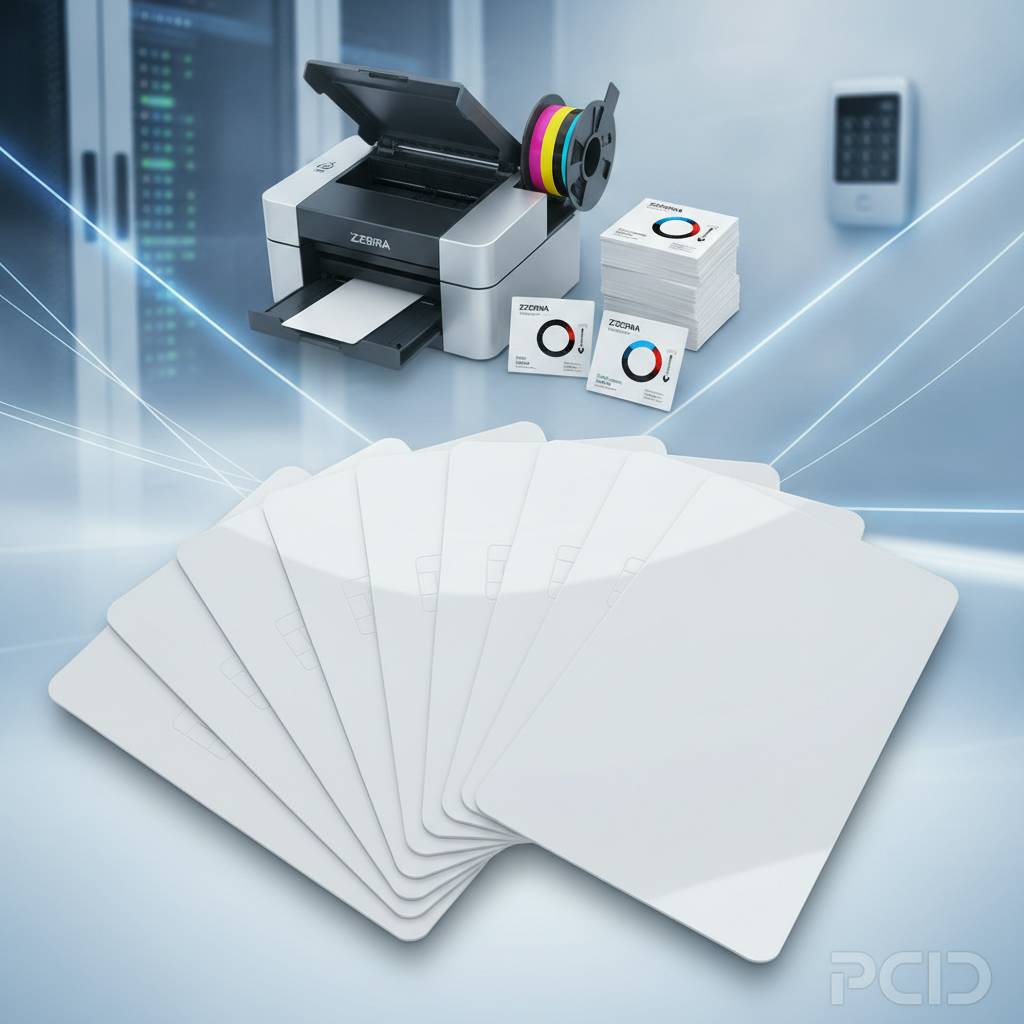
Choosing a card printer without considering the total cost of consumables is a common and costly mistake. A printer purchased at a competitive price can become expensive to operate if ribbons are proprietary, high-priced, or difficult to source. Plastic Card ID helps buyers evaluate the total program cost - hardware, cards, ribbons, and maintenance supplies together - rather than optimizing for the printer price tag alone.
Ribbon Selection and Print Quality for Security Badges
YMCKO ribbons (Yellow, Magenta, Cyan, Black, Overlay) produce full-color, photo-quality prints with a protective topcoat that resists abrasion and UV fading. For security badges that carry employee photos, printed barcodes, or color-coded access tier indicators, YMCKO is the standard ribbon choice. Monochrome black ribbons handle single-color printing at much lower cost per card - ideal for access cards where visual design is secondary to encoded data.
Ribbon capacity directly affects your cost per card. A ribbon rated for 200 prints at $45-$90 delivers a very different economics than one rated for 500 prints at $75-$200. Understanding yield ratings, panel configurations, and printer compatibility before purchasing ribbons saves money and prevents downtime caused by mismatched consumables.
Cleaning Kits, Card Carriers, and Value-Added Supplies
Printer maintenance is non-negotiable in a high-function security badge program. Dust, debris, and residue accumulate on print heads and rollers with every card pass, degrading print quality over time and eventually causing mechanical failures. Cleaning kits - typically including cleaning cards and swabs calibrated for specific printer models - should be used on a schedule tied to card volume, not ignored until problems appear.
Card carriers, sleeves, and lanyards complete the credential ecosystem. A beautifully printed security badge shoved loose into a pocket loses its effectiveness quickly - scratched, bent, or delaminated before it has served its intended lifespan. Card sleeves and holders protect the printed surface and the embedded technology, extending credential life and reducing replacement frequency. Plastic Card ID stocks these supplies alongside cards and printers so clients can source everything from a single relationship.
Card Affixing and Mailing Services for Distributed Programs
Organizations issuing credentials to remote employees, distributed membership bases, or multi-location staff face the logistical challenge of getting cards into the right hands efficiently. Plastic Card ID offers card affixing and mailing services that handle the physical distribution leg of card programs - printing, mounting, and mailing cards directly to recipients so program administrators are not managing a fulfillment operation on top of their core responsibilities.
This service is particularly valuable for organizations rolling out new access programs across multiple locations simultaneously or issuing renewal credentials to a large member base. The ability to outsource physical card distribution without outsourcing card program control is a meaningful operational advantage that keeps internal teams focused on what they do best.
Buyer's Guide - Selecting Blank Plastic Cards for Security Access Control
With so many card types, encoding technologies, and supplier options available, the buying process for security access cards can feel overwhelming - particularly for organizations setting up a program for the first time. The following framework helps buyers move from confusion to confident procurement, regardless of program size or technical complexity.
Key Questions to Answer Before Ordering
- What type of reader infrastructure is already installed - magnetic stripe, proximity (125kHz), or contactless smart card (13.56MHz)?
- How many cards does your program issue per month, and what is the expected lifespan of each credential?
- Will cards need to carry employee photos, printed barcodes, or color-coded access tier indicators?
- Do you need encoding pre-programmed by the supplier, or will you encode cards in-house using your own printer?
- Are there multiple card tiers (e.g., standard employee, visitor, contractor, executive) requiring visually distinct credentials?
- What is your acceptable cost-per-credential range, and how does that change at different volume levels?
- Does your program require card affixing and mailing, or are cards issued on-site at a single location?
Common Mistakes and How to Avoid Them
Ordering cards before confirming reader compatibility is the most frequent and most costly error in access card procurement. A box of 1,000 MIFARE 1K cards does nothing useful in a facility running HID-compatible 125kHz readers. Always verify reader specifications - ideally by checking the reader model and cross-referencing with a supplier who understands the technology - before placing any card order.
Underestimating card volume is the second most common mistake. Organizations often estimate based on current headcount without accounting for contractor churn, visitor programs, lost and damaged card replacements, or planned expansion. Building a modest buffer into initial card orders prevents the disruption of urgent reorders that arrive after your program has already stalled. CPE can help organizations model realistic annual card volume based on program type and organizational size.
Getting Expert Guidance from CPE
The specifications that matter in a security access card program are technical enough that expert guidance is not a luxury - it is a practical necessity. Coercivity ratings, RFID frequencies, chip architectures, track configurations, print head compatibility - these are not terms most program administrators encounter in their daily work, but they determine whether a card program functions or fails. Call 800.835.7919 and let the CPE team translate these technical requirements into a specific, workable card specification for your program.
The CPE relationship model is built on long-term partnerships, not transactional sales. When an organization works with Plastic Card ID to set up a card program, the goal is a program that functions well for years - not a single card order that leaves the buyer to figure out the rest alone. That perspective shapes every recommendation the team makes.
Partner with Plastic Card ID for Blank Plastic Cards and Security Access Solutions
 Twenty-five years. Over 100,000 customers. More than 50 million cards shipped to businesses and organizations across the United States. Plastic Card ID has earned its position not through marketing claims but through the compounding trust of clients who return year after year because the cards work, the service is responsive, and the expertise is genuine.
Security access control depends on credential quality. A card that demagnetizes in a wallet pocket, fails to communicate with a reader, or degrades after three months of daily badge-in use does not just inconvenience employees - it creates security gaps, administrative burdens, and erosion of confidence in the entire program. The blank plastic cards, magnetic stripe cards, proximity cards, and smart chip cards supplied by Plastic Card ID are specified for the environments and applications where they will be used, not selected for lowest possible cost.
Whether your organization needs 500 blank CR80 cards for a straightforward employee badge program or a complex multi-technology credential solution combining RFID smart cards with mag stripe encoding and on-site printing equipment, Plastic Card ID is equipped to supply, support, and scale alongside your program. From first card to fifty-millionth card, the commitment is the same: cards that work, delivered by people who know why they work.
Ready to build a security access card program that actually holds up? Contact Plastic Card ID today at 800.835.7919 and speak with a specialist who will help you get the right cards, the right technology, and the right supplies from day one.
Previous Page